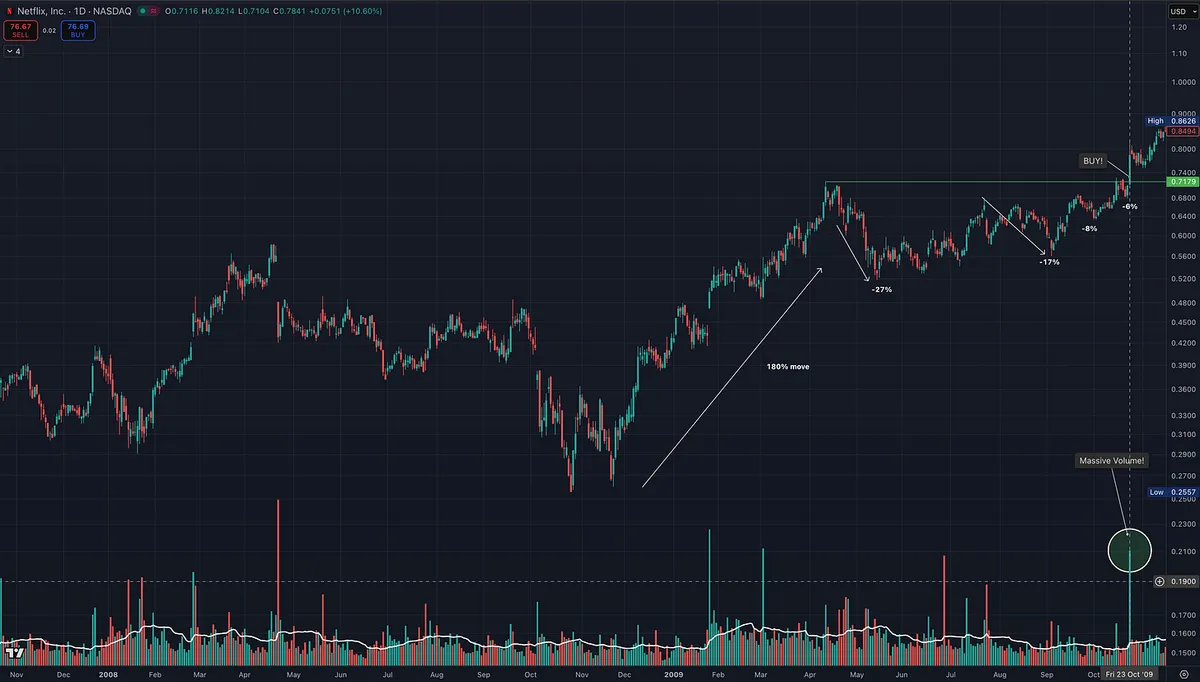
Big Move. Tighten Up. Then Explode.
This is exactly what we want to see.
First, a powerful advance.
In this case, roughly a 180 percent move.
That move tells you institutions are involved. It establishes leadership.
Then something important happens.
The stock does not collapse.
It tightens.
Each pullback becomes smaller.
Minus 27 percent. Then minus 17 percent. Then minus 8 percent. Then minus 6 percent.
That is volatility contraction.
That is supply being absorbed.
During the tightening phase, volume dries up.
Fewer shares are coming to market. Sellers disappear.
This is exactly what Mark Minervini describes in Trade Like a Stock Market Wizard when he explains that volume should contract during the tightest portion of consolidation before a breakout .
Strong expansion. Orderly digestion. Tighter contractions. Volume dry-up. Breakout on powerful volume.
When the breakout finally came, volume exploded.
Demand overwhelmed limited supply.
The result?
NFLX then ran another 500 percent.
That is what happens when compression resolves higher.
Big winners do not move randomly.
They prepare.
Compression precedes expansion.
If you learn to recognize tightening after a major advance, you stop fearing pullbacks.
You start positioning for superperformance.