Give Me the Meat in the Middle
A lot of traders obsess over buying the exact bottom and selling the exact top. I’ve found plenty of success, and a lot more contentment, taking the meat in the middle.
Look at EDRY.
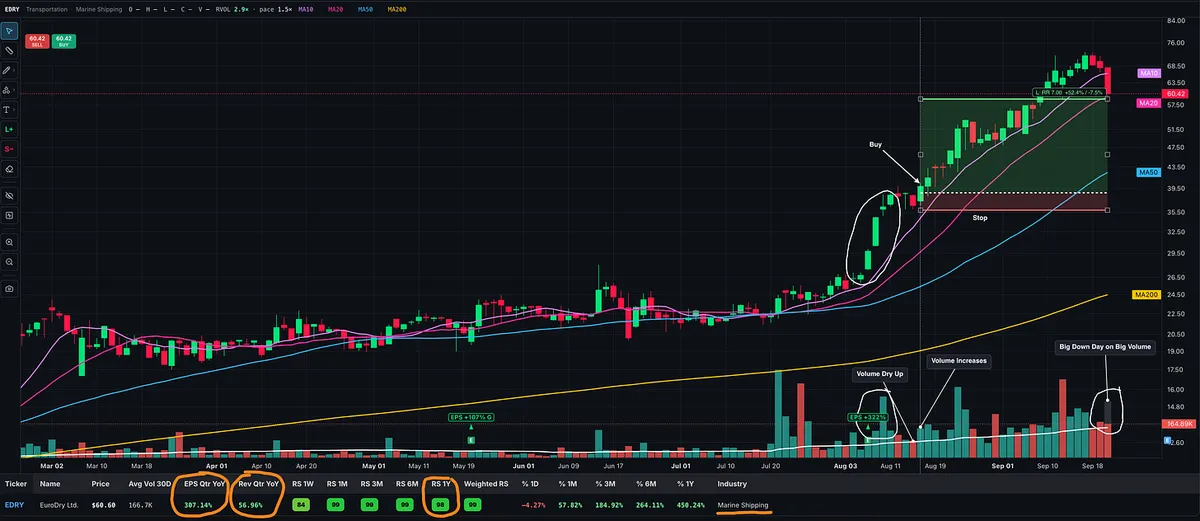
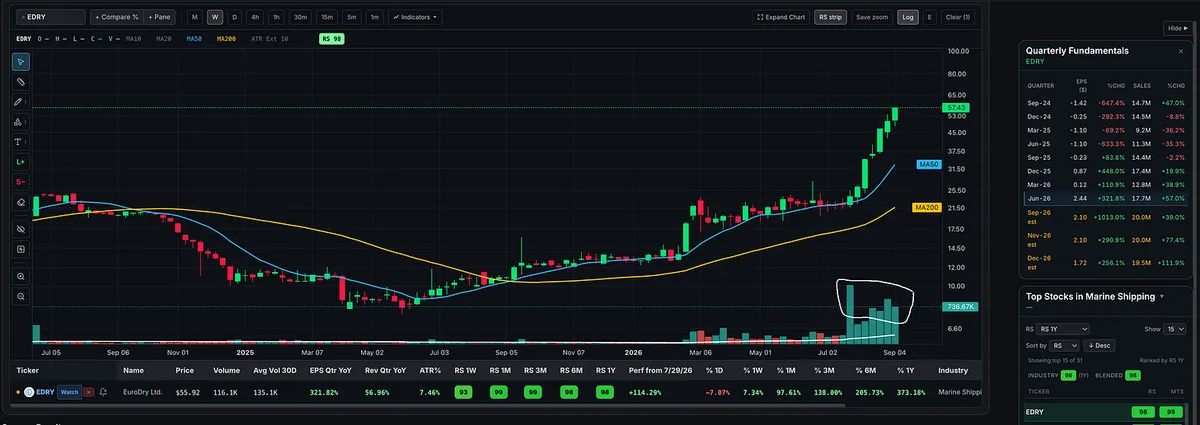
For months, it chopped sideways, developing higher lows and finding support around the 50-day. Buying a pullback might have kept you involved, but your capital could have spent considerable time waiting for sustained progress. Minervini addresses this directly: money sitting in a stock that goes nowhere has an opportunity cost while other setups develop.
Then August brought an explosive earnings move on heavy volume.
Buying immediately before the announcement would have meant gambling on the market’s reaction. Instead, you could wait and study that reaction, how well the stock held its gains, and whether buying continued afterward. Missing the first burst doesn’t necessarily mean missing the opportunity.
EDRY then tightened up. After several sessions of strong momentum, price moved sideways and volume dried up. Both Minervini and O’Neil describe tight price action accompanied by contracting volume as constructive evidence that selling pressure is diminishing.
When volume returned and price pushed out of that short consolidation, there was an entry opportunity with a nearby low against which to define risk. Depending on the entry, the low of the day could also serve as the stop.
As O’Neil writes: “You want a stock to prove its strength to you before you invest in it.”
From there, EDRY largely followed its 10-day moving average higher. Now the sharp break beneath that line on heavy volume, toward the 20-day, marks a change in behavior. For a swing trader managing this move around those averages, that deserves attention.
Kullamägi’s published approach includes taking partial profits and trailing the remaining position with the 10-day or 20-day moving average. His moving-average exit rule looks for a close below the selected line, which matters when evaluating an intraday break.
There were opportunities to sell some into strength along the way, too. Many successful traders have made the broader point that consistently capturing the exact low and high is unrealistic. Successful trading leaves some of the move behind.
You could miss the bottom, wait until after earnings, and exit below the peak while still capturing a substantial move.
That’s why I maintain a watchlist, set alerts, and look for momentum followed by tightness, drying volume, and renewed demand.
Give me a sound entry and defined risk. The meat in the middle is enough.
And if I miss it? Stay patient and move on to the next setup.