Momentum Trading Strategy

Notes

Market Conditions

Reading the overall market and deciding how aggressive to be.

Showing 121–140 of 227 notes

View on Substack ↗

The News Will Keep You Broke

“I was thinking about selling… the situation looks worse than yesterday.”

That comment is one of the most valuable lessons a trader can learn from.

Because it captures exactly how most people think during turning points in the market.

The news feels urgent. The situation feels dangerous. It feels like risk is increasing.

So the natural reaction is to step aside or take profits.

I get it. That kind of news feels important in the moment.

But I’ve learned to largely ignore that type of analysis because it usually does one thing:

👉 It keeps you on the sidelines when you should be participating.

If you go back through history, this pattern shows up over and over again.

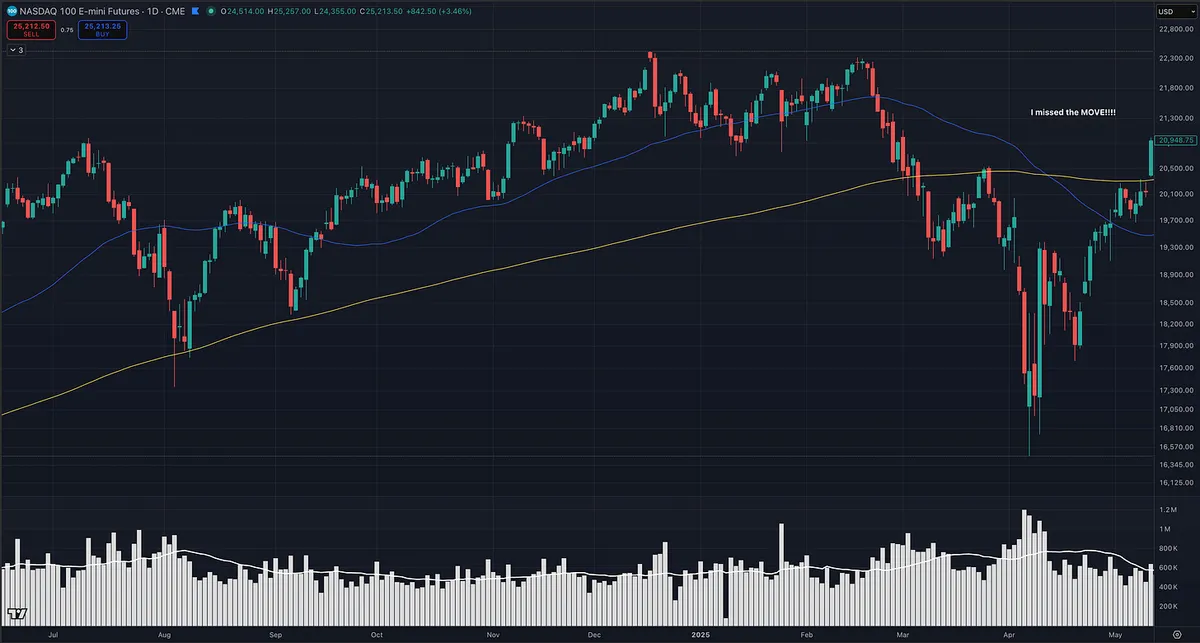
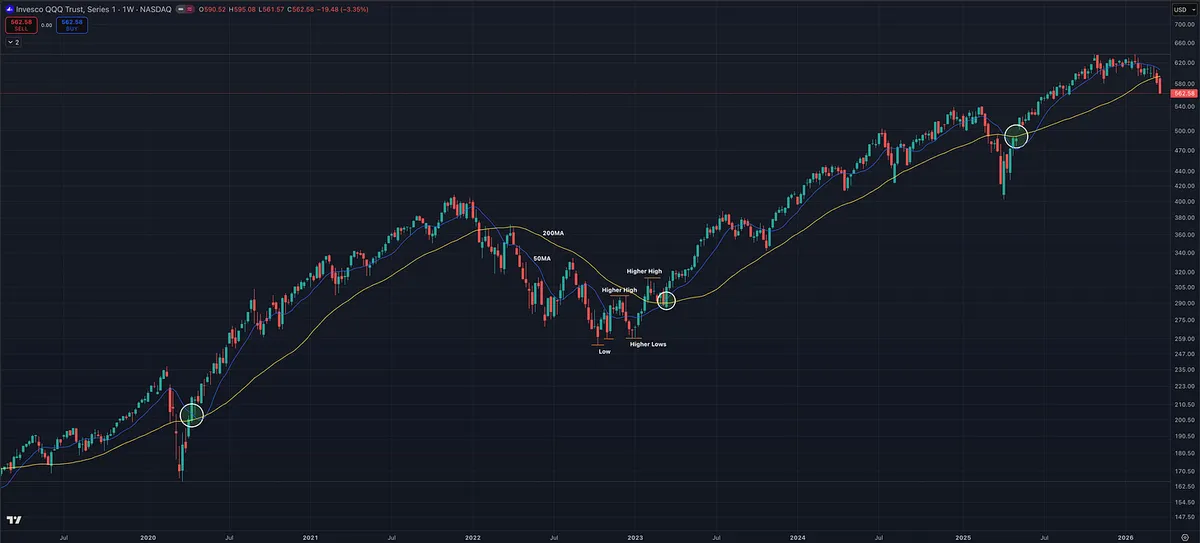
  • May 2025: Sentiment was extremely bearish. The NASDAQ-100 still rallied around 25%

  • Early 2023: Banking crisis headlines everywhere. The market pushed higher once it reclaimed key levels

  • April 2020: COVID panic. Many called it a bear market rally. “The end of the world” type of news. The NASDAQ went on to gain over 100%

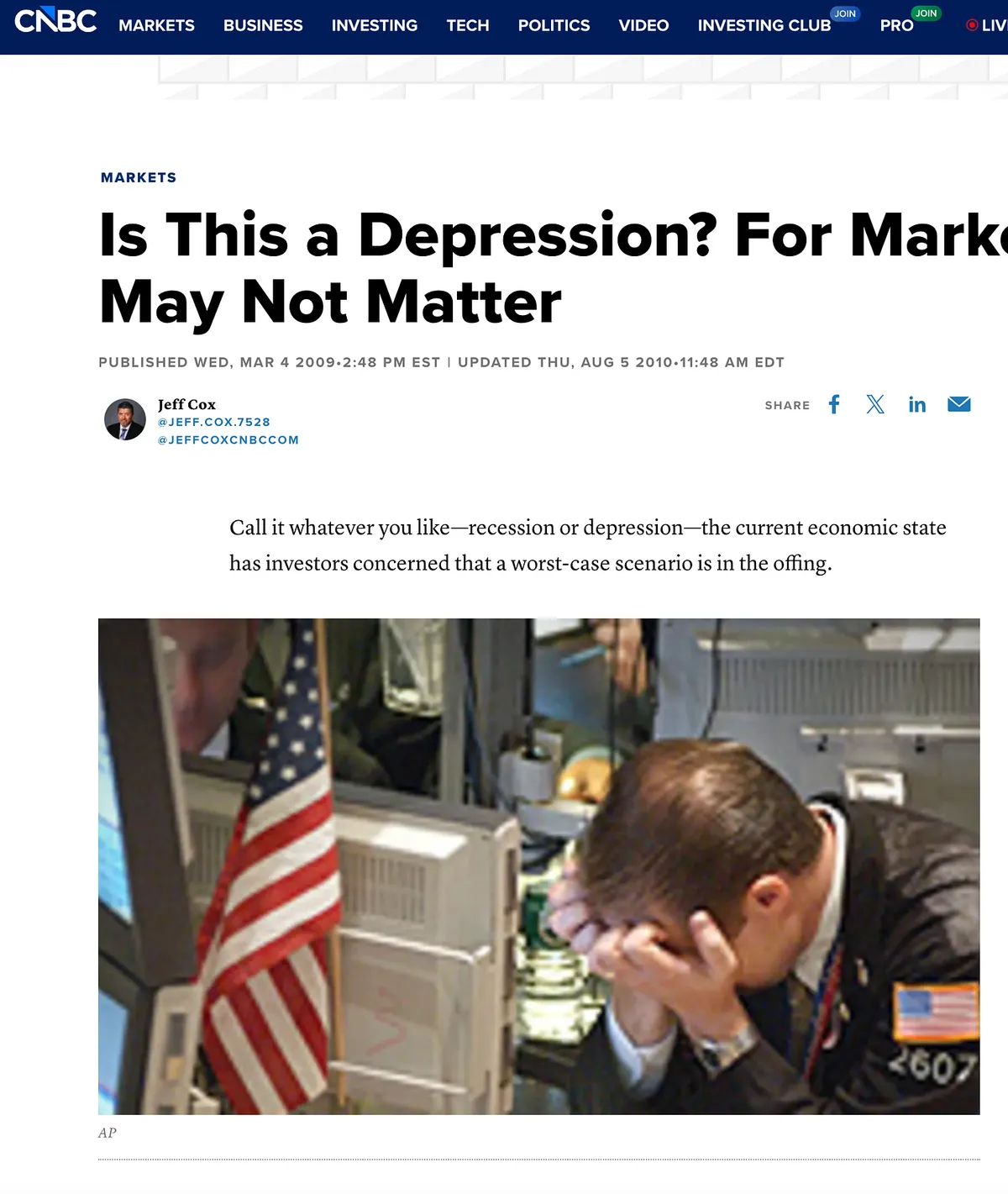
  • 2009: News flow was terrible. It turned into one of the best buying opportunities in decades

The market is almost always climbing a wall of worry.

There is always a reason not to buy.

Always.

This is the trap.

You wait for things to feel better. You wait for clarity. You wait for the news to calm down.

But the market does not wait.

By the time everything feels safe…

👉 The move is already well underway or you missed the best low risk, high reward opportunity.

So what actually matters?

  • Not headlines.

  • Not opinions.

  • Not what “should” happen.

What matters is:

  • Price reclaiming key levels 200/50 MA

  • Leading stocks breaking out

  • Strength clustering in industry groups

  • Higher Highs, Higher Lows

  • Strong Volume Price Analysis

That is the signal.

Everything else is noise.

You do not ignore risk.

You just refuse to let headlines override what the market is actually doing.

Because if you let the news dictate your decisions…

You will always be late.

And in momentum trading, late is expensive.

The next time the news feels overwhelming, remember this:

The market does not care how things feel.

It moves on supply and demand.

Follow that.

View on Substack ↗

“I Missed the Move” Already? Not So Fast

Every time the market snaps back like this, you start hearing it immediately:

“I missed it.”

Funny… because this is exactly what people were saying last year coming off the tariff scare lows.

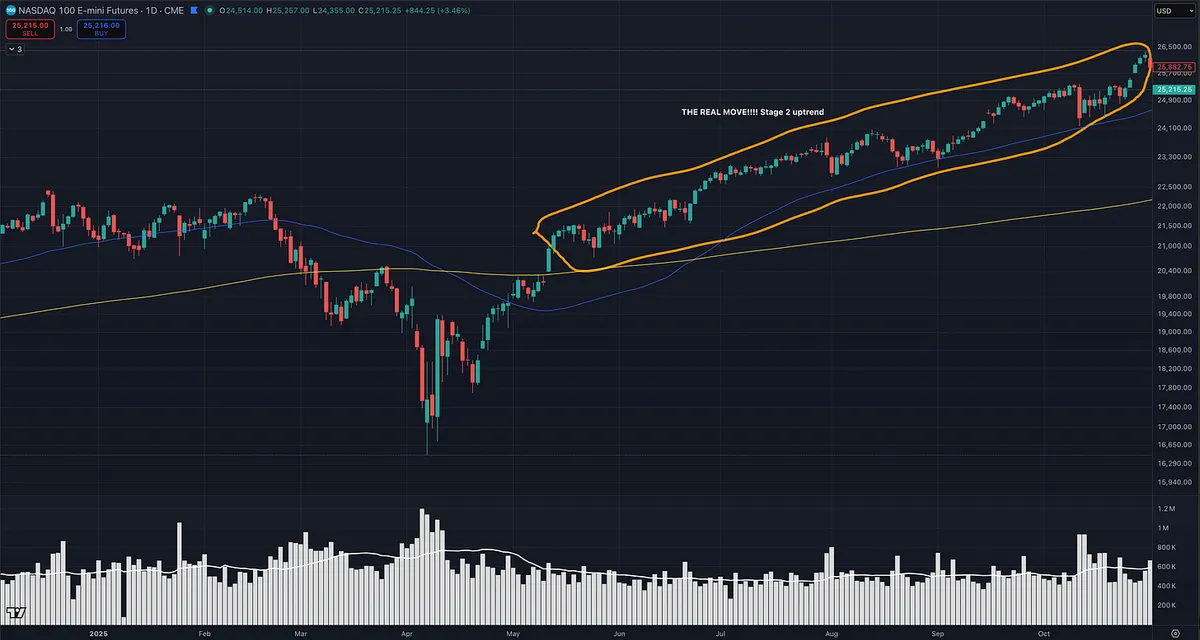
And yet, that was just the beginning of the real move.

Right now, the NASDAQ-100 is reclaiming key moving averages and showing strong momentum. That initial thrust off the lows is not the end of the move… it is often the start of a new trend.

This is where most traders get it wrong.

They think the opportunity was in the bottom.

But the bottom is where uncertainty is highest, volatility is extreme, and risk is hardest to define.

The real money is made after the market proves itself.

When:

  • Price reclaims key moving averages

  • Strength starts to concentrate in leading stocks

  • Institutions begin stepping back in

That is when trends develop.

That is when Stage 2 uptrends begin.

And that is when you want to be involved.

The irony is:

When it feels like you missed it… you are often just early in the move.

So instead of chasing the past, shift your focus to the present:

  • Is the market confirming and holding?

  • Are leaders breaking out to new highs?

  • Is relative strength expanding across sectors?

Because if those answers are yes…

Then you did not miss the move.

You are watching it begin.

View on Substack ↗

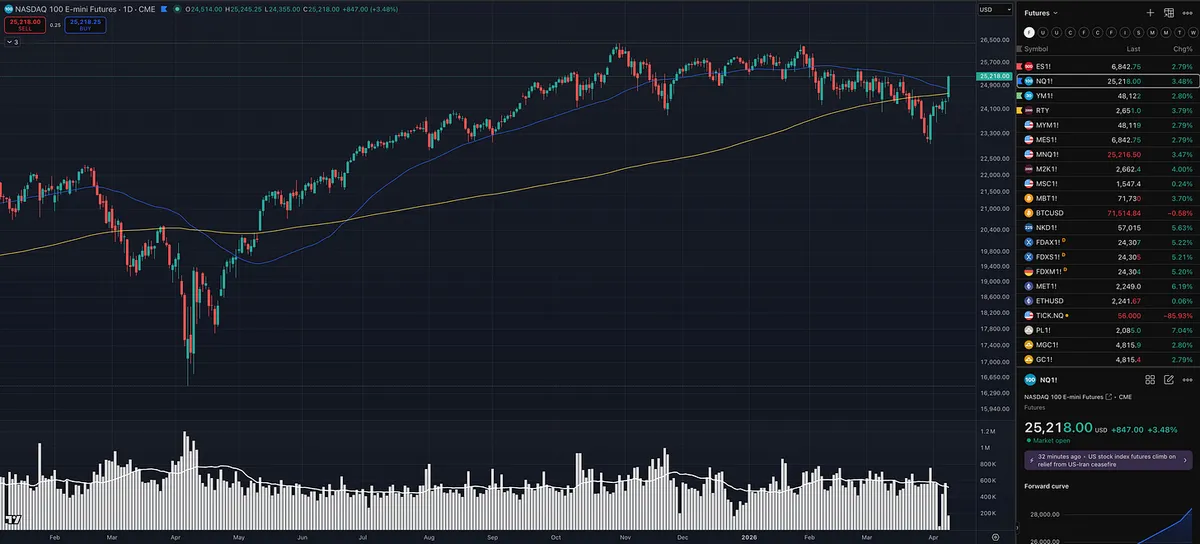
And Just Like That… We’re Back

And just like that, the market flips the script.

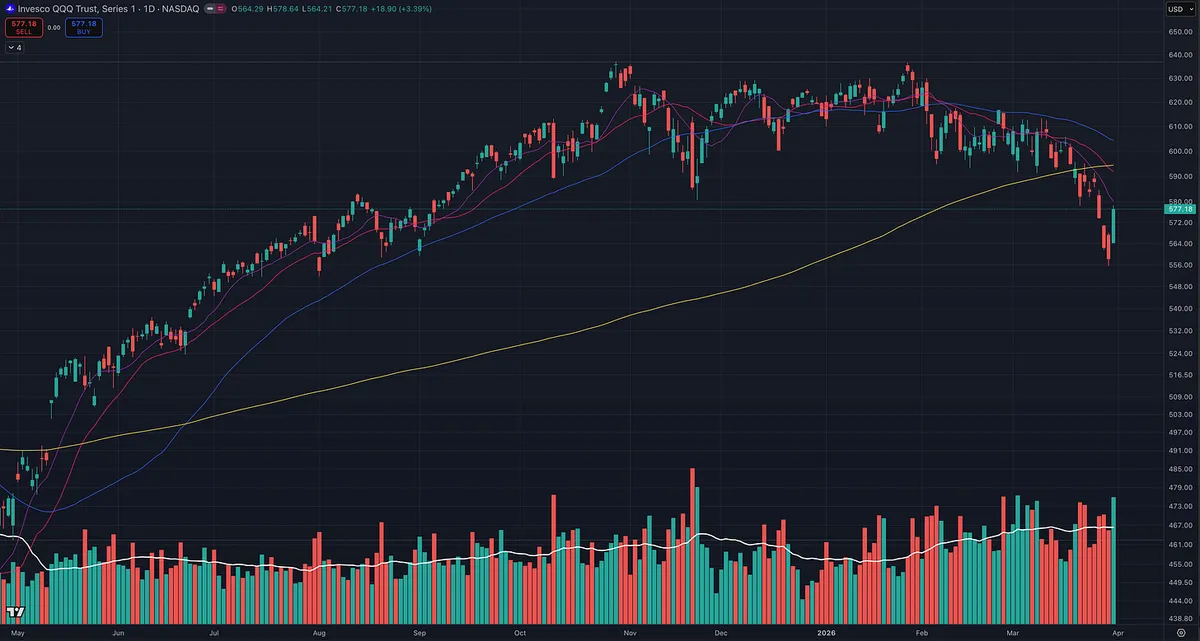
The NASDAQ-100 (with futures already up 3.55% today) is now back above all key moving averages and up nearly 10% since last Tuesday. That is a powerful move in a very short period of time.

Now the question becomes simple:

Does it hold?

Because if it does, the conversation shifts quickly from defense to offense.

Today has the potential to be a follow-through day. For that to confirm, you want to see:

  • A gain of 1 - 1.25% or more(ideally closer to 1.5% to 2%)

  • Higher volume than the prior session

  • Between Day 4 and 7

If those conditions are met, it signals institutional demand stepping back in, and historically, that is when you start leaning back into the market.

But here is the part most traders overlook:

This move is also news-driven.

That matters.

News-driven rallies can be powerful, but they can also be fragile. They can reverse just as quickly as they begin if the underlying demand is not there to support it.

So while this looks constructive on the surface, you still need to:

  • Respect the signal

  • But confirm the follow-through

  • And stay aware of the catalyst behind the move

This is where discipline separates professionals from everyone else.

Let the market prove it.

If it confirms, you step in and increase market exposure. You cannot allow emotions or opinions to keep you on the sidelines. When sentiment is most bearish, the market often moves higher. When sentiment is most bullish, that is when breakdowns tend to happen.

Price back above short-term and long-term moving averages is giving a green light.

Now the focus shifts to execution:

Find the leading stocks that are setting up.

If it breaks down, we get defensive again.

View on Substack ↗

Most Traders Miss This Before Every Market Move

Right now is a perfect time to study how the market actually behaves.

Not just how it warns you before a decline… but also what real recoveries look like and when it is actually safe to step back in.

Most traders focus on entries. The best traders focus on environment first.

If you understand the signals before the move, you stop reacting late and start positioning early.

I just made this post completely free for a limited time so you can go through it:

https://tradingmomentum.substack.com/p/how-the-market-warns-you-before-the

The market doesn’t move randomly. It leaves clues.The question is whether you’re trained to see them.

ArticleHow the Market Warns You Before the Crash (and When It’s Safe to Get Back In)
View on Substack ↗

Big Up Week… But Don’t Get Trapped Here

Professionals don’t start their week by chasing stocks.

They step back first.

They study the big picture.

Then they dive deeper.

That’s exactly what this week’s Big Picture Market Pulse is built for.

👉 https://tradingmomentum.substack.com/p/big-picture-market-pulse-april-5

Take some time this weekend to zoom out and understand what’s really happening beneath the surface before you jump into stock screening.

Yes, the market had a strong week.

But here’s what most people miss…

Some of the biggest rallies happen below the 200-day moving average.

And many of them fail.

They look like the start of something new…

Until they’re not.

We’ve seen it before. Sharp bounces. Excitement returns. Then the market rolls over again.

That doesn’t mean this move can’t turn into something real.

It might.

But right now, the evidence is still mixed.

This is where discipline matters.

This is where you step back, not speed up.

Get control of your emotions. Look at the structure. Understand the environment.

Then prepare for the week ahead with clarity, not hope.

If you’re serious about improving your results, this is where it starts.

Read the full breakdown before Monday.

On SubstackBig Picture Market Pulse | April 5, 2026
View on Substack ↗

What Is a Follow Through Day? The Signal William O’Neil Used to Get Back Into the Market

Most traders try to call the bottom. William O’Neil didn’t. He waited for confirmation, and that confirmation is called a follow through day.

After a market correction, you will almost always get a bounce. The problem is most of those bounces fail. So O’Neil studied over 100 years of market winners and found that real bull markets don’t start quietly, they start with power backed by volume.

A follow through day only counts if it happens at the right time. It must come on day 4 through day 7 of a rally attempt. Anything earlier is usually just a reflex bounce and far less reliable.

Then you need price strength. A major index like the Nasdaq or S&P 500 should rise roughly 1.5% to 2% or more. Earlier in O’Neil’s work 1% was acceptable, but over time that threshold increased to filter out weaker signals.

Finally, and most important, you need volume confirmation. The day’s volume must come in higher than the prior day, ideally above average. That is what tells you institutions are stepping in, not just retail noise.

This concept comes directly from O’Neil’s research in, where he found that this combination of timing, price, and volume often marked the early stages of a real market uptrend.

Here is the nuance most people miss. A follow through day is not a guarantee and it is not a signal to go all in. In fact, O’Neil would tell his traders they didn’t need to suddenly increase exposure. You could start very small. Just buy something. Begin testing the market.

Even when a follow through day checks all the boxes, you still proceed carefully. One of the biggest mistakes is jumping in too early or too aggressively before a proper signal is confirmed. Another is ignoring weak volume. If the index moves up but volume is light, that is a red flag. It suggests institutions are not behind the move.

You also want to see broad participation. A real uptrend is not carried by a handful of stocks. If only a few names are working, the rally is fragile and just as important, you have to watch what happens after the follow through day. If the market cannot build on it and quickly rolls over, that tells you the signal failed.

As O’Neil emphasized, a follow through day is just the beginning. You still need to see continued strength to confirm the uptrend.

Anyone can buy a bounce. Professionals wait for proof.

View on Substack ↗

The Setup Isn’t the Problem… The Environment Is

The same pattern that works today can fail tomorrow if you ignore context.

Ever notice how a setup works great for a while… then suddenly stops?

It’s not random.

It’s the environment.

Most traders obsess over patterns but ignore when those patterns actually work.

Coming out of a correction or bear phase, you will see a lot more cup and handle setups.

Why?

Because stocks are rebuilding. They need time to repair damage, shake out weak hands, and form proper bases before moving higher.

That’s Stage 1 transitioning into Stage 2.

But once you’re inside a strong Stage 2 uptrend…

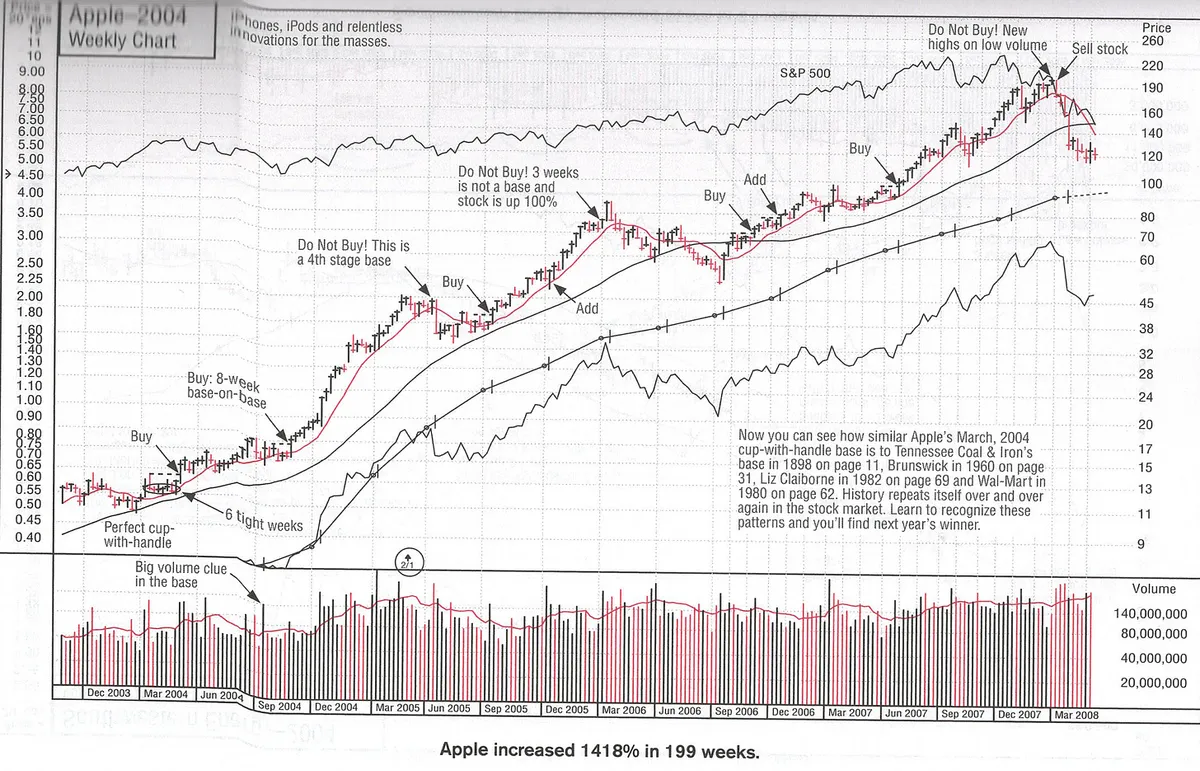
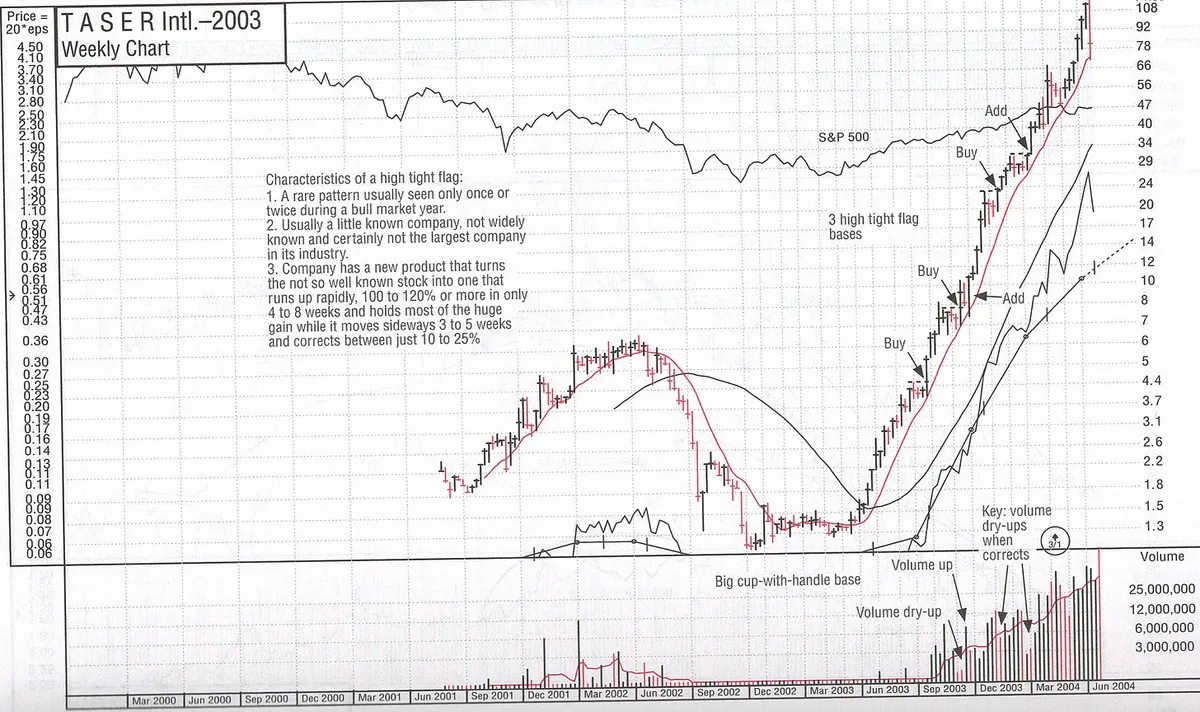
You’ll typically see fewer deep cup and handles and more tight, constructive consolidations.

The market is no longer rebuilding.

It’s expanding.

Now you start seeing:

  • Flags and Pennants

  • VCPs

  • Flat bases

  • Tight area breakouts

These tend to be shorter, tighter, and shallower than early-stage bases.

These are not bottoming patterns, they are continuation patterns forming within strength.

If you’re still looking for deep bases in a strong uptrend, you’re going to feel like “nothing is setting up” when in reality, everything is.

You’re just looking for the wrong thing.

The pattern doesn’t matter as much as the quality of price action and trend strength behind it.

This is one of those simple nuances that separates amateurs from pros.

Great traders don’t just learn setups.

They learn when those setups show up.

Same bull market. Same charts. Different lens.

Completely different results.

View on Substack ↗

As Jim Rogers put it,

“I just wait until there is money lying in the corner, and all I have to do is go over there and pick it up.”

This is not that type of market environment.

With roughly 75% of stocks following the general market direction, there is no edge in fighting the current. Patience and cash is a position.

Protect capital now so you are ready to take advantage of better conditions when they appear.

For a full breakdown of the current market environment, including indexes, sectors, and internals, read this week’s Big Picture Market Pulse.

https://tradingmomentum.substack.com/p/big-picture-market-pulse-march-29

On SubstackBig Picture Market Pulse | March 29, 2026
View on Substack ↗

The Big Picture Market Pulse is out.

Before diving into individual stocks, step back and understand the environment you’re operating in.

This report breaks down the market from top to bottom, covering major indexes, sector and industry group strength, market internals, and key macro conditions.

If you want to be prepared for the week ahead, start with the big picture.

https://tradingmomentum.substack.com/p/big-picture-market-pulse-march-29

On SubstackBig Picture Market Pulse | March 29, 2026
View on Substack ↗

Why Corrections Create the Biggest Winners

Most people fear corrections.

The best traders understand they are necessary.

Mark Minervini once said, “96% of big winners emerge from market corrections.”

That changes how you should see them.

A big correction is not just a pullback. It is a reset.

Weak stocks get cleared out. Institutions reposition. New leadership begins to form.

During this time, the goal is not to force trades.

It is to protect capital.

That is why top traders go to cash.

Not because they are scared, because they understand the cycle.

They are avoiding unnecessary losses while the next opportunities are being built.

Then comes the shift.

Leading stocks tend to lead the market, often showing strength before the market itself has fully turned.

That is where the real opportunity is.

The biggest winners do not come from extended markets.

They come out of corrections.

So instead of fearing them, start respecting them.

Because that is where the next leaders are born.

View on Substack ↗

Why Stage 2 Is the Only Time You Should Be Trading

Look at the market through one simple lens:

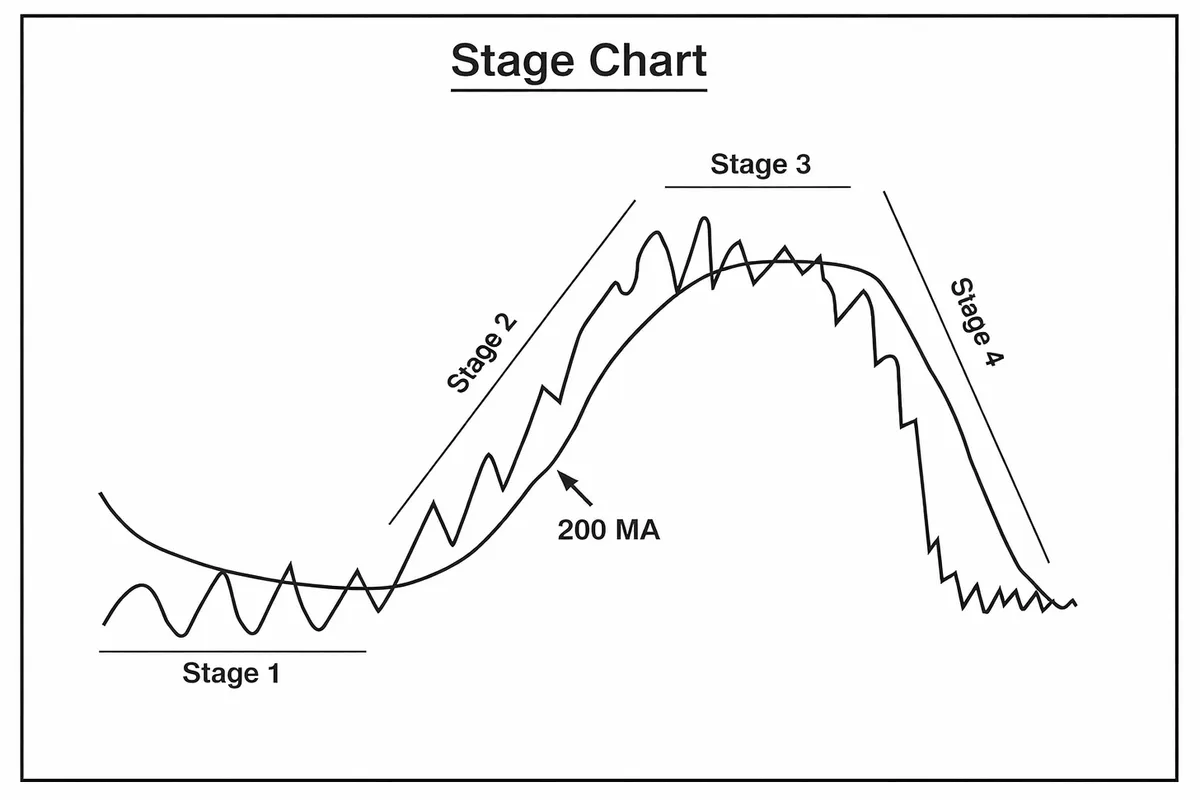
There are only four stages.

Stage 1.

Stage 2.

Stage 3.

Stage 4.

Most traders treat them all the same.

That is the mistake.

Stage 1 is where stocks go nowhere. Choppy. Sideways. No real progress.

You are not building wealth here. You are wasting time.

Stage 2 is where trends begin. Higher highs. Higher lows. Institutions stepping in.

This is where value is created. This is where money is made.

Stage 3 looks exciting. Big moves. Volatility. Headlines.

But underneath, distribution is happening.

Smart money is selling into strength.

You are not gaining an edge here. You are giving it back.

Stage 4 is where stocks break down. Lower highs. Lower lows. Weak closes.

This is where portfolios get destroyed. This is where value disappears.

So ask yourself:

Why trade in all four stages when only one actually pays you?

The best traders do less, not more.

They wait. They focus. They strike in Stage 2.

Because that is the only place you increase value without wasting time.

Everything else is noise.

Or worse.

A slow leak of your account.

View on Substack ↗

Why Are You Still Trading This Market?

If you’ve been getting beaten up in this market…

Let me ask you something:

Why are you still trading?

Seriously. Not trying to be a dick, but almost every market wizard or legendary trader who focuses on growth, momentum, and trend has said the same thing:

Market conditions matter.

Maybe it’s time to step back and look at the big picture.

This is something I write about every weekend. And for weeks now, the message has been clear:

  • Reduce exposure

  • Reduce activity

  • Sit in cash

Not because of opinion… But because of what the market is actually doing.

The warning signs have been there.

Don’t take it from me.

Open a book and you’ll see it straight from William O’Neil:

One of the biggest warning signs of a market breakdown is distribution days.

Now look at the charts:

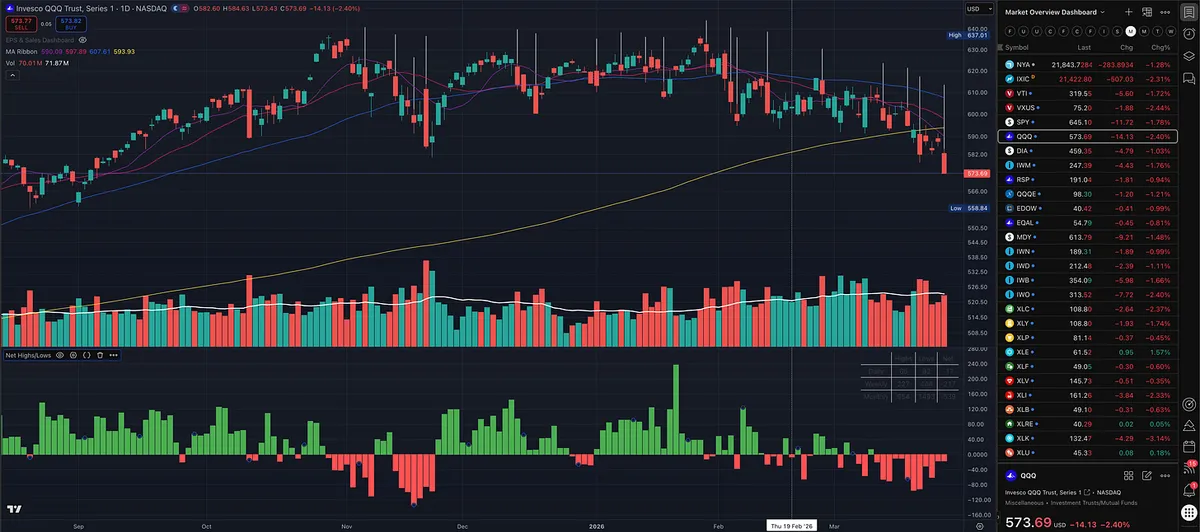
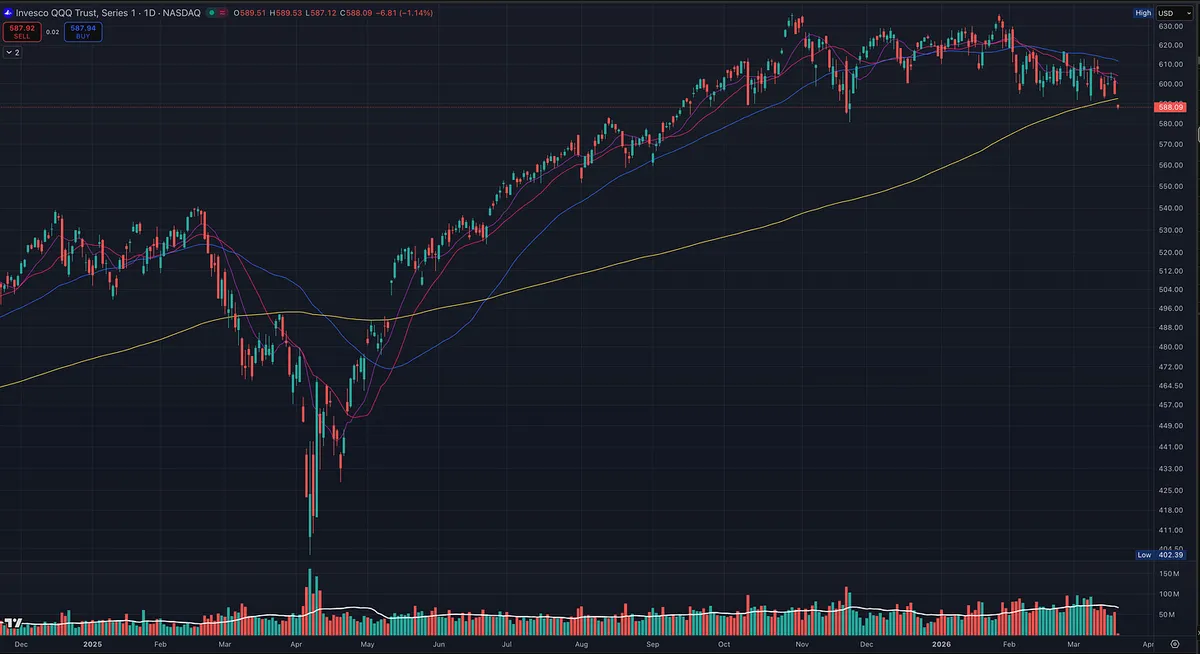
  • The Nasdaq-100 has stacked multiple distribution days, and many throughout this consolidation

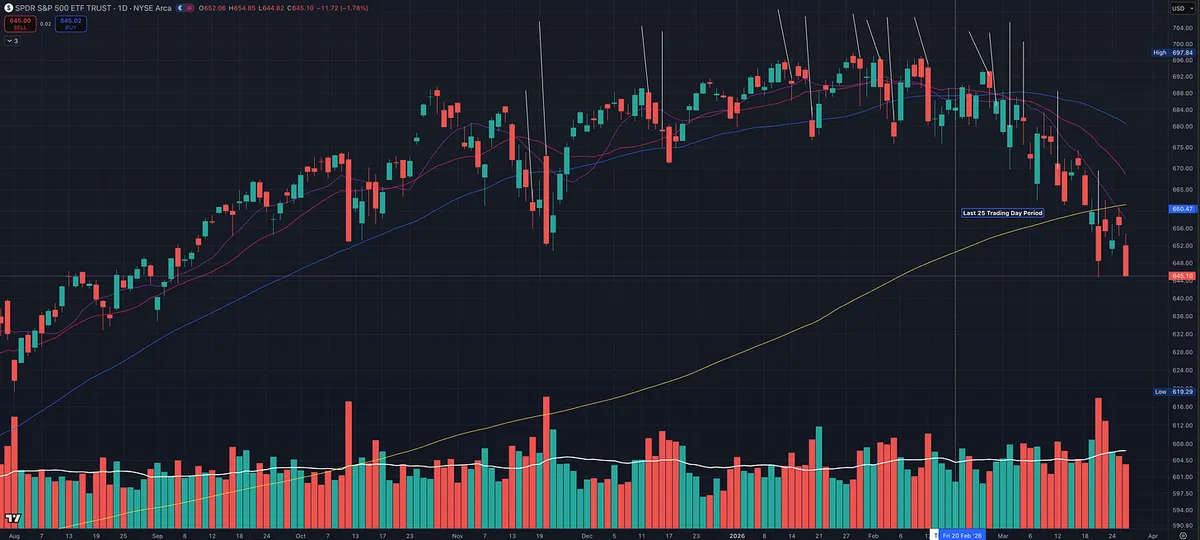
  • The S&P 500 has more over the last ~25 trading days

  • Price has broken prior lows

  • We’ve seen multiple closes below the 200-day moving average

  • The 50-day moving average is declining

  • The new highs vs new lows list is getting overwhelmed by new lows

  • And we’re seeing heavy volume on down days

Put it all together…

This is not a healthy market.

So why self-sabotage by fighting against the current?

Save your capital and mental capital for better conditions.

The market is not hiding anything right now.

It’s telling you exactly what it is.

The question is:

Are you listening?

View on Substack ↗

Bear Markets and Big Corrections Create the Next Winners

Most people see a bear market and think loss.

The best investors see preparation.

Every major winner starts the same way. It comes out of a correction. It forms a base. It tightens up while the crowd loses interest.

This is where opportunity is created.

Big corrections reset everything. Weak companies break down. Weak holders get shaken out. What remains are the strongest businesses quietly being accumulated.

That is where you want to focus.

Not on what already ran. Not on what is collapsing.

On what is building.

As volatility contracts and price action tightens, risk decreases. You are no longer chasing extended moves. You are positioning early, when the reward is asymmetric.

Low risk. High potential.

This is the phase most people ignore because it feels slow and uncertain.

But this is where the real money is made.

Bear markets and big corrections are not the enemy.

They are the birthplace of the next leaders.

Do not confuse this with bottom fishing.

We are still waiting for confirmation. A true character change. A confirmed Stage 2 uptrend before capital is deployed aggressively.

Preparation now. Execution later.

View on Substack ↗

Why Breakouts Keep Failing Right Now

Most traders think they’re doing something wrong.

They’re not.

They’re just trading breakouts in a bad market.

William O’Neil made this clear… In bear markets, corrections or sideways markets, most breakout patterns fail.

Not because the pattern is bad, but because the environment is wrong

No institutional buying

No follow through

Just quick failure and downside

So what’s the move?

Not better entries

Not tighter stops

Less trading

Sometimes the highest level play is sitting in cash

Waiting for a real uptrend to return

Because when the market turns… That’s when breakouts actually work

Until then?

Patience is the edge

View on Substack ↗

The Market Has Changed… Are You Paying Attention?

Taken together, the message is clear.

The market has transitioned from rotation to broad based deterioration.

If you look at when each major index peaked, a clear sequence emerges. Leadership has rolled over one area at a time, and now the final pockets of strength are beginning to break.

This is not random.

This is what late stage rotation looks like before it fully unwinds.

What was holding the market together is no longer holding.

Instead of capital rotating within equities, we are now seeing broad weakness across nearly all segments, with energy as one of the few exceptions.

That shift matters.

Because once rotation breaks down, there are fewer places to hide.

I’ve been talking about this in the Big Picture Market Pulse and reducing exposure as the weight of the evidence continued to deteriorate.

The full breakdown, what this means, and how to position from here is covered in this weekend’s update.

Make sure you’re paying attention and understand the big picture before the market opens.

https://tradingmomentum.substack.com/p/big-picture-market-pulse-march-22

On SubstackBig Picture Market Pulse | March 22, 2026
View on Substack ↗

Why You Can’t Find VCPs Right Now (And Why That’s Not a Problem)

Received a great question today about VCPs that I think a lot of traders are struggling with right now.

They mentioned how hard it has been to actually find clean VCP setups, even after studying charts and screening for them.

This is a great question, and honestly what you’re experiencing is completely normal.

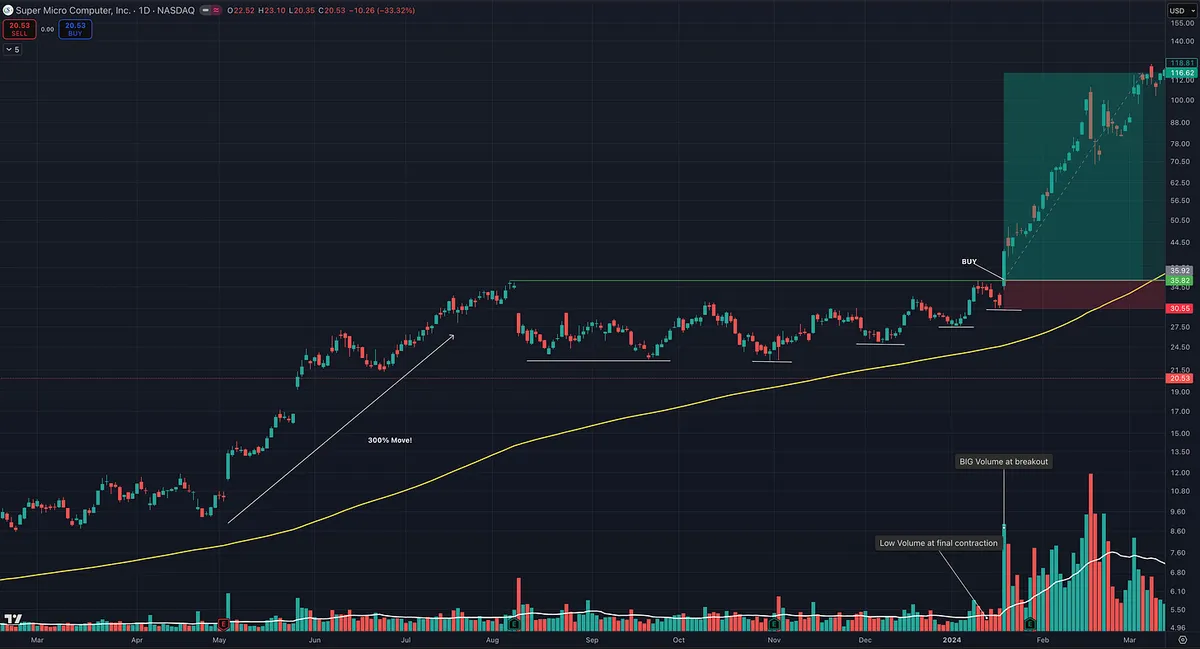
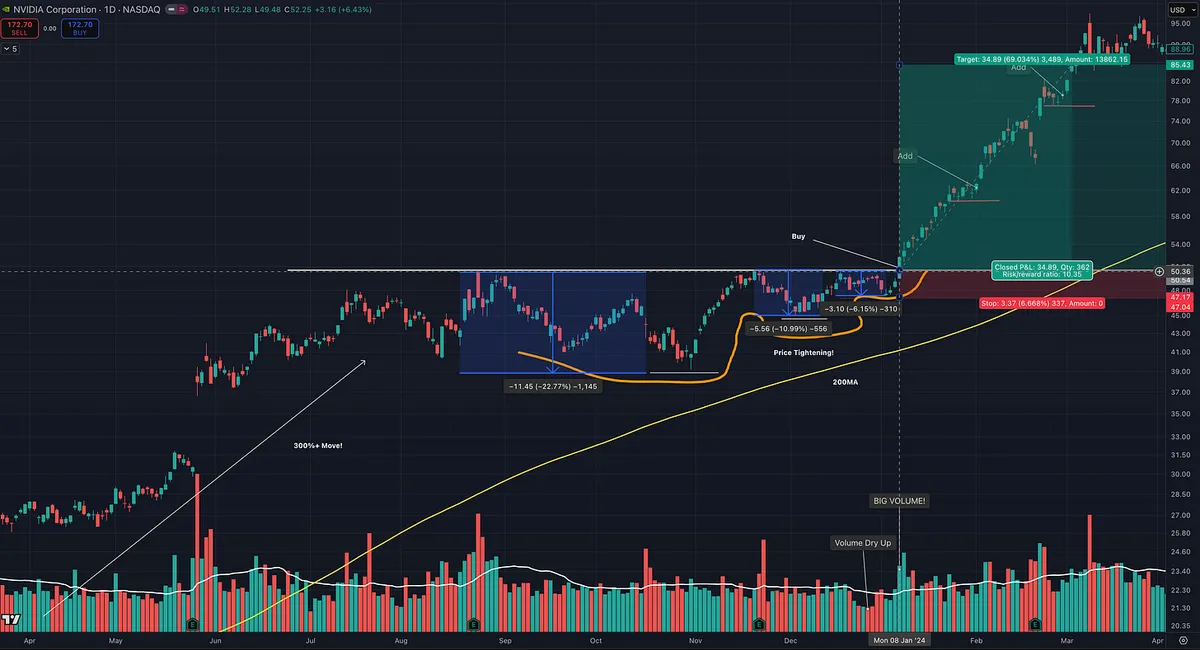
The first thing to understand is that most VCPs are not going to look like the textbook examples. The clean, perfectly staged contractions that many show are the exception, not the rule.

Minervini is not teaching you to find a perfect pattern. He is teaching you to recognize behavior.

What you are really looking for is:

  • volatility contraction over time

  • tighter price action

  • controlled pullbacks instead of sharp selloffs

  • volume drying up into the pivot

  • price tightening up the right side of the chart

Those things can show up in many different ways, and often they are subtle.

The second part of this is the environment.

Right now, it is harder to find clean setups. That is not a coincidence.

The best looking VCPs tend to show up earlier in a bull cycle when institutions are aggressively building positions and leadership is expanding. As the market matures, stocks become more extended, price action gets looser, and breakouts become less reliable.

So when you are scanning and thinking “these don’t look like the examples,” that is actually information.

It is telling you that either:

  • the setup is not truly there

  • or the environment is not ideal for it

A good way to think about it is this:

You are not trying to find a perfect VCP. You are trying to identify when supply is being absorbed before a potential expansion move.

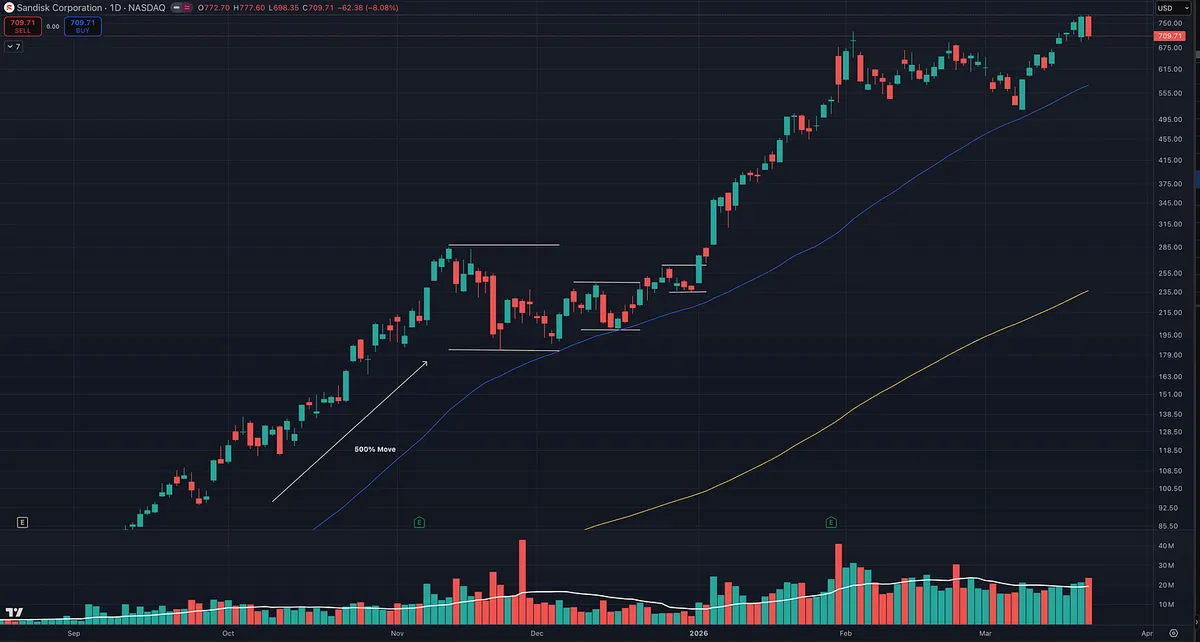
Sometimes that will look very clean like NVDA earlier in 2024 or slightly less perfect like SMCI. Other times it will look much messier, like SNDK in 2025, and require more experience to recognize.

If you are struggling to find them right now, that might not be a skill issue. It is very likely a reflection of the current market conditions.

Over time, you will get better at spotting these. It comes from screen time and reviewing charts over and over. What looks unclear now will start to stand out much more with experience.

Also, you do not need to master every setup to be successful. Some traders naturally see certain patterns better than others.

For example, you might find that:

  • cup with handle setups stand out more to you

  • or flat base breakouts are easier to recognize

That is completely fine.

The goal is not to trade every setup. The goal is to find the ones you can consistently recognize and execute well, and focus on those.

View on Substack ↗

The Market Just Flipped the Switch

Below the 200 Day, the Rules Change Whether You Like It or Not

Look at the chart again.

Not casually. Not hopefully. Objectively.

Because deep down, you already know something is different.

Price is not debating anymore. It is communicating.

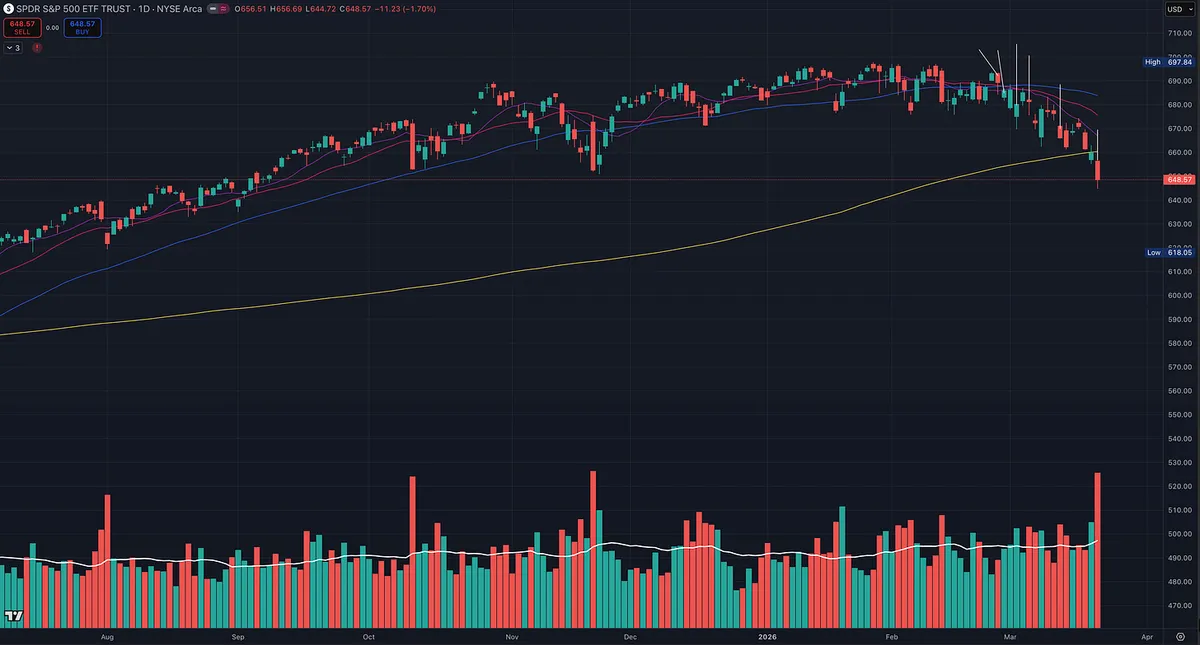
The S&P 500 and the NASDAQ 100 have both closed below the 200 day moving average. Not intraday. Not briefly. Closed below.

And as Paul Tudor Jones put it best, “Nothing good happens below the 200-day moving average.”

That statement is not dramatic. It is practical. It is survival.

Now layer in what just happened Friday.

A decisive break below the November 21 consolidation low. Heavy volume. Broad participation. Acceleration in Net 52 week lows. A 1.7% drop in the S&P 500 on BIG volume.

This is not random movement. This is distribution.

And when you zoom out, the message becomes even clearer.

The 10 day is declining. The 20 day is declining. The 50 day is declining.

That is alignment. Just not the kind bulls want.

This is exactly how a Stage 4 decline begins.

Stan Weinstein defined Stage 4 as the phase where institutions are no longer supporting price. They are exiting. Quietly at first. Then all at once.

And if you have studied William O’Neil, you already know what comes next.

He was very clear in that when the general market shows signs of distribution and begins to weaken, you must start raising cash and protecting capital. He repeatedly emphasized that the market itself determines your level of exposure, not your opinions.

You do not argue with it. You do not average down. You do not get creative.

You get defensive.

O’Neil also drilled home one of the most important truths in investing.

Three out of four stocks follow the general market trend.

That means even the strongest leaders will struggle when the indexes are under pressure. This is why he stressed the importance of interpreting market direction first before making any stock decisions.

This is where most traders lose money.

Not because they lack intelligence. Because they lack obedience to price.

Mark Minervini echoes the same principle in . When the market is not healthy, you reduce exposure aggressively. You do not force trades in poor conditions. You wait for alignment.

No hero trades. No predictions.

Just discipline.

Now here is the part most people will resist.

Could the market snap back this week? Yes.

Could we reclaim the range and move back into a sideways environment? Absolutely.

But that is not the current reality.

The current reality is what price just confirmed.

Break of support. Expansion in volume. Multiple distribution characteristics. Trend alignment to the downside.

That is Stage 4 behavior.

O’Neil specifically warned about clusters of distribution days and breaks of key support as signals that institutions are exiting. And when institutions sell, the path of least resistance is down.

And experienced traders understand something that newer traders do not want to accept.

Cash is a position.

Not a missed opportunity. Not fear. Not weakness.

Position.

In fact, during environments like this, O’Neil would often move heavily to cash and wait patiently for a confirmed uptrend to resume before redeploying capital.

Because capital preservation is what allows you to take advantage of the next real opportunity.

Right now, the goal is not to make money.

The goal is to not lose it.

But here is the part that matters most.

This is not the end of the world.

This is the process.

Every major opportunity in the market is born out of periods like this. Corrections reset leadership. They shake out weak hands. They build the foundation for the next true uptrend.

O’Neil made fortunes not by fighting these phases, but by respecting them and then stepping in aggressively when a new confirmed uptrend emerged.

If you protect your capital now, you are not falling behind.

You are positioning yourself.

Because when the next Stage 2 begins, the traders who stayed disciplined will not be trying to recover.

They will be ready to attack.

The market has already spoken.

The only question is whether you are listening.

One last note…

For those of you who have been reading my Big Picture Market Pulse and paying attention in the chat, you’ve noticed I’ve been reducing exposure and activity for weeks. So before we even got to this point, I had already reduced potential damage. This is not a sudden surprise.

Also, this is a great time to start the course. Modules 1 through 3 are complete, and Module 4 will be out soon.

Make sure to read this weekend’s post when it’s released in the next 24 hours.

View on Substack ↗

Every Trader Knows This. But Most Don’t Act On It.

Every trader would agree with this:

No single strategy works in every market environment.

Momentum strategies struggle in choppy markets.

Mean reversion struggles during strong trends.

Yet most traders never stop to ask a critical question:

What kind of market environment are we actually in right now?

Instead, they keep applying the same strategy regardless of conditions.

If you fail to analyze the broader market environment, you may end up trading in conditions that are completely misaligned with your strategy.

This principle doesn’t just apply to momentum or trend-following systems.

It applies to every trading style.

As Dr. Van Tharp explains:

“You need to understand how your system works in various market types and use it only in the types of markets for which it was designed. The common mistake most people make is trying to find a system that works in all market conditions. That’s insane.”

In other words:

Success in trading isn’t just about finding the right strategy.

It’s about using the right strategy in the right environment.

Module 2 and Module 3 of the Momentum Trading Course walk through how to evaluate and frame the market environment.

Start here: https://tradingmomentum.substack.com/p/momentum-trading-strategy-the-100-56a

On SubstackMomentum Trading Strategy: The 100-Year Playbook Behind the Biggest Winning Stocks — Module 3
View on Substack ↗

Stop Scanning Random Stocks. Do This Instead.

Stan Weinstein’s “Forest to the Trees” method that quietly finds the highest-probability breakout stocks.

Most traders open their charts and start here:

Stocks.

They scroll… scan… and hope something “looks good.”

But the traders who consistently catch monster breakouts follow a completely different process.

Stan Weinstein called it:

The “Forest to the Trees” approach.

And once you see it, your brain immediately goes:

Yeah… that actually makes way more sense.

Because it aligns with how probability actually works in markets.

Step 1 — Start With the Forest (The Market)

Before looking at a single stock, ask one question:

Is the market healthy?

The best traders want the market wind at their back.

Most stocks follow the general market direction, which is why market trend analysis is foundational to successful stock selection.

If the environment is hostile, even great stocks struggle.

Step 2 — Find the Strongest Groups

Money does not move randomly.

It moves in themes.

When institutions accumulate stocks, they often accumulate entire sectors.

That is why the biggest winners tend to emerge from leading industry groups, not isolated names.

So the next filter becomes simple:

Where is the money flowing?

Step 3 — Find the Best Stock in That Group

Only now do you zoom into individual stocks.

Inside the strongest groups, you look for:

• Tight consolidations

• Strong relative strength

• Institutional accumulation

• Clean breakout levels

• Asymmetric risk vs reward setups

At this point you are not randomly scanning anymore.

You are selecting from the strongest part of the market.

Step 4 — Remember: This Is a Probability Game

Even with perfect analysis…

You will still be wrong.

Markets are not about certainty.

They are about probabilities.

The edge comes from two simple rules:

Cut losers fast. Let winners run.

One Idea That Changes How You Find Big Winners

Most traders start with a stock.

Professionals start with the market.

Market → Sector → Stock → Breakout.

The forest leads you to the trees.