Momentum Trading Strategy

Notes

Selling & Holding Winners

Managing a trade after it starts working: when to take profits, how to stay in big winners, and when to exit.

Showing 61–80 of 95 notes

View on Substack ↗

The Pullback That Steals Your Future Gains

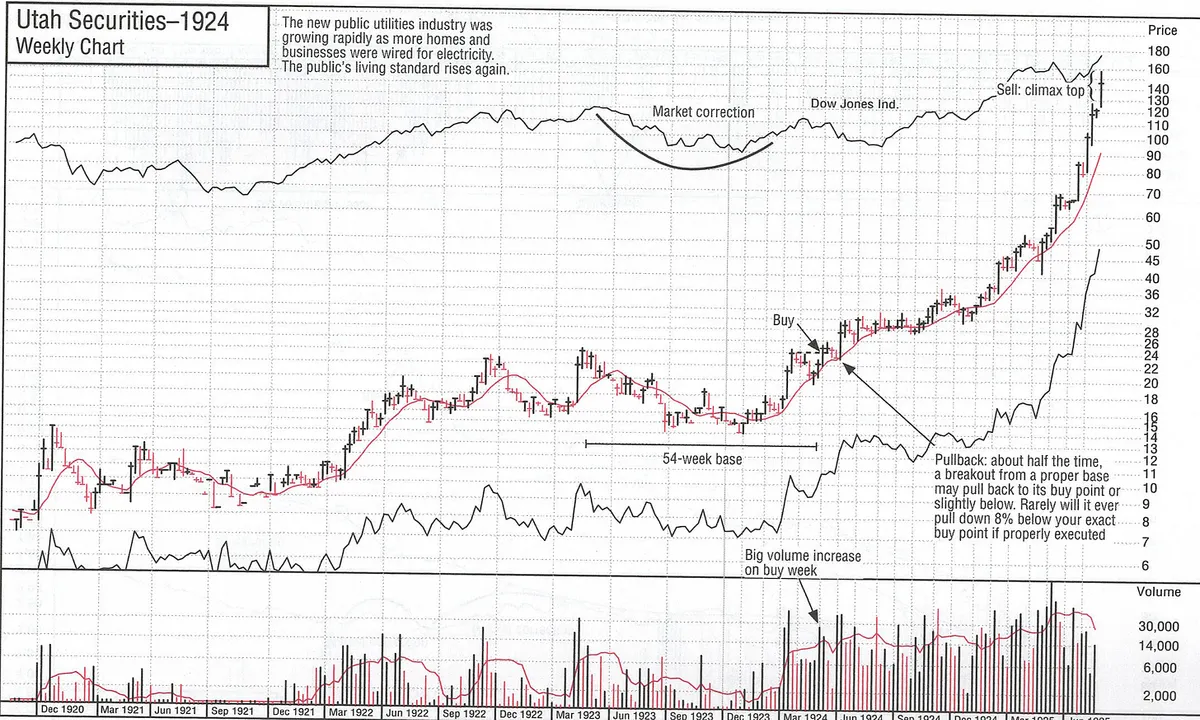
This chart is from 1924.

Different decade. Same mistake.

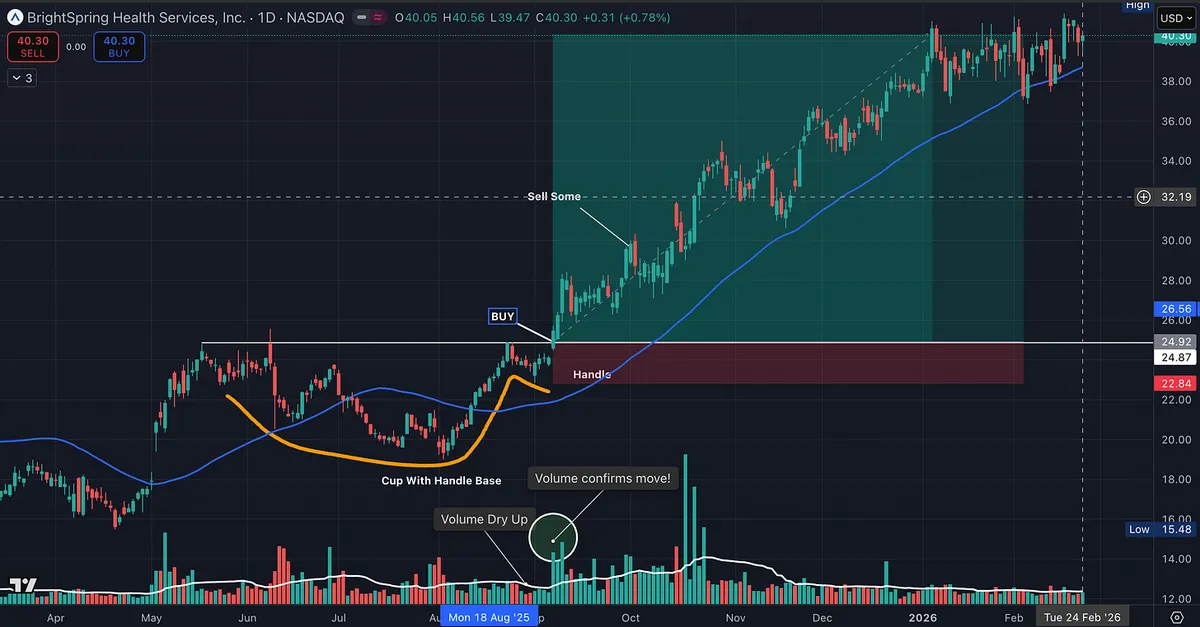
Look at the breakout.

Massive volume. Clear base. Institutions step in.

Then the stock pulls back into the buy zone.

Not breaking the pattern. Not violating the stop. Just pulling back enough to trigger fear.

This is where most traders sell.

They bought the breakout. They see red. They think, “I knew it. False breakout.”

So they exit.

Then the stock tightens.

Volume dries up.

And it begins a relentless advance.

The move they wanted. Without them.

William O’Neil studied over 1,000 of the greatest winners in history.

He found that about half the time, a proper breakout will retest the pivot or slightly undercut it.

Rarely will it drop more than 7 to 8 percent if properly bought.

That pullback is not failure.

It is a test.

The amateurs react to discomfort.

The pros react to rules.

The market has not changed in 100 years.

Human nature has not changed in 100 years.

The only question is:

Are you trading emotions… or a system?

Press winners. Cut losers.
View on Substack ↗

Stanley Druckenmiller on Letting Winners Run

Cut losers short. Let winners run.

Anyone who has been reading my notes is probably sick of hearing it.

But this is foundational.

Rookies struggle with taking losses. Pros struggle with sitting with big gains.

Druckenmiller tells on himself with Nvidia.

After riding it from around 150 to 800, he said:

“So then the stock goes to 800 and I violated everything I said in the interview. I couldn't stand success. I'd gone from 150 to 800. I was long term in it. I couldn't deal with it and I sold it. And then it was 1,400 like five weeks later and I was sick.”

Beginners fear losses.

Professionals can take losses.

But even the greats feel the discomfort of big gains.

The skill is not just cutting losers.

It is having the discipline to let a true leader keep working.

View on Substack ↗

The 50/80 Rule and Why You Must Never Fall in Love With a Stock

I once heard Mark Minervini say something that every trader should remember.

50 percent of past leaders once they top will go down 80 percent.

80 percent of past leaders will go down at least 50 percent.

Think about that.

The biggest winners of the bull market. The strongest charts. The companies with explosive earnings and dominant narratives.

Half of them will eventually collapse by 80 percent. Most will lose at least half their value.

This is why you cannot fall in love with your stocks.

It always starts the same way.

You admire the company. You believe in the product. You made great money in it before.

Now it feels familiar. Personal. Safe.

That is when it becomes dangerous.

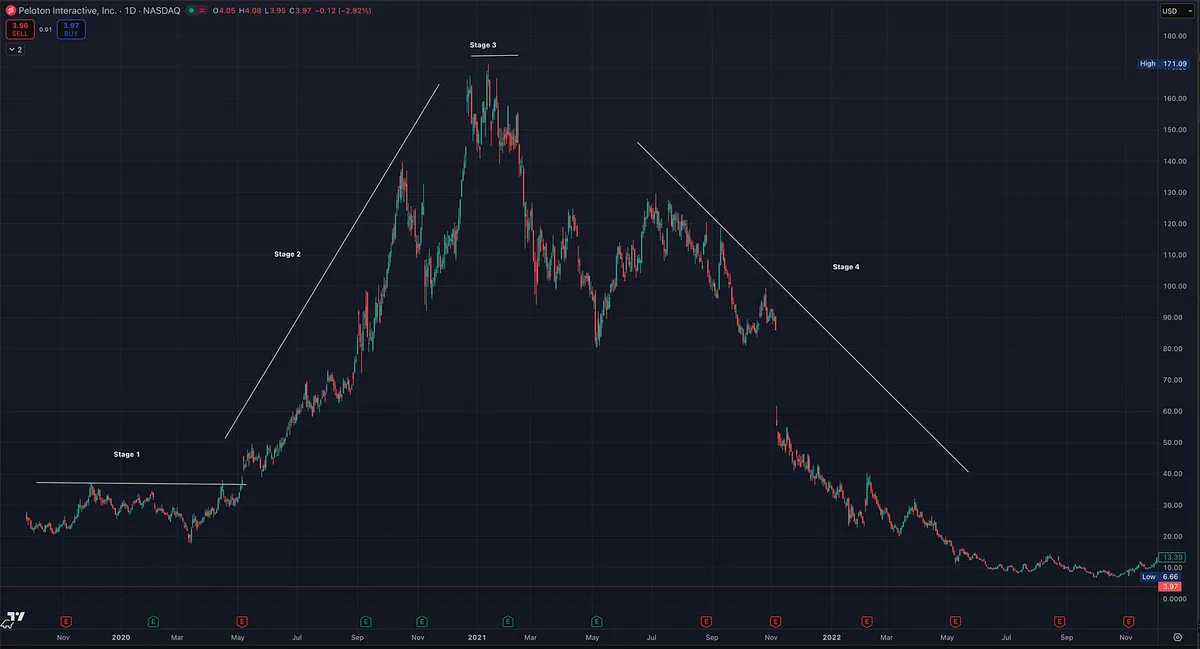
Stan Weinstein outlined the four stages of a stock cycle in Secrets for Profiting in Bull and Bear Markets . Stage 2 is where fortunes are made. Institutional accumulation drives powerful advances. That is where you press your advantage.

But Stage 4 is different.

Stage 4 is distribution. Stage 4 is broken structure. Stage 4 is long, grinding declines that destroy capital and confidence.

Once a stock transitions from leadership to deterioration, the risk profile changes completely.

If earnings and sales momentum slows. If relative strength fades. If price breaks key support. If rallies become weaker and selling becomes heavier.

You get out.

There is no way to know how far down it will go.

That is the illusion that traps investors.

They wait for it to bounce. They wait to get back to even. They tell themselves it cannot fall much further.

But a stock down 30 percent can go down 50 percent. A stock down 50 percent can go down 80 percent.

A 50 percent decline requires a 100 percent gain just to recover. An 80 percent decline requires a 400 percent gain.

The market does not care how great the company is. It does not care how much you love the story. It does not care what price you paid.

Leaders lead on the way up and they can devastate portfolios on the way down.

Great traders are not loyal to stocks. They are loyal to their process.

When the characteristics change, they act.

Love your craft. Love your discipline.

But never fall in love with your stocks.

View on Substack ↗

Protecting a Winner Before It Becomes a Loser

“You may feel dumb breaking even on a trade that was once at a profit; however, you’ll feel a lot worse if you turn a good-size gain into a loser.” — Mark Minervini

At the start of a trade, your stop serves one purpose.

To cap your loss.

You are defining risk. You are protecting capital. Nothing more.

If you risk 5 percent, that is the maximum you are willing to lose if the trade fails.

But once the stock advances meaningfully in your favor, the responsibility shifts.

In Think and Trade Like a Champion, an example is given where a stock moves roughly two times the initial risk. At that point, the stop can be raised to breakeven.

Now the trade changes.

You are no longer just limiting downside. You have removed the possibility of turning the position into a loss.

If the stock continues to make higher highs and higher lows, the position is managed accordingly.

That may include:

• Selling a portion into strength

• Raising the stop to a prior higher low

• Using a trailing method such as ATR

• Using a moving average as a guide

The objective is not to capture every last point.

It is to protect progress.

Breaking even after a meaningful advance may feel premature.

But allowing a solid gain to turn into a loss is far worse.

Risk management begins with capping losses.

It evolves into protecting gains.

View on Substack ↗

When Not to Sell an Extended Stock

Most traders see a stock up 15 or 20 percent from a base and think one thing.

It’s too extended. Time to sell.

David Ryan, three-time U.S. Investing Champion and William O’Neil protégé who ran the New USA Growth Fund, noticed something different.

In Think & Trade Like a Champion, Minervini explains that Ryan defined “extended” as more than 10 percent above the most recent consolidation. He would not buy extended stocks.

But he observed that some of these names did not roll over. They kept advancing. In many cases, they went on to make huge gains.

That observation led to a hypothesis.

If large institutions cannot fill their positions in one or two days, they must accumulate over time. That steady institutional demand pushes the stock higher across multiple sessions.

Ryan studied this relentlessly and, with programmer Rajneesh Gupta, identified specific characteristics. He originally called the setup ANTS, later referred to as the MVP indicator for Momentum, Volume, and Price.

The traits were precise:

  • 12 out of 15 up days

  • Volume up 25 percent or more

  • Price up 20 percent or more in 15 days

Here is the nuance most traders miss.

Ryan warned against buying solely on these traits if the stock is already extended. He advised waiting for a pullback or a new base to form.

But sometimes that 15-day surge begins near the bottom of a base. In that case, the stock is not extended. It is under accumulation and in position to be bought immediately.

The lesson is simple.

Do not sell strength that is under accumulation.

What feels extended to you may be institutions just getting started.

View on Substack ↗

Why Most Traders Fail Before They Even Enter The Trade

Let me ask you something.

Before you enter a trade, do you know:

Exactly where you are wrong?

Exactly what you will do if stopped out?

Exactly how you will reenter if it resets? Exactly how you will sell into strength?

Exactly what happens if the market gaps against you?

If you hesitated on any of those, you are not trading.

You are hoping.

Mark Minervini makes this crystal clear in Trade Like a Stock Market Wizard:

“Before entering any trade, you should have a specific plan that includes your entry point, your initial stop-loss, your profit objective, and your contingency plan.”

That is the difference between professionals and amateurs.

Professionals operate on contingencies.

1. The Initial Stop Loss

The only certainty in a trade is risk.

Minervini defines the stop first. Position size is calculated from that stop. If the stock violates the level that invalidates the setup, you exit.

No debate. No emotion.

2. The Reentry Plan

Most traders make this mistake:

They get stopped out and emotionally discard the stock.

Minervini teaches that a failed breakout can reset into a new entry. A pivot failure does not always mean base failure.

If fundamentals remain intact and structure repairs itself, you reenter.

This is how you catch the move that makes your year.

3. Selling At A Profit

You do not sell because you are up.

You sell because the stock becomes extended, climactic, or abnormal.

You sell partial positions into strength.

You protect gains when character changes.

You let the remainder work.

4. The Disaster Plan

This is what separates serious traders from hobbyists.

What happens if the stock gaps below your stop?

What happens during a market event?

Minervini plans for that in advance.

Hope is not a strategy.

Contingencies are.

View on Substack ↗

The Only Thing You Control In A Trade

I am always surprised by how much emphasis traders place on price targets.

It is one of the clearest signs of inexperience.

The only thing that is certain in any trade is how much you are willing to lose.

Everything else is speculation.

William O’Neil built an entire system around cutting losses quickly. He was clear that you must always know where you are wrong before you enter a trade. Protecting capital is not optional. It is foundational.

Mark Minervini reinforces this in Trade Like a Stock Market Wizard. Risk is defined first. Position size is calculated from the stop. Expectancy is built over a large sample of trades.

Neither of them teach predicting how far a stock will go.

Because you cannot know.

Anyone who has traded long enough understands this reality:

Some stocks you expect to be huge winners fail.

Some trades you had modest expectations for become extraordinary.

The outliers are unpredictable.

Over hundreds and thousands of trades, positive expectancy is built from:

Small, controlled losses.

Breakeven trades.

Modest 1R to 3R gains.

And occasionally, a very large winner.

That large winner is what drives performance.

You do not identify it in advance with a price target.

You identify it by letting it act right and continue to hold as long as it behaves constructively.

Rigid price targets can interfere with this process.

They can cause you to:

Sell your best stock too early.

Refuse to trim when weakness appears because the target was not reached.

Anchor to a number instead of reading price and volume.

Professionals think in terms of risk and probability.

They focus on the downside because that is what they can control.

They let the market determine the upside.

When fundamentals, technical structure, and market tone align, the probability increases. That is the edge.

But the size of the move is never known in advance.

Define the risk.

Manage the position.

Let strength prove itself.

The only certainty in a trade is the loss you are willing to take.

Everything else is earned by discipline.

View on Substack ↗

Why Elite Traders Work on Winners More Than Losses

After reading and listening to thousands of hours of interviews with great traders, one pattern stands out.

Many of them say they are working to improve getting more out of their winners.

I cannot recall many saying they struggle with cutting losses.

That tells you something.

Now, do not misunderstand.

These traders absolutely let winners run. That is why they survive. That is why they can pay for their losers. Most of them have win rates under 50 percent.

They already understand that a small number of trades drive the majority of profits.

And yet, they still analyze how they can extract more from their best positions.

Why?

Because of how they are wired.

Paul Tudor Jones said it clearly:

“The most important rule of trading is to play great defense, not great offense.”

The best traders think about risk first.

Where am I wrong? How much can I lose? How do I protect capital?

That mindset makes cutting losses almost automatic.

Defense becomes instinct.

But letting winners expand requires tolerating open profit volatility.

It requires sitting through pullbacks.

It requires not grabbing gains too quickly.

For someone focused on protecting capital, open profit feels like something that must be defended.

So even elite traders study how to stay in their best trades longer.

Not because they are bad at it.

But because their default setting is risk control.

Protect the downside first.

Then learn to press your advantage when the market gives it.

Play great defense.

Then allow offense to work when it matters.

View on Substack ↗

Leadership Is Measured, Not Assumed

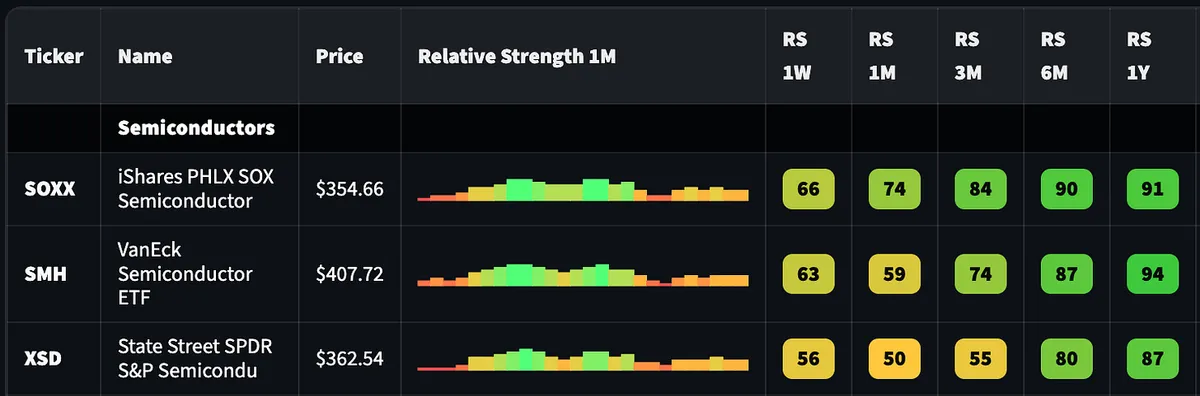
The relative strength dashboard shows short-term deceleration in semiconductors.

That is information.

It is not a conclusion.

William O’Neil teaches that the biggest winners come from leading industry groups, and that you must stay aligned with true market leaders, not laggards .

Mark Minervini teaches that market leaders do one of two things during an advance:

“The price advance of the market leader will do one of two things: it will continue its advance while the group propels it even higher, or it will consolidate in a sideways fashion and digest its previous gains while the group and other stocks in the group play catch-up.”

Consolidation is normal.

Loss of leadership is confirmed.

O’Neil makes clear that leading stocks show deterioration before major tops and that you must recognize those signals through price and relative strength behavior .

Minervini is equally direct: a leader that begins to act abnormally, with loose price action or repeated failure, is no longer a leader.

Short-term relative strength cooling does not by itself prove leadership is over.

What proves leadership is over is:

• Sustained deterioration in relative strength

• Repeated distribution

• Failed breakouts

• Violation of key support levels

• Abnormal price and volume behavior

Until those conditions appear, the proper posture is observation, not prediction.

O’Neil and Minervini do not forecast tops.

They monitor leadership and react when evidence changes.

If semiconductors remain structurally sound, tighten up, and re-accelerate, that confirms ongoing leadership.

If relative strength continues to deteriorate and price action becomes abnormal, that confirms a change.

The rule is simple and unchanged:

Stay with leaders while they act like leaders.

Exit when they stop.

View on Substack ↗

The Market Pays You on the Sell Not the Buy

Anyone can buy a hot stock.

Newsletters have been selling “the next big winner” for decades.

Beautiful analysis. Strong fundamentals. Conviction everywhere.

That is not the hard part.

The hard part is keeping the money.

Even real super performers collapse.

As Mark Minervini said:

“History shows that one-third of super performers give back all or more of their entire advance. On average, their subsequent price declines are 50 to 70 percent.”

Read that again.

50 to 70 percent.

You can be right… And still end up back at zero.

Take profits too early and your winners never pay for your losers.

Take profits too late and you round trip the entire move.

This is where most traders fail.

Not entries.

Exits.

Without a sell plan you are not managing risk.

You are hoping.

Momentum expands. Crowds chase. Then gravity returns.

Your edge is not finding leaders.

Your edge is not giving it back.

So the real question is simple:

Do you have written sell rules?

Or are you just acting on feelings?

Because the market only rewards one of those.

View on Substack ↗

Stay With the Trend Until It Ends

“The trend is your friend until the end when it bends.” Ed Seykota

This is where most traders get it wrong.

They assume a big move means it is over. They look for reasons to fade strength. They try to be early instead of aligned.

Seykota traded the opposite way.

Once a trend is established, the job is not to predict the end. It is to stay with it.

Strong trends often pause. They consolidate. They shake out weak hands.

That does not mean the move is finished.

The trend remains your friend until price proves otherwise.

Not until it feels extended. Not until it looks obvious. Only when it actually bends.

View on Substack ↗

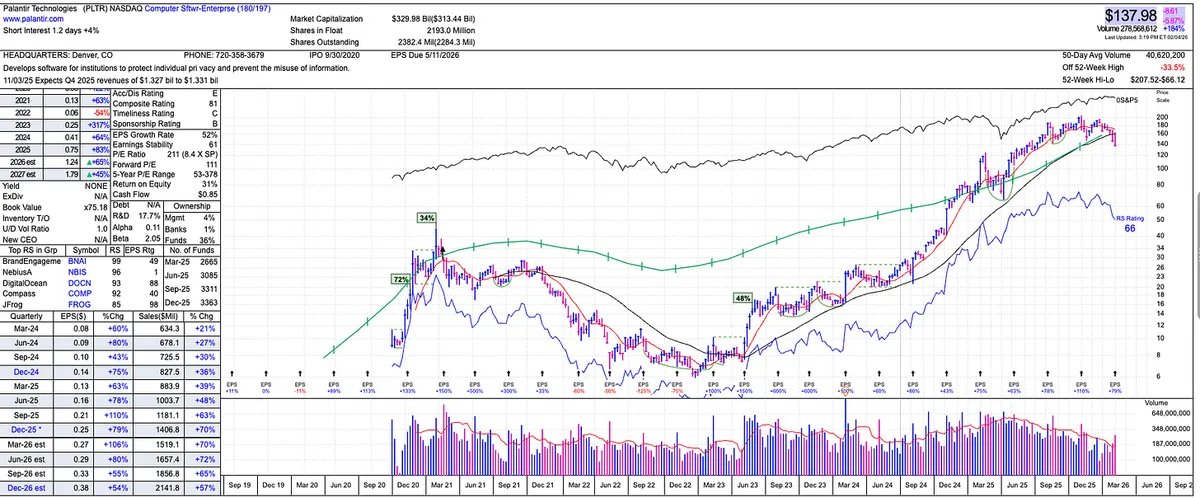
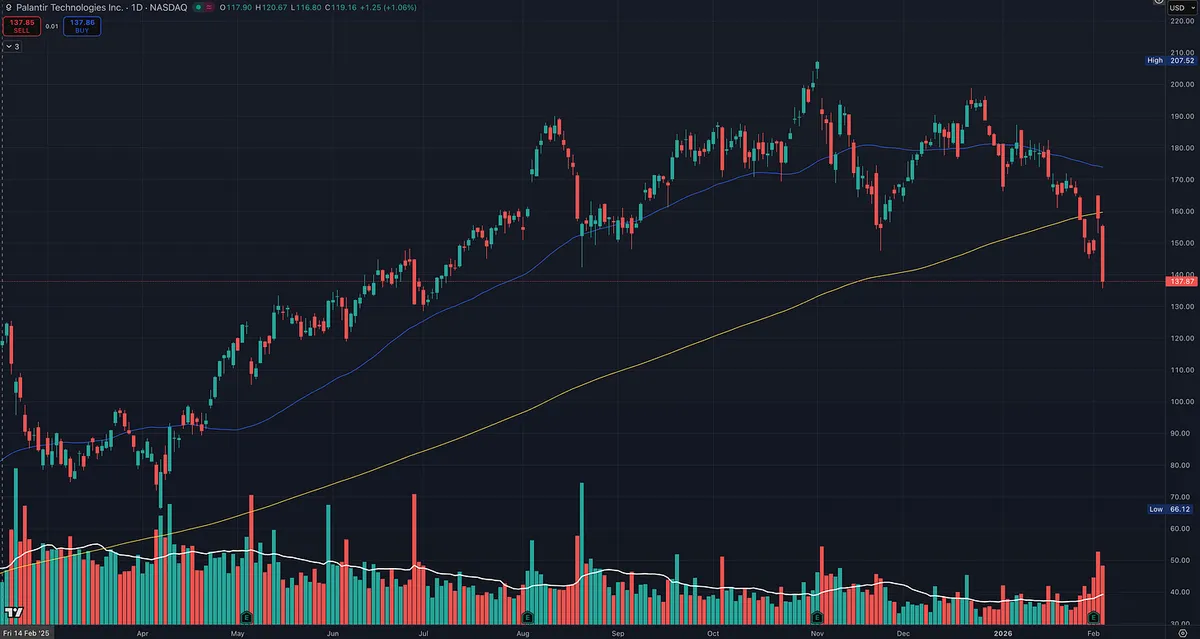
PLTR Is a Great Company. Right Now It Is Not a Great Stock.

Palantir Technologies was an amazing stock to be in. The trend was strong, relative strength was working, and price rewarded staying with it.

But for now, price has confirmed it is not a stock to be in.

This is a great real-time example of why fundamentals alone do not matter if price and trend are not aligned.

Despite strong long-term fundamentals, the stock is:

  • Below the 200 day moving average

  • Printing lower highs and lower lows

That is no longer a stage 2 uptrend. That is a downtrend.

When price breaks below the 200 day and cannot reclaim it, that is the market voting. It is telling you that demand has dried up, regardless of how good the story looks on paper.

This is exactly why I will never buy a stock just because the fundamentals look great while price looks bad.

Great fundamentals do not stop drawdowns. Great fundamentals do not override trends. Price always leads.

PLTR may absolutely be a great stock again in the future. In fact, when a name with strong fundamentals starts to repair and regain trend, it often becomes even more powerful on the next run.

But until price confirms that change, there is no point in being involved.

View on Substack ↗

It Pays to Stay With Winners: How I Trail Stops to Ride a Trend

Everybody wants the perfect entry. Perfect buy point. Perfect stop.

That obsession is exactly how you get shaken out of the stocks that can change your year.

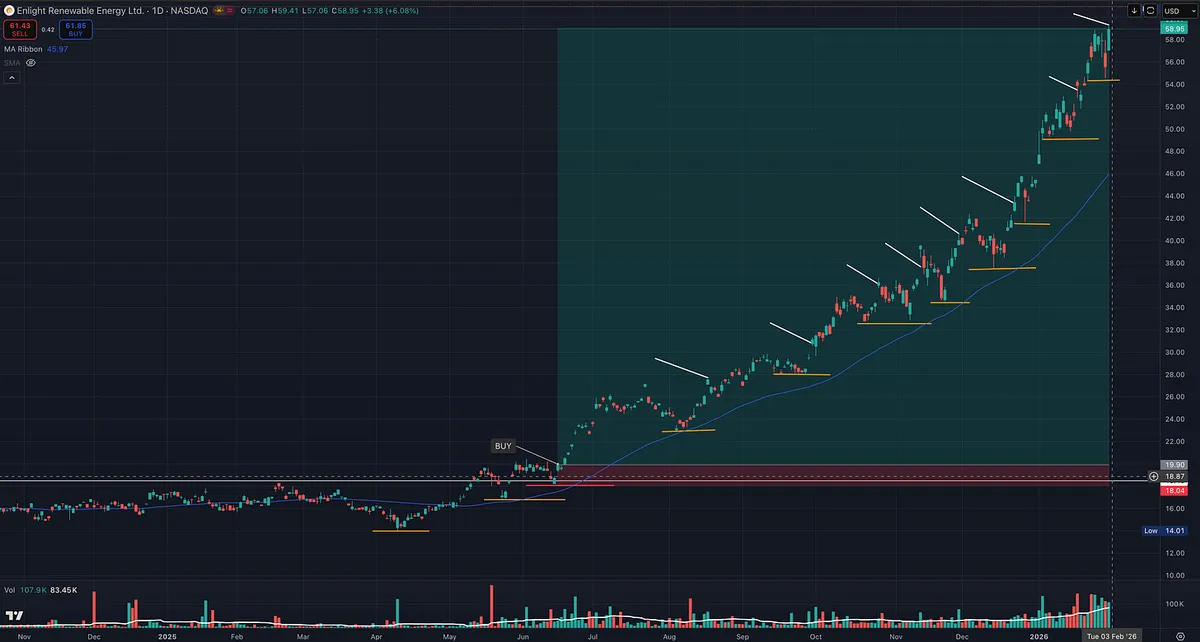
ENLT is a great example. It’s an energy name with poor earnings but huge sales, and the trend has been the story. The weekly chart is basically straight up, and price has been respecting the 10 week moving average as support.

The real edge is not “where did you buy.” The edge is how you manage the trade once you’re right.

The simple trailing stop method I use on the daily chart

Yes, you can trail a moving average. That works.

But when a stock is acting like a leader, I like something even more straightforward:

  1. When price makes a new high (white lines on the chart)

  2. I move my stop up to the prior higher low (orange line on the chart)

That’s it.

It keeps you in the trend longer because you’re letting price action tell you where the trade is wrong, instead of letting noise knock you out.

Why this matters more than your entry

You could have gotten into ENLT earlier. You could have gotten in later. It doesn’t really matter.

What matters is that you had a plan to stay with it as long as it kept printing higher highs and higher lows.

Big winners are rare. When you catch one, you don’t want to donate it back because you were micromanaging the stop or panicking on normal pullbacks.

The dirty secret of monster returns

A recent U.S. Investing Championship winner put up roughly 1,000% in a year while only being right around 22% of the time.

Read that again.

They didn’t win by being right a lot. They won because they cut losses fast and let winners run.

That’s the whole game.

Big winners allow you to lose a lot and still make money. But only if you manage them like winners.

View on Substack ↗

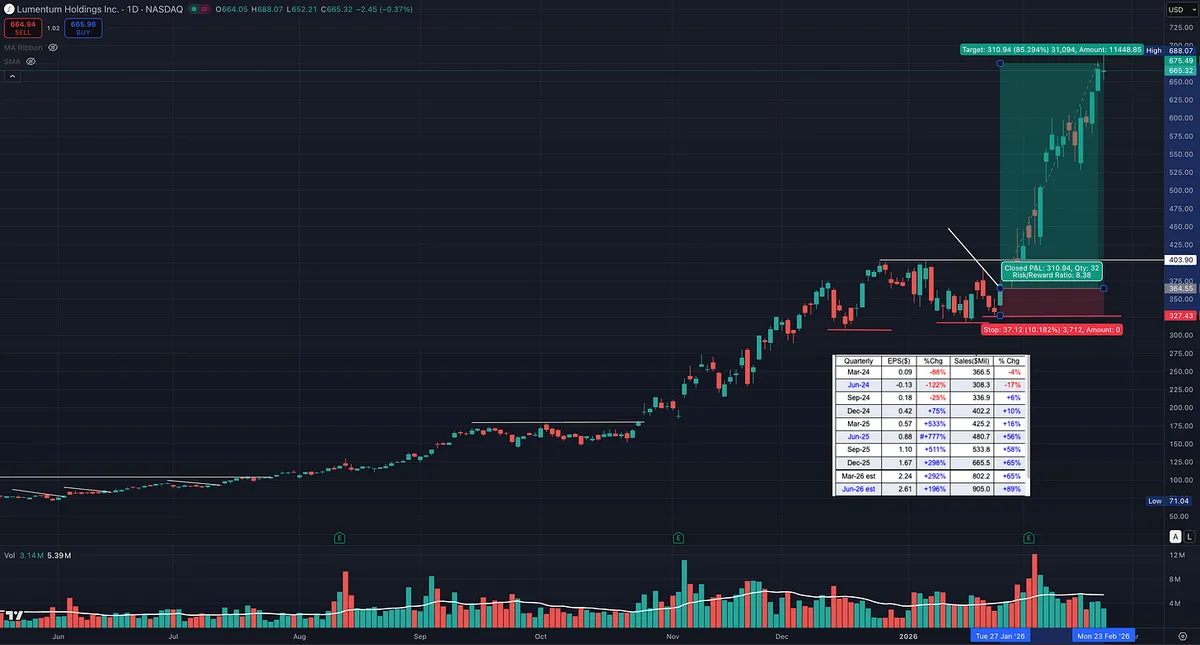
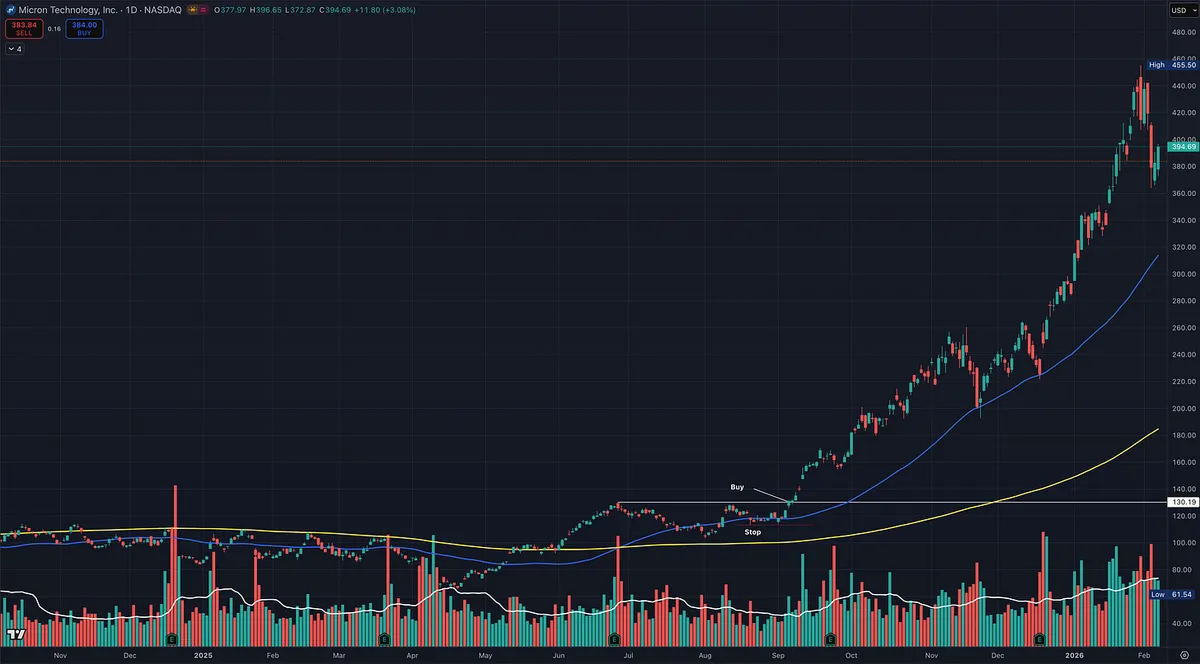
KLAC is a chart every trader should study.

Strong trend. 50 day acting as support. Higher lows. Tightening price. Low volume during consolidation.

This is what real leadership looks like.

But the most important lesson here isn’t the breakout itself. It’s how risk was structured and financed once the trade started working.

Selling some into strength, reducing risk, and letting the market pay for future risk is what separates professionals from everyone else.

I broke this down in detail here, including how traders like Soros and Minervini think about financing risk at the trade level:

https://tradingmomentum.substack.com/p/how-professionals-finance-risk-and

Save the chart. Study it. The framework matters more than the ticker.

ArticleHow Professionals Finance Risk and Why Most Traders Never Do
View on Substack ↗

Most Traders Manage Risk. Professionals Finance It.

Most traders think risk management is about being careful.

Professionals think about who is paying for the risk.

If you’re still risking your original principal on every trade, you’re playing a different game than the best traders in the world.

This is how traders like Soros and Minervini think about financing risk in real markets, using structure, partial profits, and positioning so the market pays for future risk.

Full breakdown with charts and examples here:

https://tradingmomentum.substack.com/p/how-professionals-finance-risk-and

ArticleHow Professionals Finance Risk and Why Most Traders Never Do
View on Substack ↗

Why Great Traders Can Imagine the Impossible and Why Most People Can’t Hold Winners

Bruce Kovner once said:

“First, I have the ability to imagine configurations of the world different from today and really believe it can happen. I can imagine that soybean prices can double or that the dollar can fall to 100 yen. Second, I stay rational and disciplined under pressure.”

That quote explains more about real trading skill than most indicators ever will.

The edge is not prediction. The edge is imagination plus discipline.

Great traders can mentally allow prices to do things that feel uncomfortable, unlikely, or extreme. They can imagine a stock going far higher than today’s price even when it already feels expensive. They can also imagine it going far lower and accept that reality without denial.

This matters because markets move further than logic suggests and longer than emotions can tolerate.

Most traders cut big winners early because they simply cannot imagine how much higher a stock can go. The move feels abnormal. It feels greedy. It feels unsafe. So they sell.

At the same time, those same traders hold losers too long because they cannot imagine how much further down price can fall.

That is the trap.

Being able to imagine extreme outcomes is not about forecasting. It is about trade management. It allows you to sit in winners and let trends work, while cutting losses quickly because you respect how violent downside can be.

We have seen this repeatedly in recent years. Metals and mining runs. AI and semiconductor leaders. Entire groups that looked stretched, over owned, and “done” before they even reached the halfway point of their move.

The people who made real money were not smarter. They were not better predictors. They were better at mentally accepting that price could do something bigger than their comfort zone.

If you struggle to hold winners, this is usually why.

Train yourself to think in ranges that feel uncomfortable. Allow for upside that sounds unreasonable. Respect downside that feels unlikely.

View on Substack ↗

Power Law Dynamics Explain Why A Few Trades Matter More Than All the Others

Most traders misunderstand their results because they assume trading returns behave like averages.

They do not.

Trading returns follow power law dynamics. A small number of large winning trades account for the majority of long-term profits, while most trades produce small gains, small losses, or break-even outcomes.

This is why averages are misleading. The mean return is not representative of how money is actually made. One or two exceptional trades can outweigh dozens of ordinary ones and completely skew the statistics.

Those big winners are not a bonus. They are a requirement.

In power law systems, success is driven by extremes, not consistency around the average. Markets behave this way because price movement is driven by feedback, momentum, and participation. When conditions align, trends extend far beyond what feels reasonable, and those rare extensions dominate returns.

This is also why many traders struggle even with solid systems. They cut winners early, reduce size as trades work, or stop trading before the outliers appear. By doing so, they remove the very outcomes their edge depends on.

Markets are also fractal in structure. The same price behavior appears across all timeframes. Trends, consolidations, breakouts, and failures repeat whether you are looking at a five-minute chart or a multi-year chart. The structure stays the same. Only the scale changes.

Power law returns explain why a few trades matter most. Fractal structure explains why the same setups keep appearing.

Put together, the lesson is simple.

Most trades are noise. A few trades drive nearly all meaningful results. Your job is not to optimize for the average trade. Your job is to manage risk well enough to survive the noise and stay positioned for the rare but decisive move.

The goal is not to be right often.

The goal is to still be in the trade when the big winner shows up.

View on Substack ↗

“The real money made in speculating has been: ‘IN COMMITMENTS IN A STOCK OR COMMODITY SHOWING A PROFIT RIGHT FROM THE START.’” — Jesse Livermore

This one sentence reveals a trading behavior most professionals have known for decades and most retail traders still miss.

I break down why this matters, and how the biggest stock winners in history behave exactly this way.

If your trade needs time to work, it’s already telling you something.

👉 https://tradingmomentum.substack.com/p/the-best-trades-put-you-in-the-money

ArticleThe Best Trades Put You in the Money Immediately and Never Look Back
View on Substack ↗

The best trades work from the start.

They put you in the money immediately and never look back.

I break down why the biggest stock winners over the last 100 years behave this way, and how Jesse Livermore figured it out long ago.

If your trade needs time to work, it is already telling you something.

The full article is live:

https://tradingmomentum.substack.com/p/the-best-trades-put-you-in-the-money

ArticleThe Best Trades Put You in the Money Immediately and Never Look Back
View on Substack ↗

Why Price Targets Quietly Sabotage Traders

If you have ever sold too early because you “hit your target,” If you have ever watched price keep going without you, If you have ever been right on direction but wrong on outcome, this is for you.

“I’m also a firm believer in predicting price direction, but not magnitude. I don’t set price targets. I get out when the market action tells me it’s time to get out, rather than based on any consideration of how far the price has gone.” — Linda Bradford Raschke

Direction is a thesis. Magnitude is unknowable.

Most traders try to predict both. That is where problems begin.

Price targets feel responsible. They feel disciplined. They feel like control.

But markets do not move in neat, predictable distances.

They move until they don’t.

When you anchor to a target, you stop listening to price. You exit because a number was reached, not because the market changed.

That is how traders cut winners short.

The best traders do not ask, “How far can this go?” They ask, “Is the behavior still intact?”

As long as structure holds, they stay. When behavior changes, they leave.

No guessing. No attachment. No arbitrary exits.

This is not about being reckless. Risk is still defined. Stops still exist.

The difference is how profits are handled.

Targets assume you know the future. Market action tells you what is happening now.

Professionals choose now.

Manage risk. Let the market decide magnitude.

That is how big winners happen.