Momentum Trading Strategy

Notes

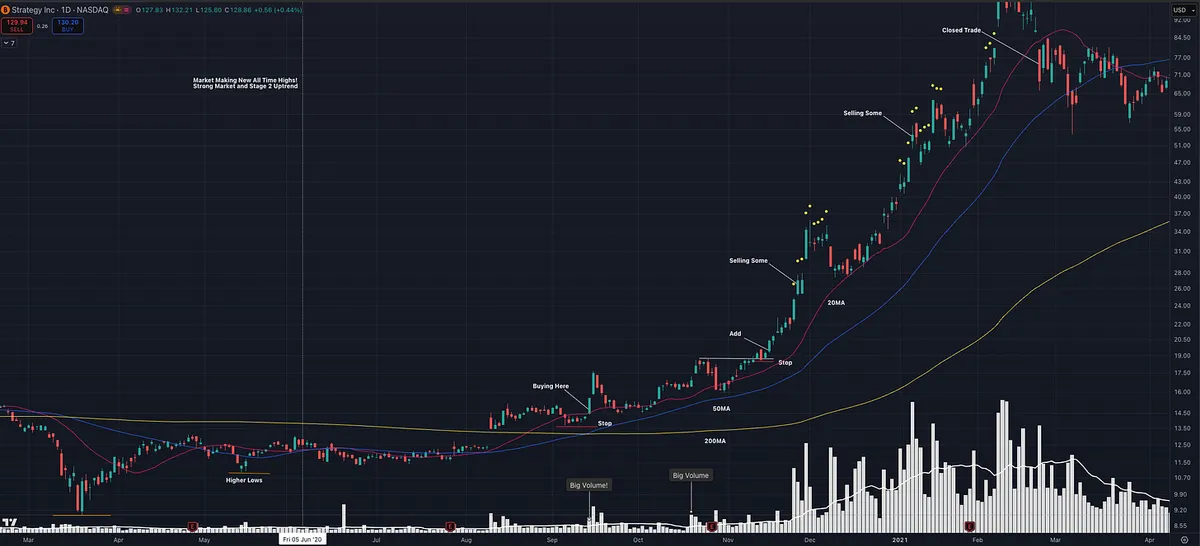
Selling & Holding Winners

Managing a trade after it starts working: when to take profits, how to stay in big winners, and when to exit.

Showing 41–60 of 95 notes

View on Substack ↗

Bubble Talk Gets Clicks. Sell Rules Make Money.

Talking about bubbles is great for engagement on social media.

But it does very little to help your actual trading.

Honestly, it doesn’t matter if we’re in a bubble.

And if we are?

Great.

Some of the biggest opportunities in market history came during periods people later called bubbles.

The 1920s.

The late 1990s.

These were incredible environments for traders who actually knew what they were doing.

The problem is not the bubble.

The problem is not knowing how to sell.

If we are in a bubble, momentum traders and growth stock invetors can make a lot of money.

And when the bubble eventually pops, it should not destroy you if you have rules.

That’s the part most people miss.

A bubble is only catastrophic if you’re holding with no exit plan, no risk management, and no sell rules (which is most people).

If every bubble headline makes you scared, that’s probably a sign you haven’t learned enough yet to be trading size in the market.

Because professional trading is not about predicting the exact top.

It’s about participating while the trend is working, managing risk the entire way, and getting out when the evidence changes.

That’s exactly what we teach inside the Momentum Trading Strategy Course.

A real process for buying strength, managing risk, selling into strength, and knowing when to get out.

View on Substack ↗

What Soros Taught Druckenmiller About Big Winners, and Why CIEN Is the Point

One of the biggest misconceptions in trading is that you need to be right all the time.

You do not.

What you need is the ability to keep losses small when you are wrong and press your advantage when you are right.

That is one of the biggest lessons Stanley Druckenmiller described learning from George Soros in Jack Schwager’s The New Market Wizards.

Druckenmiller said Soros taught him that when conviction is high, “you have to go for the jugular.”

He also called Soros “the best loss taker I’ve ever seen.”

That combination is powerful:

Be aggressive when you are right.

Walk away quickly when you are wrong.

I have made plenty of wrong calls on individual stocks. I am wrong often.

But the goal is not to be right on every name.

The goal is to structure your trading so the small losses stay small, and the winners have enough room to pay for the losers and then some.

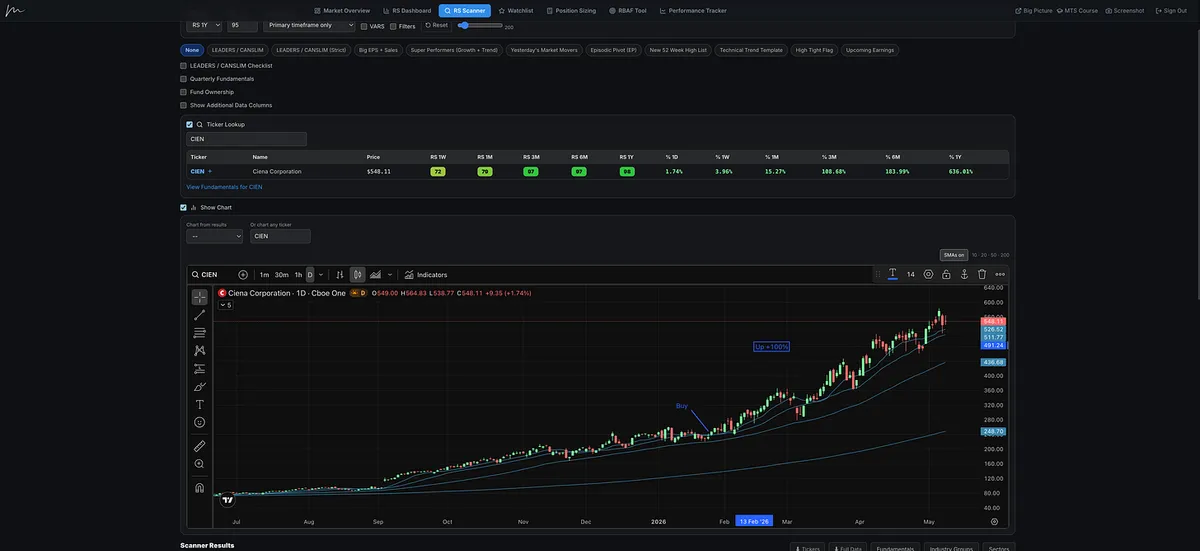
That is why a winner like CIEN, along with names like LITE and SNDK, matters so much in my trading strategy.

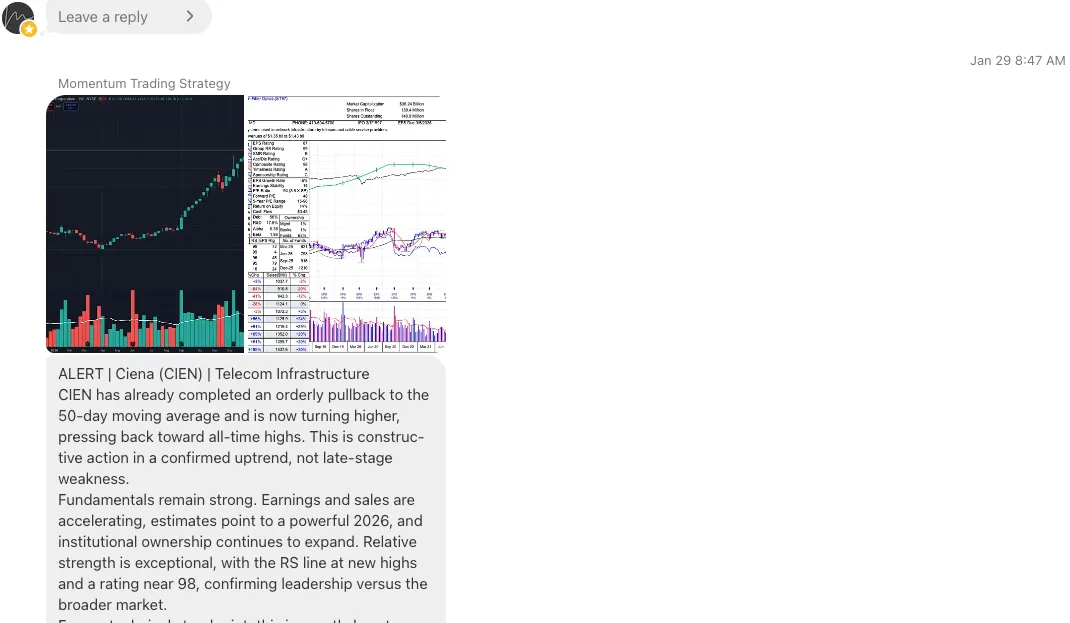
I mentioned CIEN earlier because it had the kind of relative strength, leadership, and constructive price action I look for.

Since then, it has continued to show why holding real leaders matters.

One real leader can make up for a lot of small losses.

But only if you do two things:

  • Cut the trades that are not working.

  • Hold the trades that are.

That is the hard part.

Most traders do the opposite.

They give losing trades too much room and cut winning trades too quickly.

The best traders understand the math is not about being right all the time.

It is about making sure that when you are right, it actually matters.

View on Substack ↗

The Buy Is Only the Beginning

Knowing when to sell is just as important.

Most traders spend all their time asking:

“What should I buy?”

But the better question is:

“What do I do after I buy it?”

Finding a strong stock is only the beginning.

The real money is made, or lost, in the management.

  • Do you cut the loss when the trade is wrong?

  • Do you protect break-even once the trade has worked?

  • Do you sell some into strength?

  • Do you trail the rest?

  • Do you use moving averages, ATR trailing stops, Donchian channels, or higher lows?

That is what my new article is about:

When Should You Sell a Winning Stock? The Trade Management Playbook

A trade management playbook for protecting profits without cutting your biggest winners short.

Read it here:

https://tradingmomentum.substack.com/p/when-should-you-sell-a-winning-stock

ArticleWhen Should You Sell a Winning Stock? The Trade Management Playbook
View on Substack ↗

The Market Doesn’t Care Where You Got In

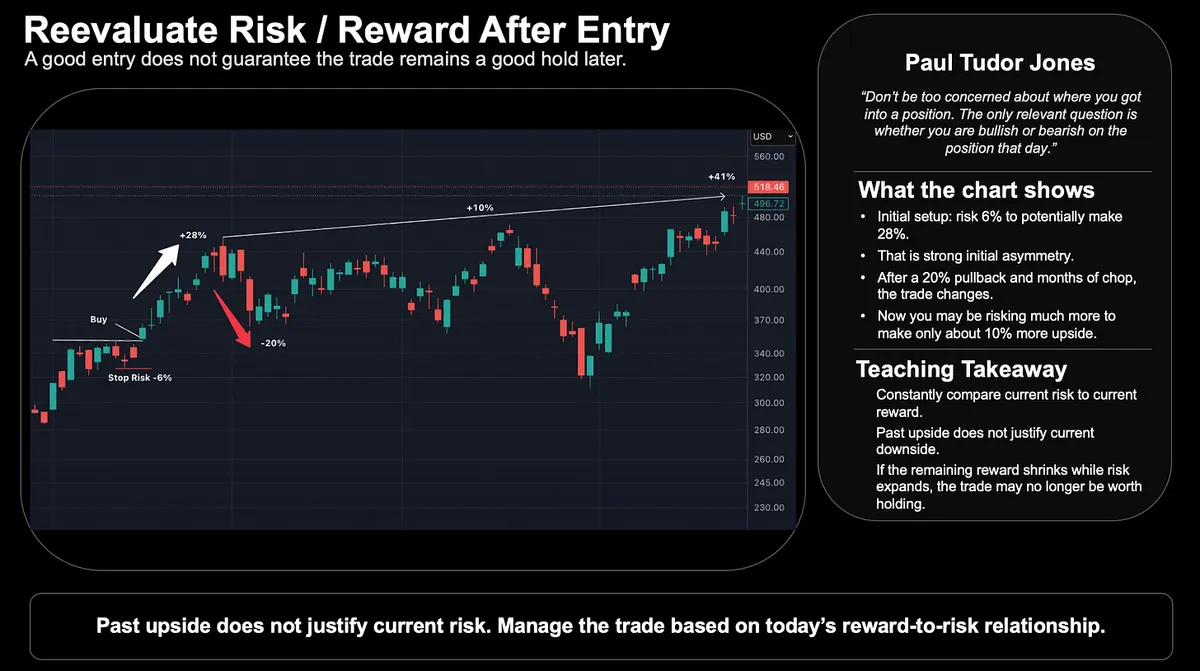
Paul Tudor Jones said:

“Don’t be too concerned about where you got into a position. The only relevant question is whether you are bullish or bearish on the position that day.”

This is one of the most important trade management lessons most rookie traders miss.

They judge the trade only from their original entry.

But risk-reward changes as the trade develops.

In this example, the initial setup was strong:

Risk: -6%

Potential reward: +28%

That is a good asymmetric opportunity.

But after the stock runs, pulls back 20%, chops sideways for months, and only offers around 10% more upside from that point, the trade has changed.

The initial trade may have been good.

The later hold may not be.

That does not mean holding is always wrong.

It means every hold needs to be judged by the current risk-reward, not the original entry.

Past upside does not justify current risk.

Your entry price is history.

The better question is:

Would I still buy this stock here today?

If not, why am I still holding the full position?

View on Substack ↗

How to Stay in Big Winners Without Guessing the Top

David Ryan shared something simple, but incredibly powerful.

His research on past market leaders showed a consistent pattern.

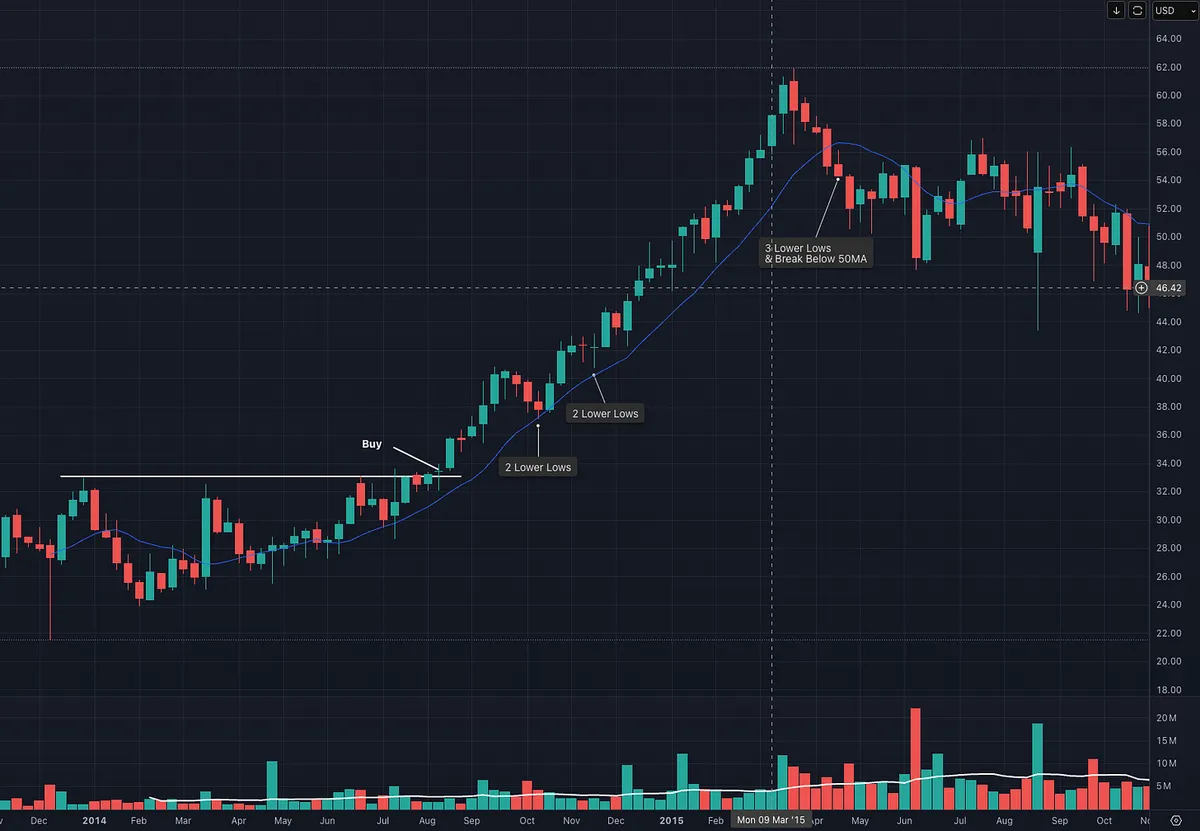
The best winning stocks rarely have three weeks of lower lows in a row.

They might pull back. They might have one or two weak weeks.

But three in a row?

That is where things start to change.

He used this insight to build a rule.

A combination of structure and trend.

First, a 50-day trailing stop (explained here… https://substack.com/@tradingmomentum/note/c-248429380?r=5ccg85&utm_source=notes-share-action&utm_medium=web)

This keeps you aligned with the primary trend.

It gives the stock room to move. It prevents you from getting shaken out too early.

Then he added a second condition.

If the stock puts in three consecutive weeks of lower lows, he exits the trade.

But this is the key nuance.

It is not just any three lower lows.

They are looking for a meaningful change in character.

That usually includes:

  • A break below the 50-day (or 10-week) moving average

  • A more significant percentage decline, not just minor pullbacks

  • Expansion in volume on the downside

When those conditions line up, that is the signal.

Not noise. Not normal consolidation.

A real shift in behavior.

This is what makes it powerful.

It allows you to stay through normal pullbacks.

But it gets you out when weakness becomes persistent and meaningful.

Most traders sell too early.

They exit on the first pullback. They cut their winners before the real move happens.

This is one way to help solve that.

You sit through one week. You sit through two.

But when that third week shows up with real pressure, you act.

It is not about predicting the top.

It is about recognizing when a strong trend is no longer acting like one.

That is how you stay in big winners long enough to matter.

And still protect yourself when the trend finally breaks.

View on Substack ↗

How to Hold Winners Longer Without Guessing the Top

In the Master Trader Program, Mark Minervini talked with David Ryan about something every trader struggles with.

How do you hold on to a great stock… longer?

Not just take a quick gain. But stay in it when it has the potential to make a much bigger move.

He introduced what he calls the 50-day breakeven or better rule.

It is simple.

And it is powerful.

This is not how you enter the trade.

You still take your entry the same way. You still define your risk the same way. You still place your initial stop based on the chart.

Nothing changes there.

The shift happens after you are in a winning position.

As the stock moves higher, the 50-day moving average starts to rise.

At some point, that 50-day will catch up to your breakeven.

That is the key moment.

Once the 50-day reaches breakeven or better, it can become your trailing stop.

From there, you let the stock work.

You are no longer guessing where to sell. You are letting the trend decide.

Minervini even said he does not rely heavily on moving averages.

But in the early stages of a bull market, this is where it becomes extremely useful.

Because the best stocks can go a long distance before they ever break the 50-day.

That is the whole idea.

Give strong trends room to develop.

Without giving back your gains.

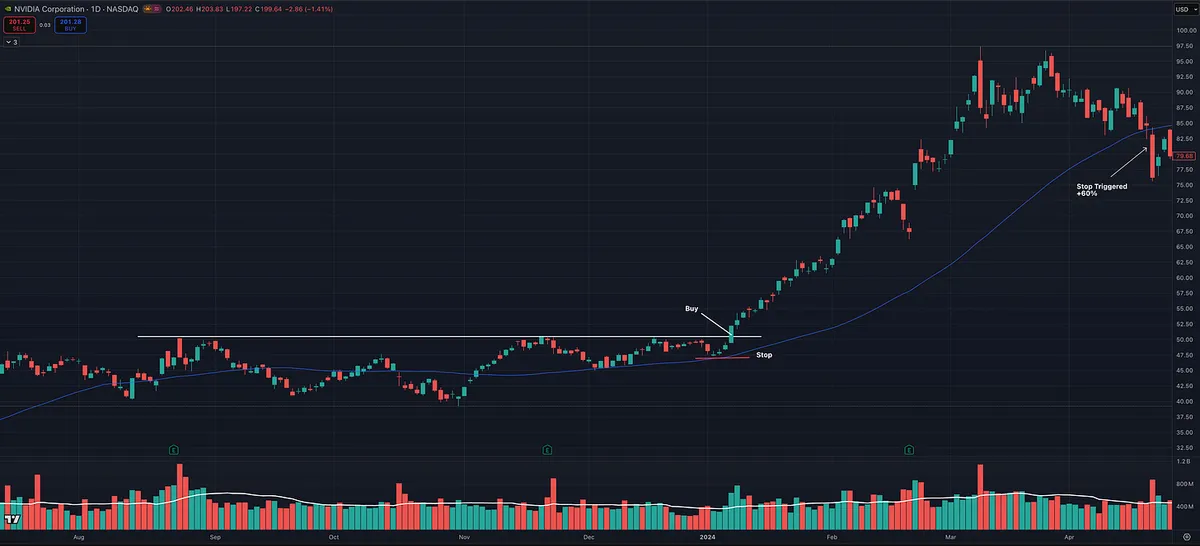
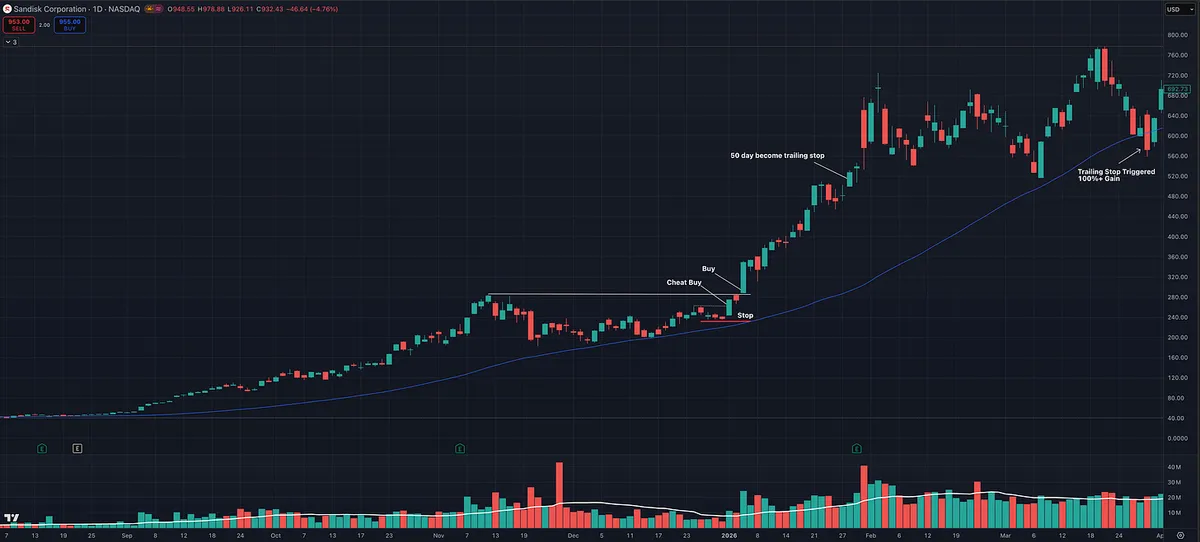
Now look at these examples.

One from NVIDIA in 2024. One from SanDisk in 2025–2026.

Both show the same thing.

A proper entry. A defined stop. Then the 50-day catching up… and taking over as the trailing stop.

That is how you stay in a winner long enough to matter.

Most traders sell too early.

Not because the stock is done.

But because they do not have a process to stay in it.

This solves that.

It is not about predicting the top.

It is about staying with the trend as long as it remains intact.

If you want to go deeper, I cover this and several other ways to manage trades using a few key indicators in Module 5 of my course, available to all paid subscribers.

View on Substack ↗

This Is How Fast It Can All Disappear

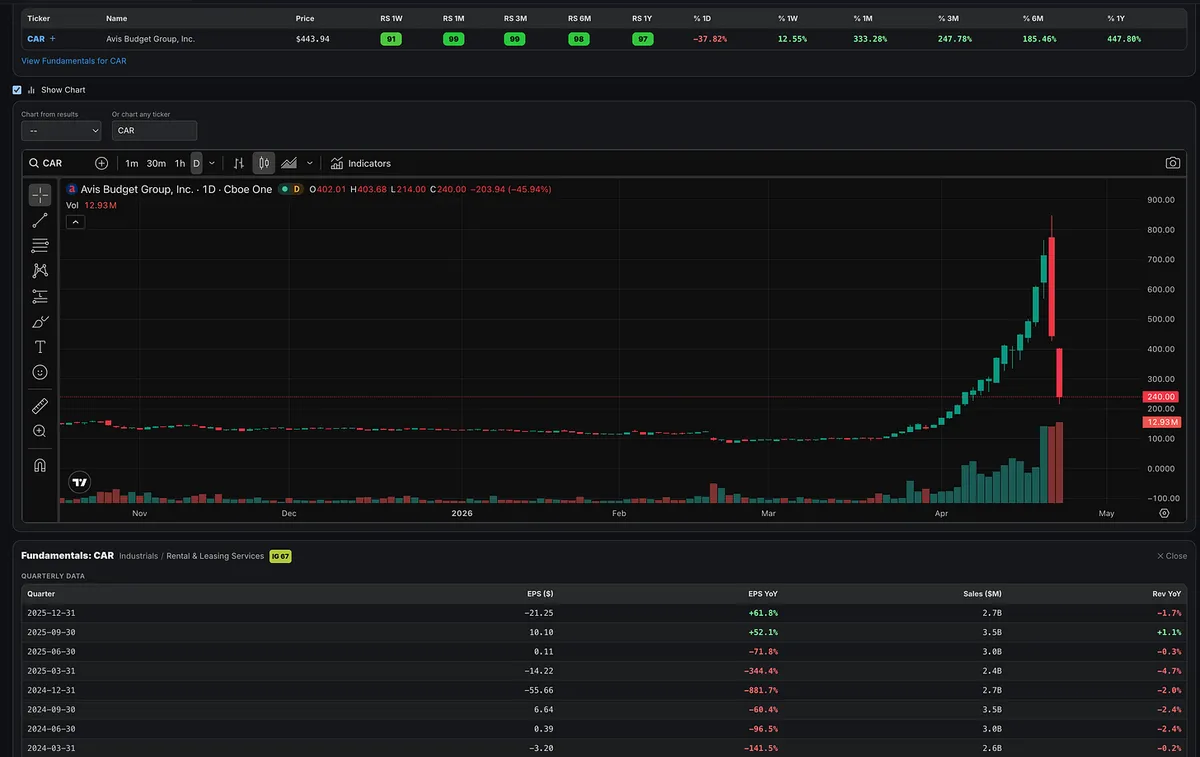
A few days ago I wrote this about CAR:

"But the same mechanics that launch a squeeze can unwind just as fast. What feels like a once in a lifetime move on the way up can turn into a sharp lesson in downside volatility."

Since then, it dropped nearly 70%.

This is the market doing what it always does. Teaching the same lesson over and over, just in different ways.

You are never going to sell the exact top. That is not the goal. The goal is to participate in the move and get out when weakness shows up.

These are some of the best lessons you can study.

I did not trade CAR. It did not fit my core criteria. I spend most of my time focused on stocks with real drivers behind them. Big earnings. Big sales growth. Something new. New product, new service, new demand, or a real shift in the industry.

CAR did not have that.

What it did have was extreme relative strength. That is enough for a short term move. That is not enough to sustain one.

And that is where most people get trapped.

They see the move. They feel the urgency. They chase it with no plan.

But the entire edge in trades like this is not the entry. It is the exit.

This stock was massively extended from the 50 day. It went parabolic.

For 15 straight days, CAR did not break the prior day’s low.

That is your guide.

Even if you chased it halfway up, even if you felt the FOMO, if you simply used a rule like “sell on a break of the prior day’s low,” you would have exited clean.

If you used an Opening Range Breakout entry on April 13th, you risked around 5% and had the potential to make 80% into that first real break of weakness.

No guessing. No hoping.

Just reacting to price.

And here is the part most people miss.

Even entering late, with a stop below the prior day’s low, you could still make multiples of your risk. Easily 4x or better.

That is the power of having a plan.

If you are going to play high volatility names, you have to respect what they are.

Fast up. Faster down. The stairs up, the window down.

Most people do not lose money because they picked the wrong stock.

They lose money because they had no exit plan and held onto losers.

Cut losers fast. Let winners run.

That is the difference between a great trade and a painful lesson.

View on Substack ↗

Everything Changes When You’re Playing With Profits

You don’t really get momentum in trading until you have profits to work with.

Because there’s a big difference between risking your capital…

And risking your profits.

This is nothing new. George Soros talked about this in a 1995 interview:

“You can't really get the dynamic going until you have a little profit under your belt because it's very different when you're risking your principal than when you're risking your profit.”

But once you build a cushion…

Everything changes.

You can think clearer. You can let trades work. You can scale properly.

That’s when real runs happen.

The key is protecting your capital early.

When things aren’t working, you reduce risk. You step back. You retrench.

You don’t press.

Because the goal isn’t just to make money.

It’s to get to a position where you’re trading with profits instead of your principal.

And this ties directly into a concept Mark Minervini talks about called financing your risk.

On the individual trade level, when a position moves in your favor and you take partial profits, you’re not just locking in gains.

You’re reducing risk.

In many cases, you’re now financing the rest of the trade with your profits.

You’re no longer risking your original capital. You’ve created a cushion and you can let the remaining position work with far less pressure.

This is one of the main reasons top traders sell into strength.

Not to exit…

But to put themselves in a position where they can stay in the trade longer.

The same principle applies at the portfolio level.

When your trades are working and the market is healthy, you gradually increase exposure.

When your trades start struggling and the market weakens, you reduce exposure.

So you’re managing risk in two ways:

At the individual trade level by financing risk and at the portfolio level through progressive exposure

Same idea.

Protect capital when things aren’t working. Press when they are.

That’s how you stay in the game long enough to catch the big moves.

To learn how to apply this in real time, Module 5 breaks down exactly how to finance risk, including entries, initial stop placement, and how to manage the trade as it develops.

https://tradingmomentum.substack.com/p/momentum-trading-strategy-the-100-026

On SubstackMomentum Trading Strategy: The 100-Year Playbook Behind the Biggest Winning Stocks — Module 5
View on Substack ↗

Don’t Ride It Back Down

Most traders make money on a stock… and still walk away with nothing.

Why?

Because they’re waiting for the top.

From How to Make Money in Stocks:

“Only a fool holds out for the top dollar.”

That’s Joe Kennedy.

Let that hit.

“The object is to get out while a stock is up before it has a chance to break and turn down.”

And Gerald Loeb said:

“Once the price has risen into estimated normal or overvaluation areas, the amount held should be reduced steadily as quotations advance.”

Read that again.

They weren’t trying to be perfect. They were selling into strength.

Not at the top. On the way up.

O’Neil summed it up best:

“The secret is to hop off the elevator on one of the floors on the way up and not ride it back down again.”

That’s the game.

You don’t get paid at the top. You get paid before the top.

Most traders won’t do this.

They’ll hold. Hope. And watch profits disappear.

The best traders?

They take money when the market offers it.

View on Substack ↗

The 4 Rules That Quietly Protect the Best Traders in the World

Everyone wants to talk about how to make big money in stocks.

Almost nobody talks about how the best traders protect their profits.

Mark Minervini explains that the real difference between average traders and superperformers is how they control drawdowns.

One bad year can erase years of progress.

Example:

$100 → +50% = $150 $150 → +50% = $225 $225 → −50% = $112

Three years of work… almost gone.

That’s why great traders focus just as much on defense as offense.

Here are four rules Minervini uses to limit drawdowns.

1. Sell Into Strength

Amateurs get greedy when a stock runs.

Professionals sell when buyers are eager.

Waiting too long often means watching a 30% gain turn into nothing.

Selling into strength keeps your equity curve stair-stepping higher.

2. Trade Small Before You Trade Big

When things are working, increase size.

When things aren’t, scale down immediately.

Most traders do the opposite.

They revenge trade and double down after losses.

Professionals let profits finance larger trades.

3. Always Trade With the Trend

Never fight the market.

Minervini puts it simply:

He never buys falling stocks.

He waits for stocks to turn and move in his direction.

Trading with the trend dramatically increases the probability of success.

4. Protect Breakeven Once You Have a Gain

Once a trade works, protect your capital.

Move your stop up.

Remove the possibility of turning a good trade into a loss.

The goal is simple.

Keep losses small. Protect gains. Let winners do the heavy lifting.

Superperformance isn’t just about finding big winners.

It’s about making sure one mistake never destroys months of progress.

View on Substack ↗

Stop Letting Big Winners Turn Into Small Winners

Minervini’s “Breakeven or Better” Rule

One of the biggest mistakes traders make is this.

They finally catch a big winner…

Then they watch half the profit disappear because they never adjusted their stop.

Mark Minervini teaches a simple rule to prevent this.

Breakeven or Better.

Here’s how it works.

Let’s say you buy a stock at $50 coming out of a base.

You set your initial stop 8% lower at $46 to control risk.

Now the trade begins to work.

The stock moves 8%… then 16%… then 24% higher.

While price is rising, something important is happening behind the scenes.

The 50-day moving average is rising too.

Eventually the 50-day line catches up to your breakeven price of $50.

At that moment the trade changes.

Your stop is no longer the original stop.

Your stop now becomes the 50-day moving average.

From that point forward the rule becomes simple.

Breakeven or Better.

Many traders will wait for a close below the 50-day before exiting.

Some even watch how the stock closes by the end of the week to avoid getting shaken out.

The key idea is this.

The 50-day moving average becomes your trailing stop.

It rises with the trend and protects your profits while still giving the stock room to move.

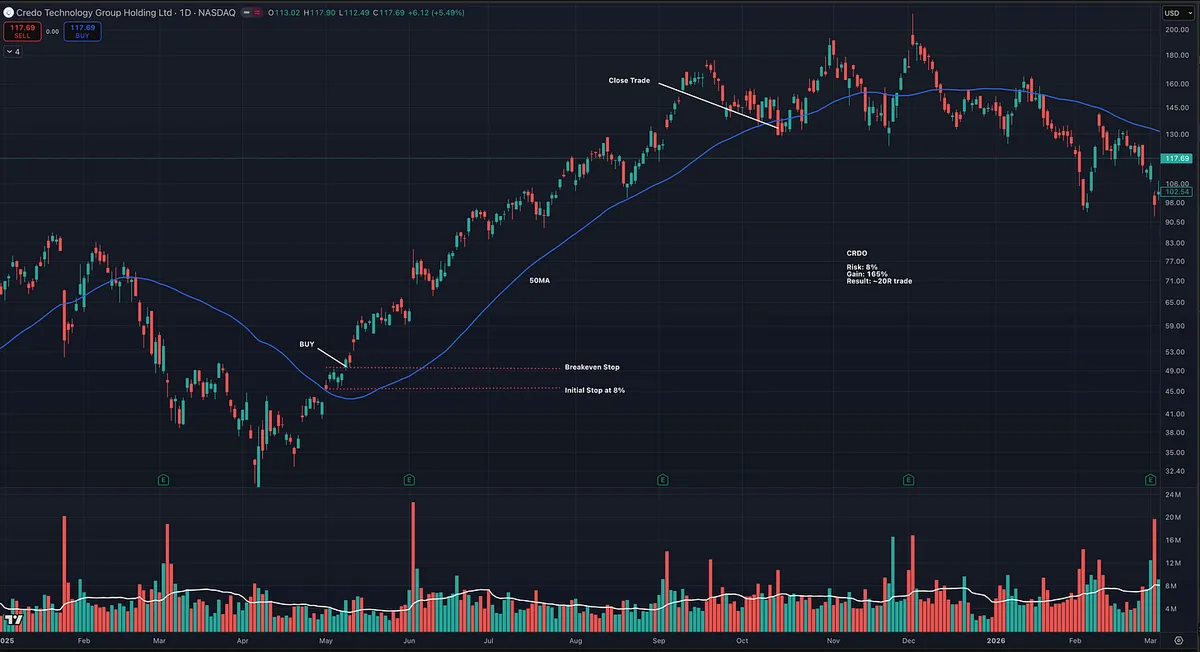
The chart below shows an example using CRDO.

Initial risk: 8% Total gain captured: 165%

That’s roughly a 20R trade.

This is how traders stay in large multi-month winners without giving everything back.

The goal is not to sell the exact top.

The goal is simple.

Never let a good gain turn into a loss.

View on Substack ↗

The Back StopHow to Protect Profits Without Killing a Big Winner

Most traders understand the first stop.

You enter a trade and define your risk.

Example.

You buy a stock at $100 and place a 5% stop at $95.

That protects you if the trade fails.

But what happens when the trade works?

Let’s say the stock suddenly gaps higher to $130.

Now you are sitting on a 30% gain.

At this point many traders make one of two mistakes.

They either sell too early.

Or they tighten their stop too much and get shaken out of a strong trend.

This is where the Back Stop comes in.

A back stop is a profit protection stop.

Instead of trailing the price tick by tick, you decide how much profit you are willing to give back.

You draw a line in the sand.

For example.

If the stock gaps from $100 to $130, you might place a back stop around $120.

Now several things are true.

You have locked in a 20% gain.

The stock still has room to fluctuate.

And if momentum continues, you stay in the move.

Of course, the stop location should also make sense technically.

In real trading you would usually place that stop under a key level, such as a higher low, support area, or important moving average.

So the exact price may not always match the example percentages.

The key idea is protecting a meaningful portion of the gain while still allowing the stock room to trend.

The key difference is this.

A trailing stop follows the price closely.

A back stop protects a meaningful profit level.

As the stock continues higher, you can move that line up.

Maybe the stock runs to $150.

Now you raise your back stop to $135 or $140.

Each adjustment protects more profit while still giving the stock room to trend.

This is one of the tools experienced traders use to stay in big winning stocks longer.

The goal is simple.

Protect the gains.

But do not suffocate the trade.

View on Substack ↗

The Free Roll StrategyHow Smart Traders Remove Risk While Keeping the Upside

One of the best feelings in trading is when a position becomes a free roll.

That’s the moment when the trade can still go much higher, but your downside risk is essentially gone.

Here’s how it works.

You enter a trade and set a stop.

Example.

You buy a stock with a 6% stop.

The trade works and the stock quickly moves 20% higher.

Now you have options.

A common strategy used by experienced traders is simple.

Sell half the position.

Then move your stop on the remaining shares to breakeven.

At that moment something powerful happens.

You are now free rolling the trade.

The worst case outcome on the remaining shares is break even.

But you already locked in a profit on the first half.

The psychological pressure disappears.

You are no longer defending the trade.

You are simply letting it work.

There is another variation some traders use.

Sell half of the position and keep the original stop on the remaining shares.

Now the profit from the first half is financing the risk on the second half.

The trade has effectively paid for itself.

This is why experienced traders love the free roll.

It allows you to stay in a potential big winner without the constant fear of giving everything back.

And sometimes…

The back half becomes the trade that makes your entire month, quarter or year.

View on Substack ↗

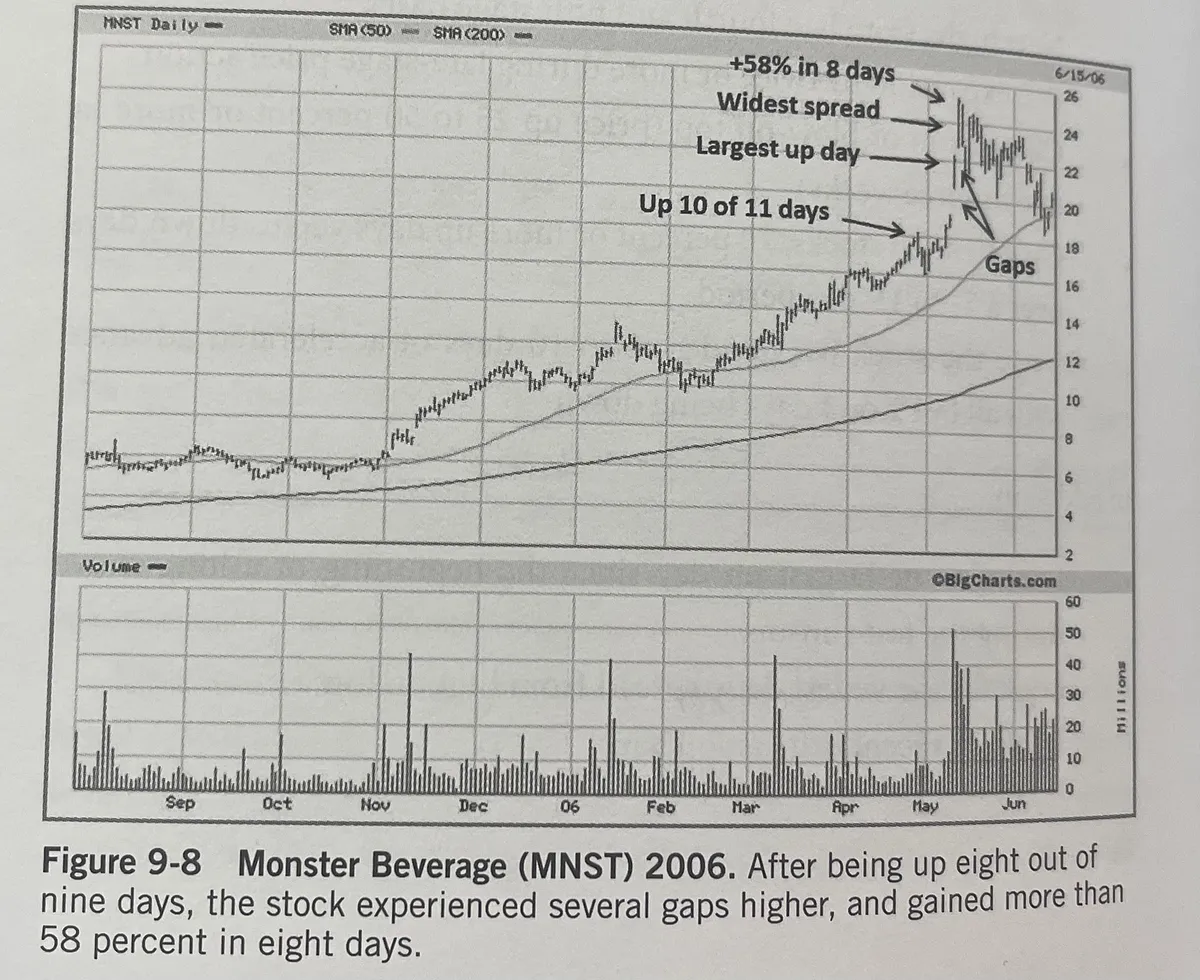
When a stock gets extended, start looking for signs of exhaustion.

Minervini talks about this when discussing selling into strength during late-stage runs.

Here’s a quick checklist I use when a stock has gone vertical:

Reversal / exhaustion signals

• 70% or more up days over a 7–15 day period

• 6–10 days of rapid advance with only 2–3 down days

• Climax move (price up 25–50% in 1–3 weeks)

• Largest up day of the entire move appears late

• Widest daily spread from high to low

• Multiple gap-ups during the run

Volume warnings

• Heaviest volume of the move on a down day

• High-volume reversal near highs

• Heavy volume but little price progress (churning)

The key idea: institutions usually distribute on the way up while everything still looks great.

By the time weakness is obvious, the move is often already over.

Example below from Minervini showing MNST running +58% in just 8 days before topping.

View on Substack ↗

The Turkey Trap Every Investor Falls Into

Right after posting about the importance of having sell rules, it reminded me of a famous story told by William O’Neil in How to Make Money in Stocks.

It perfectly captures the psychology most investors experience when it’s time to sell.

O’Neil retells a story from Fred C. Kelly about an old man trying to catch wild turkeys.

He built a simple turkey trap.

A big wooden box with a door propped open by a stick. A string ran from the stick back to the trapper sitting far away. Corn was scattered along a path leading inside the box.

The turkeys would follow the trail of corn into the trap.

Once enough birds were inside, the trapper could pull the string and the door would slam shut.

One day he had twelve turkeys inside the trap.

But then one wandered out.

“Gosh,” the trapper said, “I wish I had pulled the string when all twelve were in there. I’ll wait a minute. Maybe that one will come back.”

While he waited… two more turkeys walked out.

“I should have been satisfied with eleven,” he said. “As soon as I get one more back, I’ll pull the string.”

But more turkeys kept leaving.

Soon there were only eight.

Then five.

Then two.

Finally, there was just one turkey left.

The trapper said, “I’ll wait until he walks out or another one walks in, and then I’ll quit.”

The last turkey walked out.

The trap was empty.

He went home with nothing.

O’Neil said the psychology of investors is not much different.

When we have a good profit, we often wait for just a little more.

Then the stock pulls back.

So we wait for it to recover.

Then it pulls back more.

And before long the big winner we once had… disappears.

This is exactly why sell rules matter so much.

It’s something Mark Minervini talks about as well in Think and Trade Like a Champion. Early in his career he spent years learning how to buy great stocks, but realized later there was a huge gap in his trading plan.

He had no clear rules for how to sell a profitable position.

And that gap is where a lot of traders lose their biggest opportunities.

Because the market doesn’t reward hope.

It rewards discipline and rules.

So here’s the question.

How many of you have experienced your own version of the turkey story?

View on Substack ↗

Why Most Traders Never Cash In on Big Winners

Scroll through trading social media for five minutes and you'll notice something.

Almost every post is about what to buy next.

The next AI stock. The next biotech breakout. The next “100x opportunity.”

Charts. Price targets. Long threads explaining why a company is about to explode.

I am guilty of this too.

But there’s one problem.

Almost nobody talks about how to sell.

And that’s exactly why most traders never capitalize on their biggest winners.

Mark Minervini wrote about this in Think and Trade Like a Champion when discussing profit taking. Early in his career he spent enormous time learning how to pick stocks and when to buy them.

Fundamental analysis.

Technical analysis.

Finding the right setups.

Eventually he developed real confidence in his stock selection.

Then he discovered a huge hole in his trading plan.

He had no real plan for how to sell profitable positions.

And that realization hits many traders the same way.

At first the focus is always:

How do I find the next big winner?

But once the trade works, a completely different problem appears.

• Should you take profits?

• Should you hold?

• Should you add?

• Should you scale out?

Most traders freeze in that moment.

They either:

• Sell too early and miss the big move

or

• Hold too long and give the gains back

Meanwhile the analysts who convinced them to buy are still posting price targets that rarely play out exactly as predicted.

That’s the reality of markets.

No analyst knows exactly how far a stock will go.

Which means trading is not just about finding winners.

It’s about knowing how to manage them once you have them.

Learning when to lock in profits.

Learning when to let a true leader run.

Learning how to scale out of strength without killing your upside.

Those are the skills that turn a good trade into a career-making one.

Finding a great stock is only half the battle.

Knowing how to sell is where the real money is made.

View on Substack ↗

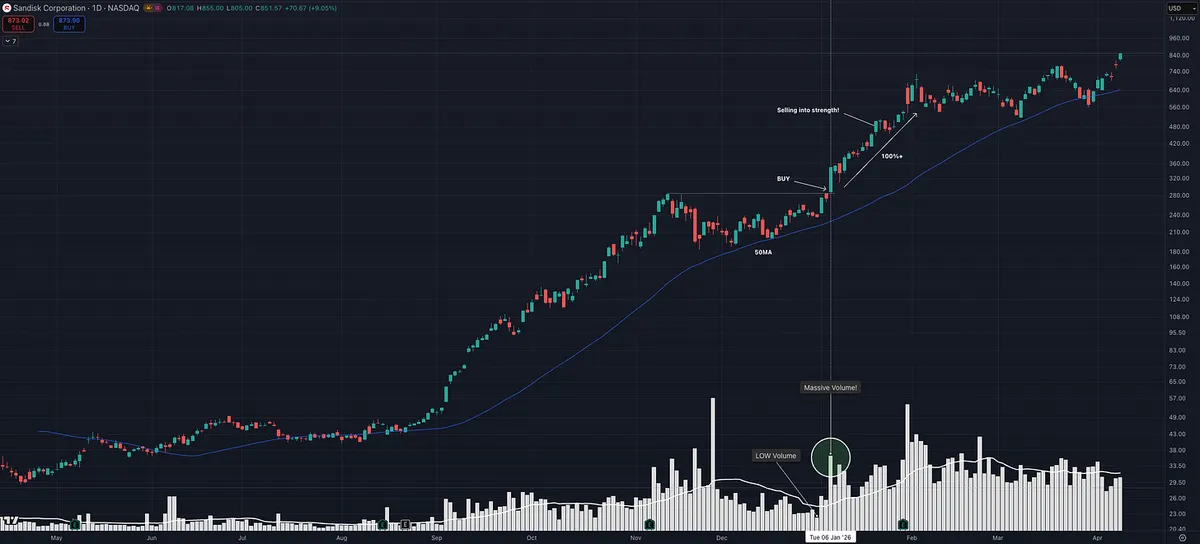
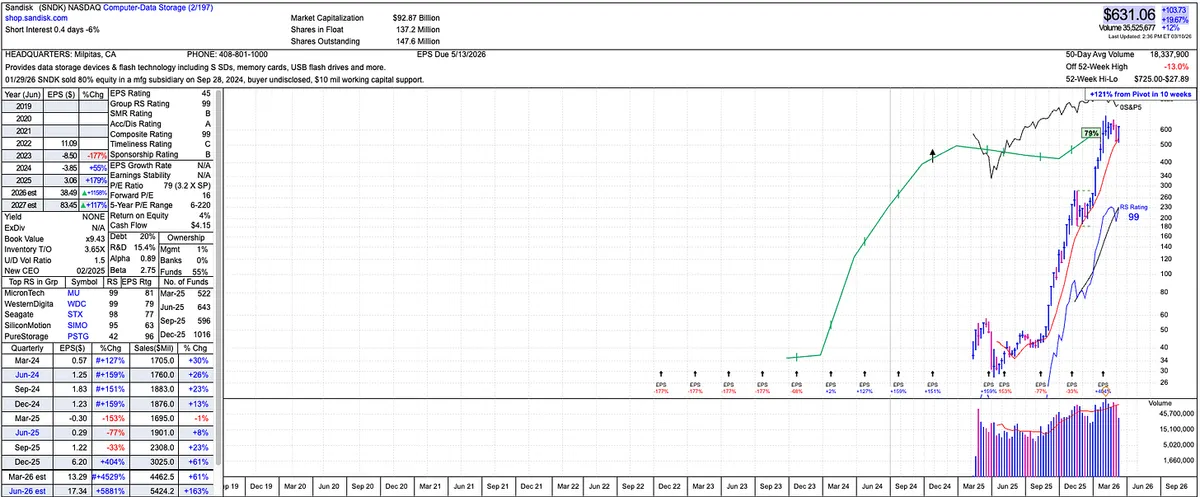
How to Buy Pullbacks in Strong Stocks (SNDK Example)

If you're a swing trader, one of the highest probability opportunities is buying pullbacks in leading stocks.

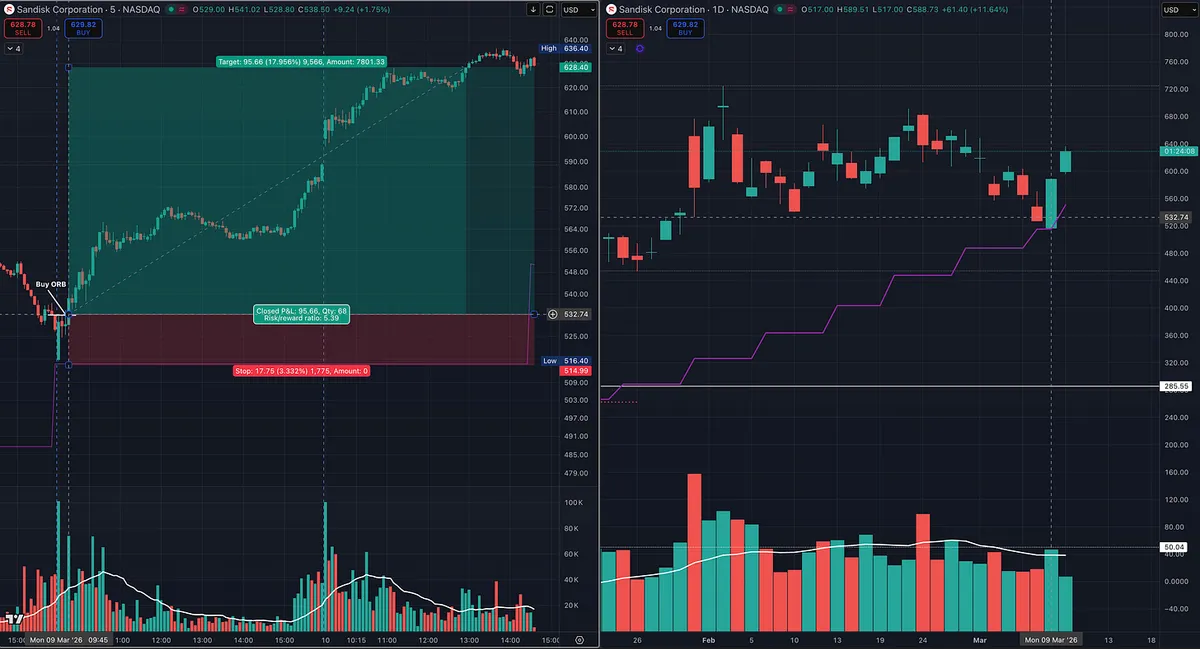
A good example right now is SNDK.

Over the past year SNDK has been a huge winner and it sits inside a very strong industry group: Computer Data Storage. When leadership groups are hot, the best strategy is usually simple.

Don’t argue with the trend. Trade with it.

Looking at the weekly chart, price has repeatedly respected the 10-week moving average, pulling back to support and then continuing higher. When a stock behaves like this, the playbook becomes straightforward:

Wait for the pullback.

Wait for support.

Then look for an entry trigger.

That’s exactly what happened here.

Before the open we saw the overall market approaching the 200-day moving average in futures. When the market found support at that level, strong stocks started to respond.

At the same time SNDK was sitting right on its 10-week support area.

That created the setup.

Instead of guessing, we waited for a tactical entry using an Opening Range Breakout, a strategy popularized by traders like Quallamaggie and Dan Zanger.

The trade was simple:

• Entry: Opening range breakout

• Risk: stop at opening range low ~3%

• Current move: ~18%

That’s roughly 5x the initial risk.

When you get a move like that, you now have choices.

You can:

• Take partial profits into strength

• Move stops higher

• Let the remaining position run

One approach is to sell some shares into strength and let the rest ride, effectively financing the remainder of the trade.

Another important lesson from this example is multi-timeframe analysis.

The weekly and daily charts provide the setup. The daily and intraday charts provide the execution.

This allows you to combine institutional trend structure with tactical entries, which is where many swing traders gain their edge.

And remember something important.

This is not a random small cap or pump-and-dump stock.

SNDK is a true growth name with strong fundamentals and massive forward estimates for earnings and sales growth. Just look at the earnings and sales on the chart!

When growth stocks in leading groups pull back to support, the goal isn’t to predict when the run will end.

It’s simply to take the setup while it works.

Because the truth is, the moment a hot sector pulls back, the commentary always starts:

“It’s extended.” “It’s overvalued.” “The run is over.”

Eventually that will be true.

But guessing when that happens costs traders enormous opportunity.

I was telling our members in the Substack Chat to keep an eye on SNDK and this is exactly why.

With setups like this we can be wrong 70% of the time and still come out ahead.

Instead, a better approach is simple:

Keep taking the setups until they stop working.

View on Substack ↗

A Clean Example of an EP + Opening Range Breakout

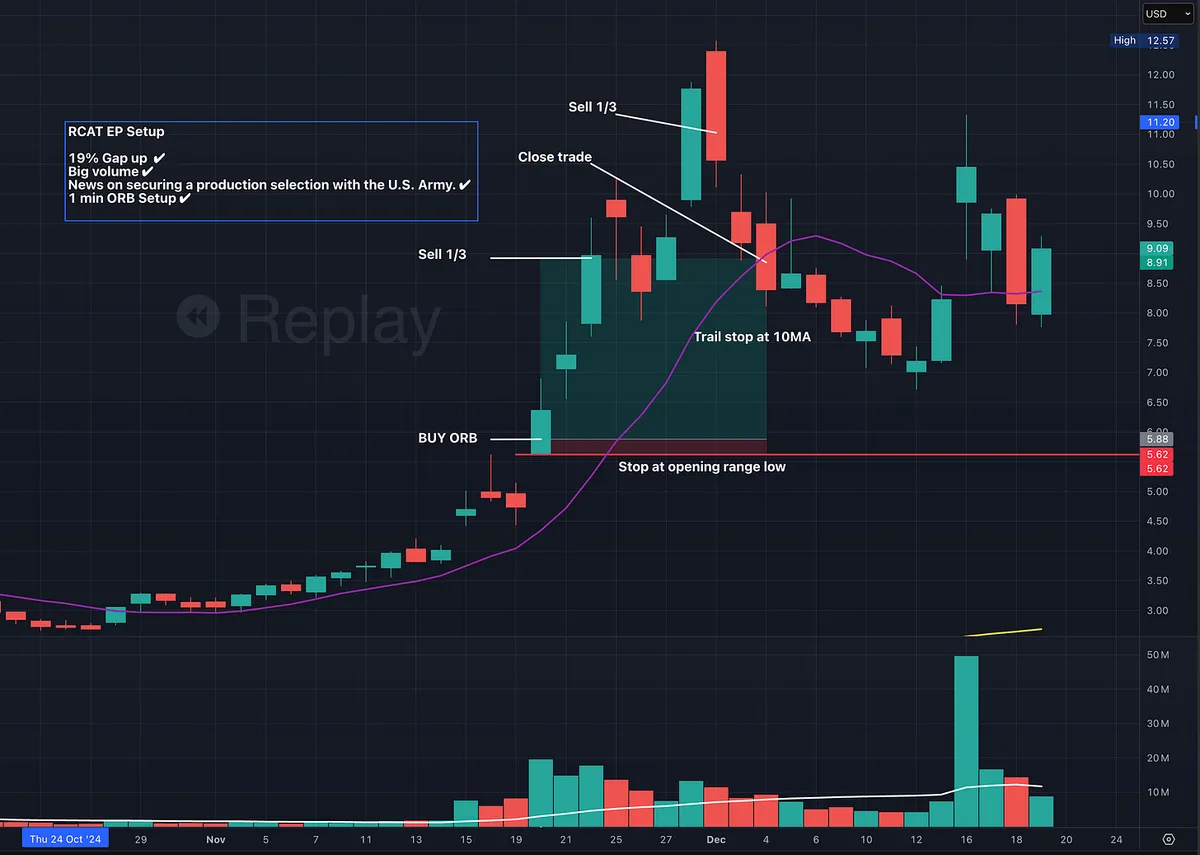
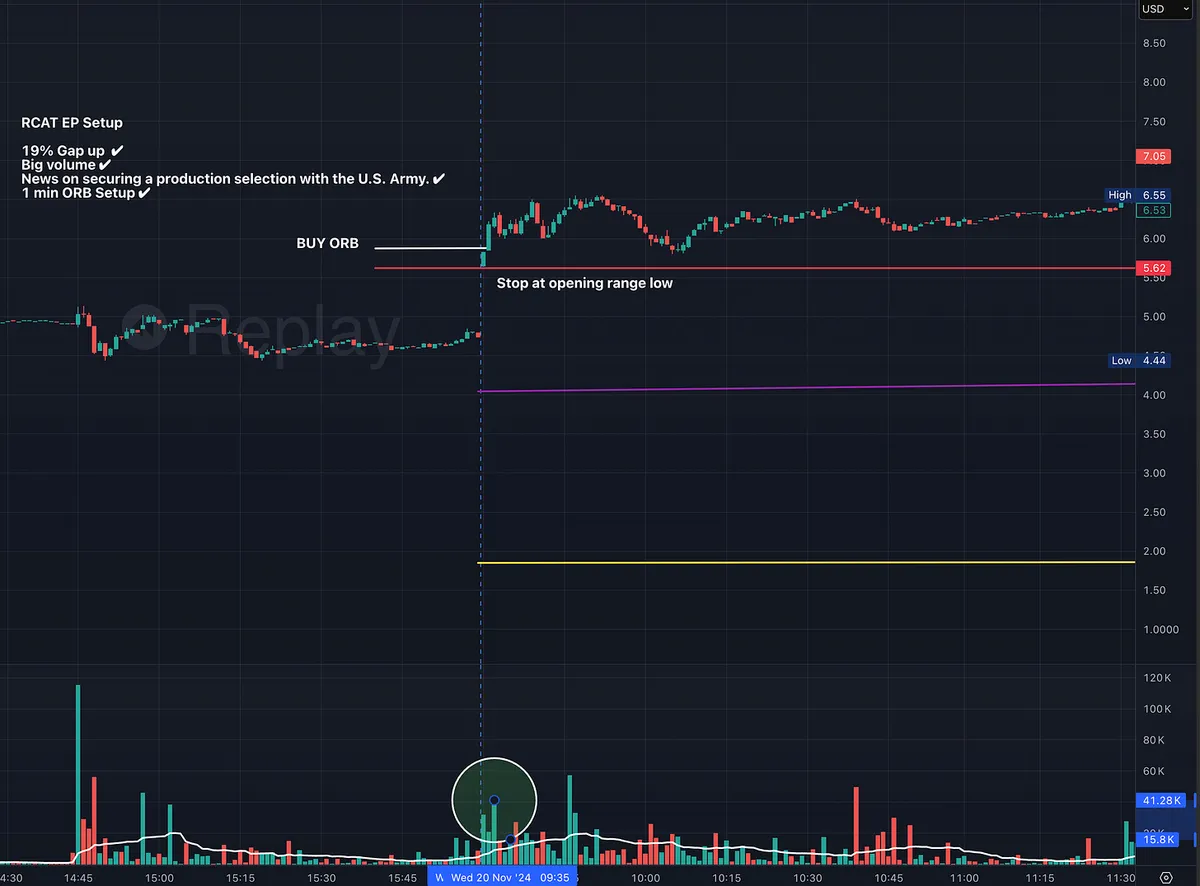
Had a few people ask questions after the recent post about EP setups and Opening Range Breakouts, so here is another example using RCAT.

RCAT gapped up 19% after news the night before that the company had secured a production contract with the U.S. Army.

This is exactly the type of catalyst that creates an EP (Event/Earnings Play).

You would typically spot this during your premarket scan, then read the news and build a plan before the open.

The key criteria were all there:

✔ Gap of 10% or more

✔ Huge volume

✔ Major news catalyst

✔ Momentum moving into the open

Because of the massive volume coming in, this was a perfect candidate for a 1-minute Opening Range Breakout (ORB).

The plan is simple.

Enter on the break of the opening range high and place the stop at the opening range low.

From there, the goal is simply to manage the position as the move unfolds.

Both Kristjan Kullamägi and Mark Minervini talk about selling into strength on large momentum moves.

In this example the trade could be managed like this:

• Sell 1/3 into strength after the first strong push

• Sell another 1/3 on a major reversal bar after the extension

• Let the final 1/3 run and trail a stop using the 10 or 20-day moving average

For beginners, Kullamägi often suggests using the 10-day moving average and waiting for a close below it.

This keeps you in the trend while protecting the majority of the move.

In this example:

• First 1/3 captured roughly 11x the initial risk

• Second 1/3 captured roughly 20x the initial risk

• Final 1/3 exited on the 10-day moving average break

This is the power of high momentum EP setups combined with tight initial risk.

The initial stop is small.

But when the move works, the reward can be many multiples of that risk.

And that is exactly what professional momentum traders are trying to achieve.

If you haven’t read the full breakdown of these setups yet, you can read it here: https://tradingmomentum.substack.com/p/the-3-trading-setups-that-turned

ArticleThe 3 Trading Setups That Turned Kristjan Kullamägi From Security Guard to $100M Trader
View on Substack ↗

Why I Mentioned AAOI Before Earnings

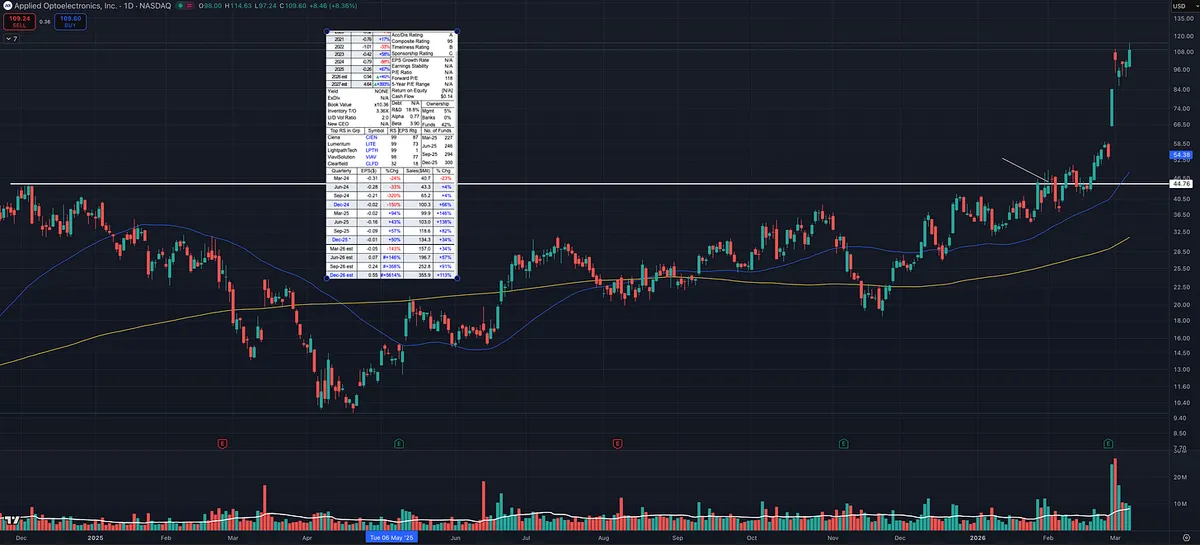
Someone asked why I mentioned AAOI in early February with earnings coming up.

First, the stock checked several boxes I look for.

It was in a HOT group (telecom) showing strong relative strength across multiple timeframes. I had already seen success with LITE and CIEN, which are in the same space. It reminded me of past industry runs like the computer data storage group when SNDK, MU, WDC, and STX all moved together.

AAOI also had:

• Strong earnings and sales acceleration

• Rising forward estimates

• Accelerating fund ownership

• Tight price action on the right side of the chart

• Trading near new 52 week highs

Since that mention the stock has moved about 150%, but the trade management is the important part.

I normally do NOT buy a stock a few days before earnings. There is too much risk and no time to build a cushion.

I follow the advice from Paul Tudor Jones:

“Never trade in situations where you don’t have control. For example, I don’t risk significant amounts of money in front of key reports, since that is gambling, not trading.”

In this case there were about three weeks before the report, which gave the trade time to work.

From the original buy, the stock moved roughly 30% before earnings.

At that point the plan becomes simple:

• Trim a large portion before the report

• Lock in gains and reduce risk

• Hold a smaller position into earnings

Even great stocks can drop 15–20% overnight on earnings.

By trimming beforehand, the position already has a profit cushion, so the remaining shares carry much less risk.

This is something I learned studying the playbooks of William O’Neil, Mark Minervini, and David Ryan.

The goal isn’t predicting earnings.

The goal is managing risk while letting strong stocks work in your favor.

View on Substack ↗

When Everyone Loves a Stock, Be Careful

“When everybody is running around saying how great a stock is, everybody who can buy probably already has, and the only direction for the stock to go at that point is down. When it’s obvious and exciting to everyone, it’s too late!” — William J. O'Neil

One of the hardest lessons in the market.

By the time a stock is on every headline, every podcast, and everyone is talking about it… the move is usually already behind it.

Great trades rarely feel obvious at the start.