Momentum Trading Strategy

Notes

Selling & Holding Winners

Managing a trade after it starts working: when to take profits, how to stay in big winners, and when to exit.

Showing 1–8 of 8 notes

$SNDK ×
View on Substack ↗

Nothing Lasts Forever. Don’t Fall in Love With Any Stock.

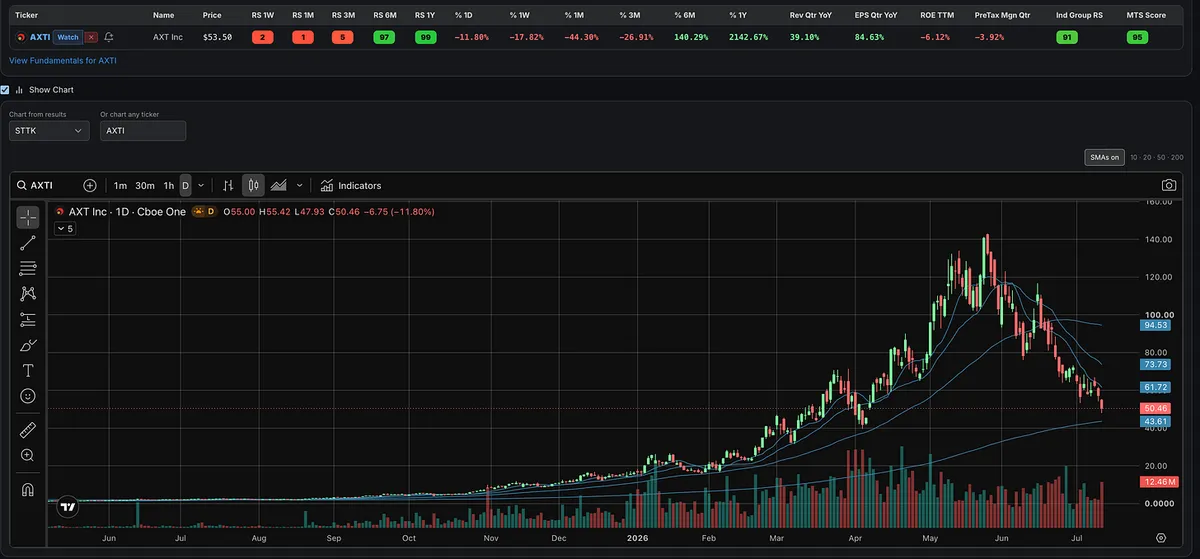
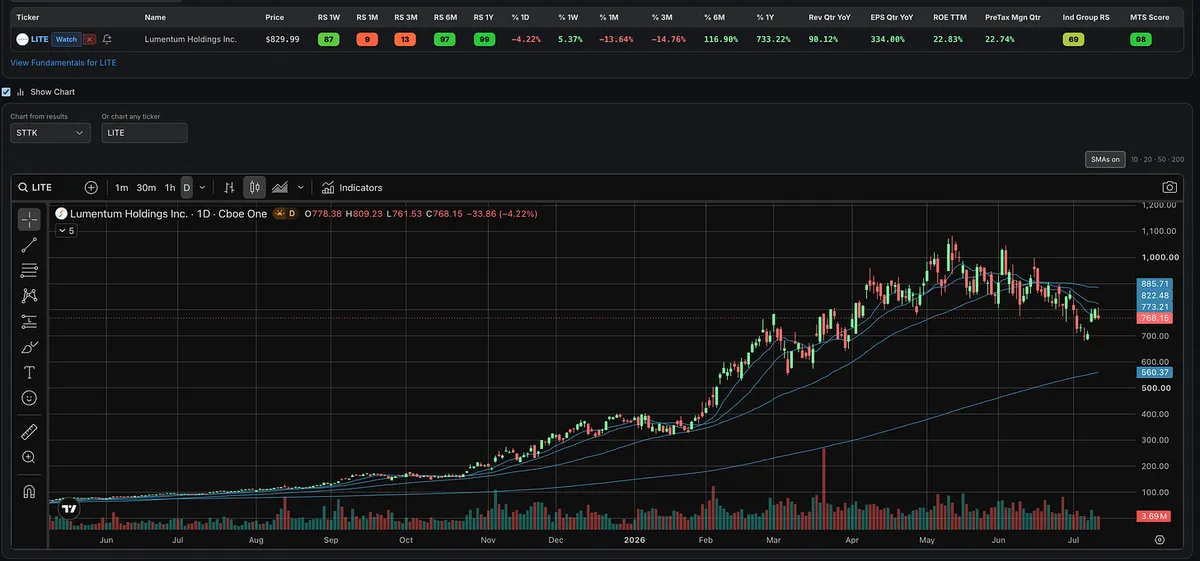
Some of the market’s biggest winners over the past year have now broken down. At least for the moment, their runs appear to be over.

AXTI delivered enormous gains over the last year, but it has now fallen below its 50-day moving average and is heading toward the 200-day. Its 10-day and 20-day lines are declining, and the 50-day is beginning to roll over.

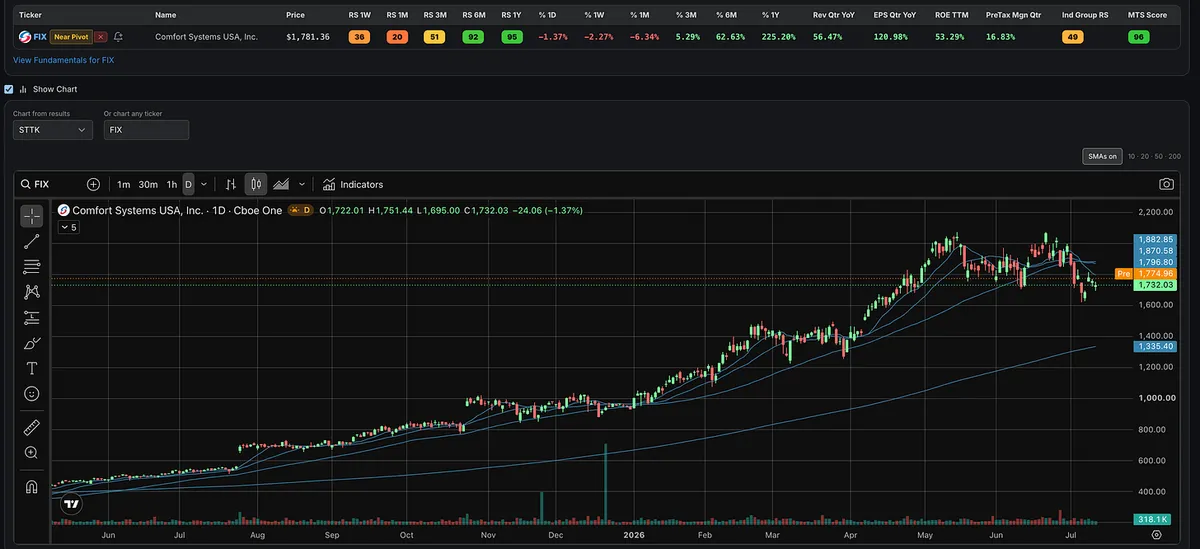
LITE, CIEN, VICR, AAOI, VIAV, TTMI, FIX, COHR, and several other former leaders have also broken down or suffered significant technical damage.

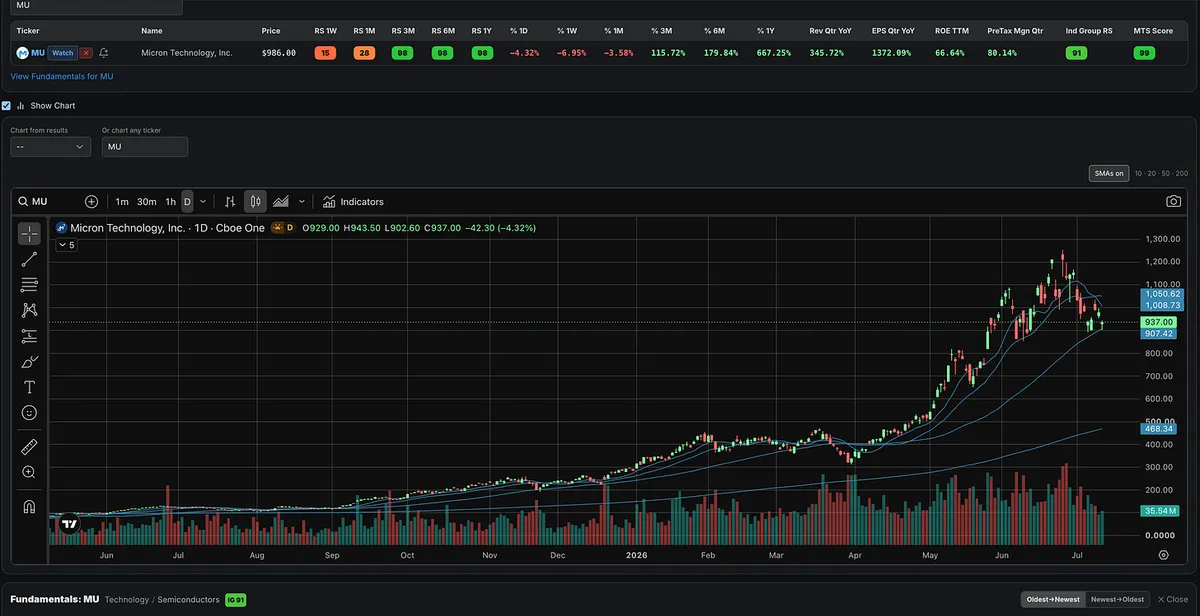
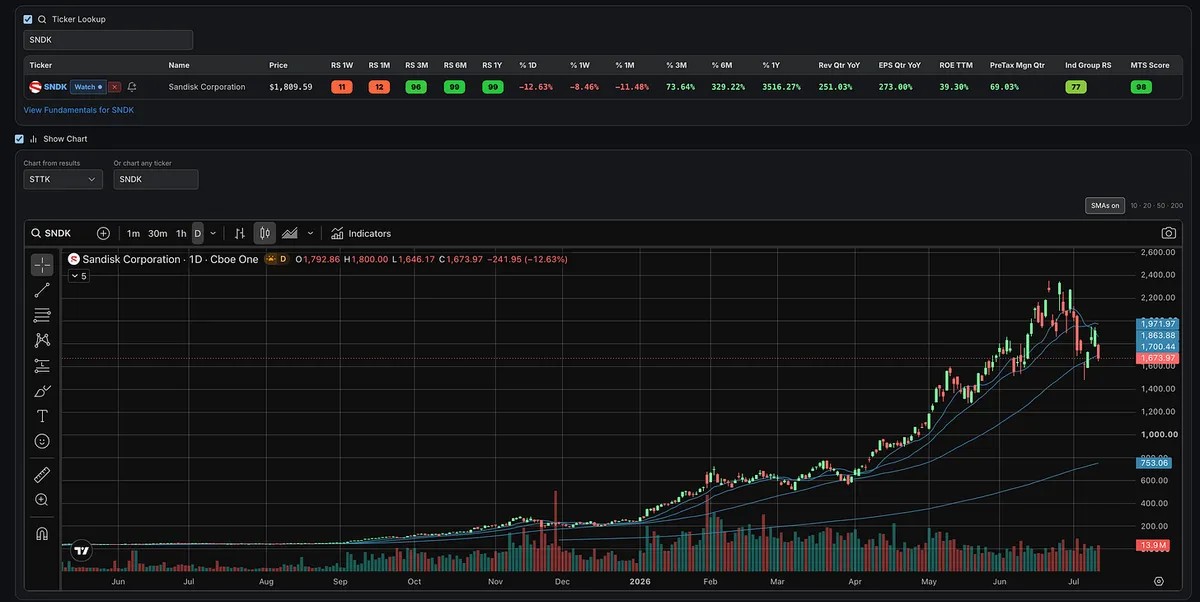
Many more are sitting in the danger zone near their 50-day moving averages. That includes the memory names SNDK, WDC, STX, and MU, along with other hot names from hot groups VPG, MBIS, MXL, LSCC, MRVL, TER, VSH, STM, ADI, INTC, TSM, LRCX, COHU, PDFS, and others.

The bottom line is that many of the stocks that have driven this market, particularly the memory, semiconductor, and telecom names, have either already broken down or are now testing a critical area around their 50-day lines.

I have not needed to share many new tickers from week to week because the same names I have discussed throughout the year continued to lead. There was no reason to constantly search for something new when the existing leaders were still working.

But nothing lasts forever.

Many of the stocks that worked all year are now either ending their runs or approaching a decisive point. Do not fall in love with any stock. Respect the price action and let the market tell you whether the trend is still intact.
View on Substack ↗

SNDK Loves the 50-Day

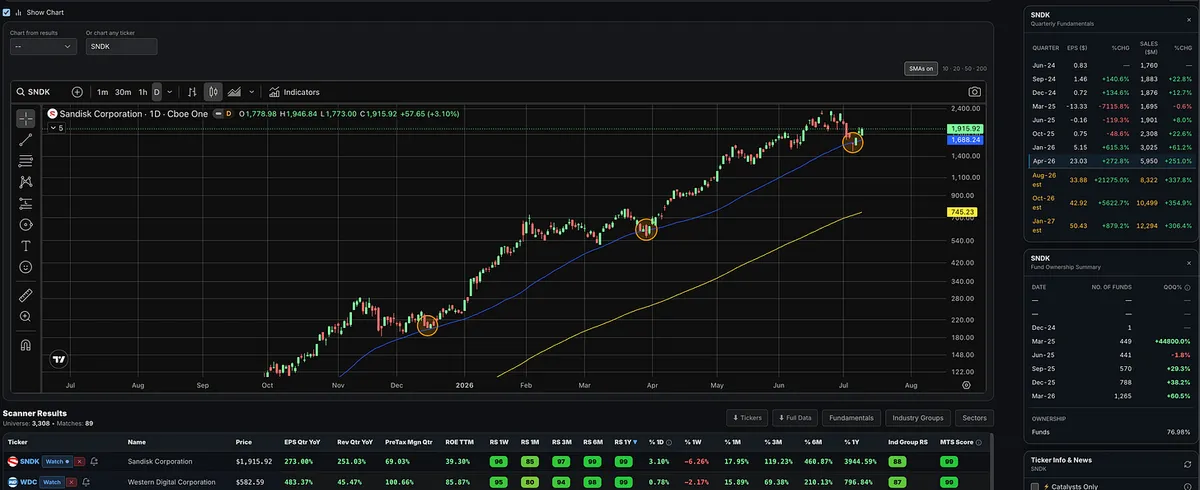
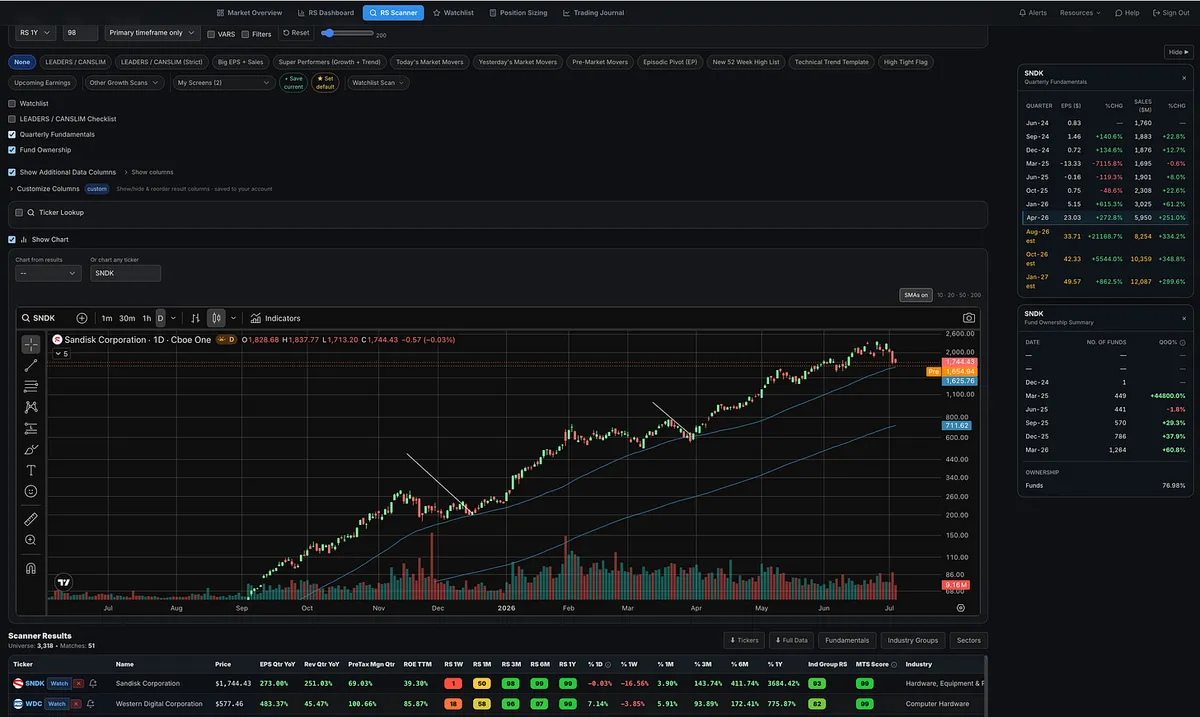
SNDK has repeatedly found support around the rising 50-day moving average throughout this massive run.

It happened in December 2025.

It happened again in late March as the market bottomed.

And now, SNDK has done it again, briefly undercutting the 50-day before reversing sharply and closing near the top of the day’s range.

We will see if the trend continues.

“The trend is your friend until the end when it bends.”

-Ed Seykota

View on Substack ↗

Everyone Wants the Next SNDK. That’s Why They Missed This One.

Most traders do not need more tickers. They need to learn how to recognize a real leader, manage risk, and stay with it until the evidence changes.

I shared SNDK back on January 22nd, and I’ve continued posting about it both publicly and inside the paid subscriber chat.

Yet I still get asked the same thing:

“What’s the next one?”

That is usually the sign of a beginning trader.

When you find a true market leader, the goal is not to immediately abandon it and go hunt for something else. The goal is to ride the move until the evidence changes.

That does not always mean you buy once and hold one full position forever.

  • You can trade around it.

  • You can sell some and hold some.

  • You can get stopped out and re-enter on a new setup.

  • You can even sell all of it and buy it back later when the stock gives you another proper entry.

But in a bull market, it is usually the same small group of names that drive most of the real performance.

Most people lose patience every time a leader pulls back, rests, or gets quiet.

Instead of waiting for the next proper entry in the strongest names, they start chasing random tickers that have not proven anything.

Meanwhile, the real leaders keep leading.

Look at SNDK.

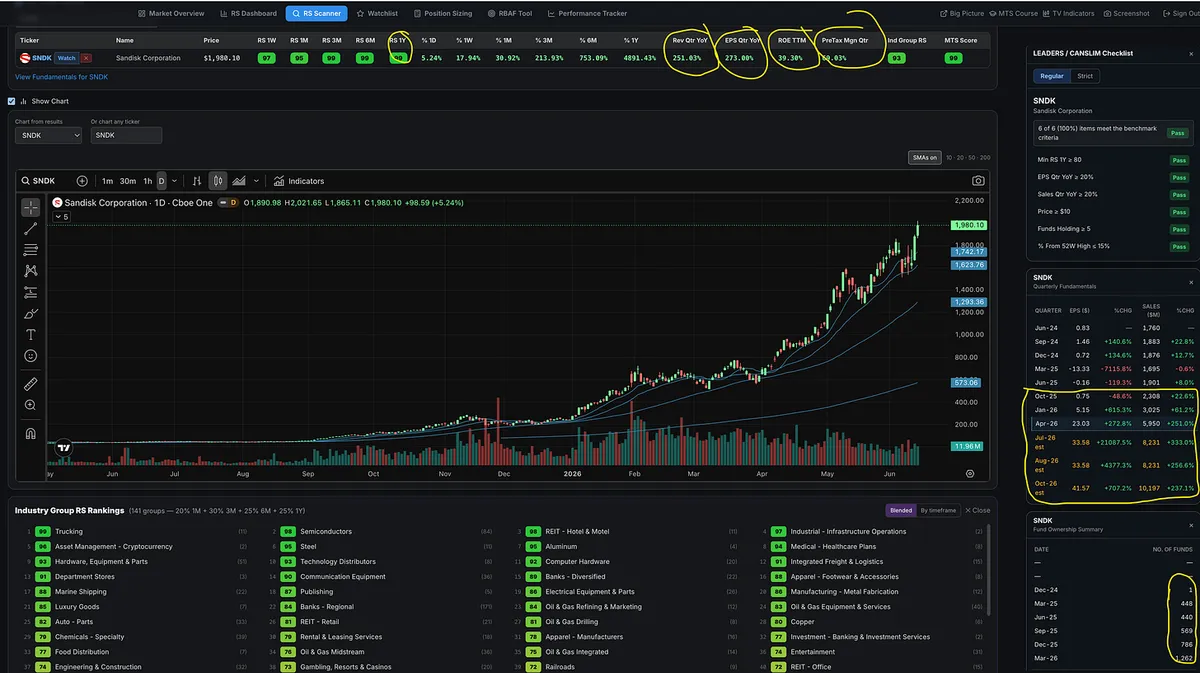
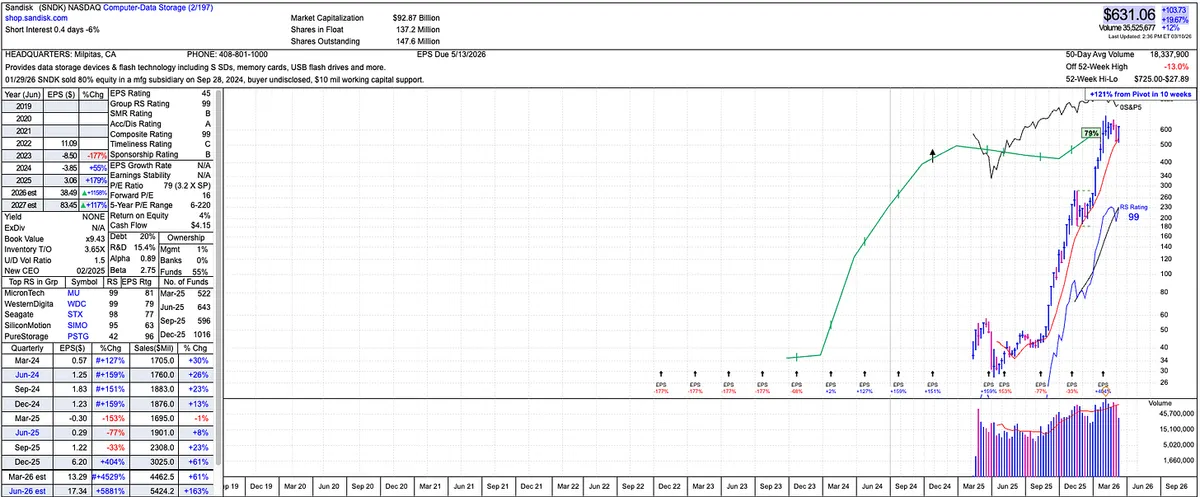
Price action has been screaming leadership. Relative strength across multiple timeframes is among the best in the market. The industry group is strong. Earnings are accelerating. Estimates are accelerating. Sales are accelerating too, which tells you this is not just a cost-cutting story.

There is real fuel behind the growth.

Funds are accumulating.

Return on equity is strong.

Pre-tax margins are strong.

The stock is tied directly into one of the biggest themes in the market: AI infrastructure and data demand.

So at some point you have to ask:

What else are you looking for?

This is CAN SLIM growth stock in real time.

And for the people who say they do not care about fundamentals, that is fine too.

It is not a coincidence that SNDK has also been showing up as a strong trend name for systematic trend followers.

Ed Seykota has had it listed on his Strong List.

One of the greatest systematic trend followers of all time is seeing the same thing CANSLIM growth stock traders are seeing.

Different methods.

Same conclusion.

Leadership.

When all of these things are lining up, the job is not to keep begging for new tickers.

The job is to recognize leadership, manage risk, and stay with the name until the evidence changes.

That is where the big money is usually made.

View on Substack ↗

What Soros Taught Druckenmiller About Big Winners, and Why CIEN Is the Point

One of the biggest misconceptions in trading is that you need to be right all the time.

You do not.

What you need is the ability to keep losses small when you are wrong and press your advantage when you are right.

That is one of the biggest lessons Stanley Druckenmiller described learning from George Soros in Jack Schwager’s The New Market Wizards.

Druckenmiller said Soros taught him that when conviction is high, “you have to go for the jugular.”

He also called Soros “the best loss taker I’ve ever seen.”

That combination is powerful:

Be aggressive when you are right.

Walk away quickly when you are wrong.

I have made plenty of wrong calls on individual stocks. I am wrong often.

But the goal is not to be right on every name.

The goal is to structure your trading so the small losses stay small, and the winners have enough room to pay for the losers and then some.

That is why a winner like CIEN, along with names like LITE and SNDK, matters so much in my trading strategy.

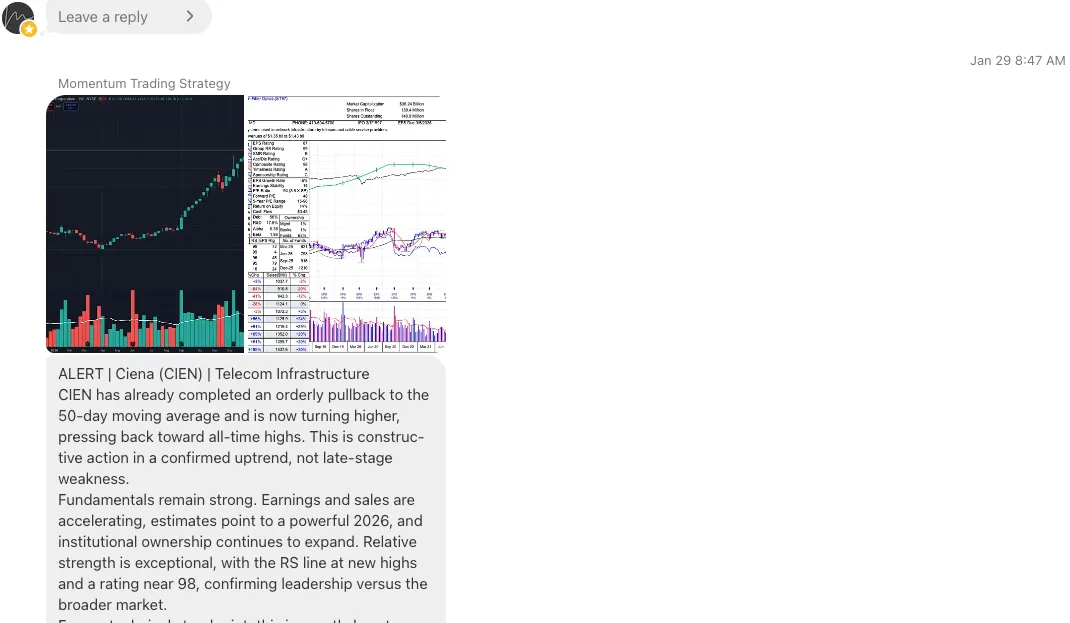
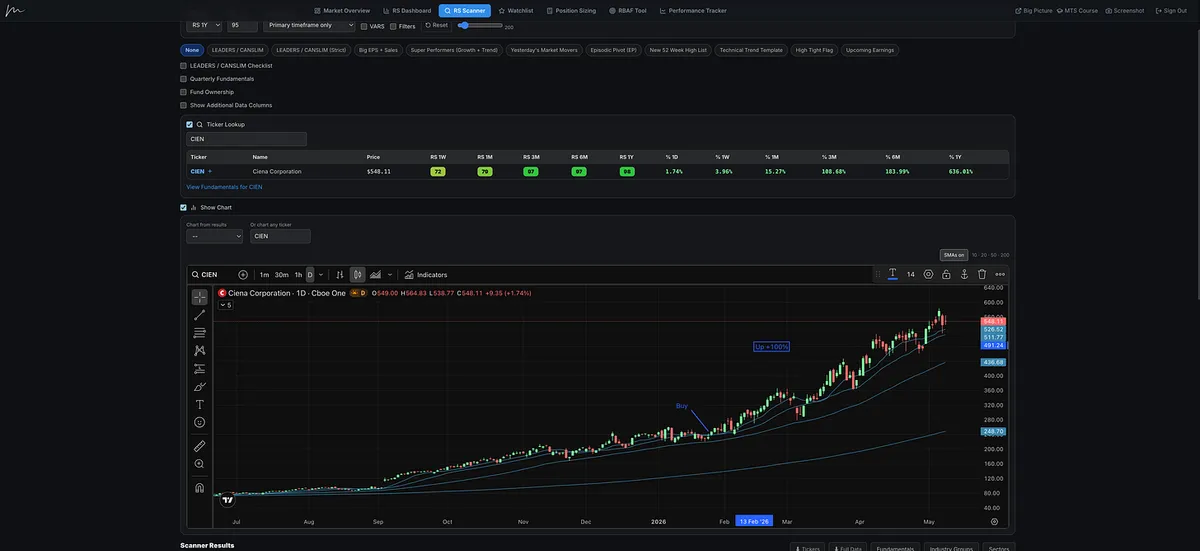
I mentioned CIEN earlier because it had the kind of relative strength, leadership, and constructive price action I look for.

Since then, it has continued to show why holding real leaders matters.

One real leader can make up for a lot of small losses.

But only if you do two things:

  • Cut the trades that are not working.

  • Hold the trades that are.

That is the hard part.

Most traders do the opposite.

They give losing trades too much room and cut winning trades too quickly.

The best traders understand the math is not about being right all the time.

It is about making sure that when you are right, it actually matters.

View on Substack ↗

How to Hold Winners Longer Without Guessing the Top

In the Master Trader Program, Mark Minervini talked with David Ryan about something every trader struggles with.

How do you hold on to a great stock… longer?

Not just take a quick gain. But stay in it when it has the potential to make a much bigger move.

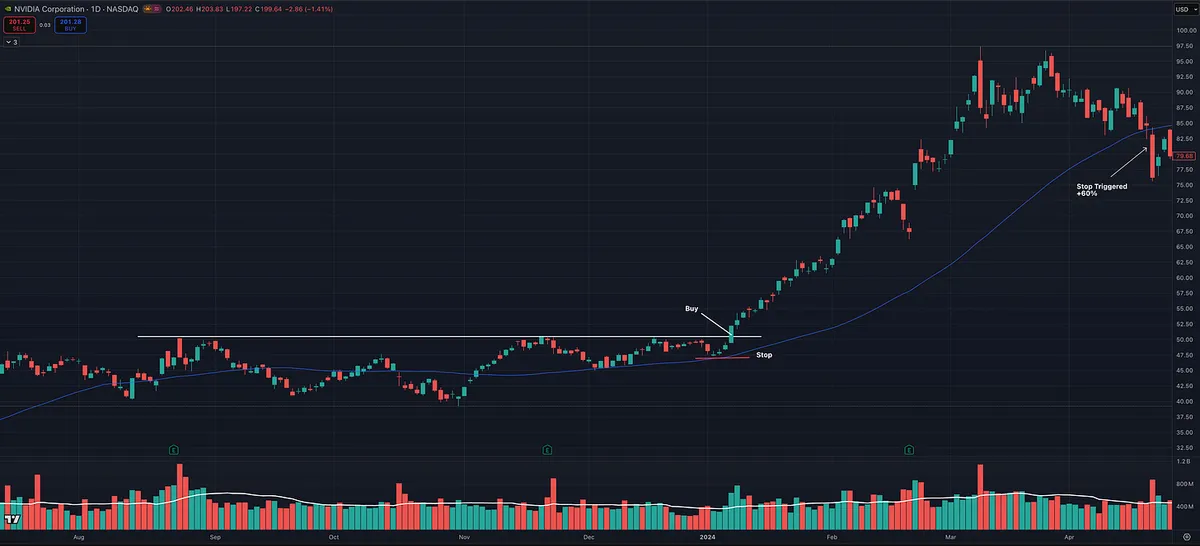
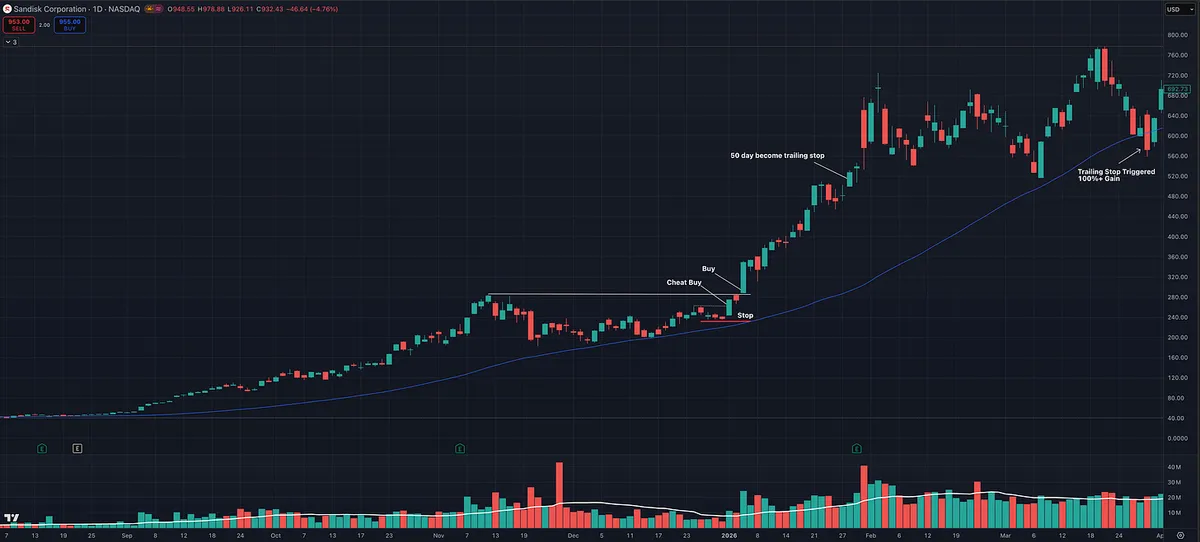
He introduced what he calls the 50-day breakeven or better rule.

It is simple.

And it is powerful.

This is not how you enter the trade.

You still take your entry the same way. You still define your risk the same way. You still place your initial stop based on the chart.

Nothing changes there.

The shift happens after you are in a winning position.

As the stock moves higher, the 50-day moving average starts to rise.

At some point, that 50-day will catch up to your breakeven.

That is the key moment.

Once the 50-day reaches breakeven or better, it can become your trailing stop.

From there, you let the stock work.

You are no longer guessing where to sell. You are letting the trend decide.

Minervini even said he does not rely heavily on moving averages.

But in the early stages of a bull market, this is where it becomes extremely useful.

Because the best stocks can go a long distance before they ever break the 50-day.

That is the whole idea.

Give strong trends room to develop.

Without giving back your gains.

Now look at these examples.

One from NVIDIA in 2024. One from SanDisk in 2025–2026.

Both show the same thing.

A proper entry. A defined stop. Then the 50-day catching up… and taking over as the trailing stop.

That is how you stay in a winner long enough to matter.

Most traders sell too early.

Not because the stock is done.

But because they do not have a process to stay in it.

This solves that.

It is not about predicting the top.

It is about staying with the trend as long as it remains intact.

If you want to go deeper, I cover this and several other ways to manage trades using a few key indicators in Module 5 of my course, available to all paid subscribers.

View on Substack ↗

How to Buy Pullbacks in Strong Stocks (SNDK Example)

If you're a swing trader, one of the highest probability opportunities is buying pullbacks in leading stocks.

A good example right now is SNDK.

Over the past year SNDK has been a huge winner and it sits inside a very strong industry group: Computer Data Storage. When leadership groups are hot, the best strategy is usually simple.

Don’t argue with the trend. Trade with it.

Looking at the weekly chart, price has repeatedly respected the 10-week moving average, pulling back to support and then continuing higher. When a stock behaves like this, the playbook becomes straightforward:

Wait for the pullback.

Wait for support.

Then look for an entry trigger.

That’s exactly what happened here.

Before the open we saw the overall market approaching the 200-day moving average in futures. When the market found support at that level, strong stocks started to respond.

At the same time SNDK was sitting right on its 10-week support area.

That created the setup.

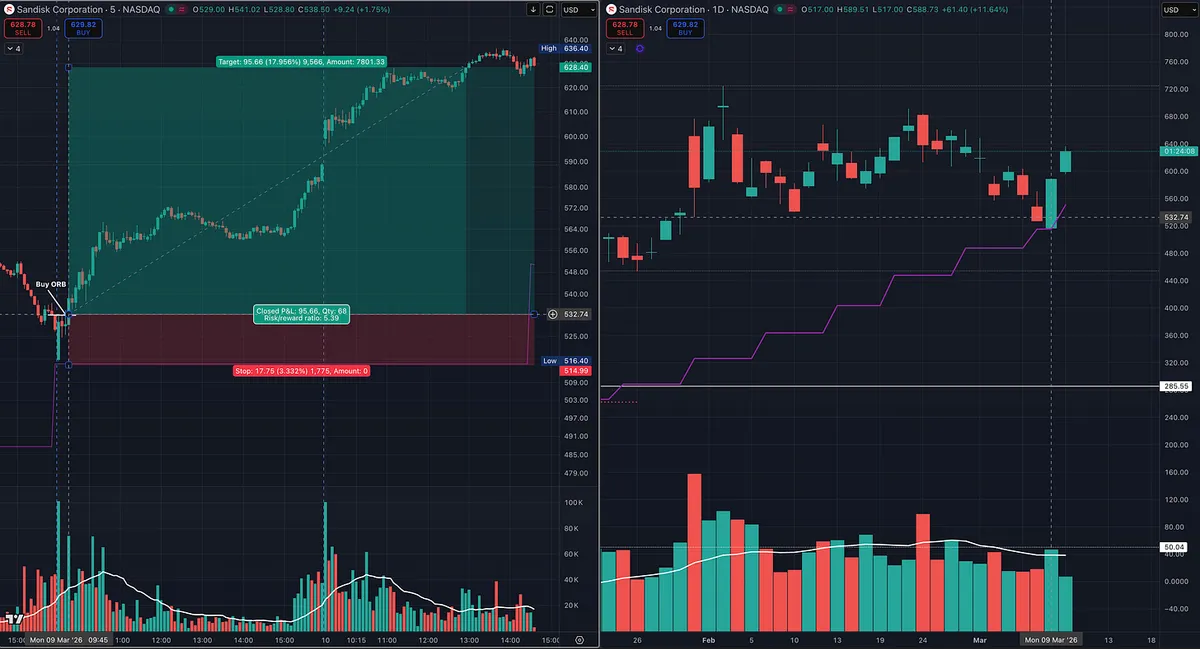
Instead of guessing, we waited for a tactical entry using an Opening Range Breakout, a strategy popularized by traders like Quallamaggie and Dan Zanger.

The trade was simple:

• Entry: Opening range breakout

• Risk: stop at opening range low ~3%

• Current move: ~18%

That’s roughly 5x the initial risk.

When you get a move like that, you now have choices.

You can:

• Take partial profits into strength

• Move stops higher

• Let the remaining position run

One approach is to sell some shares into strength and let the rest ride, effectively financing the remainder of the trade.

Another important lesson from this example is multi-timeframe analysis.

The weekly and daily charts provide the setup. The daily and intraday charts provide the execution.

This allows you to combine institutional trend structure with tactical entries, which is where many swing traders gain their edge.

And remember something important.

This is not a random small cap or pump-and-dump stock.

SNDK is a true growth name with strong fundamentals and massive forward estimates for earnings and sales growth. Just look at the earnings and sales on the chart!

When growth stocks in leading groups pull back to support, the goal isn’t to predict when the run will end.

It’s simply to take the setup while it works.

Because the truth is, the moment a hot sector pulls back, the commentary always starts:

“It’s extended.” “It’s overvalued.” “The run is over.”

Eventually that will be true.

But guessing when that happens costs traders enormous opportunity.

I was telling our members in the Substack Chat to keep an eye on SNDK and this is exactly why.

With setups like this we can be wrong 70% of the time and still come out ahead.

Instead, a better approach is simple:

Keep taking the setups until they stop working.

View on Substack ↗

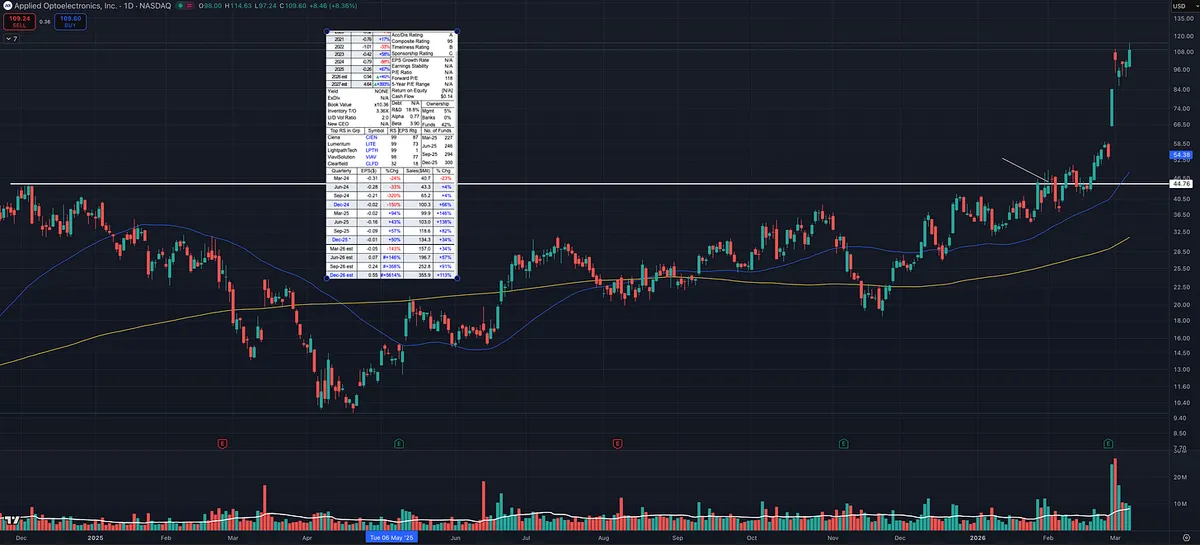
Why I Mentioned AAOI Before Earnings

Someone asked why I mentioned AAOI in early February with earnings coming up.

First, the stock checked several boxes I look for.

It was in a HOT group (telecom) showing strong relative strength across multiple timeframes. I had already seen success with LITE and CIEN, which are in the same space. It reminded me of past industry runs like the computer data storage group when SNDK, MU, WDC, and STX all moved together.

AAOI also had:

• Strong earnings and sales acceleration

• Rising forward estimates

• Accelerating fund ownership

• Tight price action on the right side of the chart

• Trading near new 52 week highs

Since that mention the stock has moved about 150%, but the trade management is the important part.

I normally do NOT buy a stock a few days before earnings. There is too much risk and no time to build a cushion.

I follow the advice from Paul Tudor Jones:

“Never trade in situations where you don’t have control. For example, I don’t risk significant amounts of money in front of key reports, since that is gambling, not trading.”

In this case there were about three weeks before the report, which gave the trade time to work.

From the original buy, the stock moved roughly 30% before earnings.

At that point the plan becomes simple:

• Trim a large portion before the report

• Lock in gains and reduce risk

• Hold a smaller position into earnings

Even great stocks can drop 15–20% overnight on earnings.

By trimming beforehand, the position already has a profit cushion, so the remaining shares carry much less risk.

This is something I learned studying the playbooks of William O’Neil, Mark Minervini, and David Ryan.

The goal isn’t predicting earnings.

The goal is managing risk while letting strong stocks work in your favor.