
Trading articles/When Should You Sell a Winning Stock? The Trade Management Playbook
May 6, 2026 · Momentum Trading Strategy
When Should You Sell a Winning Stock? The Trade Management Playbook
How to Use ATR Trailing Stops, Moving Averages, Donchian Channels, Partial Sales, and Risk Financing to Protect Profits Without Cutting Your Biggest Winners Short
Originally published on Substack.
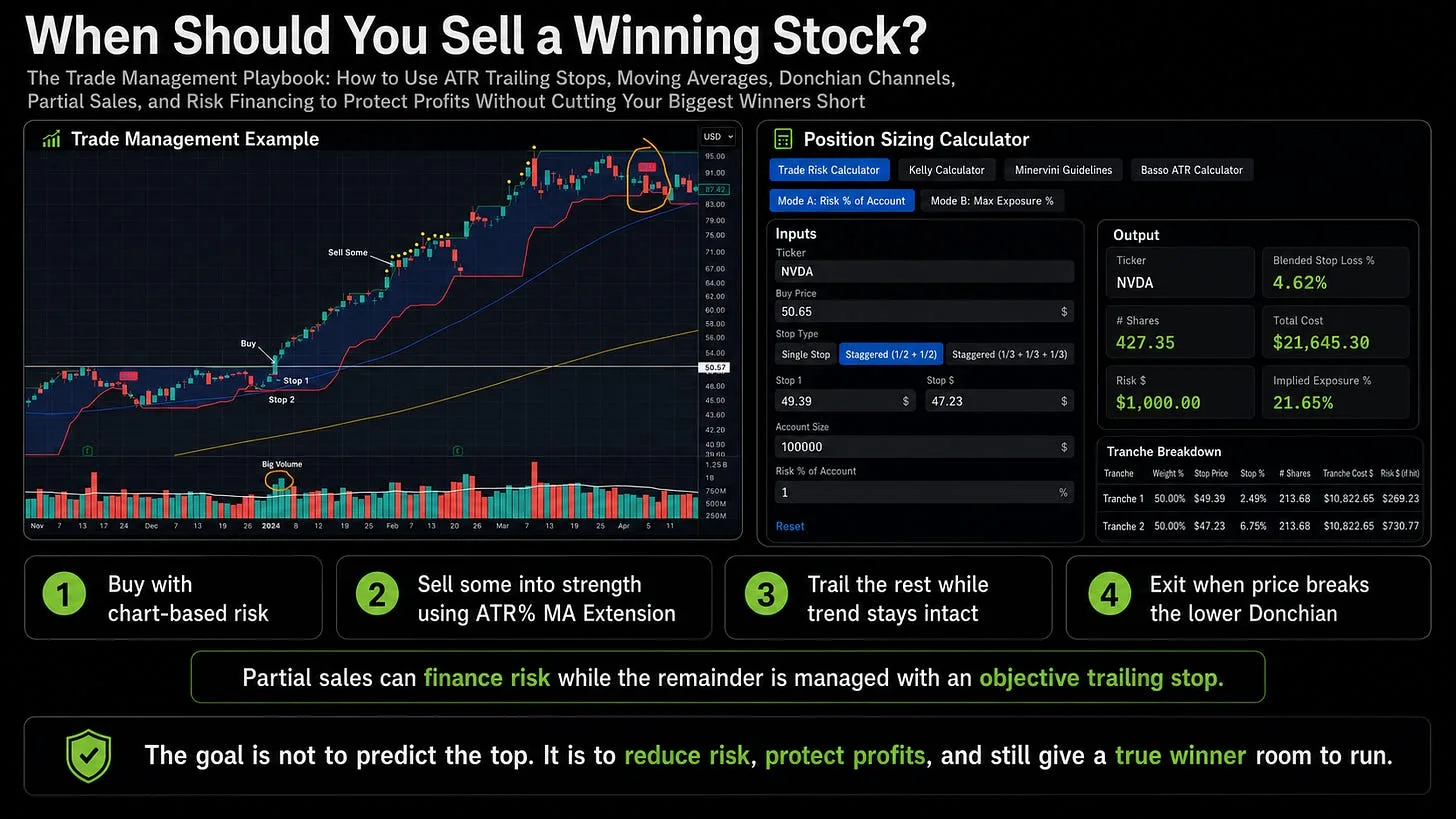
Most traders spend the majority of their time looking for what to buy.
They screen for the next leader.
They look for the next breakout.
They chase the next stock with high relative strength, big earnings, or a powerful chart pattern.
That part matters.
But finding the stock is only the beginning.
The part that actually determines whether you compound capital over time is what you do after you enter.
- Do you sell too early?
- Do you hold too long?
- Do you watch a good winner turn into a scratch trade?
- Do you let a solid gain round trip into a loss?
- Do you have a plan for when the trade works immediately?
- Do you have a plan for when it pulls back naturally before moving higher?
Most traders do not lose because they never find winning stocks. Many lose because they do not know how to manage a position once they are in it.
That is what this post is about.
Not the perfect entry.
Not the perfect stock.
Trade management.
How to decide when to sell, when to hold, when to trim, and how to use trailing stops to protect profit while still giving a stock enough room to become a real winner.
The mistake: treating every sell decision like a prediction
A lot of traders think selling means predicting the top.
That is not the goal.
The goal is not to sell at the exact high.
The goal is to manage the risk-reward relationship as the trade changes.
A stock can be a great buy at one point, a great hold at another point, and a poor hold later, even if the stock eventually goes higher.
That is one of the most important trade management lessons I have learned.
Once you enter a position, the only question that matters is not, “Where did I buy?”
The question is:
Does the risk-reward still make sense from here?
A trade that was originally risking 5% to potentially make 20%, 30%, or more may be a great trade at the entry.
But after the stock has already run 30% or 40%, the risk-reward may look completely different.
If you now have to sit through a 25% or 35% pullback just to make another 10% to 15% above the prior high, that is no longer the same trade.
The entry may have been good.
The hold may not be.
That is why trade management is not just about having a stop.
It is about constantly reevaluating the position.
The three trade management priorities
Once I am in a trade, I think about management in three stages.
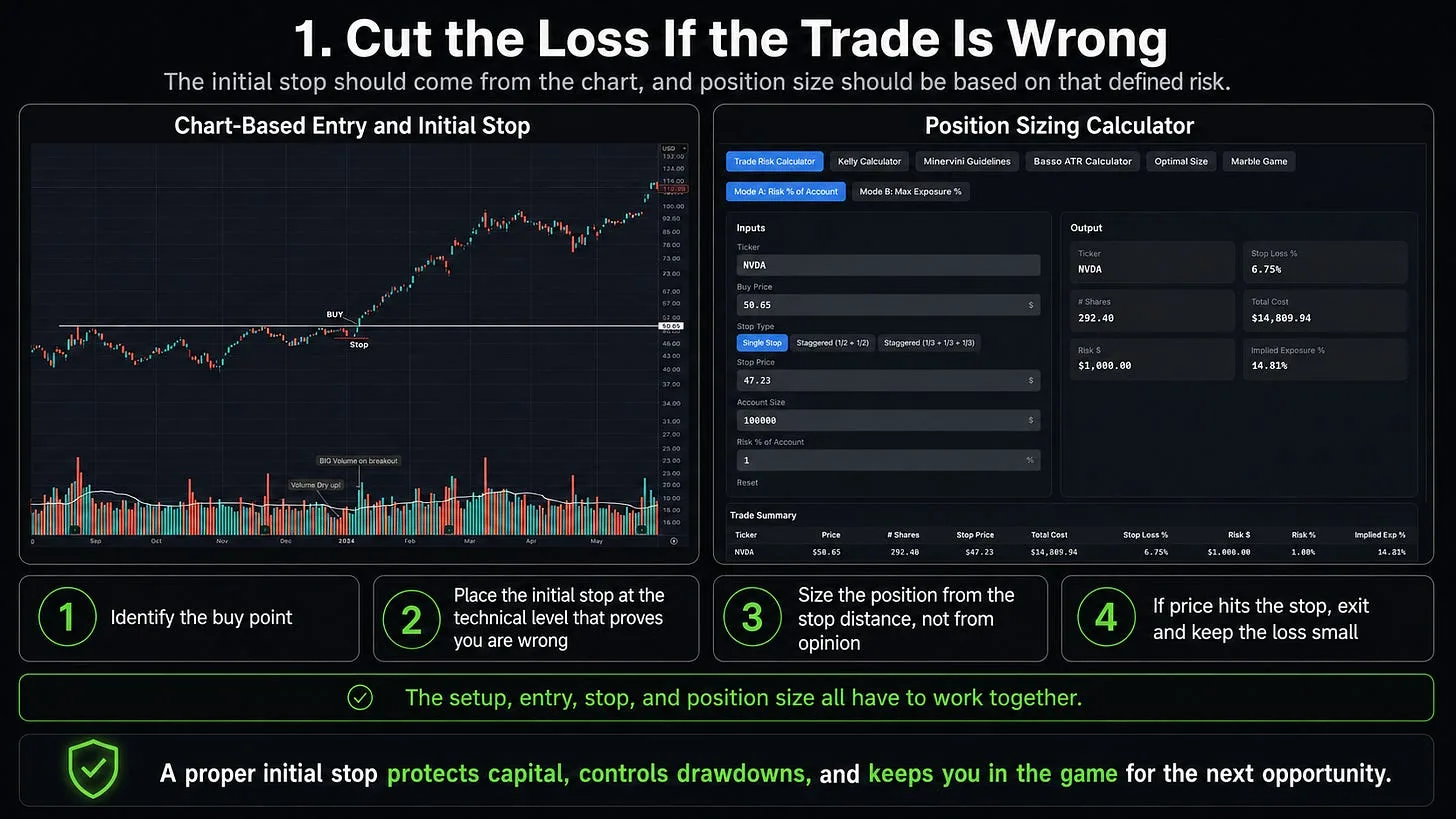
1. Cut the loss if the trade is wrong
This is the initial risk.
Before entering, I want to know where I am wrong.
That level should usually come from the chart, not just a random percentage.
For example:
- Below a pivot low
- Below a higher low
- Below the low of a handle
- Below the low of the day on an opening range breakout
- Below a key moving average
- Below a clear support level
The mistake many traders make is taking a random percentage stop and placing it in the middle of normal price action.
They hear “cut losses at 7% or 8%,” so they buy anywhere and slap an 8% stop below the entry.
That is not the point.
The setup, entry, stop, and position size all have to work together.
If the proper technical stop is too wide, I either reduce position size or skip the trade.
2. Protect break-even once the trade has earned it
After the stock moves in my favor, the next priority is protecting break-even.
This does not always mean moving the stop exactly to my entry price.
Break-even can also mean I have sold enough into strength that even if the rest of the position comes back, the total trade is not a loser.
That distinction matters.
There are multiple ways to protect break-even:
- Move the stop to the entry price
- Move the stop under the first natural reaction low
- Sell part of the position into strength and leave the original stop in place
- Use open profit to reduce the remaining dollar risk on the trade
The key is simple:
Once the stock has moved enough in your favor, you do not want a good trade turning into an unnecessary loss.
3. Protect profit without killing the larger move
After break-even is protected, the job changes.
Now the goal is not just avoiding a loss.
The goal is protecting a meaningful gain while still allowing the stock enough room to become a bigger winner.
This is where trailing stops, partial sales, and financing risk come in.
You are trying to balance two competing ideas:
You do not want to give everything back.
But you also do not want to sell every winner too early.
That balance is trade management.
Four ways to trail a winning trade
There is no single perfect trailing stop.
Different traders use different methods.
The best method depends on your timeframe, personality, average gain, average loss, win rate, and the type of move you are trying to capture.
Here are four methods I use and teach.
1. Dynamic ATR trailing stop
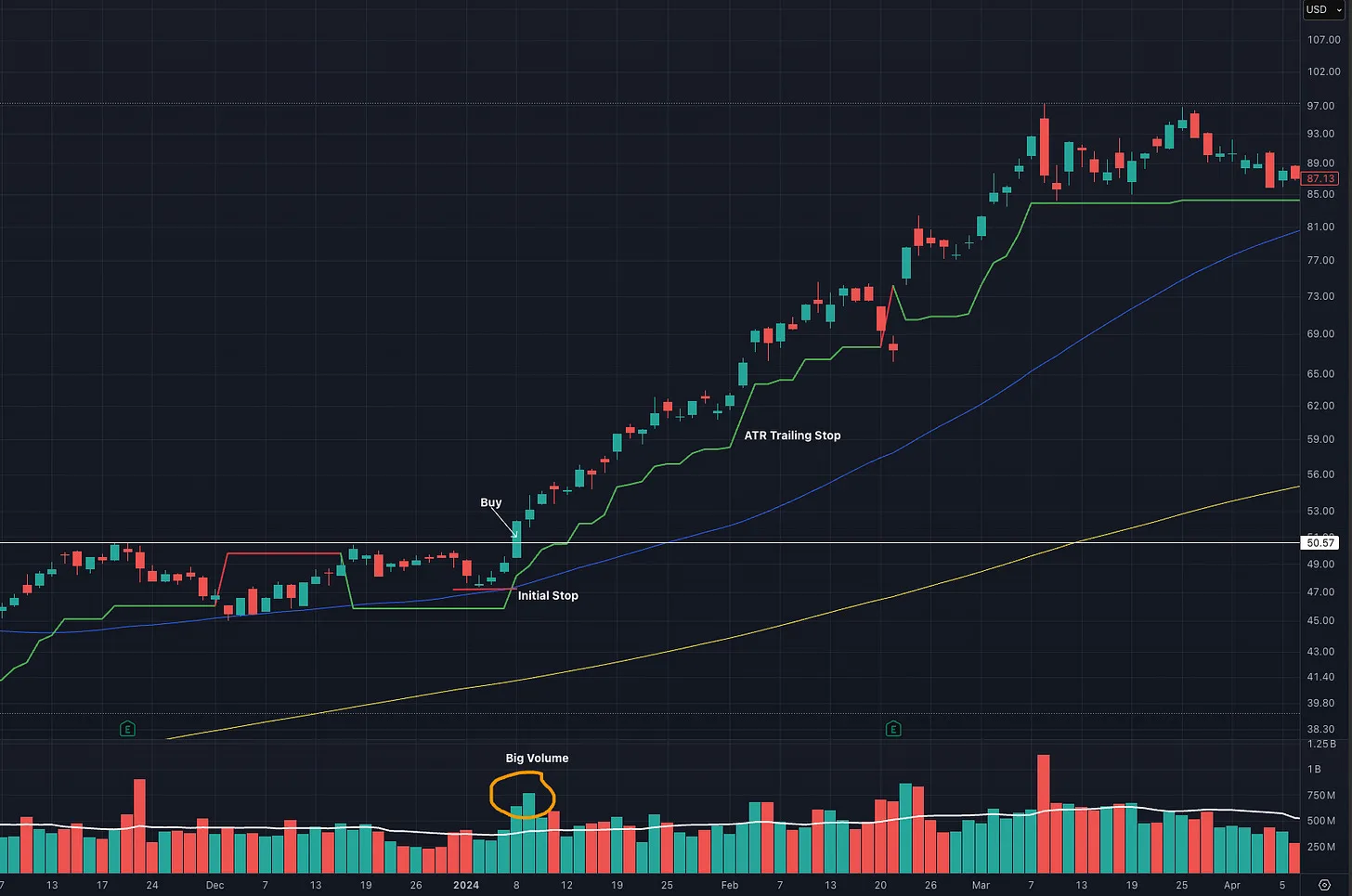
ATR stands for Average True Range.
It is a volatility measure.
A dynamic ATR trailing stop adjusts as price moves and as volatility changes. Instead of using a fixed stop from the entry price, it trails the position based on recent volatility.
For example, a trader might use a 20-period ATR with a 2x or 3x multiplier.
A dynamic ATR trailing stop can be useful once the trade is already working because it helps you stay with the trend without making every sell decision emotionally.
I usually think of ATR trailing stops as a trade management tool, not always the best initial stop tool.
There is an important distinction here.
A fixed ATR stop can be used at entry to define initial risk.
A dynamic ATR trailing stop is usually better for managing a winner after the position has already moved in your favor.
Why?
Because ATR stops can widen during volatile periods.
If the market is getting choppy and breakouts are failing, using ATR as your initial stop can sometimes do the opposite of what you need. It can make losses larger at the exact moment you should be tightening up.
But once you are already in a winning trade, a dynamic ATR trailing stop can help you give the stock room while still having an objective exit.
When I like ATR trailing stops
I like them most when:
- The stock is trending cleanly
- The position is already profitable
- I want to avoid selling too early
- I want an objective way to stay with the move
- The stock has enough volatility that a tight moving average stop would shake me out too early
The risk of ATR trailing stops
The downside is that ATR stops can be loose.
They may keep you in the move longer, but they can also allow a larger giveback.
That is not necessarily wrong.
It just means you need to know what game you are playing.
If your goal is to capture larger trend moves, the ATR trailing stop may fit.
If your goal is shorter swing trades with tighter profit protection, it may be too wide.
2. Moving average trailing stop
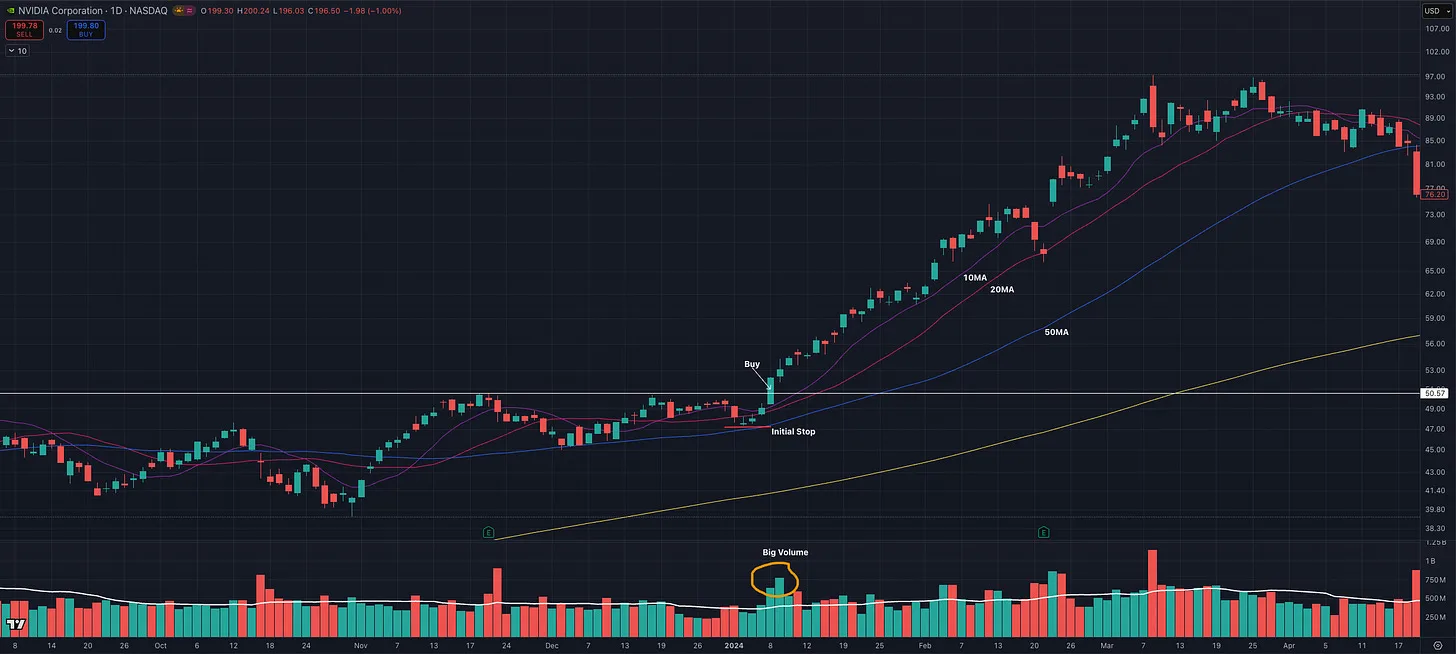
A moving average trailing stop is one of the simplest ways to manage a trend.
You choose a moving average and use it as your guide.
Common examples:
- 10-day moving average for faster momentum trades
- 20-day moving average for more room
- 50-day moving average for longer holds
- 200-day moving average for long-term trend followers
The basic rule might be:
If price closes below the moving average, sell.
Or:
If price breaks below the moving average intraday, sell.
Those are very different rules.
A close below the moving average gives the trade more room.
An intraday break is faster and more defensive.
Neither is automatically right or wrong.
You need to decide in advance which one fits your strategy.
When moving average stops work well
Moving average stops work best when the stock is respecting a particular moving average.
Some powerful leaders ride the 10-day or 20-day moving average during strong momentum phases.
Others need the 50-day.
The chart will usually tell you which one matters.
If a stock has repeatedly found support at the 20-day moving average, then using the 20-day as a trailing guide makes more sense than randomly choosing the 50-day.
If a stock is a bigger, slower position trade, the 50-day may be more appropriate.
This is also where partial sales can be useful.
You do not always have to make an all-or-nothing decision.
One option is to sell part of the position, maybe one-third or one-half, when price breaks or loses a faster moving average like the 10-day or 20-day. That allows you to lock in a meaningful gain and reduce risk.
Then, you can let the rest of the position work using a slower trailing guide, like the 50-day moving average.
That blend can be powerful.
The faster moving average helps you protect some profit when the stock starts getting extended or loses short-term momentum.
The slower moving average gives the remaining shares enough room to potentially capture a much larger trend.
In other words, you are not trying to predict the exact top.
You are using the faster moving averages to finance risk and protect part of the gain, while using the slower moving average to give the true winner room to keep working.
The risk of moving average stops
The downside is that moving averages can lag.
They can also get messy in sideways markets.
A stock can slightly undercut a moving average, shake everyone out, and then recover.
That is why some traders do not sell on the first intraday break. They wait for a close below the moving average or a clear character change.
Again, this is not about finding the perfect rule.
It is about matching the rule to the trade you are trying to hold.
3. Donchian trailing stop
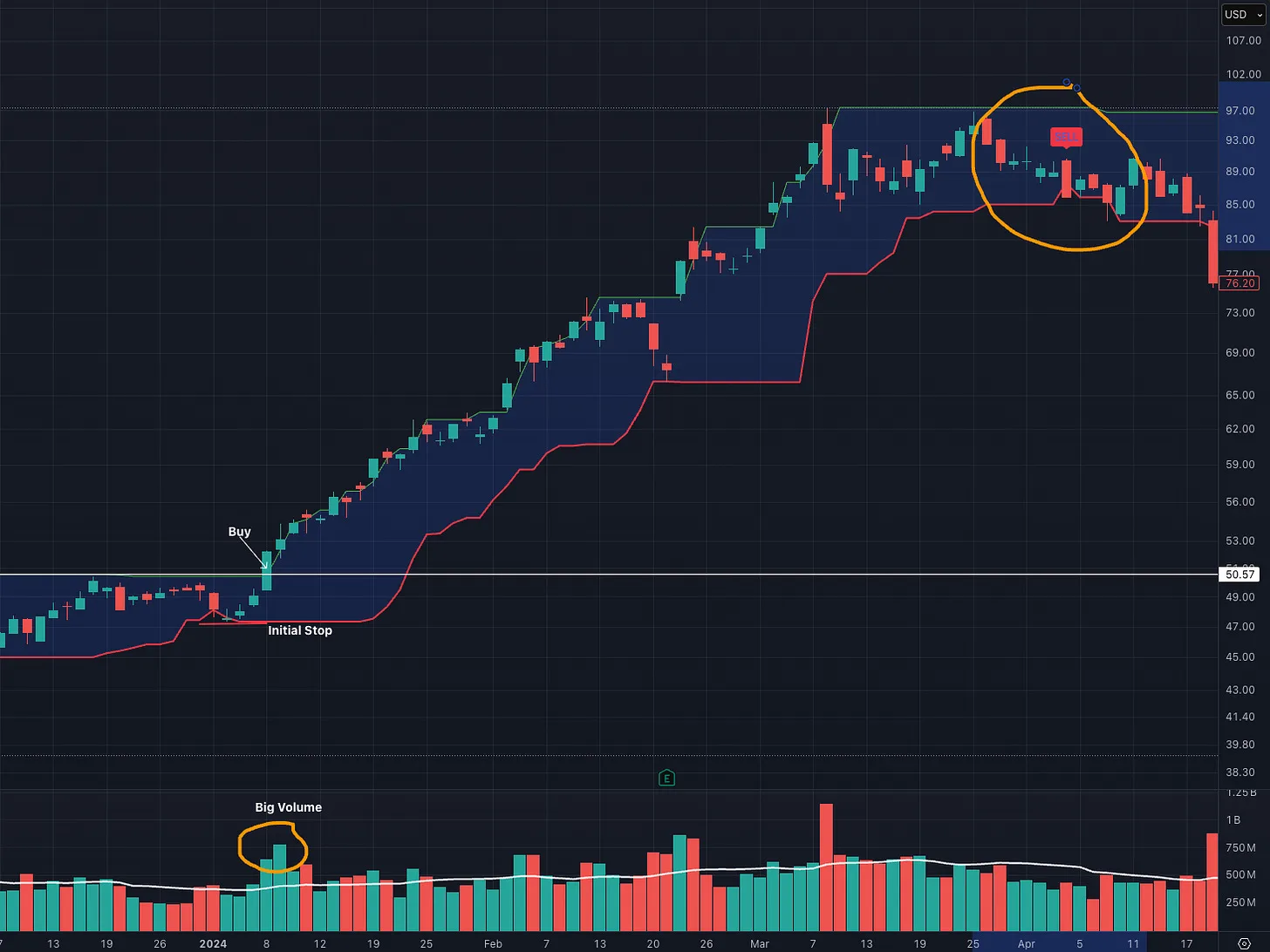
A Donchian stop is based on the lowest low over a set lookback period.
For example, a 20-day Donchian channel tracks the highest high and lowest low over the last 20 days.
For a long position, the lower channel can act as a trailing stop.
If price breaks below the lowest low of the lookback period, the trend may be changing.
This method comes from classic trend following.
It gives trades room.
That can be a strength and a weakness.
Why Donchian stops are useful
The Donchian stop is helpful because it is objective.
You are not guessing.
You are not reacting emotionally to every red candle.
You are saying:
“As long as price does not break the lowest low of this lookback period, I am staying with the trend.”
This can be especially useful for bigger trend moves where you do not want to micromanage every pullback.
The tradeoff
The tradeoff is giveback.
A Donchian stop may let you ride a larger move, but it will often give back more before it gets you out.
That is the cost of trying to catch bigger trends.
Tighter stops usually protect more profit but can get you out earlier.
Looser stops usually keep you in longer but allow more giveback.
You cannot have both perfectly.
That is why the exit method has to match the objective of the trade.
4. Higher low trailing stop
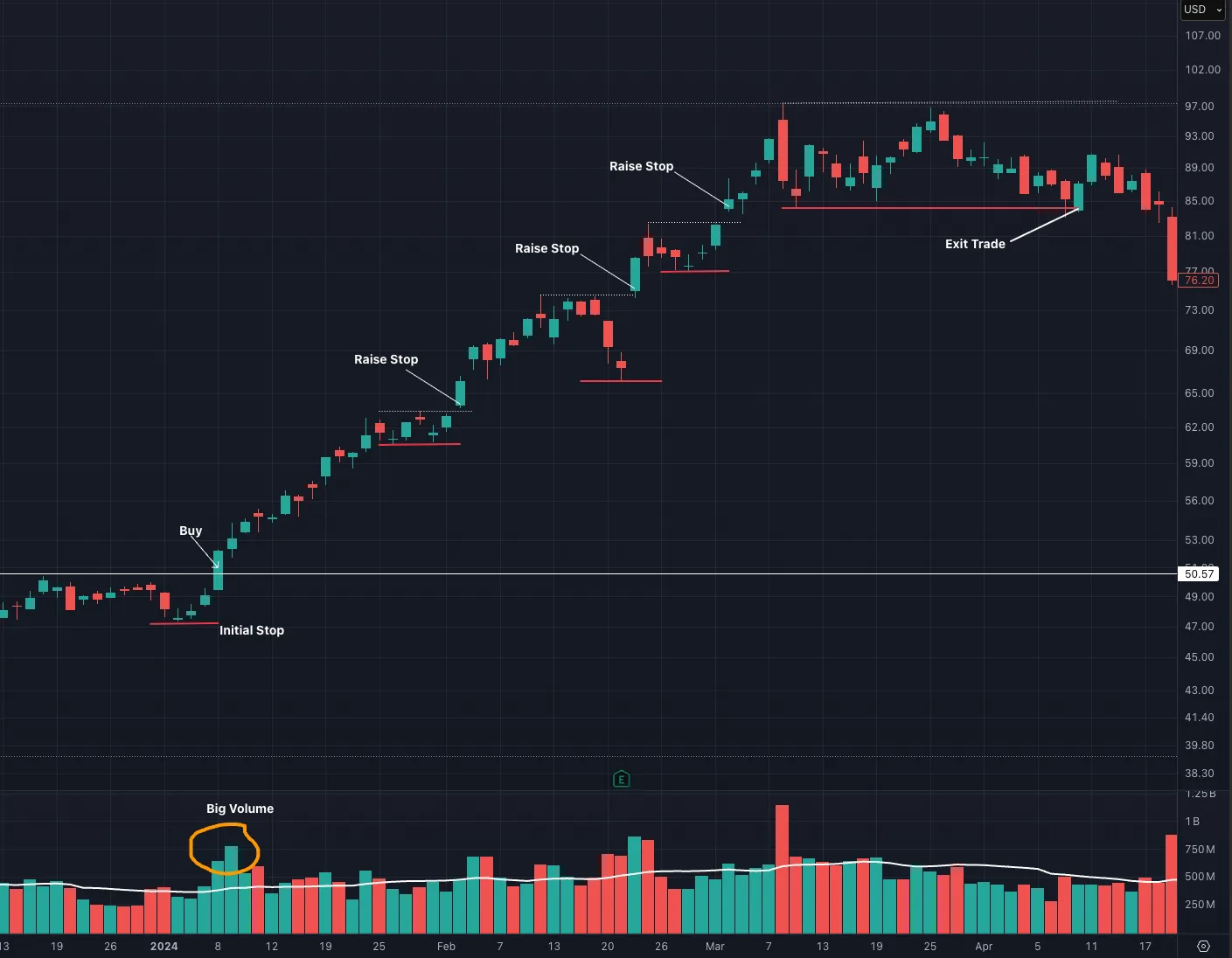
The higher low trailing stop is one of the most intuitive methods.
As the stock makes higher highs and higher lows, you trail your stop under the prior higher low.
The logic is simple.
In an uptrend, price should keep forming higher lows.
If price breaks the prior higher low, the character of the trend may be changing.
This method works especially well with stocks that move in clean stair-step fashion.
Breakout.
Pullback.
New high.
Higher low.
New high.
Higher low.
As each new higher low forms, the stop can be raised.
Why I like higher low stops
I like this method because it is chart-based.
It forces you to manage the trade based on structure.
You are not selling just because the stock is up.
You are not selling just because you are nervous.
You are selling when the structure that supported the trade starts to break.
The risk of higher low stops
The main downside is subjectivity.
Different traders may draw the higher lows differently.
Some may use the intraday low.
Some may use the closing low.
Some may give the stock a little room below the level.
That is fine, but the rule needs to be clear before the trade becomes emotional.
Financing risk: selling some without killing the trade
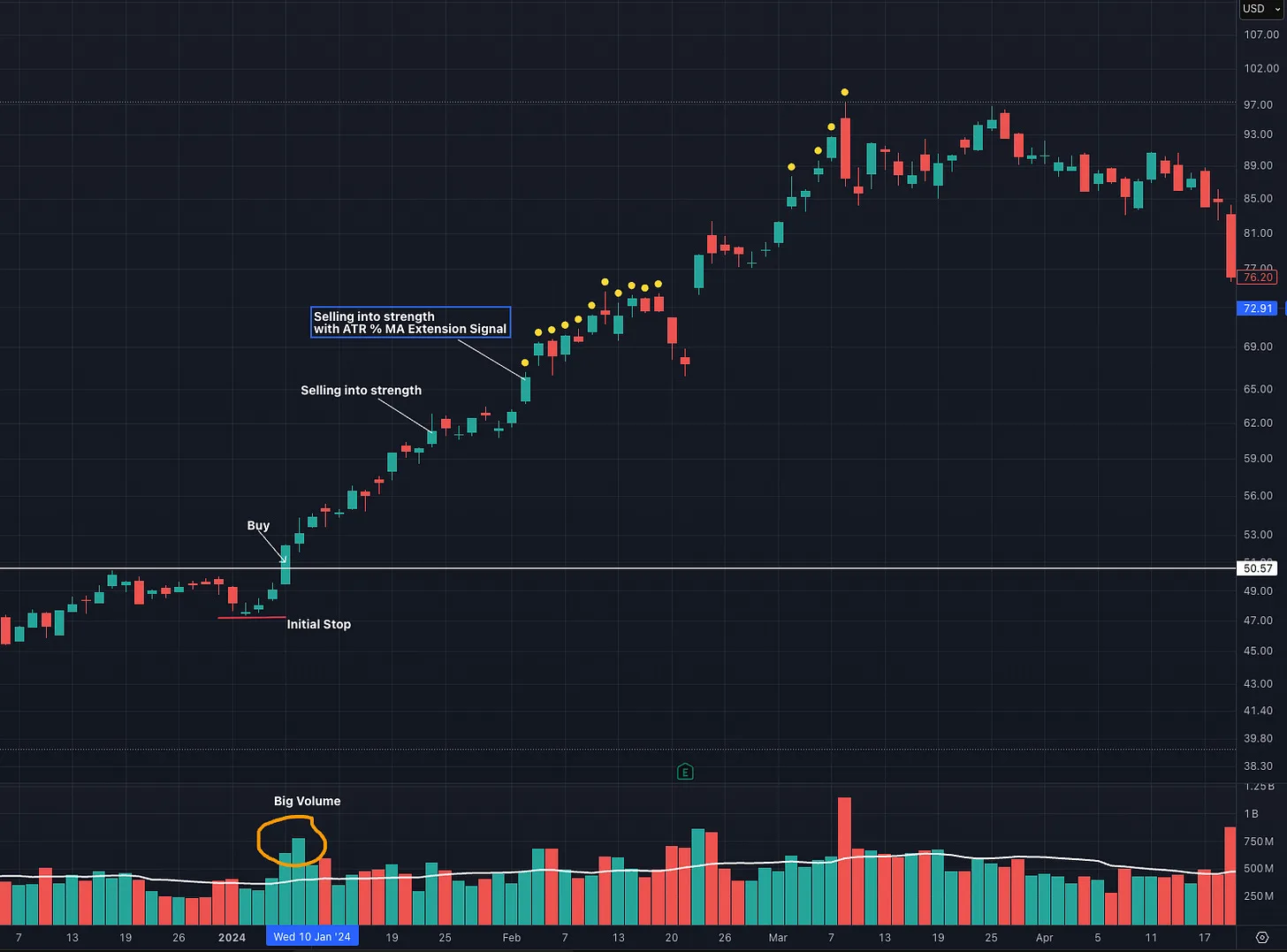
One of the most useful trade management concepts is financing risk.
This means selling part of a winning position into strength so the rest of the trade can be held with less emotional and financial pressure.
The goal is not to call the top.
The goal is to reduce risk while keeping exposure to the bigger move.
For example, let’s say you enter a stock with a 6% risk.
The stock quickly moves up 18%.
You are now up roughly three times what you originally risked.
At that point, you have options.
You can:
- Sell one-third or one-half into strength
- Move the stop to break-even
- Move the stop under the first natural reaction low
- Keep the full position but trail it with a defined method
- Use the open profit to finance a later add-back
This is where trading becomes more flexible.
You are no longer just asking, “Should I sell or hold?”
You are asking:
“How can I reduce risk while still giving this stock a chance to become a bigger winner?”
That is a much better question.
Selling into strength versus selling into weakness
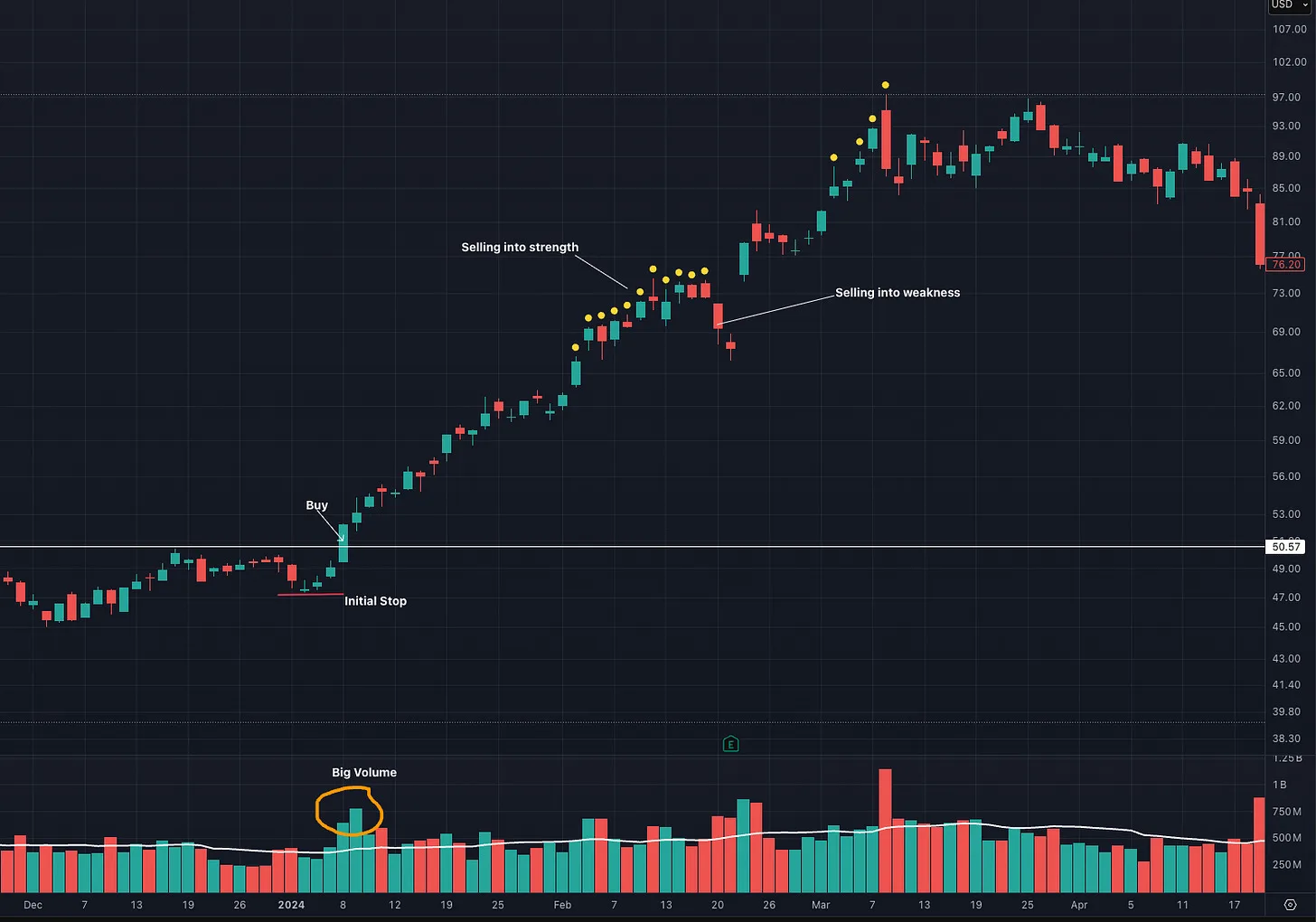
There are two basic ways to take profits.
You can sell into strength.
Or you can sell into weakness.
Selling into strength means trimming when the stock has moved sharply in your favor.
Maybe it is extended from the moving averages.
Maybe it is up three, four, or five times what you risked.
Maybe it is approaching a logical profit zone based on your average gain, prior moves, or historical tendencies.
Selling into weakness means waiting until the stock starts to break a trailing stop or show a character change.
Both can work.
The key is understanding what each one does.
Selling into strength
Selling into strength helps you lock in something while the stock is still acting well.
It can reduce regret if the stock reverses.
It can finance the rest of the trade.
It can help you hold the remaining shares longer.
The downside is that you may sell some too early.
That is why I usually think of selling into strength as a partial sale, not a full exit.
You are not saying the move is over.
You are saying the trade has paid you enough to reduce risk.
Selling into weakness
Selling into weakness keeps you fully invested as long as the trend remains intact.
This can be better for catching larger moves.
The downside is that you will usually give back more before exiting.
That is the tradeoff.
The best approach is often a blend.
Sell some into strength.
Trail the rest using a defined method.
That way, you get paid on part of the position while still giving yourself a chance to participate in the larger move.
The first natural reaction matters
One of the most important moments in a trade is the first natural reaction after the breakout.
A stock rarely goes straight up forever.
Even the strongest leaders pause, pull back, or consolidate.
The key question is:
How far did the stock move before that first reaction?
There is a huge difference between these two situations.
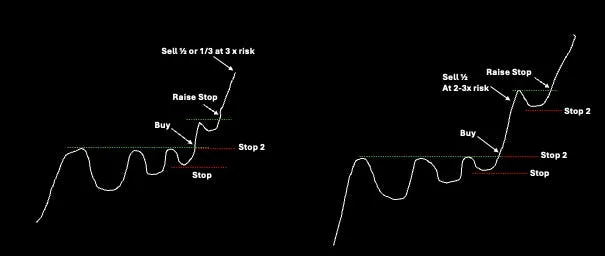
Scenario 1: The stock is only up 1R before pulling back
If you risked 6% and the stock is only up 6% before the first pullback, that is not a huge reward yet.
In that case, selling too early may turn you into a one-to-one trader.
If your strategy depends on average winners being much larger than average losers, constantly taking 1R profits can destroy your edge.
In this scenario, I am more likely to give the stock room and let the initial stop do its job.
Scenario 2: The stock is up 3R or more before pulling back
Now it is different.
If you risked 6% and the stock quickly moves up 18%, 24%, or 30%, the trade has given you a meaningful profit cushion.
At that point, I want to start thinking about protecting break-even or locking in something.
That does not mean selling the whole position.
It means the trade has earned enough that I do not want to watch the entire gain disappear without a plan.
This is why context matters.
You cannot manage every trade the same way.
A slow 1R move and an explosive 4R move require different decisions.
Trading around a position
Trading around a position means you are not just buying once and selling once.
You may trim part of the position into strength, hold the rest, and then add back later if the stock sets up again.
This can be powerful with true market leaders.
For example:
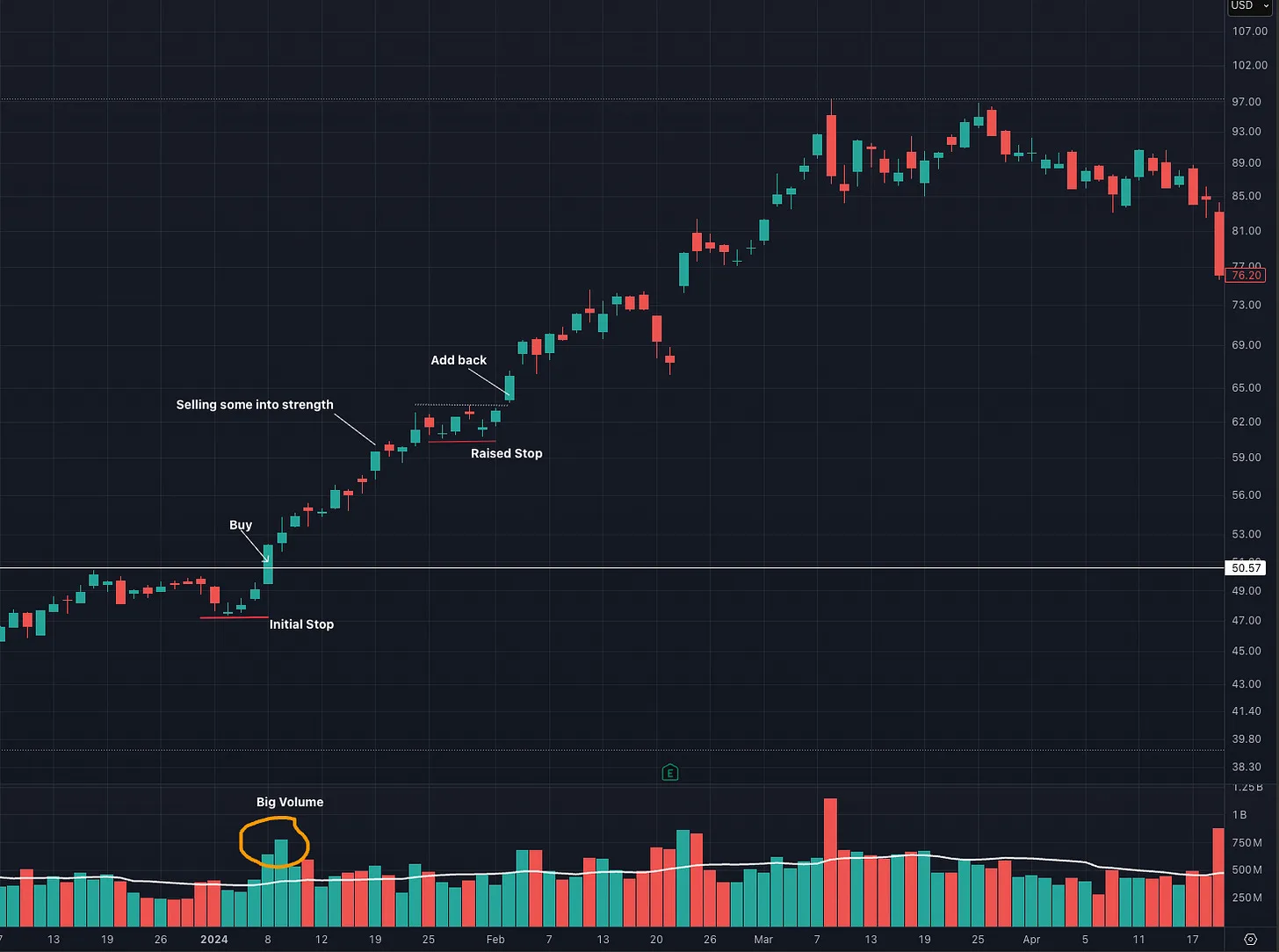
- You buy the breakout.
- The stock moves in your favor.
- You sell one-third or one-half into strength.
- The stock pulls back naturally and tightens.
- It breaks out again with strong volume.
- You add back the shares you trimmed.
- You raise your stop based on the new structure.
This allows you to stay aligned with the larger trend while still managing risk along the way.
You are not blindly holding.
You are not randomly selling.
You are using strength, pullbacks, and new setups to manage exposure.
Adding without increasing total risk
A lot of traders hear “average up” and assume it means taking more risk.
It does not have to.
You can add to a winning position while keeping the total dollar risk the same, but only if you raise the stop correctly.
Here is the basic idea.
You buy the first position.
The stock moves in your favor.
You now have open profit.
If the stock sets up again, you can use some of that open profit to finance the add.
But you cannot leave the original stop far below the market and keep adding aggressively.
That is how a winning trade turns into a mess.
When you add, you need to recalculate the risk on the full position.
The new stop has to make sense for the combined shares.
The question is not, “Can I add?”
The question is:
“If I add here and the new stop gets hit, what is the total result on the entire trade?”
If the answer is still acceptable, the add may make sense.
If the answer turns a good trade into unnecessary account risk, the add is too aggressive.
How to choose the right trailing method
The right trailing stop depends on the kind of trade you are trying to capture.
Here is how I generally think about it.
Use a faster moving average when the trade is shorter-term
If I am trying to capture a shorter swing, I do not want to give the stock a massive amount of room.
A 10-day or 20-day moving average may be more appropriate.
Use a wider ATR or Donchian stop when the goal is a larger trend
If I believe the stock has potential to become a larger position trade, a wider stop may make sense.
That could mean a dynamic ATR trailing stop, a Donchian stop, or a 50-day moving average.
Use higher lows when the structure is clean
If the stock is stair-stepping higher, I like using prior higher lows.
It keeps the exit tied directly to the chart.
Use partial sales when the stock gets extended
If a stock moves quickly and becomes extended, I usually want to sell something into strength.
Not because I know it is the top.
Because I know the trade has paid me enough to reduce risk.
Signs the trade may be changing character
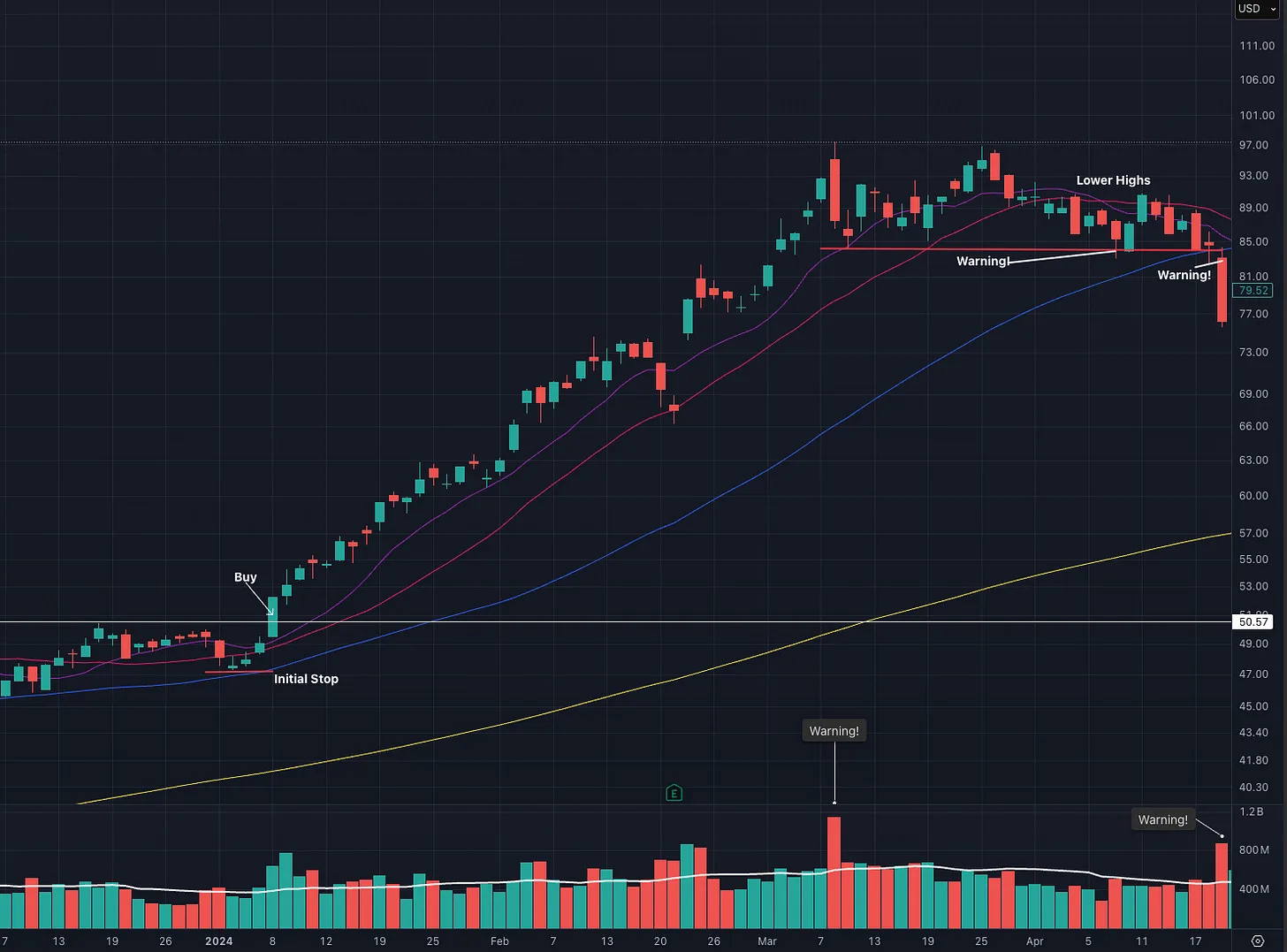
Trailing stops are useful, but they are not the only thing to watch.
Sometimes the stock starts giving clues that the character of the move is changing.
Examples:
- Breaks below a key higher low
- Closes below a moving average it had respected
- Heavy-volume selling appears after a strong advance
- Breakouts stop following through
- Pullbacks get deeper and more volatile
- The stock starts lagging while the market or group remains strong
- The stock gives back a large portion of the move and cannot reclaim prior highs
- Earnings or news changes the original thesis
A character change does not always mean the stock is doomed.
It means the risk-reward has changed.
That is the point.
You do not need to predict the future.
You need to recognize when the current trade no longer looks like the trade you originally entered.
The most important question after a stock has already run
After a stock has made a big move, ask this:
Would I buy it here today with the same conviction and the same risk-reward?
If the answer is no, then you need to ask why you are still holding the full position.
Sometimes the answer is:
“Yes, because the trend is intact and my trailing stop gives it room.”
That is fine.
Sometimes the answer is:
“No, but I am emotionally anchored to my entry and I do not want to sell because I might miss more upside.”
That is not a plan.
That is attachment.
The market does not care where you bought.
It only cares what the position is worth now and what the risk-reward looks like from here.
A simple trade management framework
Here is a simple framework you can apply.
Before entry
Know:
- Where you are buying
- Where you are wrong
- How much you are risking
- Whether the stop makes sense technically
- Whether the position size makes sense
- What kind of trade you are trying to capture
After the trade starts working
Ask:
- Am I up enough to protect break-even?
- Has the stock moved 3R, or more?
- Is it extended from the moving averages?
- Has it gone through its first natural reaction?
- Should I sell some into strength?
- Should I raise the stop under a higher low?
- What is price telling me right now?
As the trade matures
Decide:
- Am I trailing with ATR?
- Am I trailing with a moving average?
- Am I trailing with Donchian channels?
- Am I trailing under higher lows?
- Am I holding for a larger trend or managing a shorter swing?
- Has the stock changed character?
When the trade starts weakening
Ask:
- Did it break the level that mattered?
- Did the risk-reward change?
- Am I still holding because of the chart or because of my entry price?
- Is this still one of the best uses of my capital?
That last question is important.
Every dollar in a weak trade is a dollar that cannot be used in a better opportunity.
The goal is not perfection
You will not sell every top.
You will sell some stocks too early.
You will hold some too long.
You will trim a position and watch it keep running.
You will hold a position and wish you had trimmed more.
That is trading.
The goal is not perfection.
The goal is having a repeatable process that keeps losses controlled, protects good gains, and still gives you the chance to capture the big outlier winners.
Final thought
Finding a winning stock is only one part of trading.
Managing it correctly is what determines whether that winner actually changes your account.
A great entry can still become a mediocre trade if you mismanage the exit.
A good winner can become a scratch trade if you never protect anything.
A potential monster can become a small gain if you sell everything too quickly.
That is why trade management matters.
The best traders are not just good stock pickers.
They are risk managers.
- They know when to cut the loss.
- They know when to protect break-even.
- They know when to finance risk.
- They know when to trail the rest.
And most importantly, they know that every trade has to be reevaluated as the risk-reward changes.
Because the goal is not to be right on every trade.
The goal is to survive the losses, protect the winners, and stay in the game long enough for the big moves to matter.
Want to go deeper?
This article only scratches the surface of trade management, risk control, position sizing, and the process of finding true market leaders.
Inside the full Momentum Trading Strategy Course, I go much deeper into these concepts with video lessons, chart walkthroughs, real examples, and the tools I use to manage trades from entry to exit.
We cover how to define risk before entering, where to place stops, how to trail winners, when to sell into strength, how to finance risk, how to size positions properly, and how to review your trades so you can keep improving over time.
The full course and software platform are included with All-Access.
More in Strategy & Tactics
All Strategy & Tactics articles →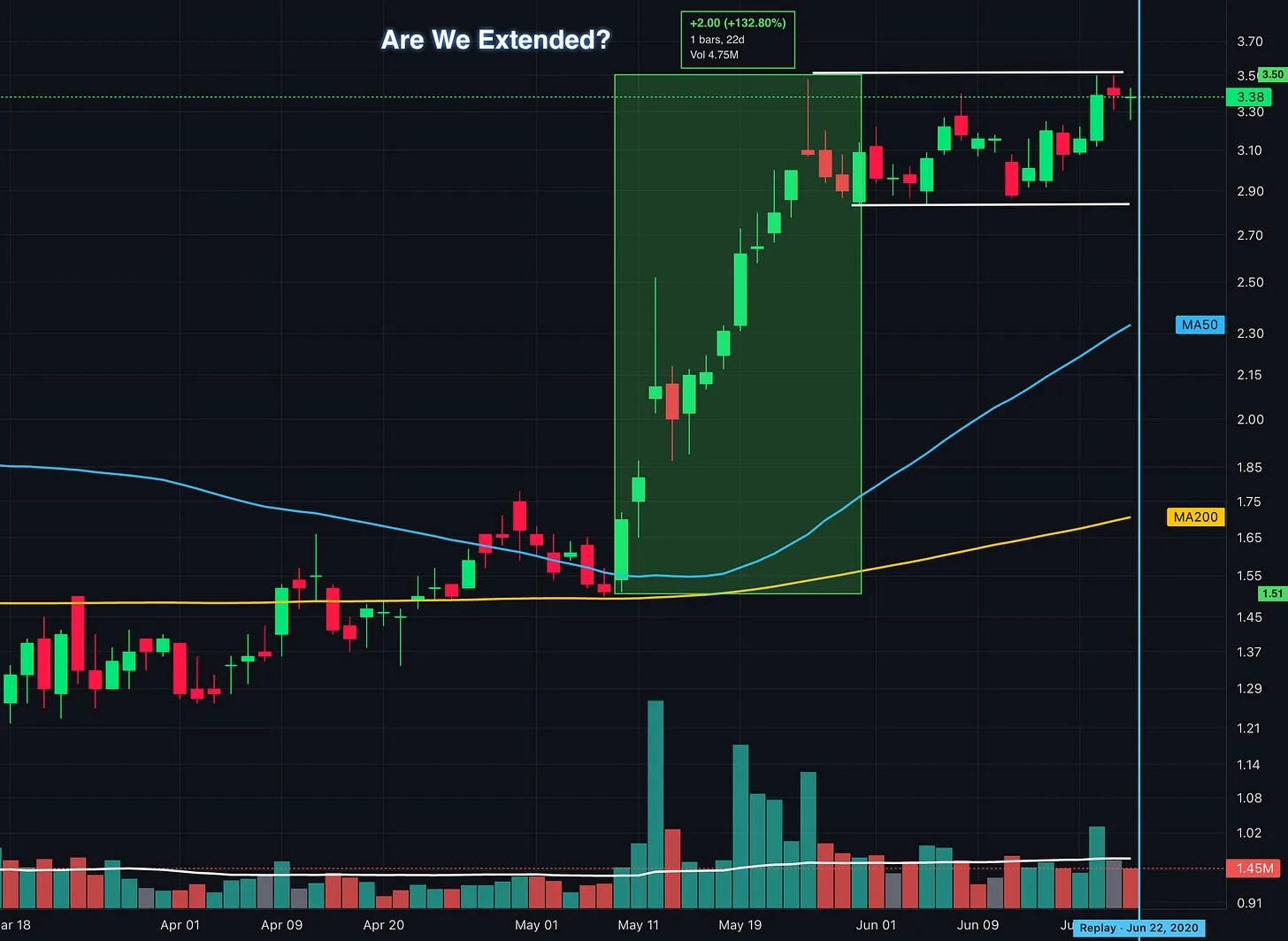
Oct 8, 2026 · Strategy & Tactics
Up 100% and Still Buyable? What Traders Get Wrong About Extended Stocks
How to identify proper buy points, avoid chasing stock breakouts, and manage entry risk using lessons from William O’Neil, Mark Minervini, David Ryan, and Dan Zanger.
- Momentum Trading
- VCP
- position trading
- Growth Stock Trading
- David Ryan
- Flag Pattern
- chart patterns
- Cup and Handle
Sep 27, 2026 · Strategy & Tactics
Should You Follow Leading Stocks or Wait for Market Confirmation?
How to read the market, industry groups, and individual stocks together so you can recognize opportunities, build exposure, and respond when conditions change
- growth stocks
- CANSLIM
- Trading
- position trading
- Stan Weinstein
- William O'Neil
- Momentum Trading Strategy
- Trade stocks
Sep 25, 2026 · Strategy & Tactics
Stage Analysis: How to Spot Stage 3 in Real Time
Recognize a developing Stage 3 using Stan Weinstein’s framework, with real chart examples, warning signs, and lessons for protecting your gains
- Momentum Trading
- Nasdaq
- technical analysis
- CANSLIM
- position trading
- Stan Weinstein
- QQQ
- Find True Market Leaders