Momentum Trading Strategy

Notes

Selling & Holding Winners

Managing a trade after it starts working: when to take profits, how to stay in big winners, and when to exit.

Showing 21–40 of 95 notes

View on Substack ↗

Swing Trader or Position Trader? The Difference Is Management

The underlying strategy may be the same. What changes is the entry, holding period, and method used to manage the trade.

Time frame affects how long we hold a position and how we manage the trade. It does not necessarily change the foundation of the strategy.

Mark Minervini describes swinging in and out of stocks to compound capital, while David Ryan emphasizes holding winners as long as the uptrend remains healthy. These are tendencies, not rigid rules.

Minervini may hold an exceptional winner for multiple quarters, while Ryan will exit immediately if a new position hits his stop or doesn’t act right.

William O’Neil also combines profit-taking rules with provisions for holding exceptional winners longer. Position trading does not mean holding every purchase for years or tolerating big drawdowns. The longer holding period applies only to stocks that continue acting correctly.

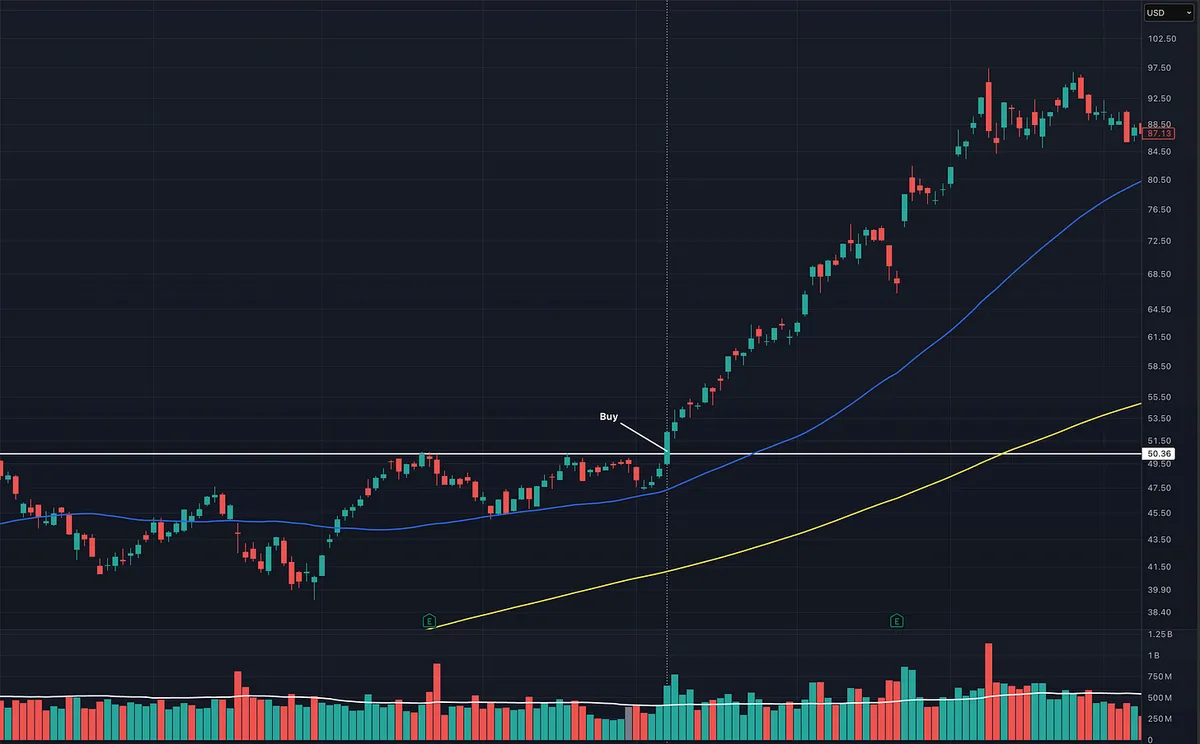
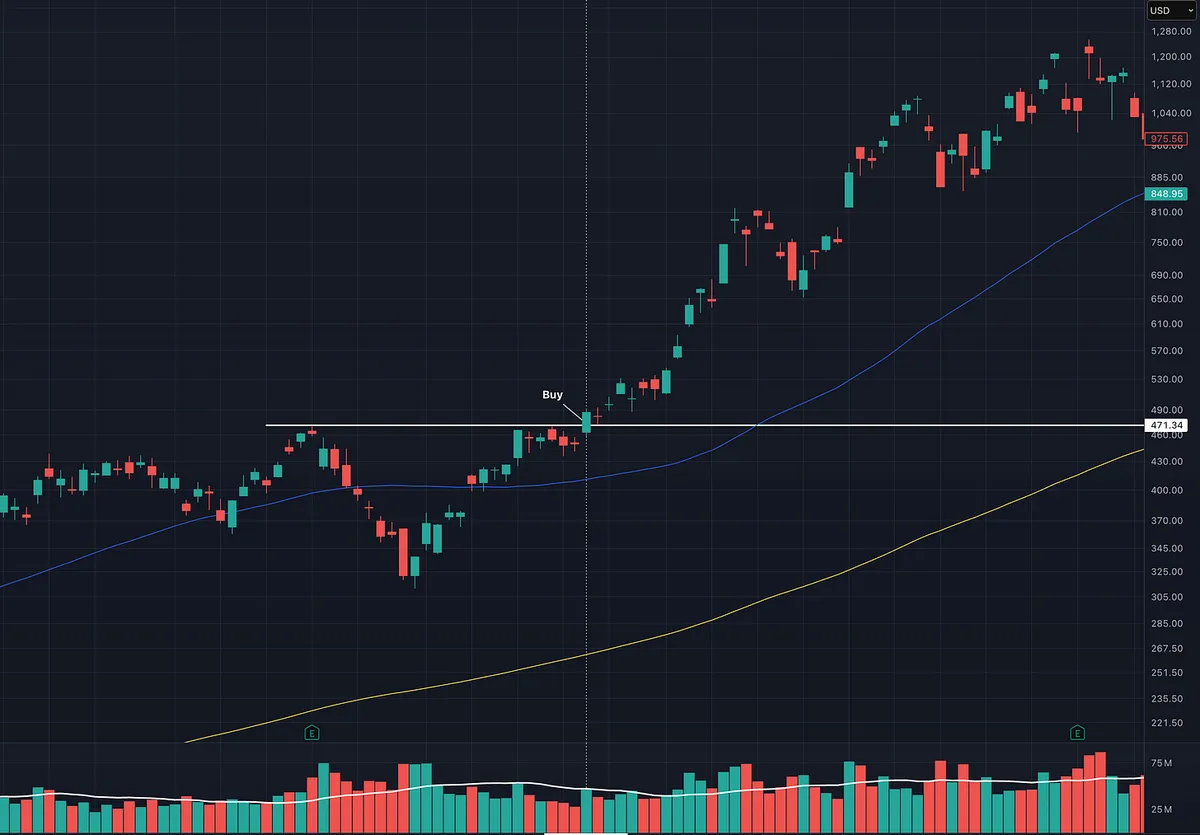
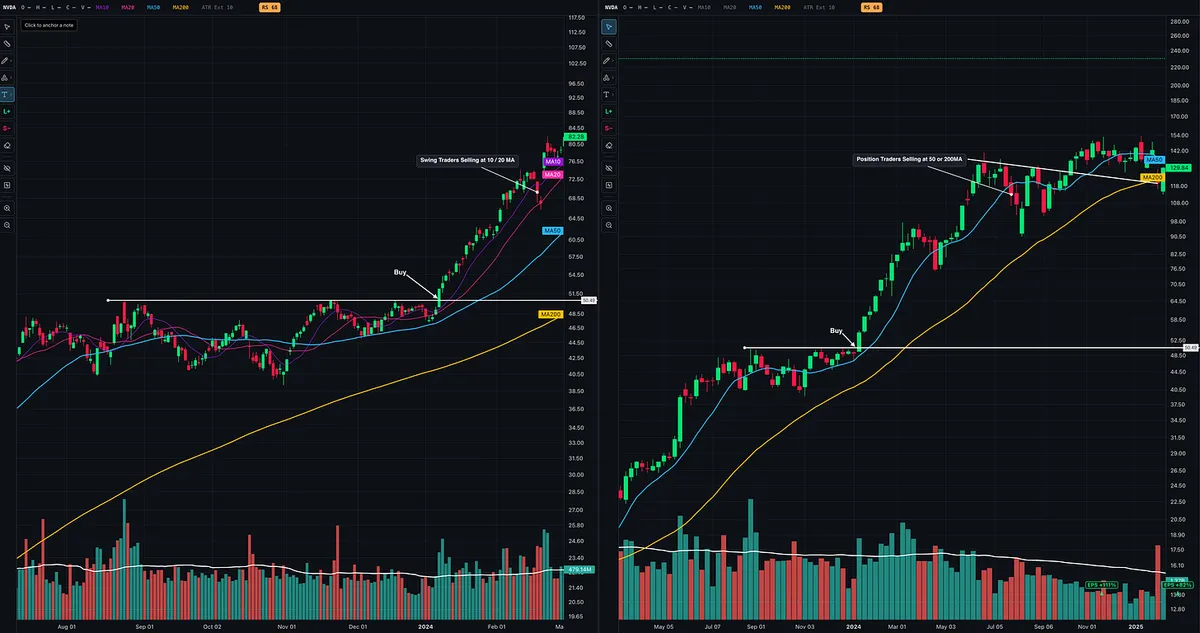
NVDA illustrates how the same opportunity can be managed differently depending on the trader’s time frame.

In this example, both traders enter at the same breakout.

The swing trader may capture the faster portion of the move and begin selling as the stock loses its shorter-term 10-day or 20-day moving averages. The position trader may give the stock more room and use the 50-day or even the 200-day moving average, along with the larger price structure, to participate in a longer advance.

They do not have to use the same entry, either.

One trader may enter on an early cheat, pullback, or pullback reversal, while another waits for the traditional breakout. These are differences in execution, not necessarily differences in the underlying strategy.

Many newer traders confuse a trader’s time frame with the time frame of the chart being viewed. They are related, but they are not the same thing.

A setup can be visible on the weekly chart that is not as clear on the daily chart. A shorter, tighter setup may also appear on the daily chart without creating a distinct pattern on the weekly chart.

Ideally, as we see in this NVDA example, the daily and weekly charts are aligned. The weekly chart confirms the larger Stage 2 uptrend and overall price structure, while the daily chart provides a more precise view of the setup, entry, and risk.

David Ryan is primarily a position trader, but he studies both daily and weekly charts. Minervini generally trades shorter-term swings, but he also uses both.

A swing trader may naturally rely more heavily on the daily chart for setups, entries, and trade management while using the weekly chart for context. A position trader may rely more heavily on the weekly chart for the larger trend and base structure while using the daily chart to refine entries and manage risk.

The chart time frame is the lens being used. The trading time frame is how the position is managed.

A position trader generally seeks to compound capital by giving winning stocks more time to produce larger gains. A swing trader seeks to compound the account through greater trade frequency.

What they share is more important than what separates them.

Both are buying a high-relative-strength leader in a confirmed Stage 2 uptrend with constructive price and volume characteristics. The opportunity may be the same. The difference is how each trader chooses to manage it.
View on Substack ↗

When Should You Sell a Winning Stock?

Finding a great stock is only half the battle.

The harder part is knowing when to hold, when to trim, and when to protect the gain without cutting a potential monster winner short. In this post, I break down how I use moving averages, donchian channels, higher lows, ATR trailing stops, partial sales, and financing risk to manage winning trades.

O’Neil and Minervini both spent a lot of time on this exact problem because how you manage the winner can matter just as much as finding it.

👉 Read: https://tradingmomentum.substack.com/p/when-should-you-sell-a-winning-stock

ArticleWhen Should You Sell a Winning Stock? The Trade Management Playbook
View on Substack ↗

You Don’t Need to Be Right That Often

One of the best lessons in Momentum Masters is…..

You do not need a high win rate to make big money.

Mark Minervini says he would rather keep losses small and let gains outweigh them than focus on being right all the time.

David Ryan says two or three really good stocks in a year can make up for all the small losses.

Dan Zanger says most of his profits came from a small number of massive winners.

Small losses are part of the business.

The mistake is letting a small loss turn into a large one, or selling your best winners too early.

Keep losses small, let winners run.

View on Substack ↗

The Best Way to Hold a Winner Longer? Sell Some of It.

That may sound backward, but it is one of the best lessons I learned from Mark Minervini after first learning the basics from William O’Neil.

In Trade Like a Stock Market Wizard and Think & Trade Like a Champion, Minervini explains how the priorities of a trade should change as it progresses:

  1. Limit the loss.

  2. Protect the break-even point.

  3. Protect the profit.

Once a stock advances multiples of your initial risk, one option is to sell part of the position and protect break-even on the remaining shares.

Minervini refers to this as a “free roll,” because the profit taken on the first portion can finance the risk on the rest of the trade.

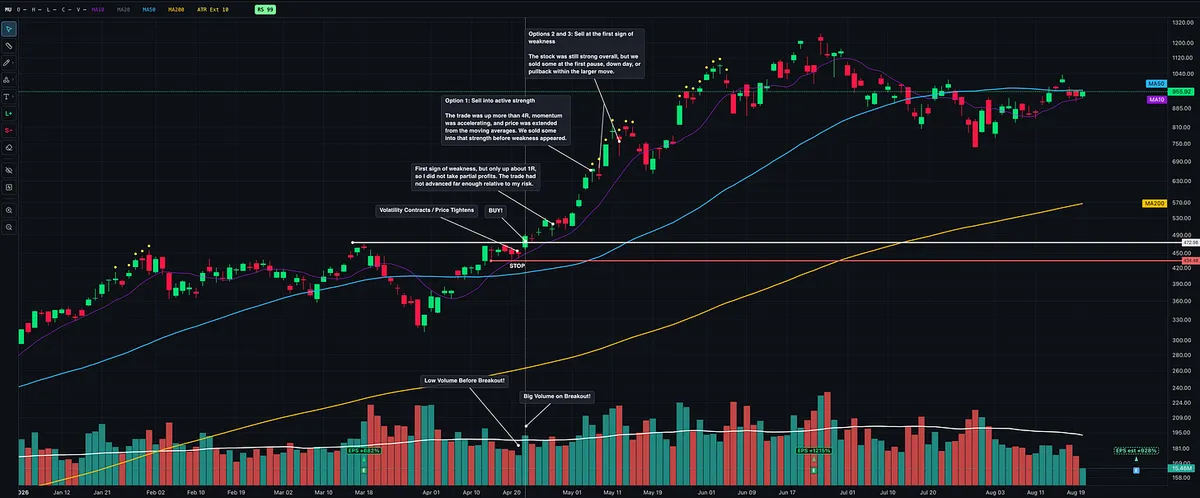
However, I do not automatically sell just because a stock reaches 2R or 3R. There are two ways I may take partial profits after a powerful advance.

The first is selling into active strength.

If a stock is advancing normally, or surges into a rapid move with powerful momentum, I may sell some while it is actively moving higher. I am not trying to guess the top. The stock will often continue rising after I sell some, and that is perfectly fine.

The second is selling at the first sign of weakness following a powerful advance.

If it is an exceptionally fast-moving stock and I am already up three times my risk or more, I may let it continue running as long as possible. Once the momentum begins to cool, I may sell some during the first down day, the beginning of the first pullback, or the first sideways consolidation.

In Minervini’s terminology, the first method is selling into strength and the second is selling into weakness. However, both involve taking profits while the stock remains in a position of strength overall. I am not waiting for a major breakdown or serious technical damage.

Plenty of extremely successful traders manage positions differently. Some focus more on adding to their winners and holding the entire position through deeper pullbacks. That works too.

But taking partial profits and then protecting break-even is what has worked best for me.

I like getting into a position where my original principal is protected and I am managing the remaining position with profits already locked in. Even if the stock comes all the way back to my stop, I can still walk away with a small winner.

But the small profit is not the biggest benefit.

The biggest benefit is the patience and clarity it gives me.

Once I have sold some and protected my break-even point, I am far less tempted to react to every small intraday move or normal daily pullback. Even if I entered using an intraday or daily chart, I can shift my attention to the weekly chart, filter out the noise, and give the larger trend room to develop.

That makes it much easier to stay with a true market leader long enough for it to become a major winner.

The key is not to move the stop to break-even too quickly. The trade must first earn that adjustment by producing a meaningful gain. Otherwise, you risk choking off a perfectly healthy position before it has enough room to work.

One final point: taking partial profits does not mean I never add to the position again.

If the stock continues working, makes higher highs and higher lows on the larger timeframe, and forms another constructive consolidation or base, I may add shares back as it turns higher or triggers another entry.

The profits already locked in can help finance the risk on those additional shares.

Minervini describes a similar technique as “Add and Reduce.” More broadly, many growth stock traders refer to this as trading around a core position.

Selling part of a position does not mean losing conviction in the stock. It means actively managing risk while preserving the opportunity for a much larger gain.

Sometimes selling a little sooner is exactly what allows you to hold the real winner much longer.

View on Substack ↗

Everyone’s Afraid of an AI Bubble. They’re Missing the Point.

We are likely in an AI bubble.

That does not mean artificial intelligence is fake, useless, or incapable of changing the world.

Railroads changed the world and helped fuel major investment manias.

The automobile, radio, electricity, aviation, and other new technologies helped drive the speculative boom of the 1920s.

The internet changed the world and created the dot-com bubble.

The pattern is familiar.

Transformative innovation attracts capital.

Capital attracts excitement.

Excitement turns into speculation.

Eventually, prices run ahead of reality.

Then the bubble bursts.

But the crash does not make the technology disappear.

Most of the weak companies are wiped out, capital becomes more disciplined, and the strongest survivors continue building the future.

That is often where the real transformation begins.

So being in a bubble does not mean we stop trading.

For a growth stock or momentum trader, bubbles can create some of the greatest opportunities in the market.

The real danger is not participating, and participating without sell rules.

Inexperienced investors buy the biggest names, assume the trend will continue forever, and never decide when to take profits or when to exit.

That is not what we do.

We do not need to predict the exact day the bubble pops.

We follow price, volume, market direction, institutional selling, and the behavior of leading stocks.

As the evidence weakens, we peel out of positions and raise cash.

William O’Neil taught it.

Mark Minervini teaches it.

It is exactly what I teach inside the Momentum Trading Strategy course.

The bubble is not what should scare you.

Having no sell rules should.

View on Substack ↗

Would You Risk Months of Progress on One Earnings Report?

You finally find the right stock.

The setup works. The stock breaks out. You sit through the normal pullbacks, manage the position correctly, and build a meaningful profit.

Then you see the earnings date.

Now the question starts running through your head:

Do I hold and risk giving back the gain, or sell and watch the stock gap up without me?

Every serious trader eventually faces this decision.

There is no perfect answer because earnings reactions are unpredictable. A company can report outstanding numbers, raise guidance, and still sell off. Another company can report disappointing results and gap higher.

That is why I never buy a new position immediately before earnings.

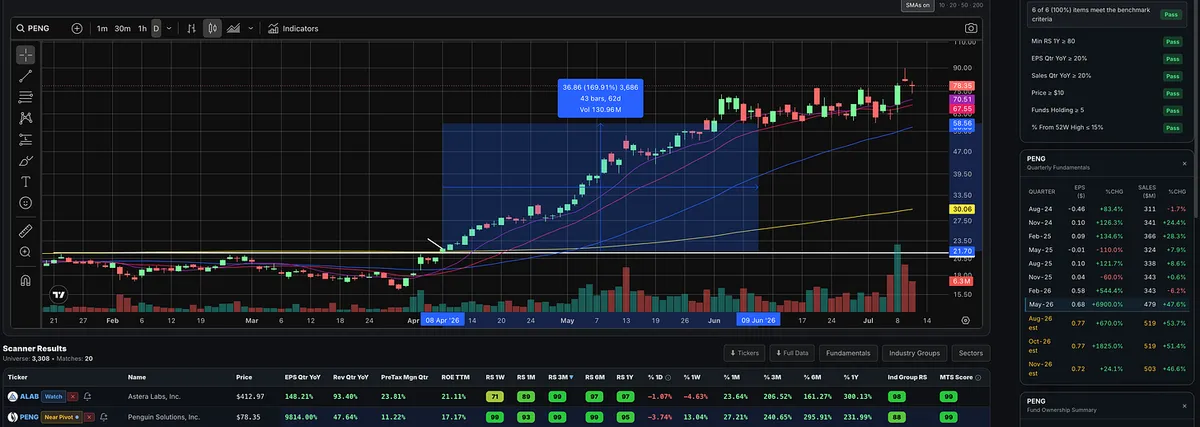
But if earnings are still a couple of weeks away and the setup is excellent, I may take the trade. That gives the stock time to move higher and allows me to build a profit cushion before the report.

If I am up 15% to 20%, I will often sell part of the position into strength and hold a smaller piece through earnings.

But here is the part traders often misunderstand:

A profit cushion does not eliminate earnings risk.

A stock can easily gap down more than your entire gain. The real question is not simply whether you are profitable.

The real question is:

How much damage could this position do to your account if the reaction is brutal?

That is what determines how much I hold.

I consider the health of the market, the strength of the industry group, the stock’s price action, its volatility, my total exposure, and how well I have been trading recently.

When the market is healthy, my portfolio is performing well, and the stock remains a leader in a strong group, I may accept more earnings risk.

When the market is deteriorating or my trades have been struggling, I protect capital. I may reduce heavily or sell the entire position before the report.

That is progressive exposure.

You earn the right to take more risk through strong performance. You do not force risk when the market or your own results are telling you to become defensive.

Longer-term positions can be different. If I have owned a stock for months, already held through a previous report, and built a very large cushion, I may hold the next earnings report without trimming.

But even then, I am not holding blindly.

The market, the industry group, the fundamentals, and the stock’s price action still need to support the decision.

Some great traders occasionally hold through earnings with reduced size and a cushion. Others refuse to hold through earnings at all.

The lesson is not that one approach is always right.

The lesson is that you need a rule before the report arrives.

Never wait until the final minutes before the close and make an emotional decision.

Know how much you are willing to lose.

Know how much of the position you are willing to hold.

Know what a severe gap would do to your total account.

And remember this:

If holding the position is going to prevent you from sleeping, the position is probably too large.

Earnings risk cannot be eliminated.

But it can be planned for, reduced, and controlled.

That is the difference between holding with a strategy and simply holding with hope.

This is the type of practical risk-management framework I teach inside the MTS Course, including a method for using a stock’s own volatility to estimate the type of earnings gap you should be prepared to withstand.

View on Substack ↗

The Best Trades Usually Don't Give You Much Time to Doubt

Have you ever noticed that your biggest winners often seem to work almost immediately?

That's not just your imagination.

William O'Neil, David Ryan, and Mark Minervini all studied their greatest winning trades and reached a similar conclusion. The vast majority moved in their favor almost immediately after the breakout. A few came back to test the entry, but most simply took off and never looked back.

What's interesting is that Peter Brandt, a classical chartist who trades differently and focuses primarily on commodities rather than growth stocks or fundamentals, arrived at the same conclusion after decades of reviewing his own results.

He found that roughly 20% of his trades produced the majority of his profits. And those exceptional trades? Most never looked back after entry. Only a small percentage returned to test the breakout.

  • Different markets.

  • Different strategies.

  • Different decades.

  • The same lesson.

The biggest winners often tell you they're winners early.

That's why these legendary traders all preach the same principle:

Cut your losses quickly and keep them small. Then give your winners the time and space to become exceptional.

The next monster winner probably won't spend much time asking for your permission. It will simply go.

View on Substack ↗

Nothing Lasts Forever. Don’t Fall in Love With Any Stock.

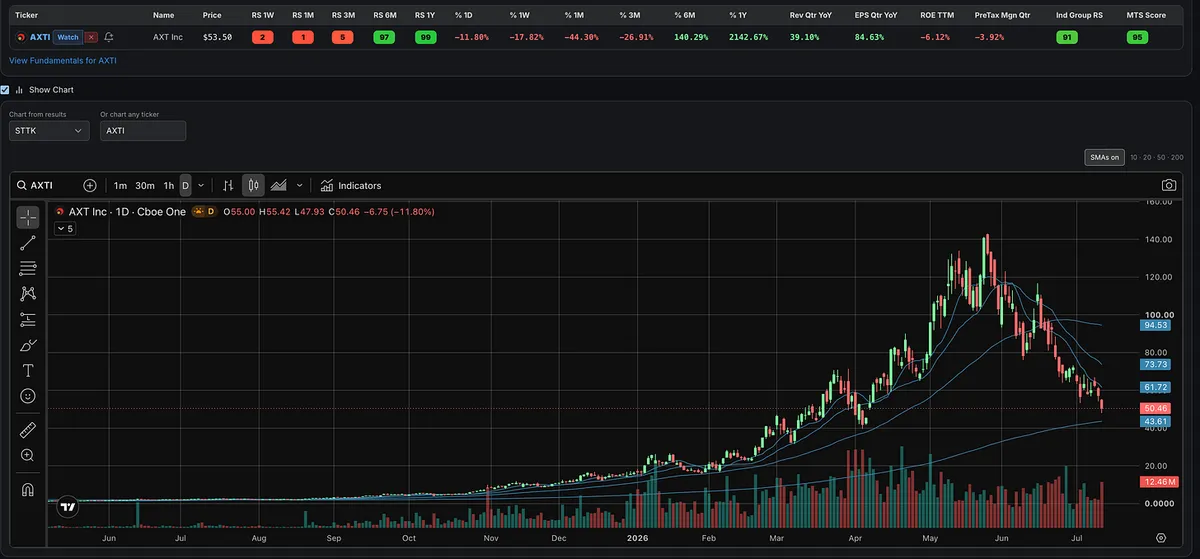
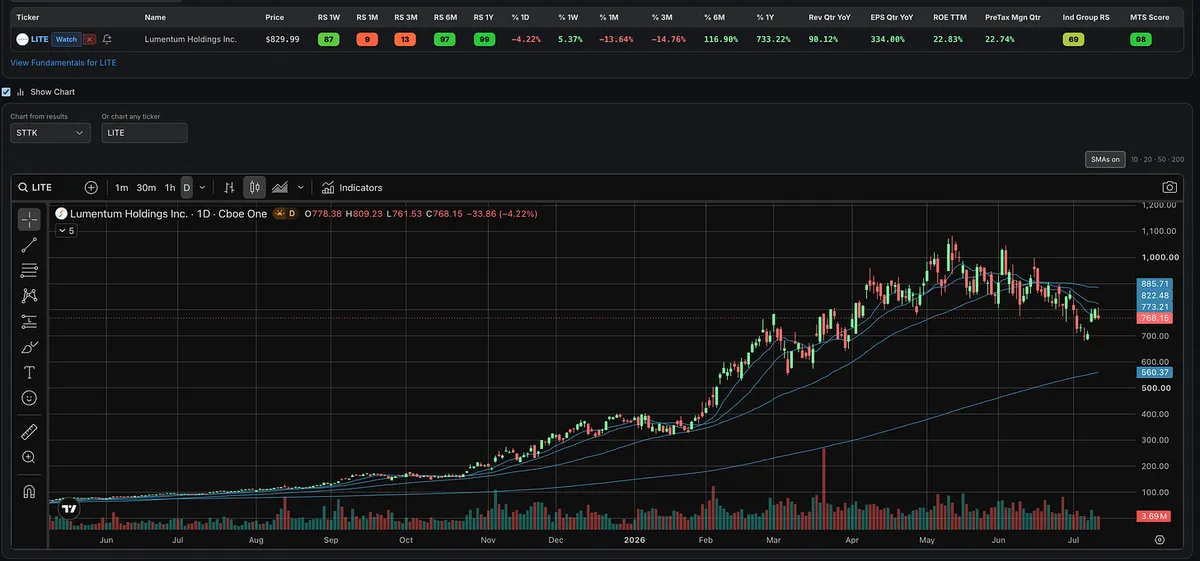
Some of the market’s biggest winners over the past year have now broken down. At least for the moment, their runs appear to be over.

AXTI delivered enormous gains over the last year, but it has now fallen below its 50-day moving average and is heading toward the 200-day. Its 10-day and 20-day lines are declining, and the 50-day is beginning to roll over.

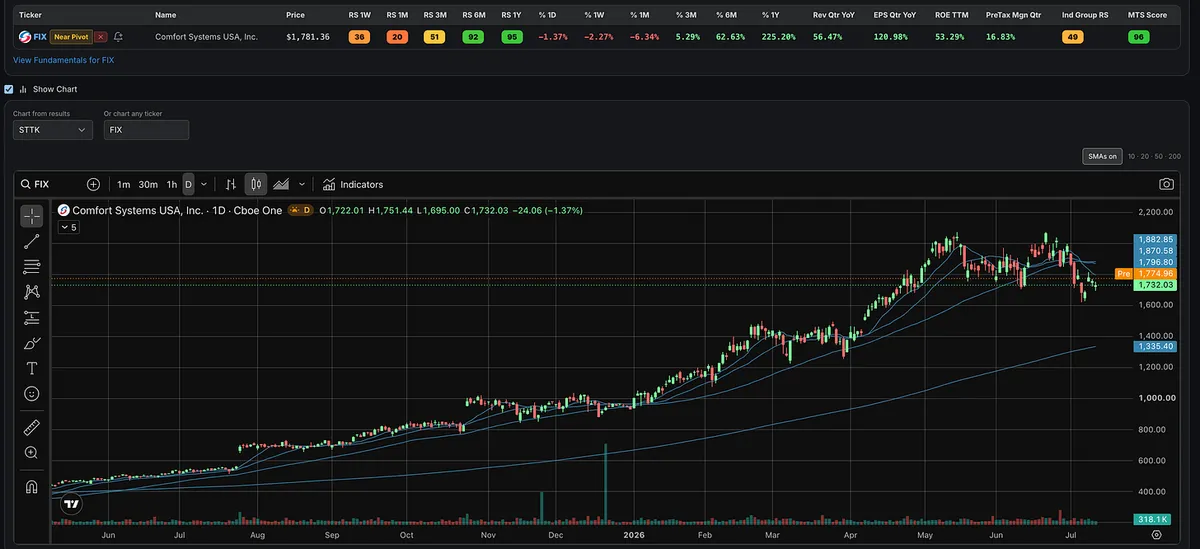
LITE, CIEN, VICR, AAOI, VIAV, TTMI, FIX, COHR, and several other former leaders have also broken down or suffered significant technical damage.

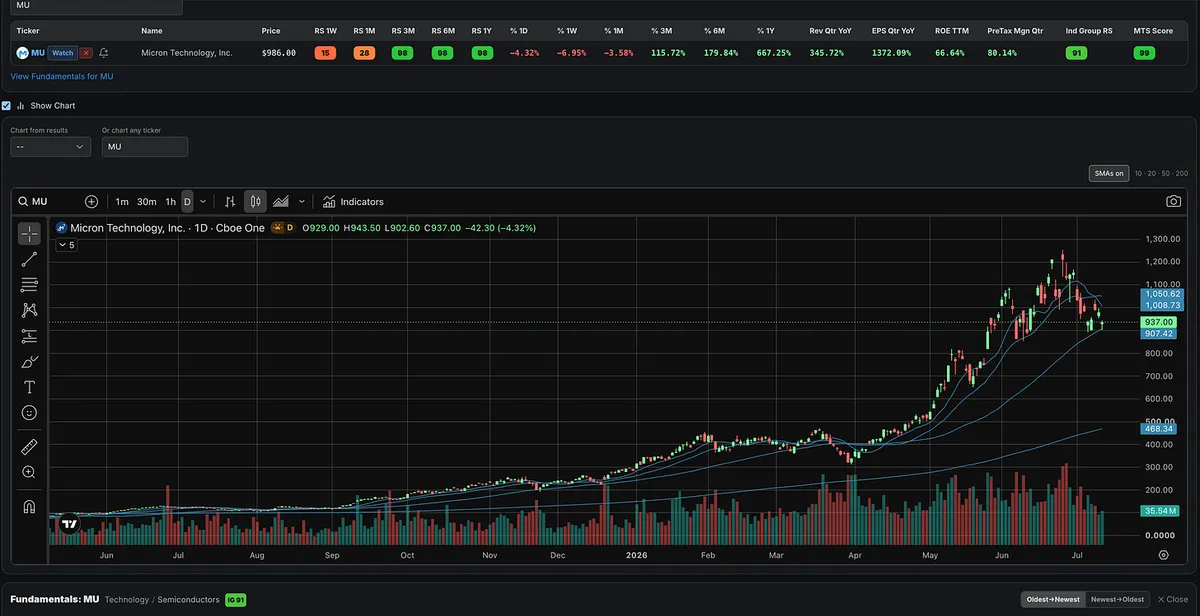
Many more are sitting in the danger zone near their 50-day moving averages. That includes the memory names SNDK, WDC, STX, and MU, along with other hot names from hot groups VPG, MBIS, MXL, LSCC, MRVL, TER, VSH, STM, ADI, INTC, TSM, LRCX, COHU, PDFS, and others.

The bottom line is that many of the stocks that have driven this market, particularly the memory, semiconductor, and telecom names, have either already broken down or are now testing a critical area around their 50-day lines.

I have not needed to share many new tickers from week to week because the same names I have discussed throughout the year continued to lead. There was no reason to constantly search for something new when the existing leaders were still working.

But nothing lasts forever.

Many of the stocks that worked all year are now either ending their runs or approaching a decisive point. Do not fall in love with any stock. Respect the price action and let the market tell you whether the trend is still intact.

View on Substack ↗

Your Stop Is Nonnegotiable. After That, the Stock and the Market Get a Vote.

Before I enter a trade, I build a plan.

My initial stop is nonnegotiable. I am 100% strict with it. I do not widen it, lower it, or give the stock more room because I suddenly feel hopeful.

At that point, my principal is still at risk and the stock has not proven itself.

But once the trade begins working, I sell some into strength and move my stop toward breakeven. From there, I still follow my plan, but I become more adaptable.

When I was in the military, we built detailed plans, but we always understood one thing:

The enemy gets a vote too.

Trading is no different.

The stock gets a vote.

Price action gets a vote.

The overall market gets a vote.

Be rigid with your initial risk.

Be adaptable once the trade has earned that flexibility.

View on Substack ↗

SNDK Loves the 50-Day

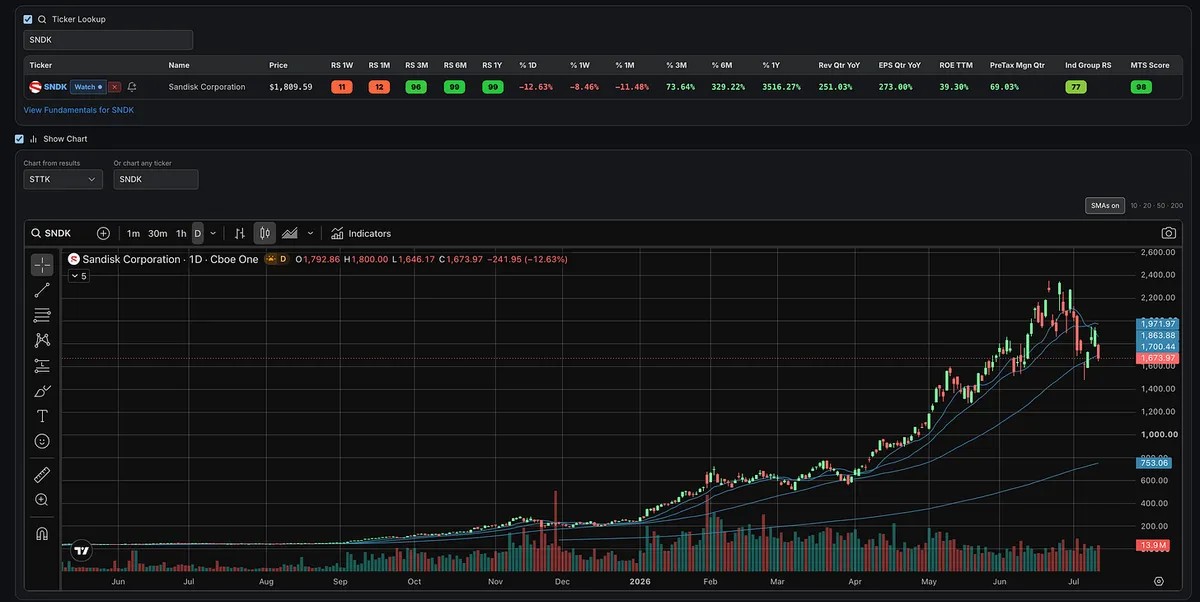
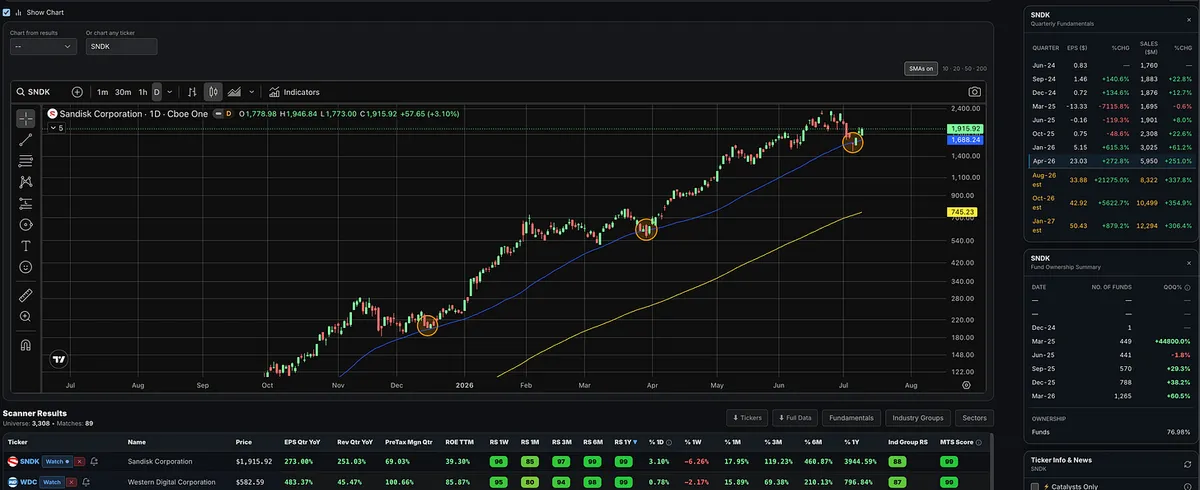
SNDK has repeatedly found support around the rising 50-day moving average throughout this massive run.

It happened in December 2025.

It happened again in late March as the market bottomed.

And now, SNDK has done it again, briefly undercutting the 50-day before reversing sharply and closing near the top of the day’s range.

We will see if the trend continues.

“The trend is your friend until the end when it bends.”

-Ed Seykota

View on Substack ↗

The Trend Is Your Friend Until It Ends

“The trend is your friend except at the end where it bends.”

-Ed Seykota

One of the hardest parts of trading is not finding a stock in an uptrend.

It is staying with it long enough to let the trend work.

This is where moving averages can help.

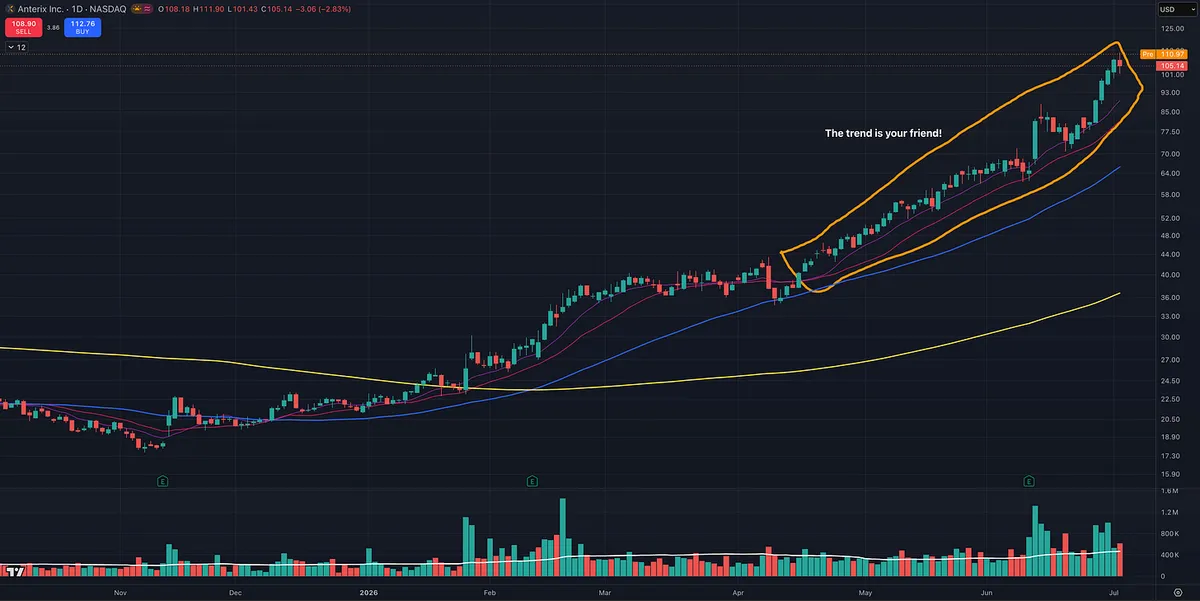
When the shorter-term moving averages are layered above the longer-term moving averages, and they are all pointing higher, you usually have a clean, orderly trend.

That helps keep you from overreacting to every small pullback.

Do you need moving averages to see this?

Of course not.

Tight price action, consistent higher highs, higher lows, and controlled pullbacks can tell the same story.

But moving averages give you a visual guide.

They help you stay with strength while the trend is intact.

And they help warn you when the character starts to change.

We do not need to predict the exact top.

We just ride the trend while it is healthy, then recognize when the stock stops acting right.

The trend is your friend.

Until it bends.

View on Substack ↗

Broken Stocks Do Not Need Your Loyalty

A stock does not care that you believe in it.

A stock does not care where you bought it.

A stock does not care how much research you did.

When price breaks down, volume expands, and leadership disappears, the message has changed.

The best traders listen.

The worst traders negotiate.

View on Substack ↗

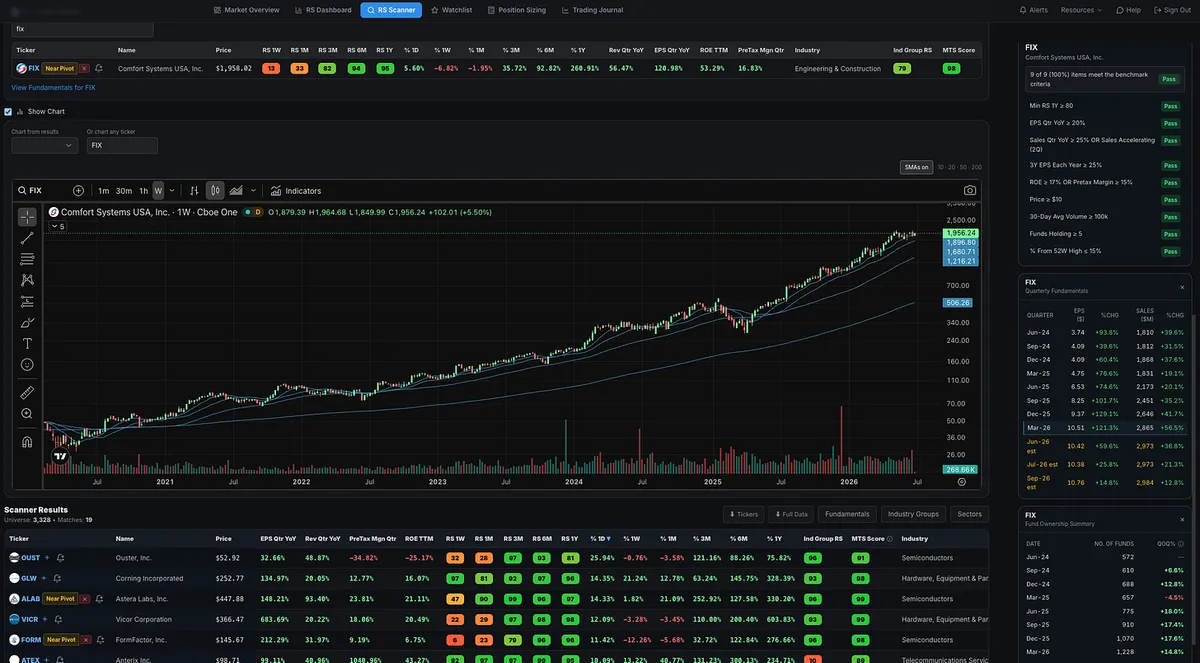
Can’t Stop, Won’t Stop: FIX

Comfort Systems USA (FIX) continues to refuse to end its trend.

Every time the stock looks like it may finally need a deeper reset, buyers show up. It has repeatedly found support around key moving averages, including the 10-week and 50-day area, and continues to hold near highs after a massive multi-year advance.

This is what real leadership often looks like. Strong stocks do not always give easy pullbacks. They ride the short-term moving averages, shake out weak hands, and keep pressing higher while traders wait for a better entry that never comes.

The fundamentals still support the move. FIX continues to show strong earnings growth, strong sales growth, high ROE, and a 98 MTS Score.

At some point, every trend ends.

But until price actually breaks, the message is simple:

The trend is still alive.

View on Substack ↗

Risk/Reward Changes With Every Candle

Paul Tudor Jones said:

“I can always tell a rookie trader because he will ask me, “Are you short or long?” Whether I am long or short should have no bearing on his market opinion. Next he will ask (assuming I have told him I am long), “Where are you long from?” Who cares where I am long from? That has no relevance to whether the market environment is bullish or bearish right now, or to the risk/reward balance of a long position at that moment.” -Paul Tudor Jones

That is one of the most important lessons in trade management.

The market does not care where you got in.

Your original entry does not determine whether the trade is still good today.

What matters is the current evidence.

  • Is the market still acting right?

  • Is the stock still acting right?

  • Has the setup matured?

  • Has the risk/reward changed?

Too many traders anchor to their entry price, their original thesis, or someone else’s position.

But the only question that matters is whether the trade still makes sense right now.

Not yesterday.

Not at your entry.

Right now.

View on Substack ↗

Everyone Wants the Next SNDK. That’s Why They Missed This One.

Most traders do not need more tickers. They need to learn how to recognize a real leader, manage risk, and stay with it until the evidence changes.

I shared SNDK back on January 22nd, and I’ve continued posting about it both publicly and inside the paid subscriber chat.

Yet I still get asked the same thing:

“What’s the next one?”

That is usually the sign of a beginning trader.

When you find a true market leader, the goal is not to immediately abandon it and go hunt for something else. The goal is to ride the move until the evidence changes.

That does not always mean you buy once and hold one full position forever.

  • You can trade around it.

  • You can sell some and hold some.

  • You can get stopped out and re-enter on a new setup.

  • You can even sell all of it and buy it back later when the stock gives you another proper entry.

But in a bull market, it is usually the same small group of names that drive most of the real performance.

Most people lose patience every time a leader pulls back, rests, or gets quiet.

Instead of waiting for the next proper entry in the strongest names, they start chasing random tickers that have not proven anything.

Meanwhile, the real leaders keep leading.

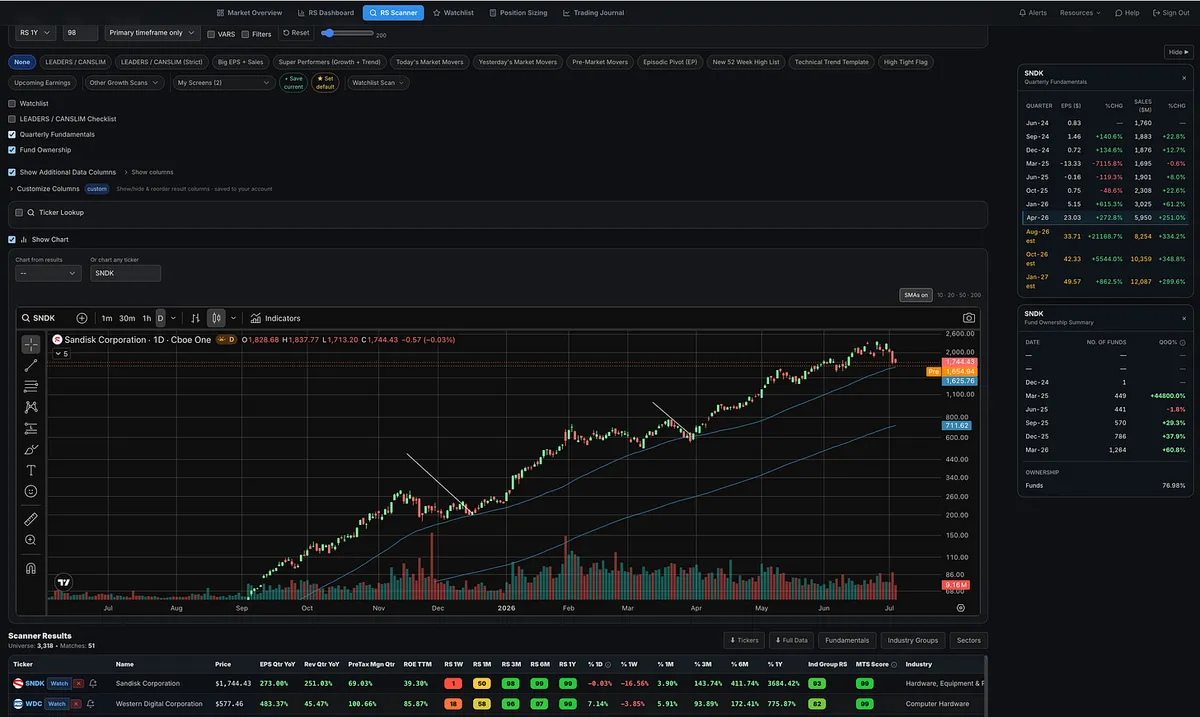
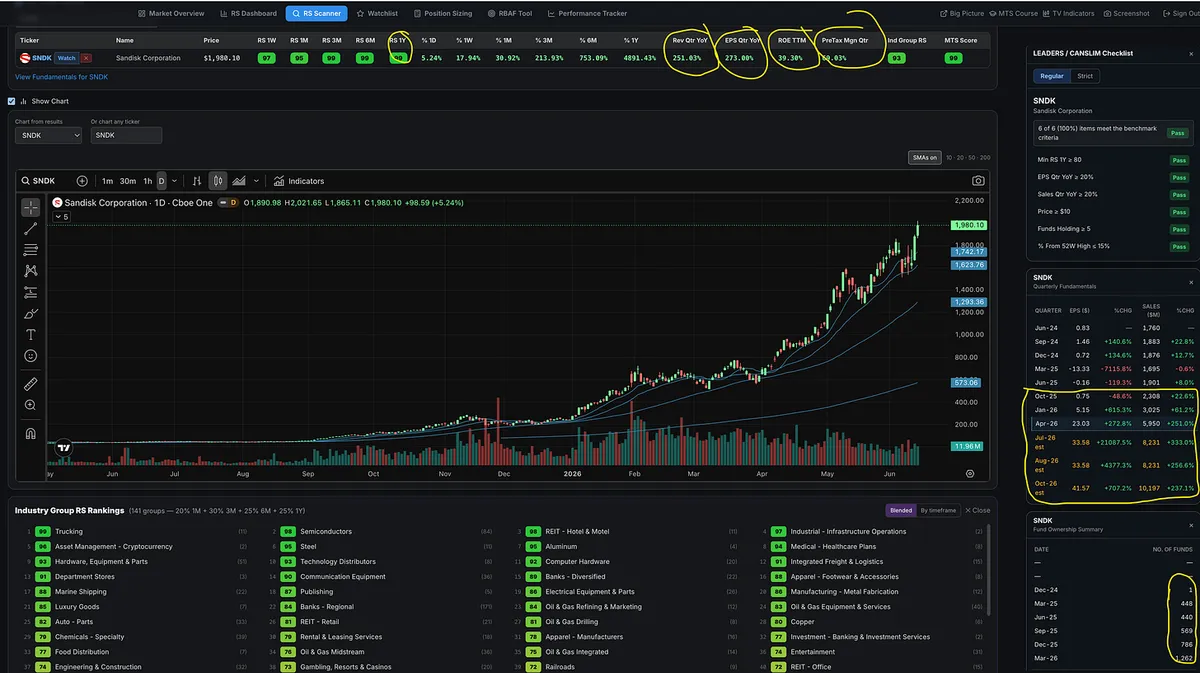
Look at SNDK.

Price action has been screaming leadership. Relative strength across multiple timeframes is among the best in the market. The industry group is strong. Earnings are accelerating. Estimates are accelerating. Sales are accelerating too, which tells you this is not just a cost-cutting story.

There is real fuel behind the growth.

Funds are accumulating.

Return on equity is strong.

Pre-tax margins are strong.

The stock is tied directly into one of the biggest themes in the market: AI infrastructure and data demand.

So at some point you have to ask:

What else are you looking for?

This is CAN SLIM growth stock in real time.

And for the people who say they do not care about fundamentals, that is fine too.

It is not a coincidence that SNDK has also been showing up as a strong trend name for systematic trend followers.

Ed Seykota has had it listed on his Strong List.

One of the greatest systematic trend followers of all time is seeing the same thing CANSLIM growth stock traders are seeing.

Different methods.

Same conclusion.

Leadership.

When all of these things are lining up, the job is not to keep begging for new tickers.

The job is to recognize leadership, manage risk, and stay with the name until the evidence changes.

That is where the big money is usually made.