
Trading articles/How Professionals Finance Risk and Why Most Traders Never Do
Jan 30, 2026 · Momentum Trading Strategy
How Professionals Finance Risk and Why Most Traders Never Do
From base structure to partial sells, this is how great traders stop risking principal
Originally published on Substack.
Most traders think risk management means smaller position sizes.
Professionals think about who is paying for the risk.
If you are still risking your original principal on every trade, you are playing a very different game than the best traders in the world.
George Soros explained this clearly in his 60 Minutes interview. His real edge came once he was no longer risking his original capital, but instead deploying accumulated profits. Mark Minervini teaches the same idea at the trade level through precise entries, partial sells, and aggressive risk reduction.
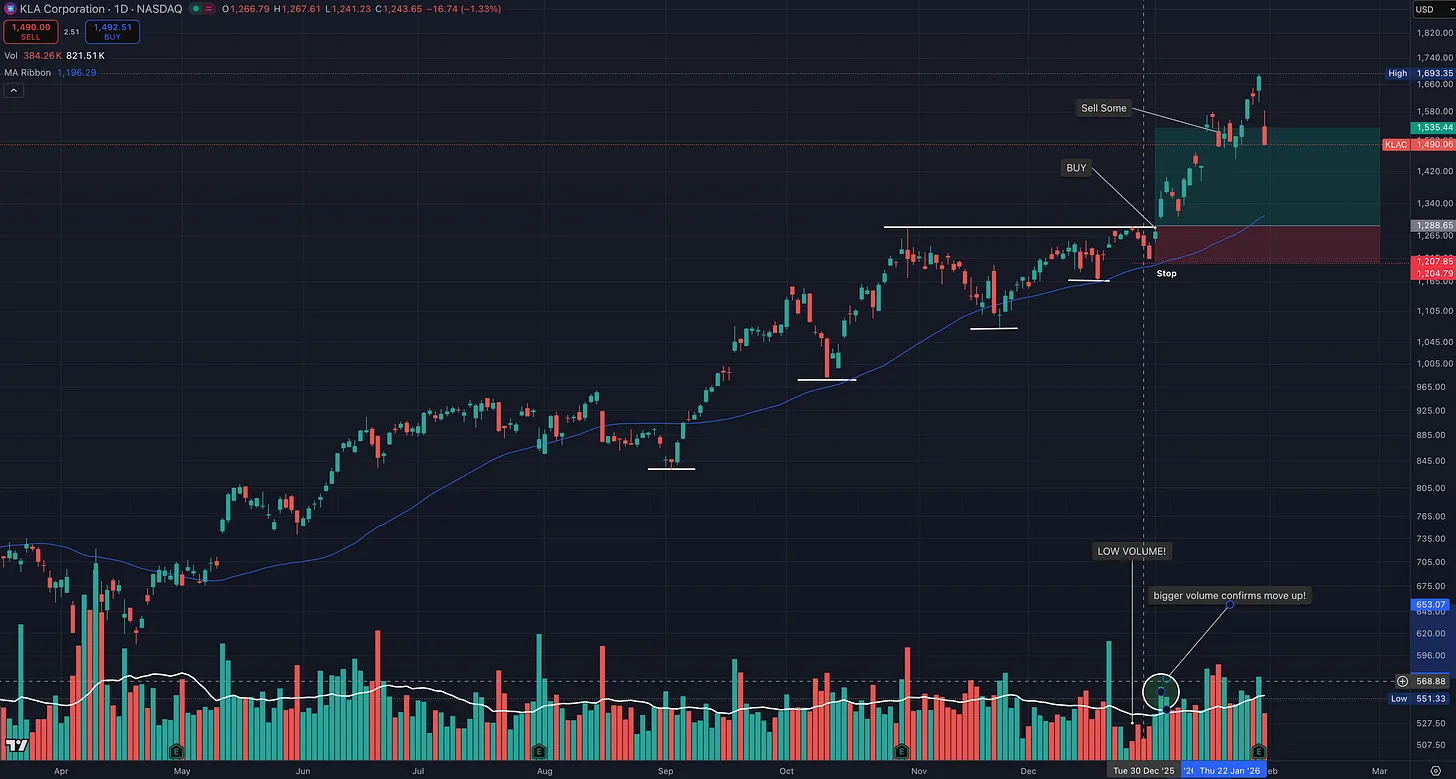
KLAC provides a textbook example of how these ideas come together in real markets.
From late October into early January, KLAC was consolidating while continuing to find support at the 50 day moving average, which it has respected. More importantly, the stock continued to make higher lows and higher highs. That alone tells you the trend is intact. Strong stocks do not violate key moving averages. They respect them.
During this period, price tightened. Volatility contracted. Volume dried up. This is exactly what you want to see before a potential move higher. Tight price action is the market telling you supply is being absorbed.
That tightening created a very clean and very defined low risk entry.
Buying the breakout meant risking a small amount relative to the potential upside. As the chart shows, the initial move delivered roughly three times what was risked. That is the first objective.
At that point, you can sell some into strength. Now the trade is financed.
Once partial profits are taken, everything changes psychologically and mathematically.
You now have options.
You can move the stop to breakeven and eliminate downside.
You can give the remaining position more room and let the trend work.
You can trail a stop under a prior higher low or use a moving average, understanding that moving averages are often briefly pierced before price resumes higher.
No matter what happens next, you are no longer trading with fear. You are trading from a position of strength.
Even if price pulls back and stops you out, you walk away with a profit. If it continues higher, you are still in the game.
This is how big winners are built over time.
Most traders focus only on being right. Professionals focus on structuring trades so they cannot be hurt and can press when they are right.
This is also why you can take these setups repeatedly.
Many will fail.
Some will work modestly.
A few will turn into outsized winners.
That is how names like MU, FIX, gold, and other major leaders pay for dozens of small losses.
How to Finance Risk Using Base Structure
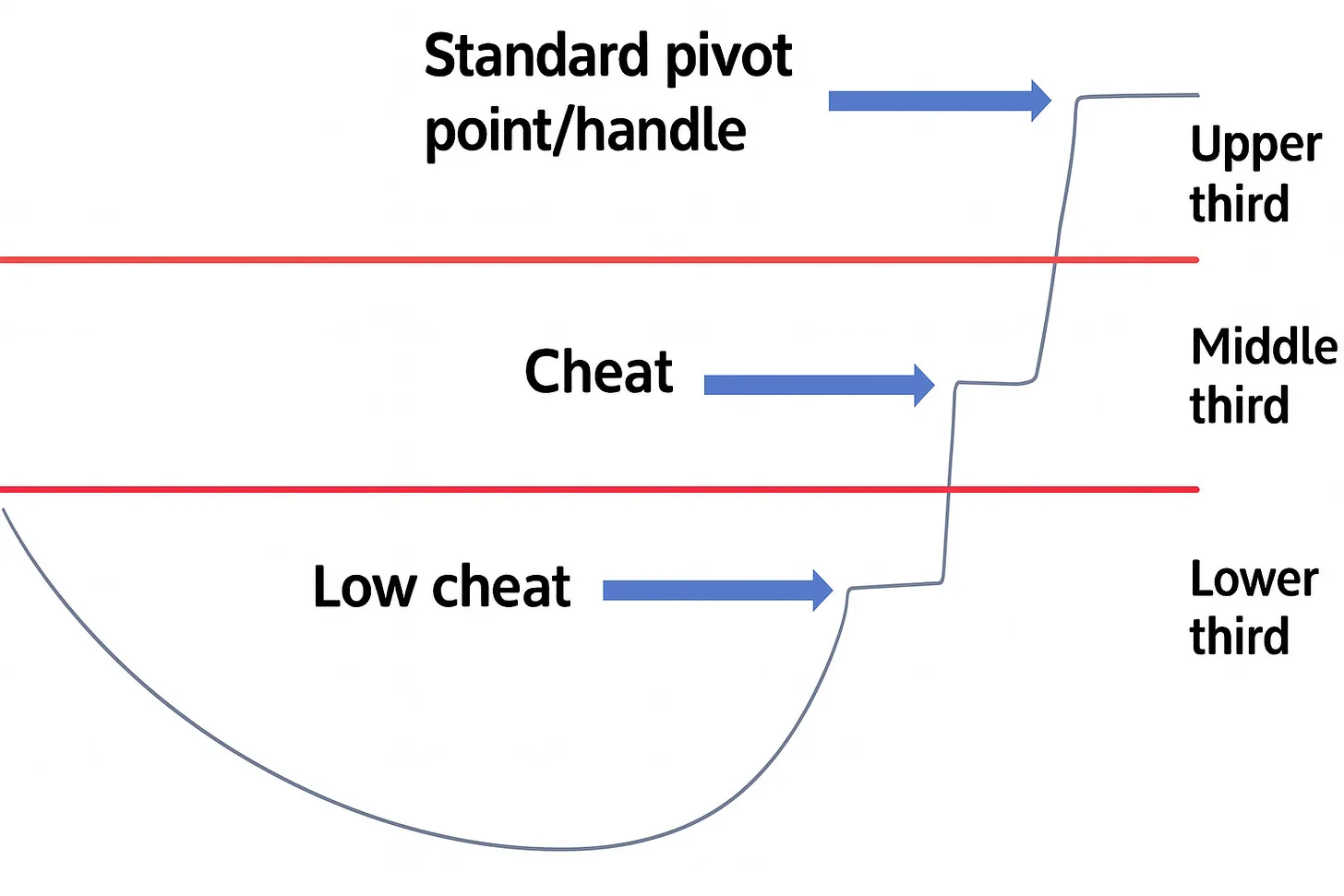
As shown in the diagram, not all buy points are created equal. Strong bases often offer multiple entry opportunities, each with different risk profiles.
Low cheat.
Occurs in the lower third of the base as price begins to turn up. This carries the highest failure rate but the smallest dollar risk and the largest potential reward.
Middle cheat.
Occurs as price tightens in the middle third of the base. Risk is reduced, confirmation improves, and this area often aligns with moving average support.
Standard pivot or handle breakout.
Occurs in the upper third of the base. This has the highest probability of follow through, depending on market conditions, since some environments favor breakouts and others do not. It also comes with the widest stop and the largest risk if entered for the first time, which is why position size should be reduced to compensate.
When these entry techniques are combined with partial profit taking, a powerful loop is created.
Early entries reduce initial risk.
Breakouts provide expansion and confirmation.
Partial sells finance the remaining position.
Remaining shares can be held with reduced or eliminated risk.
Lastly, once you build a large enough account, most of your risk is no longer coming from the original principal you deposited. You are placing trades using accumulated profits, not survival capital. That is a very different psychological and mathematical position than risking money you cannot afford to lose.
This is what Soros meant by not risking your principal.
Minervini shows how to apply this idea at the trade level. Enter with low risk. Press when you are right. Sell into strength. Reduce or eliminate risk as the trade works. When done correctly, the market itself pays for your future risk.
This is how two great traders’ wisdom comes together in real world trade management.
Protect the downside first.
Let the upside take care of itself.
That is how longevity is built in this game.
More in Risk Management
All Risk Management articles →
Oct 11, 2026 · Risk Management
How Many Stocks Should You Own? The Mistake That Can Cost You Your Biggest Winners
What William O'Neil, Mark Minervini, and the Market Wizards teach us about portfolio concentration, position sizing, cash management, and knowing when to stop trading.
- Momentum Trading
- Investing
- CANSLIM
- Trading
- position trading
- Growth Stock Trading
- Portfolio Heat
- David Ryan
Jul 7, 2026 · Risk Management
Position Size and Manage Risk Like a Market Wizard
Using Bruce Kovner’s stop-loss principle to plan the trade before the trade begins.
- growth stocks
- Momentum Trading
- fundamental analysis
- Learn Trading
- technical analysis
- Investing
- CANSLIM
- Trading
Jul 2, 2026 · Risk Management
Why Great Traders Can Seem Bipolar in Choppy Markets
The best traders are not changing their minds because they are confused. They are changing their exposure because the market evidence has changed.
- Momentum Trading
- progressive exposure
- Learn Trading
- CANSLIM
- Trading
- position trading
- Growth Stock Trading
- stock trading