
“The foolish belief that there is conspiracy in the markets. I have known many of the great traders in the world, and I can say that 99 percent of the time, the market is bigger than anybody and, sooner or later, it goes where it wants to go.” -Michael Marcus
Notes
Lessons from Legendary Traders
Notes built around one named market figure's own words or story, such as O'Neil, Livermore, Minervini, Seykota, Druckenmiller, Tudor Jones or other Market Wizards.
Showing 221–240 of 263 notes
Financing Your Risk: A Minervini and Soros Method
How I use the low cheat setup, partials, and breakeven stops to trade with house money
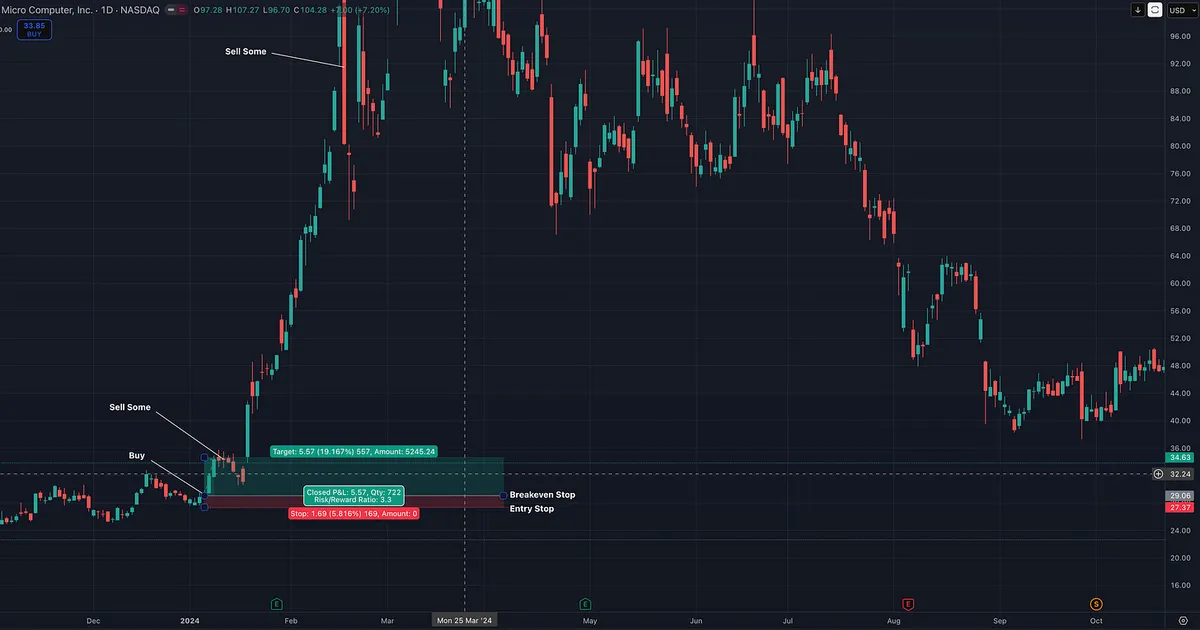
This SMCI chart from 2024 is a perfect example of what I mean when I say I like to finance my risk.
I bought using a classic Minervini low cheat entry. That means I was not waiting for a flat-base breakout at new highs. I entered lower in the base as price turned back up, forming a higher low and then a higher high. It is a tactical way to enter earlier when you see constructive higher-high and higher-low structure developing.
Once the trade began working and I hit roughly three times my initial risk, I sold a portion into strength. This locked in profit and reduced my emotional burden. When price pulled back, formed another higher low, and then pushed to a fresh high, that is when I moved my stop to breakeven. At that point the remaining position was operating on house money.
This idea lines up perfectly with something George Soros said in his 60 Minutes interview: “It’s very different when you’re risking your principal than when you’re risking your profits.”
That is the entire logic behind financing your risk. Lock in gains early when structure allows, remove exposure, and let the rest of the trade run without emotional drag.
Minervini gave me the entry tactics. Soros gave me the psychology. Together they create a simple edge: Protect the downside, pay for the trade early, and let the market decide how big the winner becomes.
“I realized that every time I had a loss, I needed to learn something from the experience and view the loss as tuition at the College of Trading. As long as you learn something from a loss, it’s not really a loss.” -Tom Basso
“Three out of four stocks will go in the same direction as a significant move in the market averages.” -William J. O’Neil
“I set protective stops at the same time I enter a trade. I normally move these stops in to lock in a profit as the trend continues. Sometimes, I take profits when a market gets wild. This usually doesn’t get me out any better than waiting for my stops to close in, but it does cut down on the volatility of the portfolio, which helps calm my nerves. Losing a position is aggravating, whereas losing your nerve is devastating.” -Ed Seykota
“I could publish my trading rules in the newspaper and no one would follow them. The key is consistency and discipline.” — Ed Seykota, Market Wizards (1989)
Can Regular People Be Taught to Become Millionaire Traders?
Most traders believe success comes from talent. The Turtle experiment proved something very different.
Two Chicago traders once trained a group of complete beginners for two weeks and handed them real capital. Many of those students went on to make millions by following a simple set of rules.
No special background. No genius needed. Just discipline and a system.
I just published a deep dive on the entire experiment, including the real rules they used, how they entered trends, where they placed stops, how they pyramided, and why the lessons still matter today.
Read the full breakdown here:
https://tradingmomentum.substack.com/p/the-100-million-bet-that-rewrote
“The way to build long-term returns is through preservation of capital and home runs.” -Stanley Druckenmiller
The Lessons From an Anonymous Pit Legend That Every Trader Should Know
The Phantom of the Pits was written anonymously by a pit trader and it sums up many of the same lessons we have heard from the greats for more than 100 years. His approach focuses heavily on mindset, risk, and behavior, which is why so many traders still study his work today.
I broke down the core ideas from his book, including why he believed small risk at the start and adds only after confirmation created a safer way to build size. Plenty of traders succeed using different methods, but Phantom’s perspective is valuable because it explains the psychology behind why his rules worked for him and many others on the floor.
If you want a clear look at how he thought about risk, confirmation, and survival, here are the lessons from his book.
Read: https://tradingmomentum.substack.com/p/trading-lessons-from-the-phantom
The One Thing Almost Every Market Wizard Gets Right
Quick question:
Do you think it's more important to grow your account fast, or to avoid the big drawdowns that erase months or even years of progress?
If you leaned toward minimizing drawdowns, you already think like the Market Wizards.
When you study the greats, the pattern is clear. As they evolved, almost all of them shifted their focus from trying to increase returns to finding ways to reduce drawdowns. They improved their strategies by cutting risk, tightening exits, reducing size, and avoiding the environments that historically hurt them.
Many of them willingly gave up growth to smooth their equity curve.
Professionals are far more impressed by how much someone risked compared to what they earned. They judge a trader by the efficiency of the return, not the size of it.
The key metrics they care about:
Max Drawdown
MAR or Calmar ratio
Risk of Ruin
Time Under Water
Recovery Factor
Ulcer Index and Ulcer Performance Index
MAE (Maximum Adverse Excursion)
Intra-trade Drawdown
Heat on open positions
MAE and Heat expose a critical truth. Some traders close with small losses, but their trades were down 50 or 70 percent while open. On paper they look disciplined. In reality they were praying, adding, moving stops, or risking ruin.
One of the most interesting examples in Unknown Market Wizards was Amrit Sall, the sniper-style trader who had huge winners, sometimes 20R or more, yet extremely low drawdowns and almost no heat. His Sharpe ratio looked only average because the Sharpe formula penalizes upside volatility the same as downside volatility, treating his massive gains as risk. The adjusted Sortino ratio told the real story. It highlighted his incredible downside risk control because he rarely experienced meaningful adverse movement. He focused on low risk, huge reward opportunities with very small drawdowns and massive upside potential.
This exposed a major flaw in the Sharpe ratio. It rewards frequent small gains that often hide large tail risk, and it punishes precise traders who risk very little and occasionally win big.
Professionals avoid big losses. They respect traders who risk almost nothing and still produce meaningful returns.
Growth is easy to chase. Protecting capital and reducing drawdowns is what actually builds wealth.
Dr. Van Tharp’s Marble Game proves the power of position sizing in the simplest way imaginable.
Give 10 people the exact same trades: same entries, same exits, same starting capital and you’ll end up with wildly different results.
Some will make millions…
Others will go broke.
The difference?
Not the system.
Not the market.
Not “luck.”
Position size.
Find out why and play the game yourself.
https://tradingmomentum.substack.com/p/the-van-tharp-marble-game-the-single
Trading Rules Paul Tudor Jones Lives By
from Market Wizards
“Don’t ever average losers.”“Losers average losers.”
“Decrease your trading volume when you are trading poorly; increase your volume when you are trading well.”
“Never trade in situations where you don’t have control. For example, I don’t risk significant amounts of money in front of key reports, since that is gambling, not trading.”
“If you have a losing position that is making you uncomfortable, the solution is very simple: Get out, because you can always get back in. There is nothing better than a fresh start.”
“Don’t be too concerned about where you got into a position. The only relevant question is whether you are bullish or bearish on the position that day. Always think of your entry point as last night’s close.”
“The most important rule of trading is to play great defense, not great offense.”
“Don’t be a hero. Don’t have an ego. Always question yourself and your ability. Don’t ever feel that you are very good. The second you do, you are dead.”
“Don’t focus on making money; focus on protecting what you have.”
“When I am trading poorly, I keep reducing my position size. That way, I will be trading my smallest position size when my trading is worst.”
“I think one of my strengths is that I view anything that has happened up to the present point in time as history. I really don’t care about the mistake I made three seconds ago in the market. What I care about is what I am going to do from the next moment on. I try to avoid any emotional attachment to a market.”
The Art of Sleeping Well: Risk Management Like Bruce Kovner
“Whenever I enter a position, I have a predetermined stop. That is the only way I can sleep. I know where I’m getting out before I get in. The position size on a trade is determined by the stop, and the stop is determined on a technical basis. For example, if the market is in the midst of a trading range, it makes no sense to put your stop within that range, since you are likely to be taken out. I always place my stop beyond some technical barrier.” — Bruce Kovner, Market Wizards
The Lesson
This quote captures one of the most timeless principles in trading: control risk first, profit comes second. Kovner didn’t guess where the market might go; he defined exactly where he’d be wrong before entering the trade.
The Example: Translating the Quote Into Action
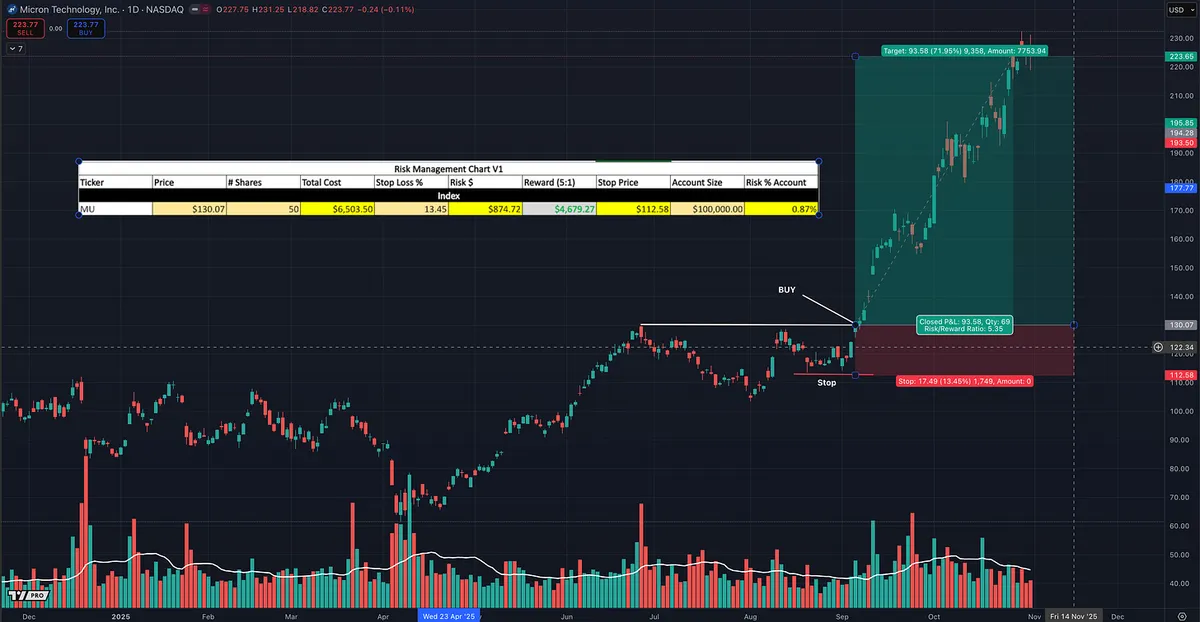
Let’s bring this to life with Micron (MU).
Entry: $130.07
Stop: $112.58
Stop Loss %: 13.45%
Account Size: $100,000
Target Risk per Trade: 1% (or $1,000)
If we simply bought any random number of shares, a 13.45% stop could easily blow through our target risk. But instead, we let the chart dictate where the stop goes — just below a key technical level — and then we adjust our position size so that the dollar loss stays within 1% of the account.
That’s how we arrive at 50 shares, risking $874.72 total.
Why the 13.45% Stop Makes Sense
Looking at the chart, you can see how the stop sits below prior support and the breakout zone — a level where, if price falls back through, the trade idea is invalidated. That’s exactly what Kovner meant by placing your stop beyond a technical barrier.
Setting the stop inside the range would’ve exposed us to random volatility and a likely premature exit. By respecting market structure, we give the trade room to breathe — but by managing position size, we keep risk capped and consistent.
The Takeaway
The professional mindset isn’t about predicting the next big move — it’s about controlling the downside so you can stay in the game long enough to catch the upside.
Every trade starts with two questions:
Where am I wrong? → defines your stop.
How much am I willing to lose? → defines your position size.
When you combine those answers, you get clarity, consistency, and, as Kovner said, the ability to sleep at night.
Interesting Irony in Who Retail Investors Study
It’s fascinating how many retail investors try to model themselves after people like Buffett, Munger, or Dalio, investors managing tens or hundreds of billions with access, leverage, and deal flow that the average trader will never have.
And yet, there’s a whole group of traders who built wealth starting with modest capital. People like Jesse Livermore, Nicolas Darvas, William O’Neil, David Ryan, Mark Minervini, Dan Zanger, Kristjan Kullamägi, and others have frameworks that are far more aligned with what most individuals are actually trying to do: grow a small account into something meaningful.
It’s not that one approach is better than another. There are countless ways to make money in markets, and different styles fit different personalities. But it’s interesting how often people choose to follow those who play a completely different game.
Many of the big institutional names didn’t even start that way. They evolved as their capital base grew, because managing billions requires a different approach than managing thousands. So maybe it’s worth asking: Are you studying the people whose path matches where you are, or where they ended up?
It’s Not About How Often You Win — It’s About How Big You Win.
Most people focus on being right often, not being right big. In reality, the majority of the best traders understand that you don’t need a high win rate to generate extraordinary returns. You just need to win big when you’re right and lose small when you’re wrong.
Stanley Druckenmiller is a perfect example:
“The way to build long-term returns is through preservation of capital and home runs.”
Over three decades, he averaged more than 30% annual returns managing billions, not because he was always right, but because his winners were big enough to pay for the losers. He focused on low-risk, high-reward trades.
The Market Doesn’t Care What You Think
“I think one of my strengths is that I view anything that has happened up to the present point in time as history. I really don’t care about the mistake I made three seconds ago in the market. What I care about is what I am going to do from the next moment on. I try to avoid any emotional attachment to a market. I avoid letting my trading opinions be influenced by comments I may have made on the record about a market.” -Paul Tudor Jones
The Timeless Structure of Markets: Understanding Stan Weinstein’s Stage Analysis
In 1988, Stan Weinstein introduced a framework that still outperforms countless modern trading systems.
This comprehensive guide breaks down his Stage Analysis — how to identify where you are in the market cycle, trade in harmony with the trend, and avoid catastrophic losses.
Discover why, even decades later, simplicity — not complexity — remains a trading edge.
https://tradingmomentum.substack.com/p/stan-weinsteins-stage-analysis-the
Watch Your Ego
“Don’t be a hero. Don’t have an ego. Always question yourself and your ability. Don’t ever feel that you are very good. The second you do, you are dead.” — Paul Tudor Jones
Confidence builds great traders. Ego destroys them. Know the difference.
The Cheetah Principle
“Although the cheetah is the fastest animal in the world and can catch any animal on the plains, it will wait until it is absolutely sure it can catch its prey. It may hide in the bush for a week, waiting for just the right moment. It will wait for a baby antelope, and not just any baby antelope, but preferably one that is also sick or lame. Only then, when there is no chance it can lose its prey, does it attack. That, to me, is the epitome of professional trading.” — Mark Weinstein, Market Wizards
The Diversification Delusion
“Diversification is a hedge for ignorance. I think you are much better off owning a few stocks and knowing a great deal about them.”
— William O’Neil
“Diversification is protection against ignorance. It makes little sense if you know what you’re doing.”
— Warren Buffett
Two completely different types of investors — O’Neil, a growth and momentum trader, and Buffett, a long-term value investor, yet both came to the same conclusion.
Most people think diversification reduces risk. But for those who actually know what they’re doing, it often does the opposite. It dilutes focus, weakens conviction, and hides bad decisions behind averages.
Real safety doesn’t come from owning more. It comes from understanding more — from knowing exactly what you own and why.