
Trading articles/The Van Tharp Marble Game: The Single Most Important Lesson in Trading
Nov 10, 2025 · Momentum Trading Strategy
The Van Tharp Marble Game: The Single Most Important Lesson in Trading
How a 65% losing system can still make you rich — if you size your trades correctly
Originally published on Substack.
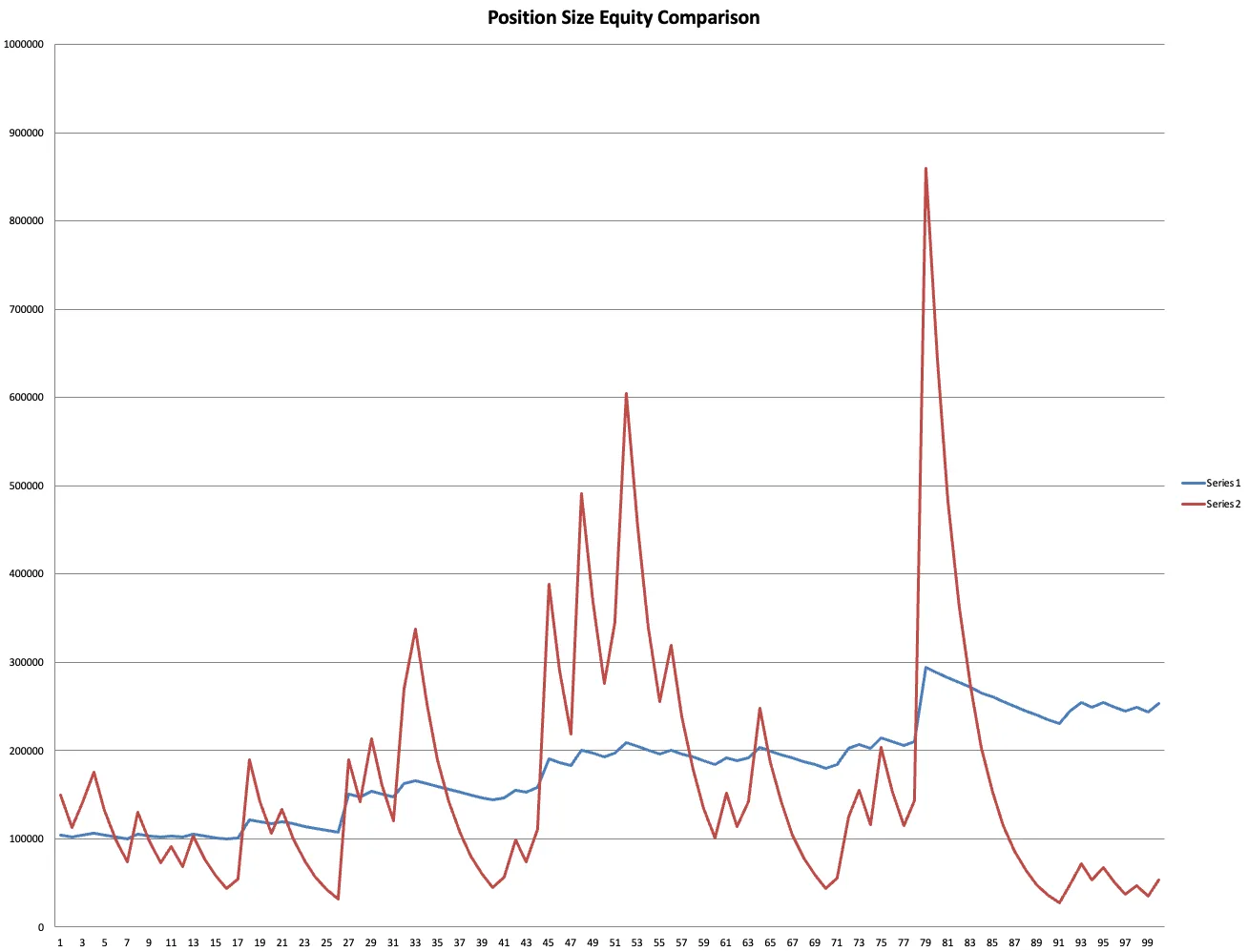
If you’ve been trading for any amount of time, you’ve likely obsessed over entries — chart patterns, indicators, fundamentals, timing…
But Dr. Van K. Tharp — author of Trade Your Way to Financial Freedom and Trading Beyond the Matrix — showed the world something far more powerful:
Your position size matters more than your entry.
To prove it, he created one of the simplest teaching tools in all of trading:
The Marble Game
It looks like a child’s game.
It is not.
It’s the clearest, fastest way to understand:
- Why most traders lose even using profitable systems
- Why win-rate is almost meaningless
- Why survival matters more than return
- Why your biggest edge is emotional + probabilistic
Once you “see it,” you’ll never look at trading the same way again.
Let’s walk through it.
The Marble Game: How It Works
You start with a bag containing 100 marbles.
Each draw represents one trade.
After a draw, the marble goes back in the bag (replacement), and you draw again.
Each marble has a fixed R-multiple outcome.
What’s an R-multiple?
R = your initial risk per trade
- If you risk 1R = $1,000 and make +3R → you made $3,000
- If you lose −1R → you lost $1,000
Good traders think in R, not dollars.
Here’s the official distribution:
Official Van Tharp Marble Distribution
(From Trading Beyond the Matrix)
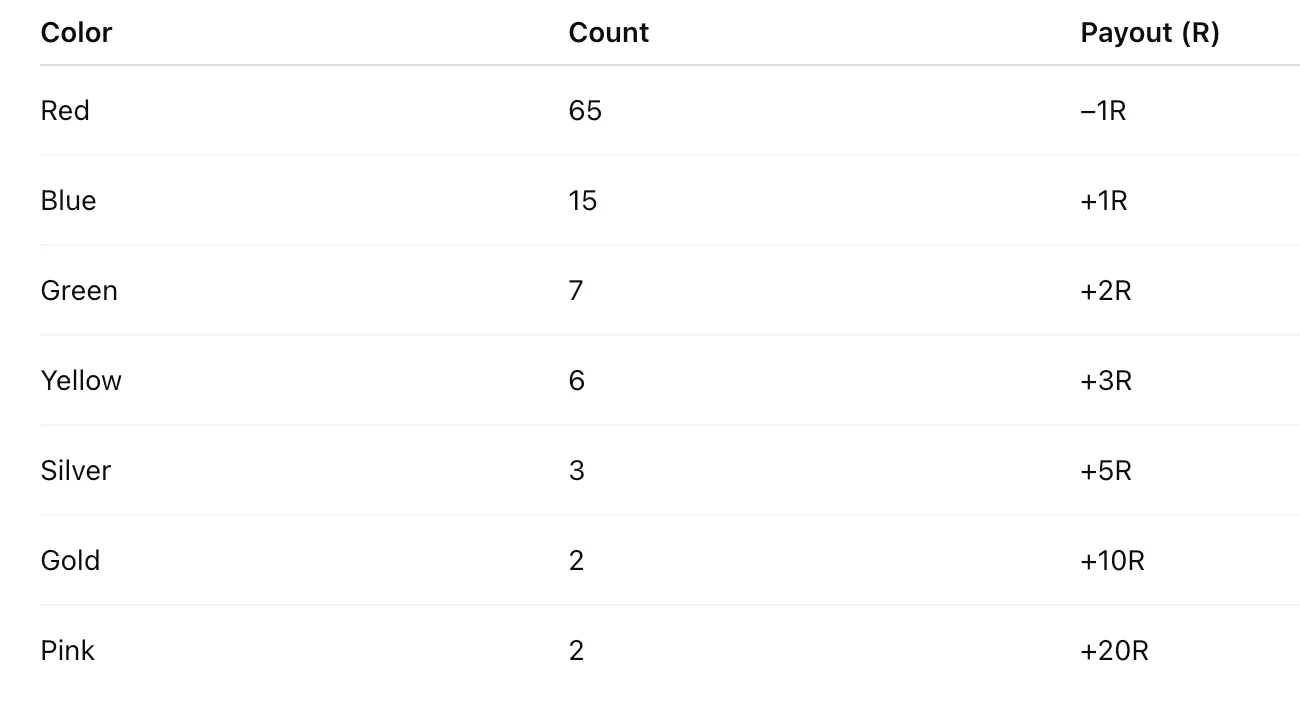
✅ 65% losers
✅ 35% winners
✅ But among the winners are massive outliers → +5R, +10R, +20R
These rare, oversized winners give the game — and any trend-like system — a strong positive expectancy, even though most trades lose.
This is critical:
The edge is real — but only if you survive the losing streaks long enough to reach the big winners.
Expectancy > Win-Rate
Even with 65 losing marbles at –1R, the +5R, +10R, +20R marbles make the game very profitable over time.
E=∑(probability×outcome)
This destroys a popular myth:
❌ High win-rate = success
✅ High expectancy = success
You can win 35% of the time and still grow wealth at scale…
if you size properly.
Most people don’t.
But Here’s the Catch
Just like flipping a coin doesn’t produce perfect alternating heads/tails…
A 65% loss rate does NOT mean every 3 trades → 2 losses + 1 win.
You will see:
- 5 losses in a row
- 10 losses in a row
- 15+ losses in a row
The winners come in clumps.
The losers come in clumps.
Randomness produces streaks, not balance.
Most traders underestimate this — and they size too large.
They get crushed during a losing cluster, blow up emotionally or financially, and never stick around long enough to hit the +10R and +20R trades that make the system profitable.
This game isn’t about prediction.
It’s about survival.
The Real Lesson: Position Sizing Controls Your Destiny
In workshops, Van Tharp would have students play the game using real money.
Nearly everyone lost, even though the game’s expectancy is positive.
Why did they lose?
⚠️ They bet too big.
Those who bet:
- 0.5%–2% per trade → usually ended profitable
- 10%+ → usually blew up
Same game.
Same distribution.
Same entries.
The only difference?
✅ How much they risked each time.
This is the heart of professional trading:
Two traders can take the exact same system and end with completely different equity curves.
Not because of entries.
Not because of intelligence.
Not because of intuition.
Because of position sizing.
Let that sink in.
My Excel Simulation
100 Trades → One Sequence → Multiple Bet Sizes
To internalize this lesson, I recreated the Marble Game in Excel.
I held constant:
✅ The trade sequence (same 100 outcomes)
The only variable:
➡️ Position size (%)
Here’s what happened:
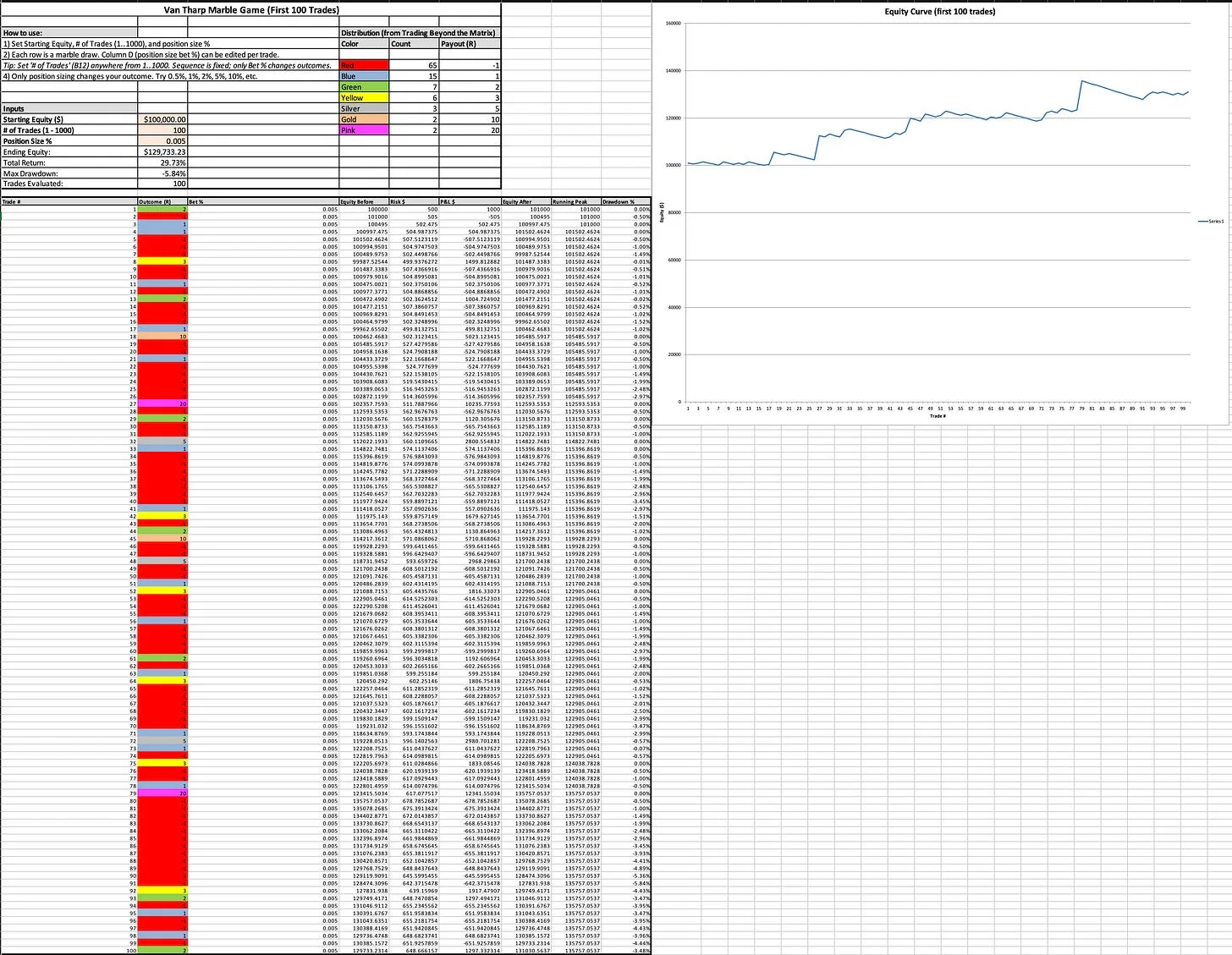
✅ 0.5% Risk
- Smoothest compounding
- Max drawdown ≈ 5%
- Emotionally easy
- Solid growth
Slow + steady wins.
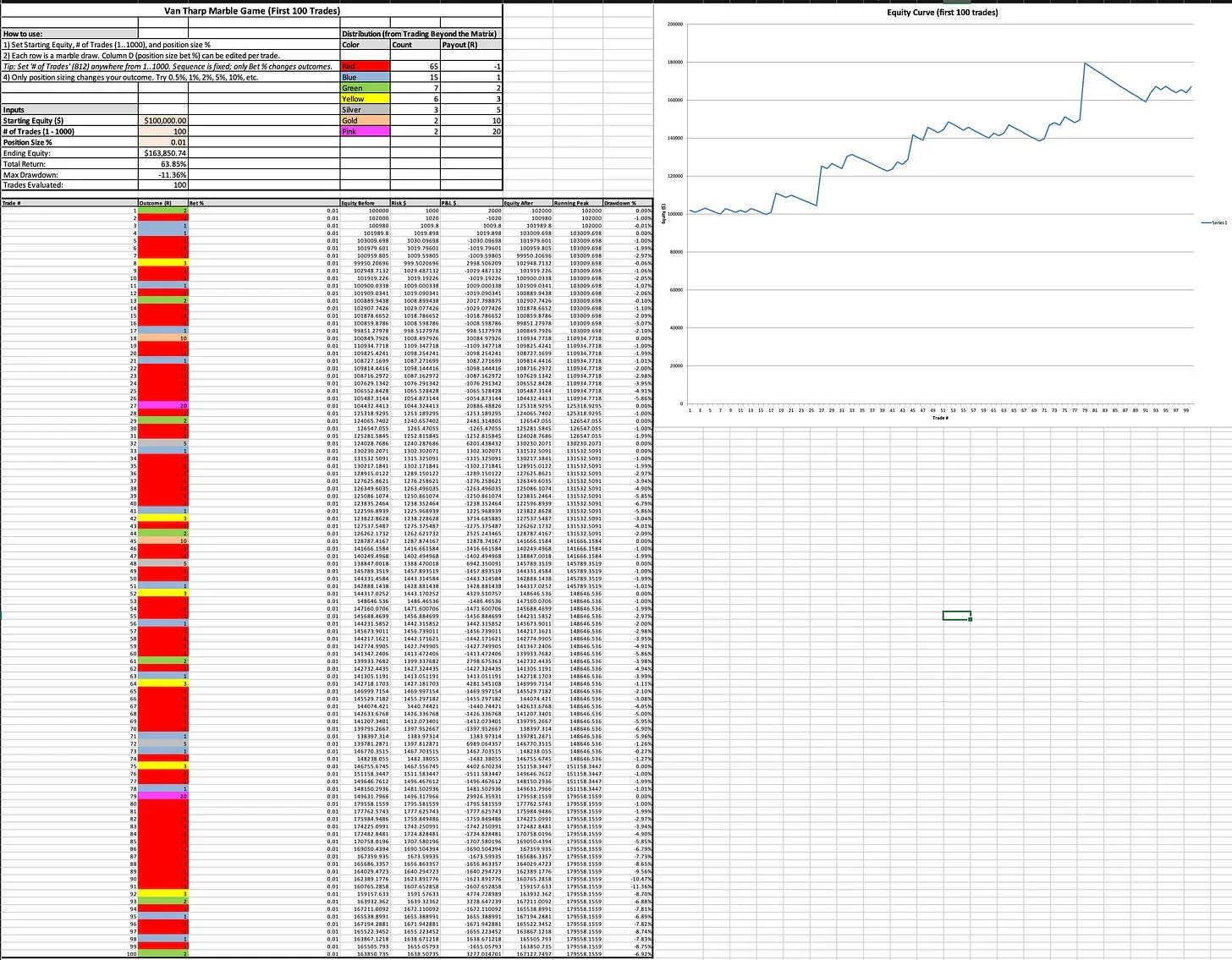
✅ 1–2% Risk
- Meaningful compounding
- Max drawdowns ≈ 10–20%
- Growth + survivability
Best balance for most traders.
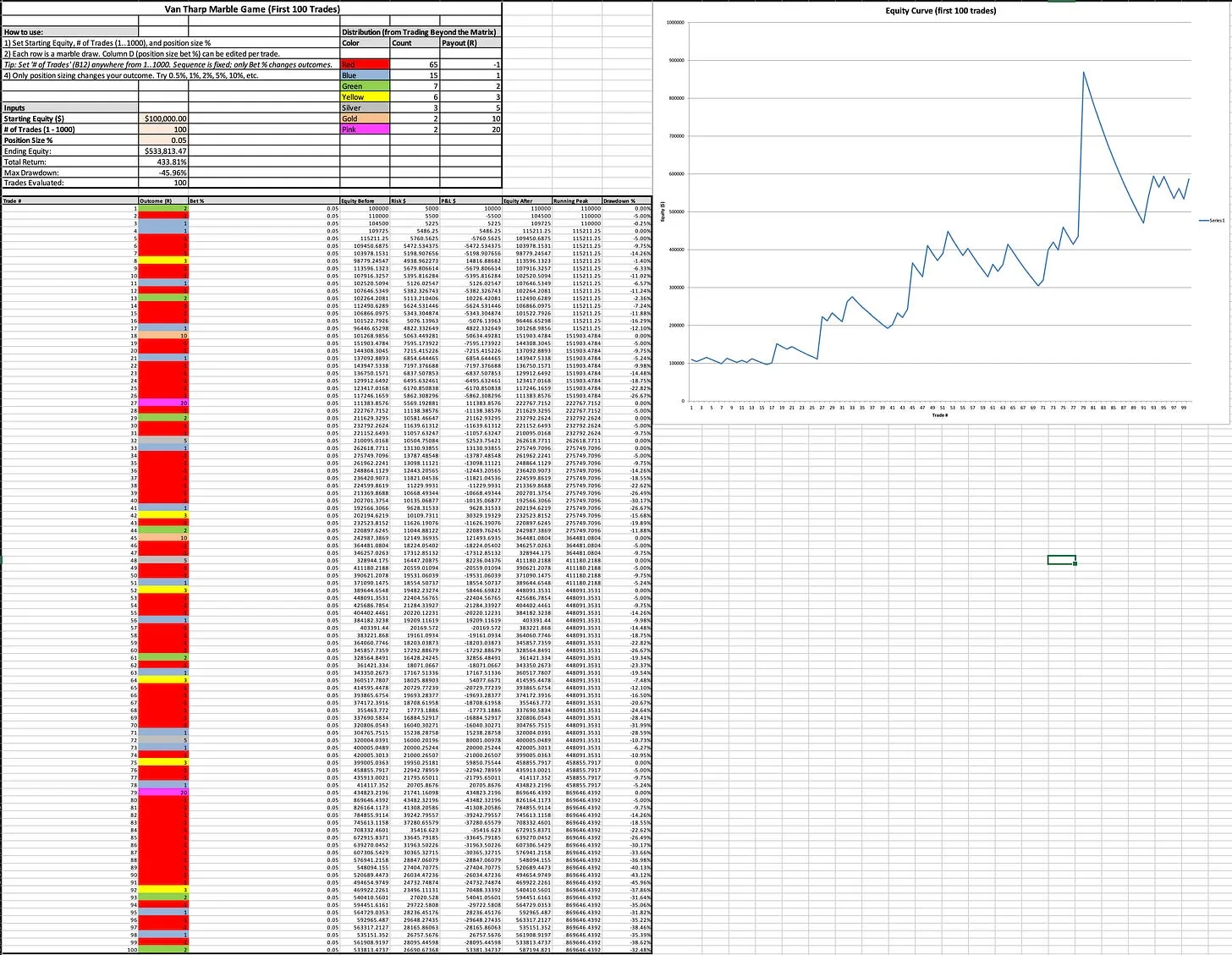
⚠️ 5% Risk
- Faster upside
- But nasty drawdowns (40–60%)
- Emotionally testing
Still positive expectancy —
but few can stick with it.
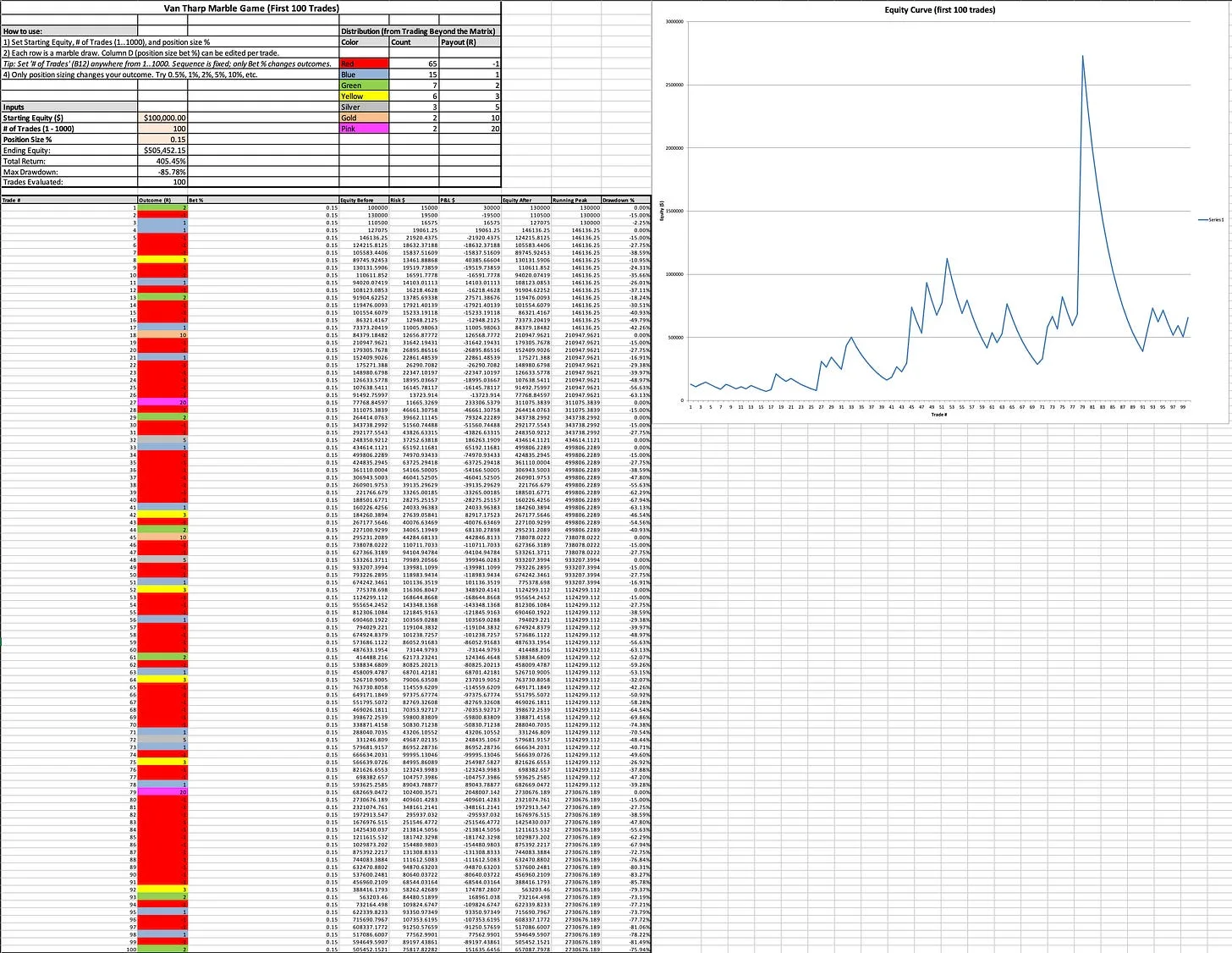
🔥 10–15% Risk
- Insane upside if you catch winners early
- BUT enormous drawdowns (70–88%)
Mathematically viable → emotionally devastating.
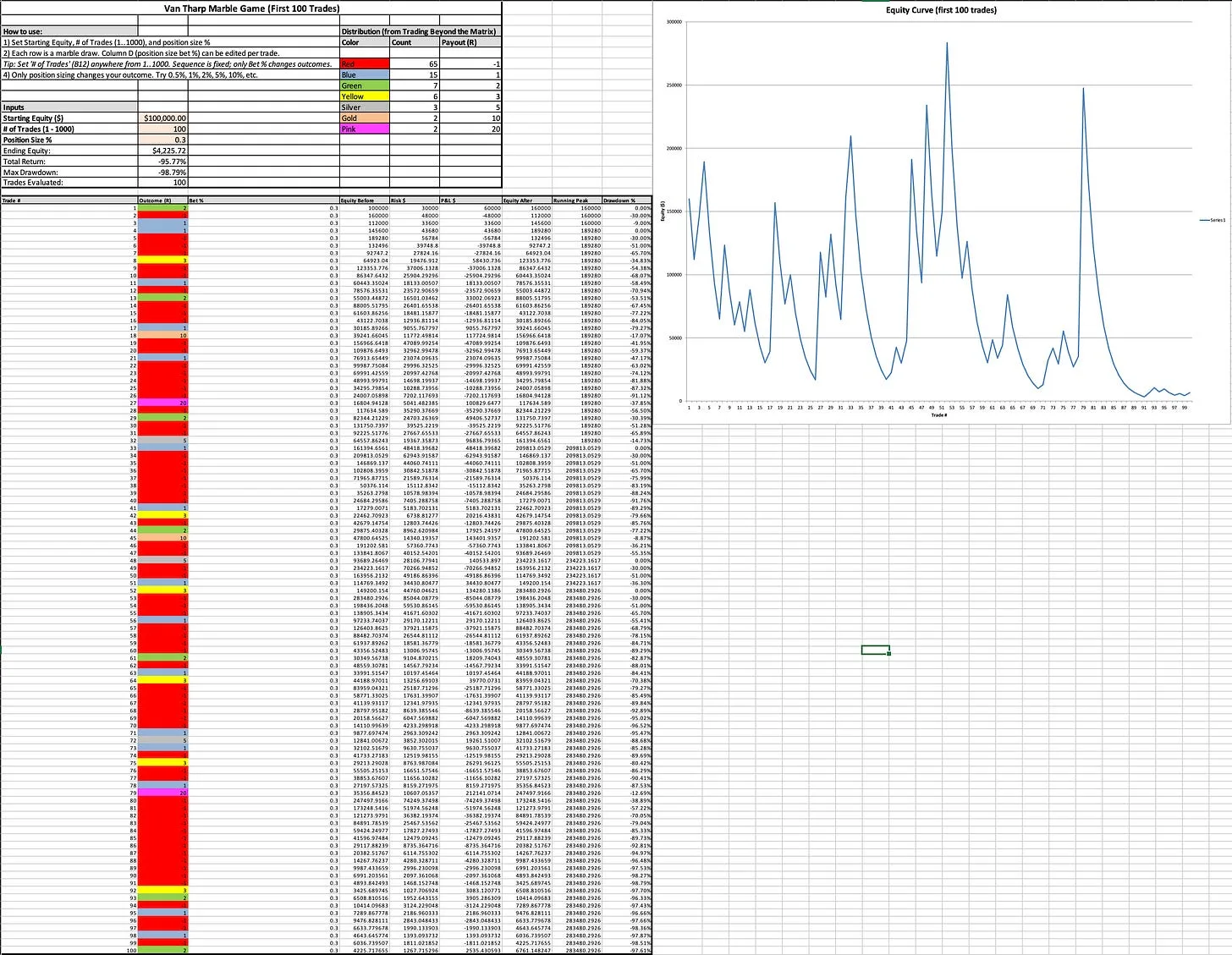
💀 20–30%+
- You might briefly hit millions…
- But almost every path ends in ruin
Even WITH +20R wins.
Same trades → different outcomes → all controlled by position size.
The Most Important Metric: Max Drawdown
Most people focus on ending P&L.
But experienced traders know:
Max drawdown determines whether you survive long enough to realize the system’s edge.
Your returns don’t matter if you size so aggressively that you quit after a –50% hit.
The Marble Game makes this painfully obvious.
A student betting 25% of equity may hit a +20R marble early and balloon their account…
…then disappear within ten trades.
This happens in real markets too.
Play the Marble Game at Home
You can play this with family, friends, students, or trading buddies.
It’s simple, powerful, and guaranteed to change how you think about risk.
What you need
- A bag
- 100 marbles (colored/labeled per the distribution)
- A notebook or spreadsheet
- Starting equity
- A fixed position-size %
Pick a sizing rule — 0.5%, 1%, 2%, 5%…
Then you’re ready to play.
Version 1 — Everyone Uses the SAME Draw Sequence
(This mirrors my Excel simulation)
- One person draws marble #1 → everyone records the outcome
- Everyone applies their own position size %
- Repeat for 100 draws
The trade outcomes are identical — but everyone risks different amounts.
At the end:
Same trades → wildly different equity curves → totally different outcomes
Some players finish up nicely…
Some barely make anything…
Some blow up completely…
And the only difference was → position size.
This perfectly illustrates Van Tharp’s point that position sizing drives results more than entries.
Version 2 — Everyone Draws Their OWN Marbles Each Time
This version adds an extra layer of realism.
Each person draws independently for 100 trades.
Everyone uses the same starting equity + sizing, but because outcomes are random, every player experiences a different sequence of wins and losses.
This demonstrates two deeper truths:
✅ Wins/losses arrive in streaks
✅ Two traders running the SAME strategy will see different equity paths
✅ Variance affects psychology as much as math
Even if two players both risk 1% per trade…
- One may hit a +20R marble early and compound beautifully
- The other may open with 8 straight losses and fall into a painful drawdown
Same system → different luck → different emotional + financial outcomes
This is what it feels like to trade a positive expectancy system in real life.
Why Both Versions Matter
Both versions of the Marble Game illustrate different, but equally important lessons. When everyone uses the same sequence of draws, the outcomes prove that position sizing is the primary driver of performance. Even with identical trades, players end with dramatically different equity curves simply because they risk different amounts.
In contrast, when everyone draws their own independent marbles, the game reveals how randomness and streaks affect every trader differently. Despite using the same system and position-sizing rules, each person experiences a unique run of winners and losers, leading to different emotional and financial journeys.
Taken together, the two versions show that trading success depends not only on how much you risk, but also on your ability to withstand the inevitable variability of real-world outcomes.
Play the game both ways and you’ll see:
It’s not your entry.
It’s not your “intuition.”
It’s not your ability to guess right.
It’s your ability to survive long losing streaks with intelligent position sizing.
How to Run It
- Draw 100 marbles
- Record each outcome in R
- Apply your % position sizing
- Track equity over time
Then compare results.
- Same draws?
Different sizing = different destinies - Different draws?
Same system = different emotional journeys
Either way…
You will never think about risk the same way again.
Key Takeaways
✅ Entries matter far less than you think
✅ Win rate is nearly irrelevant
✅ Expectancy = everything
✅ Streaks are normal, prepare for them
✅ Position sizing determines survival
✅ Survival > returns
✅ Same system → different outcomes depending on bet size
✅ Emotional durability is a trading edge
If you internalize only one idea from Van Tharp, let it be this:
Position sizing isn’t just a component of your system, it’s the force that determines your long-term results.
Final Thought
The Marble Game reveals a deep truth:
Trading success is not about predicting markets.
It’s about managing your risk and emotions so you can keep playing long enough to realize your edge.
If you can size properly, survive losing streaks, and stay emotionally stable…
You can win big, even with a 35% win rate.
If you can’t?
No entry strategy in the world will save you.
More in Legendary Traders
All Legendary Traders articles →
Sep 17, 2026 · Legendary Traders
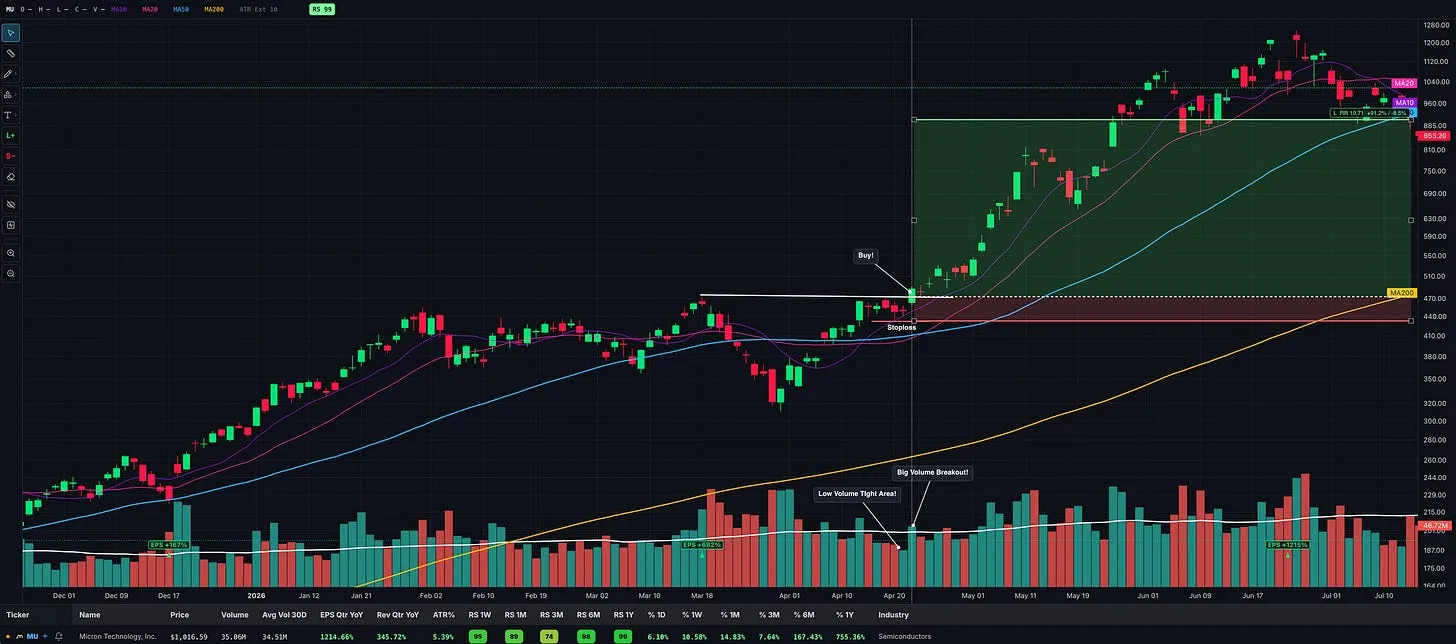
4 Legendary Traders. 4 Breakout Entry Tactics.
A chart-by-chart breakdown of Minervini’s VCP, O’Neil’s cup with handle, Darvas’s box breakout, and Kullamägi’s opening range breakout.
- how to make money in stocks
- IBD
- Momentum Trading
- VCP
- technical analysis
- CANSLIM
- Trading Setups
- position trading
Sep 6, 2026 · Legendary Traders
Market Wizard David Ryan: How He Made 1,379% in Three Years
Inside the growth-stock approach of William O’Neil’s protégé and three-time U.S. Investing Champion, from precise entries to holding major winners.
- IBD
- fundamental analysis
- Learn Trading
- technical analysis
- position trading
- David Ryan
- Market Wizard
- CAN SLIM
Aug 29, 2026 · Legendary Traders
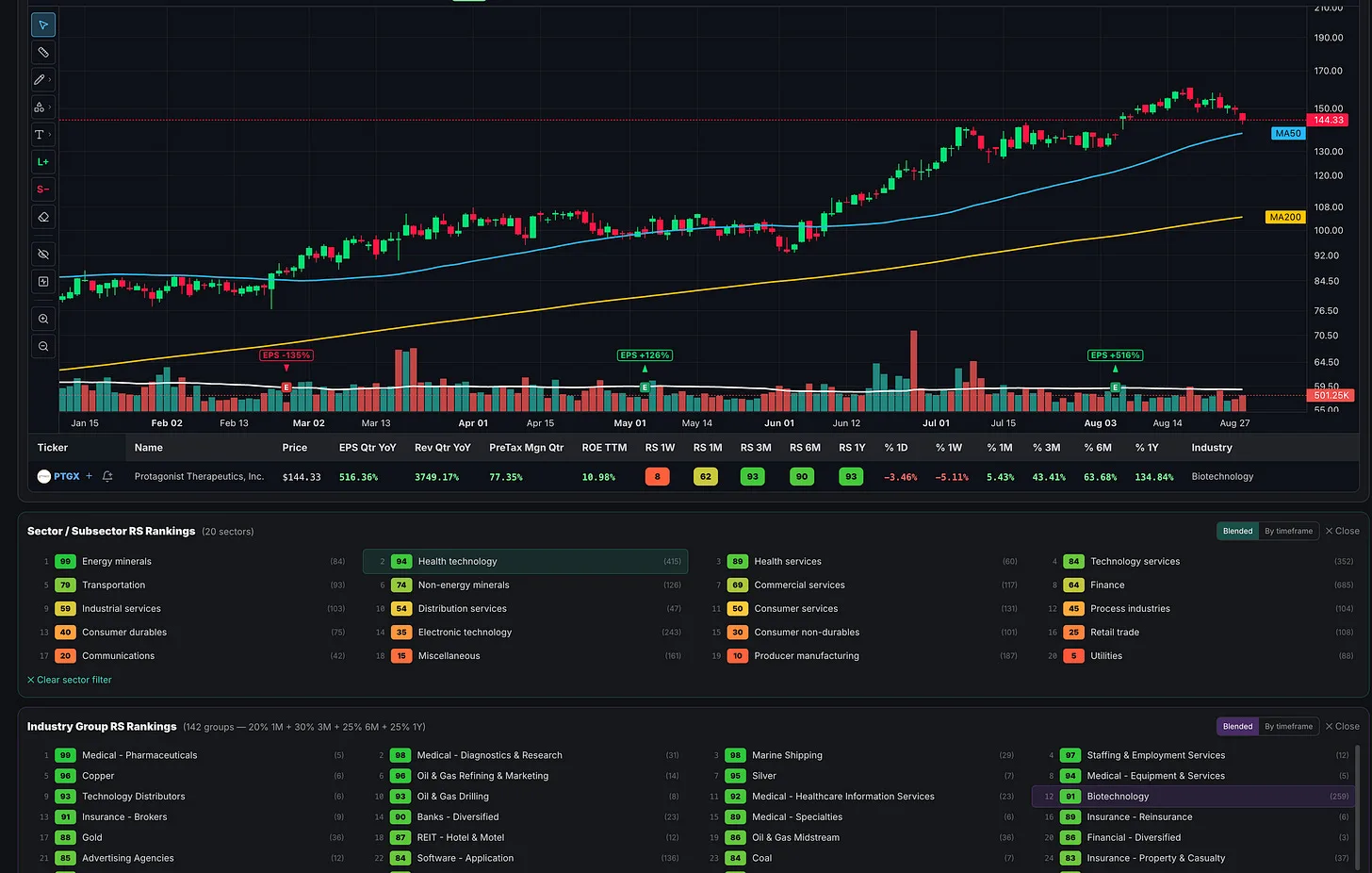
Why the Market’s Biggest Winning Stocks Rarely Move Alone
Lessons from Nicolas Darvas, William O’Neil, and Mark Minervini on using industry-group strength and relative strength to find new market leaders without getting whipsawed.
- growth stocks
- CANSLIM
- position trading
- David Ryan
- stock trading
- Kristjan Kullamägi
- Nicolas Darvas
- industry groups