The Art of Sleeping Well: Risk Management Like Bruce Kovner
“Whenever I enter a position, I have a predetermined stop. That is the only way I can sleep. I know where I’m getting out before I get in. The position size on a trade is determined by the stop, and the stop is determined on a technical basis. For example, if the market is in the midst of a trading range, it makes no sense to put your stop within that range, since you are likely to be taken out. I always place my stop beyond some technical barrier.” — Bruce Kovner, Market Wizards
The Lesson
This quote captures one of the most timeless principles in trading: control risk first, profit comes second. Kovner didn’t guess where the market might go; he defined exactly where he’d be wrong before entering the trade.
The Example: Translating the Quote Into Action
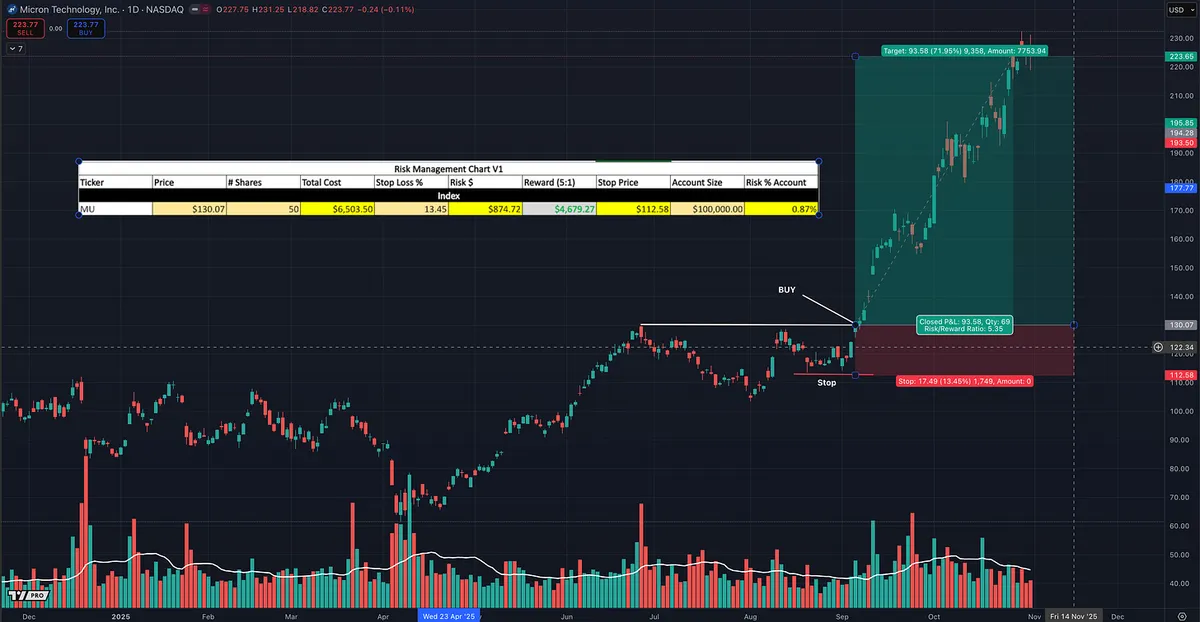
Let’s bring this to life with Micron (MU).
Entry: $130.07
Stop: $112.58
Stop Loss %: 13.45%
Account Size: $100,000
Target Risk per Trade: 1% (or $1,000)
If we simply bought any random number of shares, a 13.45% stop could easily blow through our target risk. But instead, we let the chart dictate where the stop goes — just below a key technical level — and then we adjust our position size so that the dollar loss stays within 1% of the account.
That’s how we arrive at 50 shares, risking $874.72 total.
Why the 13.45% Stop Makes Sense
Looking at the chart, you can see how the stop sits below prior support and the breakout zone — a level where, if price falls back through, the trade idea is invalidated. That’s exactly what Kovner meant by placing your stop beyond a technical barrier.
Setting the stop inside the range would’ve exposed us to random volatility and a likely premature exit. By respecting market structure, we give the trade room to breathe — but by managing position size, we keep risk capped and consistent.
The Takeaway
The professional mindset isn’t about predicting the next big move — it’s about controlling the downside so you can stay in the game long enough to catch the upside.
Every trade starts with two questions:
Where am I wrong? → defines your stop.
How much am I willing to lose? → defines your position size.
When you combine those answers, you get clarity, consistency, and, as Kovner said, the ability to sleep at night.