Momentum Trading Strategy

Notes

Finding Leading Stocks

What to buy: how to find, screen and rank the strongest stocks and industry groups.

Showing 141–160 of 299 notes

View on Substack ↗

Most People Don’t Realize How Big This Growth Is

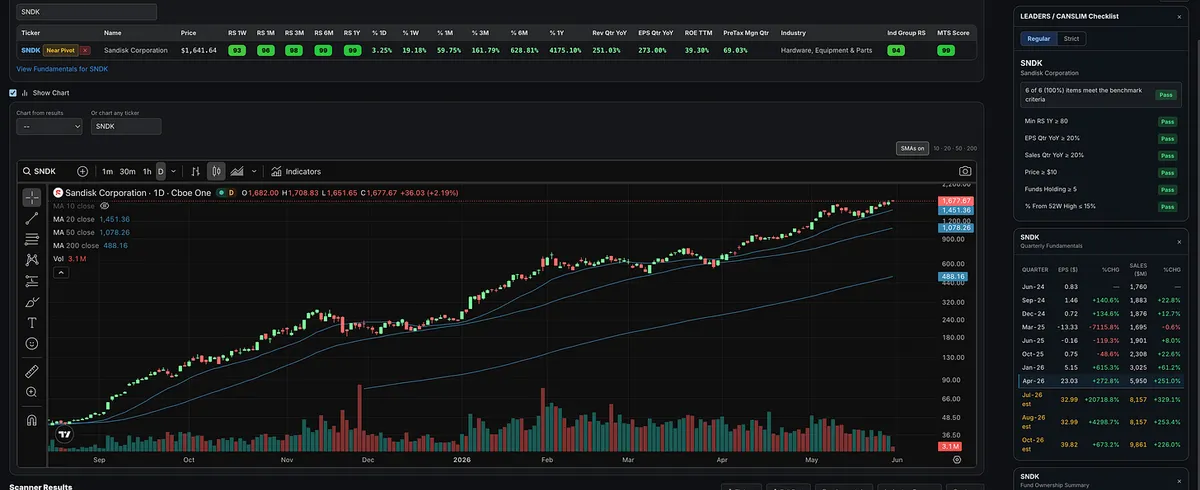
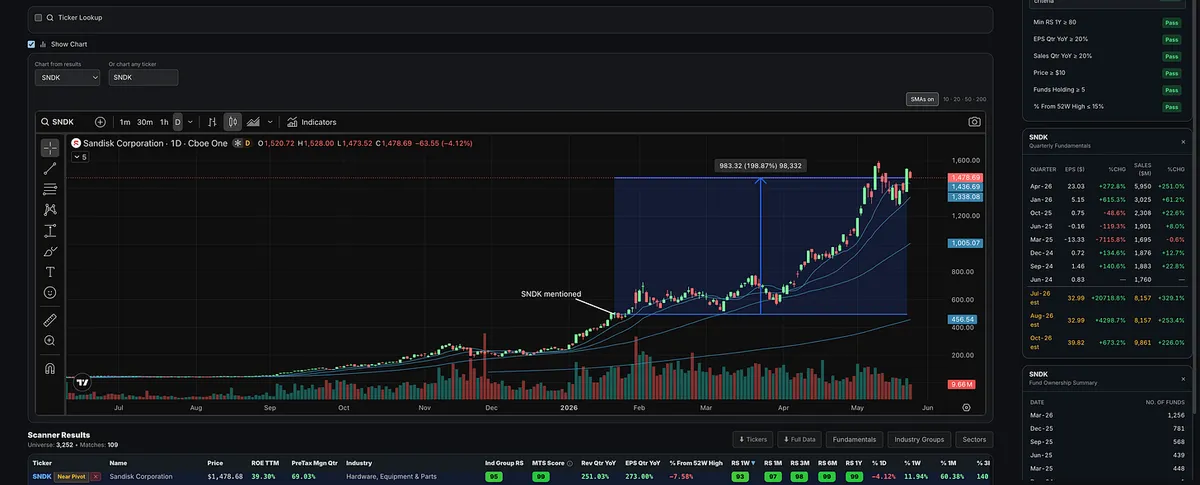
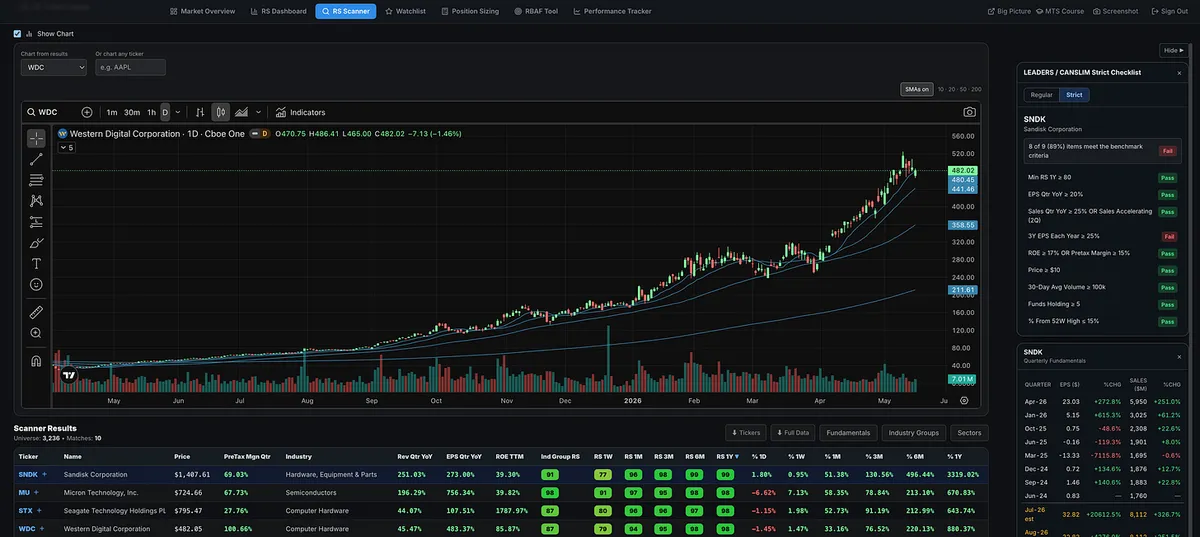
Look at SNDK.

Revenue growth: +251%.

EPS growth: +273%.

ROE: 39%.

Pretax margin: 69%.

This is not normal.

This is the jet fuel behind the price action.

Most traders are looking for cheap stocks.

I’m looking for exceptional companies with exceptional numbers being rewarded by the market.

Big earnings growth.

Big sales growth.

High relative strength.

Strong margins and roe.

These characteristics have led to some of the market’s biggest winning stocks for longer than all of us have been alive.

The names change.

The characteristics do not.

View on Substack ↗

Most Traders Are Working Too Hard

Ever notice how the harder most people try in the stock market, the worse their results seem to get?

The problem usually isn't effort.

It's where the effort is being spent.

You've probably heard of the 80/20 Principle:

80% of results come from 20% of actions.

The market is no different.

People spend endless hours screening for stocks, searching hidden corners of the market, reading news, and doing more research.

But if you've been following along, many of the strongest names right now are the same names, in the same industry groups, that were showing strength months ago, and in some cases, even a year ago.

That’s why I haven’t been posting many new names recently.

The names that are doing amazing are mostly names I have already mentioned several times since starting this Substack.

The strongest stocks usually tell you they are strong before everyone agrees.

Many traders are just making this harder than it has to be.

And the funny thing is, by constantly searching for “something else,” they often hurt their own results.

They move away from leadership.

They buy weaker names.

They increase their fail rate.

They take more losses.

Because the market is difficult, people assume success requires more complexity.

In reality, success often comes from doing a few simple, boring, important things exceptionally well, over and over again.

Spend some time identifying the 20% that produces 80% of your results.

Then do more of that.

And cut the waste.

View on Substack ↗

Keep It Simple

A lot of traders make the market more complicated than it needs to be.

I get it.

It feels good to search for the next stock nobody is talking about.

It feels productive to hunt for something new.

But over the last few months, the market has made the message pretty simple:

The same strong names in the same strong groups keep working.

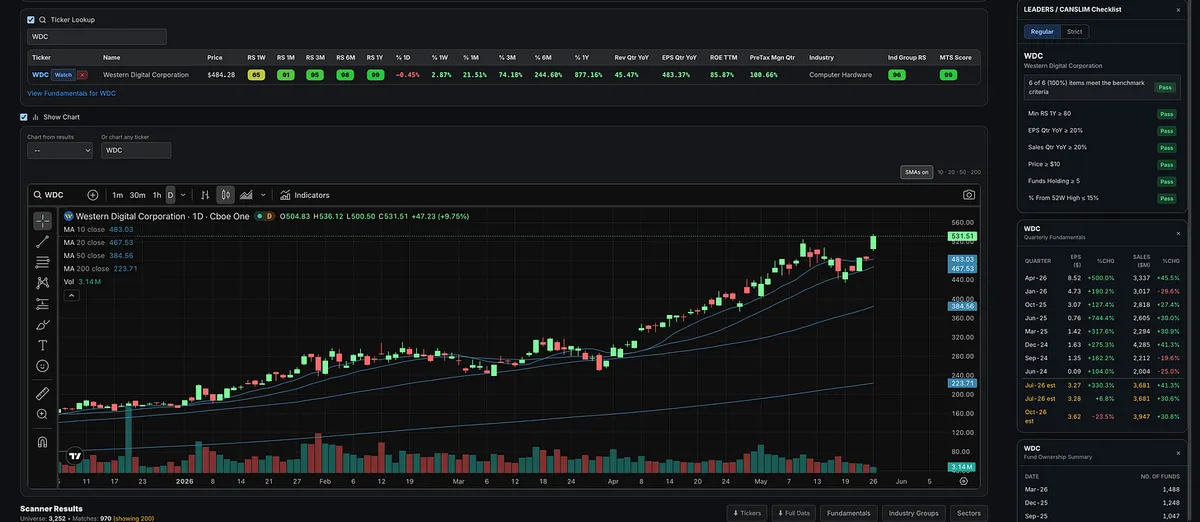
WDC is another one.

It is breaking out to new highs today and has the same characteristics I keep talking about:

  • Big earnings.

  • Big sales.

  • Strong return on equity.

  • Strong margins.

  • A hot industry group.

  • Aligned with the current bull market theme.

  • Fund ownership growing quarter over quarter.

This is not about making the process complicated.

It is about finding the strongest stocks in the strongest groups, tracking them, and staying aligned with them as long as the evidence remains intact.

Most traders do not need more complexity.

They need more discipline following what is already working.

View on Substack ↗

VSH: Price Is King

VSH is one of those names that has been showing up on my relative strength screener.

I have not participated in it.

I have mostly just watched it go higher.

But when you look at the last three quarters, it is easy to understand why the stock has been moving.

  1. Earnings have accelerated.

  2. Sales have accelerated.

  3. It is in a hot industry group.

And the estimates over the next few quarters are large.

That said, it is not perfect.

Pre-tax margins and ROE are not great, and fund ownership has been relatively flat quarter over quarter.

But price is king.

And VSH has been a huge winner for the traders who participated in it.

This is another reminder that the relative strength screener is not there to tell me what I already believe.

It is there to show me what the market is actually rewarding. Simple but powerful tool.

View on Substack ↗

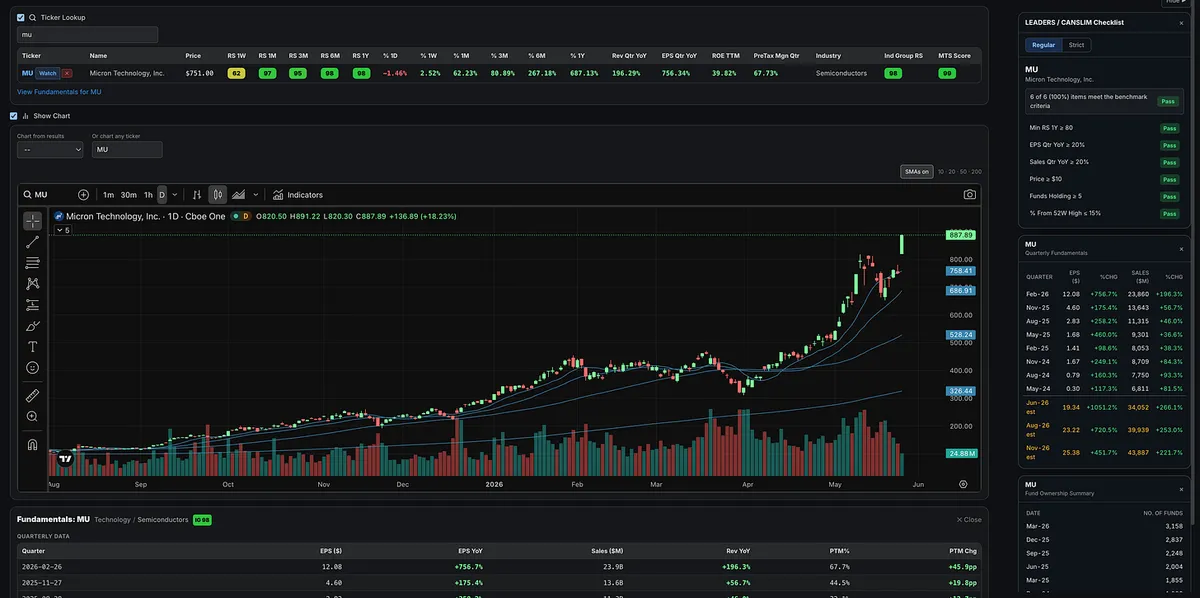
MU Breaks Out Again

I’ve been talking about MU since January.

And now we have another breakout to new highs.

Why have I liked MU?

Same thing I keep saying over and over again.

  • Big earnings.

  • Big sales.

  • Amazing return on equity.

  • Strong margins.

  • A hot industry group.

  • One of the strongest stocks in that group.

  • Aligned with the current bull market theme.

  • Fund ownership also continues to increase quarter over quarter.

Yes, there have been higher-performing relative strength stocks on a pure price basis.

But when you combine fundamentals and price action, there are not many names that come close to MU.

This is not about chasing random names.

It is about identifying super performance characteristics, tracking the leaders, and staying aligned with the strongest stocks in the strongest groups as long as the evidence remains intact.

MU continues to check those boxes.

View on Substack ↗

Fundamentals Build the Thesis. Price Tells You What to Do.

Institutional researcher Milton Berg worked with George Soros and Stanley Druckenmiller.

One thing he has said that I think more traders should pay attention to is that Soros and Druckenmiller may not talk about this much publicly, but they enter and exit positions based on technicals, with fundamentals as the backdrop.

That is not much different from what William O’Neil, Mark Minervini, and many growth stock investors do.

We want the fundamentals.

Big earnings. Big sales. Strong return on equity. Strong margins. Something new. A hot industry group. A stock aligned with the current bull market theme.

But we do NOT enter and exit based on the story alone.

We enter and exit based on what the chart is telling us.

The fundamentals help build the thesis.

The technicals help tell us when institutions are accumulating, when demand is showing up, how risk can be defined, and when the evidence is starting to change.

Soros and Druckenmiller may have looked at different types of fundamentals than a CAN SLIM growth investor, but the principle is very similar:

Use fundamentals to understand the opportunity.

Use price action to manage the trade.

View on Substack ↗

Stock Screening: The Same Names Keep Showing Up

There is no surprise here.

Most of the names I liked in my weekend scanning are the same names we have been talking about for months.

The best stocks usually keep showing up.

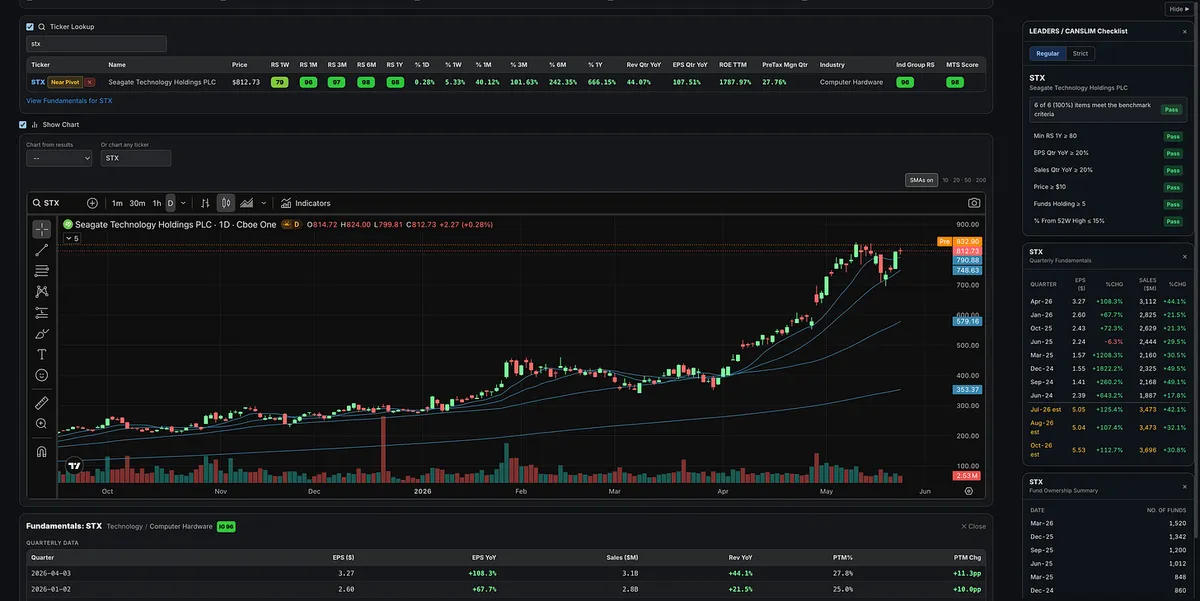
STX is one of them.

It is moving back toward new highs, and it still has a lot of the characteristics I want to see:

  • Strong earnings growth.

  • Strong sales growth.

  • High relative strength.

  • Strong ROE and margins.

  • Increasing fund ownership.

  • A strong industry group.

  • Price action aligned with the current bull market theme.

This is not about finding something obscure.

It is about finding strength, tracking it, and staying aligned with it as long as the evidence remains intact.

Eventually, every trend ends. The setups will stop working, the leaders will break down, and the market will rotate somewhere else.

But if you have been doing this correctly, by the time that happens, the gains from the trend should more than offset the normal losses that come when the move finally ends.

That is the whole point of following leadership.

You are not trying to be right forever.

You are trying to stay aligned while the evidence is there, and then get out when the evidence changes.

View on Substack ↗

The Stock Wasn’t a Secret. The Clues Were Public.

SNDK is now up over 200% since I first mentioned it.

But the lesson is not “buy SNDK.”

The lesson is that big winning stocks usually leave clues before the move becomes obvious.

SNDK had several of the characteristics I look for:

  • Strong relative strength.

  • A hot industry group.

  • Accelerating earnings and sales.

  • Growing fund ownership.

  • Price moving with institutional demand.

This is not some new strategy invented for social media.

It is the same basic system William O’Neil taught for more than 50 years, built on principles that go back to the great traders of the early 1900s.

Find the strongest stocks.

In the strongest groups.

With the strongest growth.

Showing institutional accumulation.

Then wait for a proper setup where risk can be defined.

The names change.

The characteristics do not.

View on Substack ↗

Why I Track Big Gap-Ups Inside the RS Screener

Someone asked me why I track episodic pivots and big gap-ups inside the Relative Strength Stock Screener.

Here’s why.

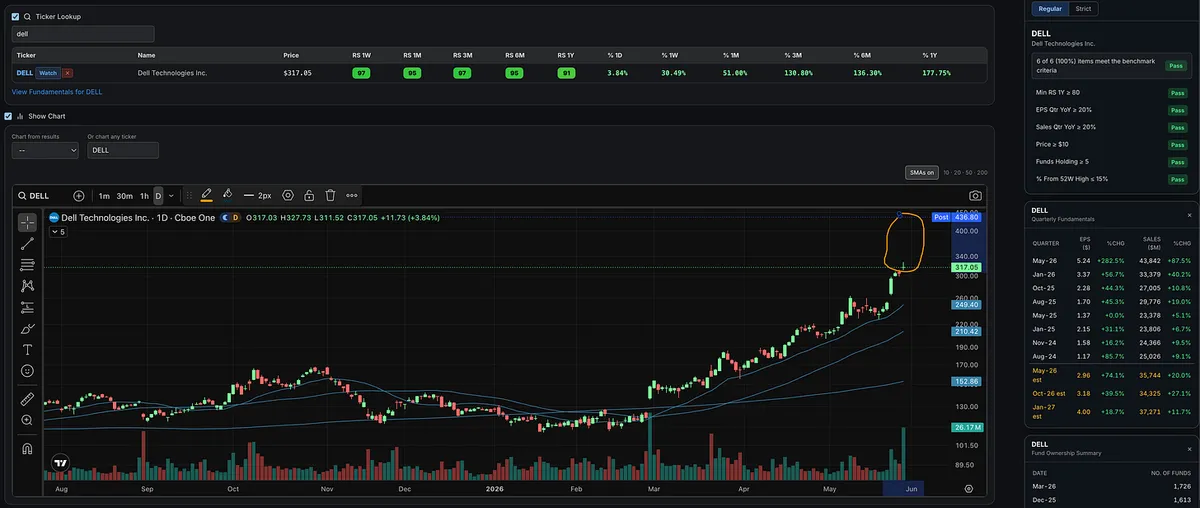
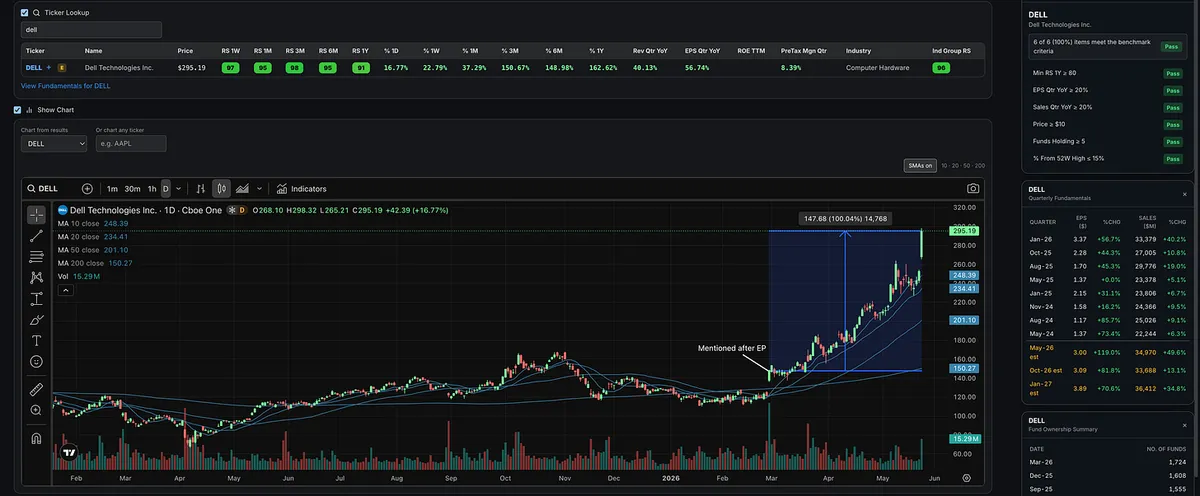
I wrote about Dell on March 1st after its episodic pivot, when the stock gapped up more than 10% on earnings with massive volume.

Since then, Dell has continued to trend higher, up roughly 100%, while making higher highs and higher lows.

Strong industry group. High relative strength across multiple time frames. Strong earnings. Strong sales. Massive volume after earnings.

That is exactly the kind of behavior I want to track.

Not because every gap-up works.

Not because you blindly chase every stock that moves.

But because big institutional-quality moves often leave footprints before the bigger trend fully develops.

The Relative Strength stock screener inside the Momentum Trading Strategy app is simple, but extremely powerful.

It helps me find the names that are showing up in the right places, at the right time, with the right characteristics.

This is exactly what I’m using to find the stocks I share.

View on Substack ↗

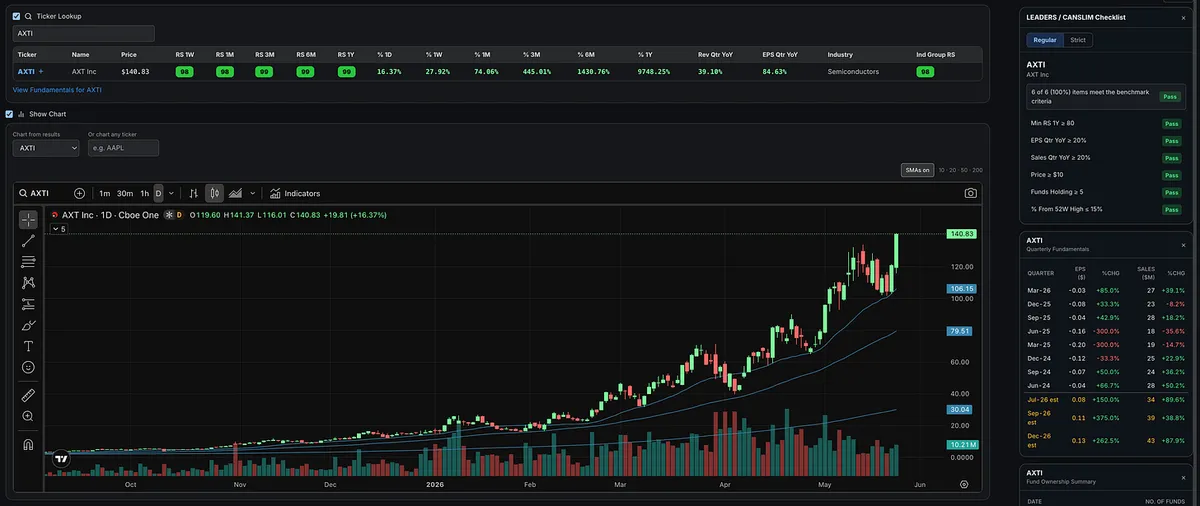
Are You Sick of Me Posting About AXTI Yet?

AXTI is back at all-time highs.

Are you sick of me posting about this stock yet?

Good.

Because this is the whole point of relative strength.

The strongest stocks usually keep showing up before everyone wants to believe them. They keep appearing on the screens. They keep building higher. They keep forcing you to either pay attention or make excuses.

That does not mean you chase.

That does not mean you FOMO into the trade.

And it definitely does not mean the stock can’t pull back or that the trend will last forever.

But when a stock keeps showing up with strong price action, strong relative strength, strong earnings and sales, and strength from a leading industry group, it deserves to stay on the radar.

This is where a lot of traders make the mistake.

They miss the first entry, take it off the watchlist, and never come back.

Or the stock pulls back, and they assume the move is over.

But leading stocks can trend for months.

AXTI has been doing exactly that.

So the better question is not, “Did I miss it?”

The better question is:

Is the trend still intact, and is the stock still acting like a leader?

“The trend is your friend except at the end when it bends.” — Ed Seykota

And right now, AXTI still hasn’t bent.

View on Substack ↗

The Quiet Warning Showing Up Under the Surface

A lot of leading stocks are still acting strong.

Many are making new highs. Many still have great relative strength.

Price is still king, and I would never execute a trade based on one data point alone.

But I am noticing something worth paying attention to.

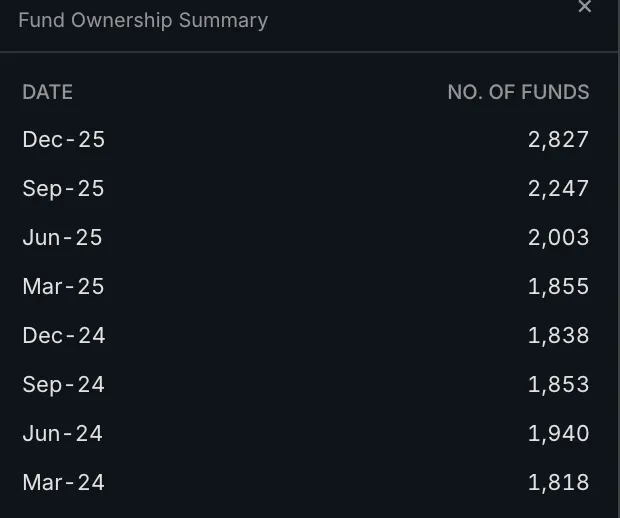
On the most recent earnings reports for a lot of leading names I’ve been following, fund ownership has dropped.

Again, this does not mean the move is over.

These stocks can absolutely keep running higher from here. That’s exactly why price always comes first.

Also, sometimes this happens for a quarter or two, then funds increase again and come right back into the name.

But when leading stocks are pushing higher while fund ownership starts declining, it can be an early sign that some institutions are taking profits into strength.

If price starts to break down later, this gives us a possible clue as to what may have been happening under the surface.

Some names where I’m noticing this:

SIMO, ALAB, MRVL, LITE, TTMI, NVT, LASR, AMD, STRL, LRCX, AAOI.

This is not a sell signal.

This is not a prediction.

Just something I’m taking note of.

View on Substack ↗

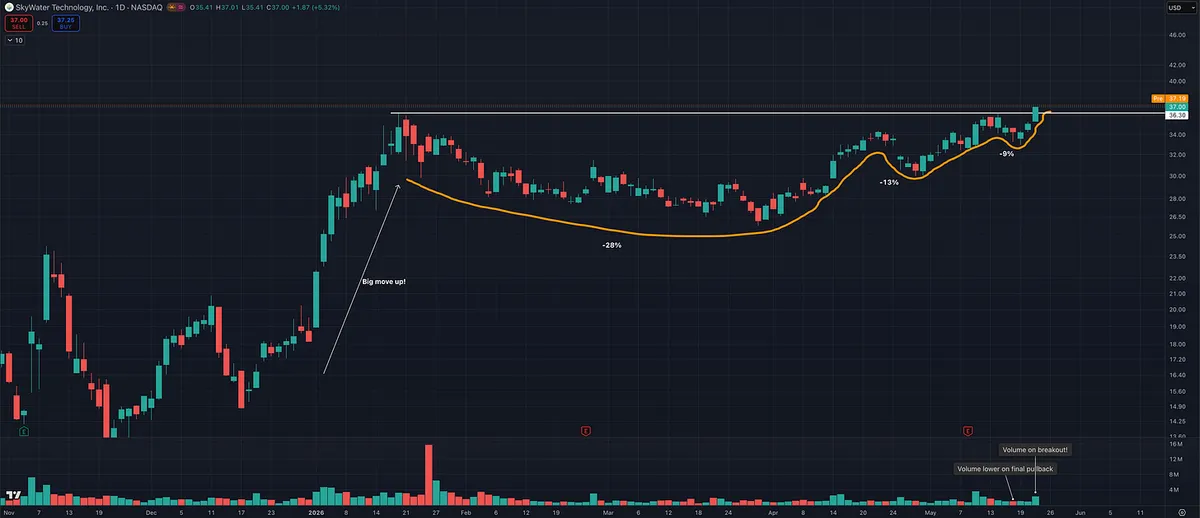
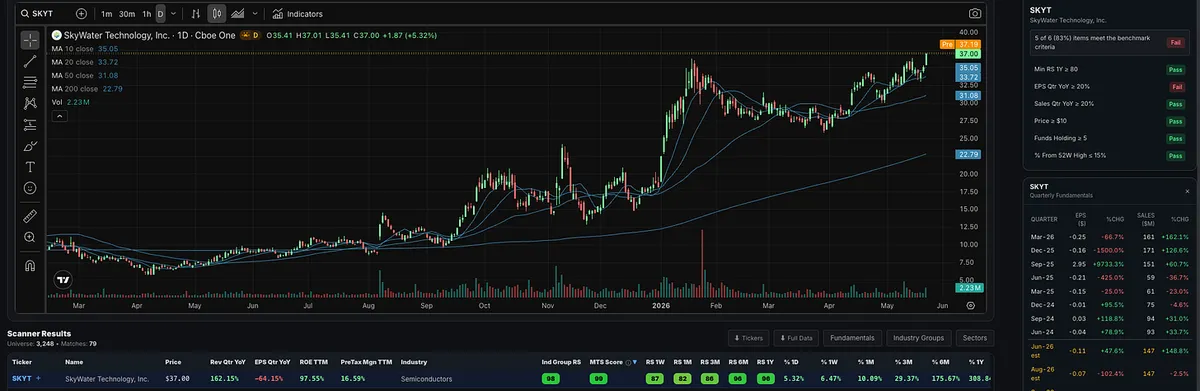
SKYT is not a perfect name, but the VCP action made me take a deeper look.

The earnings are not great. Last quarter was still negative, although it did improve from the prior quarter, and estimates look better going forward.

Fund ownership also dropped almost 50% last quarter, which is not something I ignore.

But price is still king.

And when SKYT showed up on my scanner, the technical action stood out.

After a huge move of well over 100%, the stock started tightening up near its highs:

  • 28% pullback.

  • 13% pullback.

  • 9% pullback.

That is classic volatility contraction.

The final pullback came on lower volume, then volume came back in on the breakout to all-time highs.

That is exactly what you want to see.

Again, this is not a perfect name.

But it has strong ROE, decent margins, strong sales growth, exposure to a strong semiconductor group, and strong relative strength.

This is why I don’t look at one data point in isolation.

Price is still the final judge.

The best setups are rarely perfect.

Would I prioritize a name with better earnings and stronger fund ownership?

Absolutely.

But I also don’t ignore setups with strong price action, tight volatility contraction, and volume coming in at the right time.

View on Substack ↗

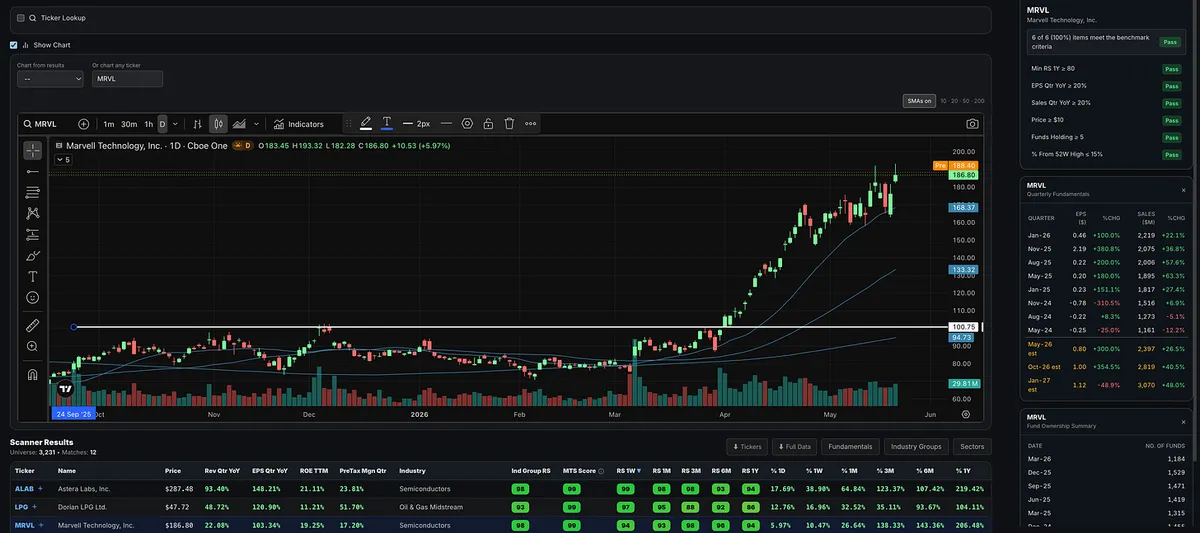
Look at MRVL.

This is what leadership looks like.

The stock has been showing a great deal of relative strength. Over the last week, it has held up extremely well and continues to trade near highs.

Fundamentally, it checks a lot of the boxes we want to see: strong earnings growth, good sales growth, good ROE, solid pre-tax margins, and it belongs to a strong industry group.

The relative strength is also very strong across multiple time frames, and it has been consistently outperforming.

View on Substack ↗

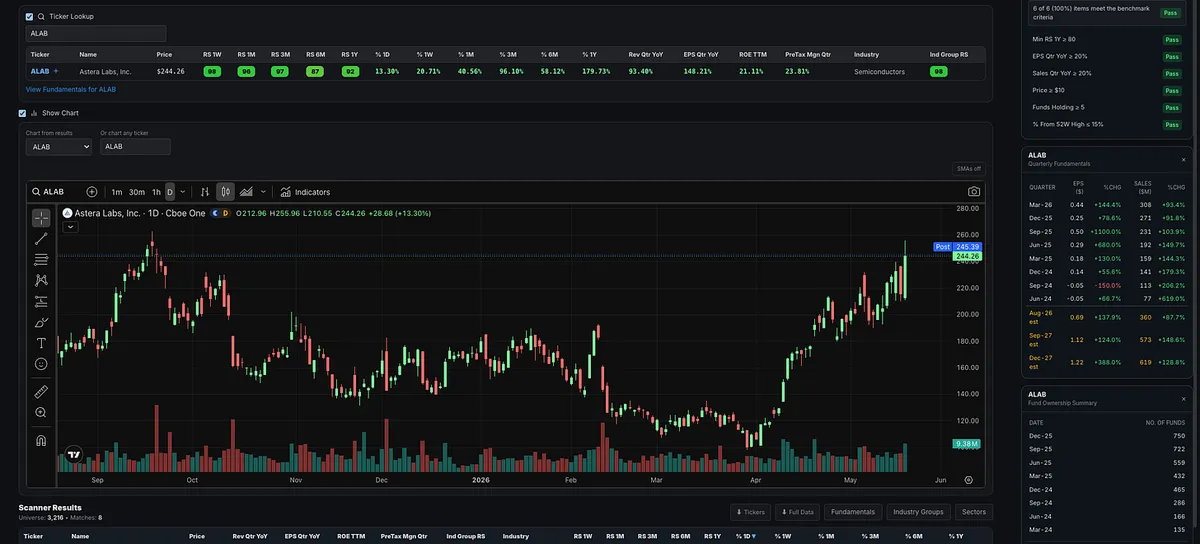
The strongest stocks often reveal themselves when the market is pulling back.

Will ALAB end up being one of them?

ALAB is up 13% today, and the earnings report is already out of the way.

Big sales growth.

Big earnings growth.

Strong ROE.

Strong margins.

Fund ownership increasing.

Relative strength still near the top of the market.

And now it’s pushing back toward all-time highs while the broader market is pulling in.

View on Substack ↗

Stop Chasing Stocks. Start Mastering the Real Game.

I’m amazed at how much effort people put into trying to find the next big stock, while ignoring the things that actually determine whether they survive long enough to compound capital:

  • Risk management.

  • Position sizing.

  • Trade management.

  • A disciplined process.

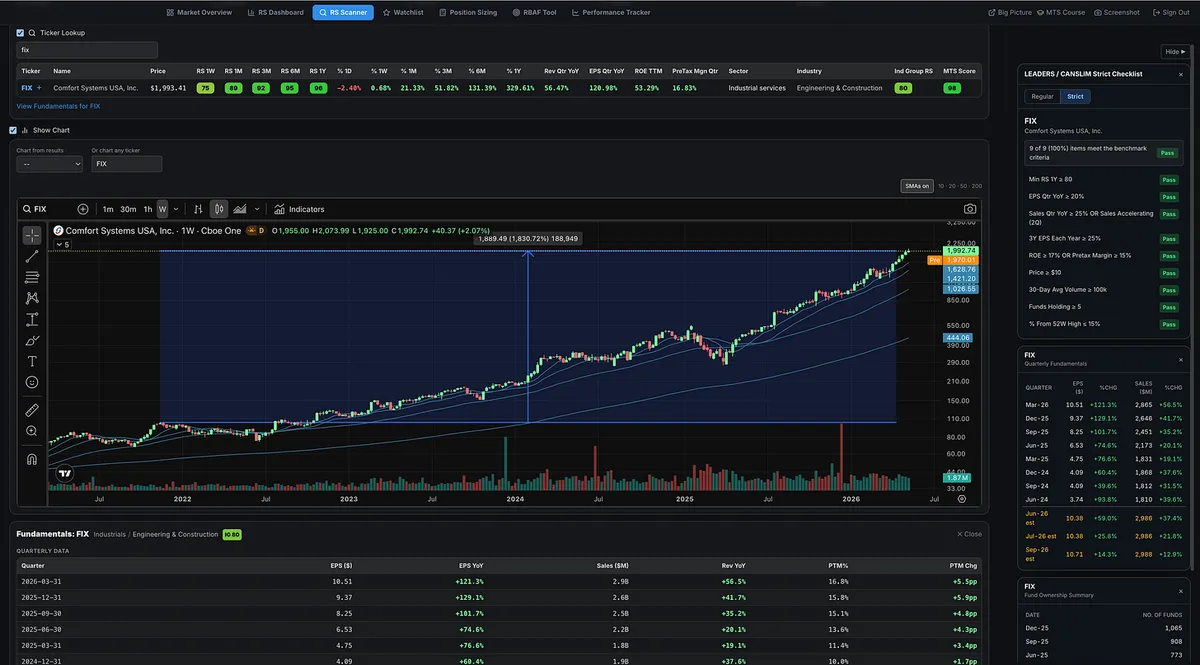
FIX is a great example.

This is not some random name that suddenly showed up on a screen. I’ve talked about FIX for a long time and have been watching it since 2022.

Why?

Because it checks many of the same boxes William O’Neil wrote about when studying the greatest winning stocks in market history.

  • Consistently strong relative strength. 90+

  • Massive quarterly earnings growth.

  • Massive quarterly sales growth.

  • Annual earnings growth of 25% or greater over the last three years.

  • Strong return on equity.

  • Strong margins.

  • Increasing fund ownership quarter after quarter.

At some point, what else are you looking for in a leading stock?

The problem for most traders is not that there are no good stocks.

The problem is usually one of three things:

  • They are looking at and trading the wrong stocks, instead of focusing on the right characteristics.

  • They lack discipline, risk management, and position sizing skills.

  • They have no clue how to manage the trade once they are in.

  • Or they do not have a real system or strategy.

Everyone says they want stocks.

But when strong names show up, many people still do not execute.

And the ones who do execute often do not know how to manage the trade once they are in it.

That is exactly why I decided to put so much work into the Momentum Trading Strategy Course.

Because finding the next big stock is only a small part of success in this game.

Real lasting success comes from knowing what to look for, when to act, how much to risk, and how to manage the position after entry.

Stocks matter.

Process matters more.

View on Substack ↗

The News Was Late. The Stock Was Already Leading.

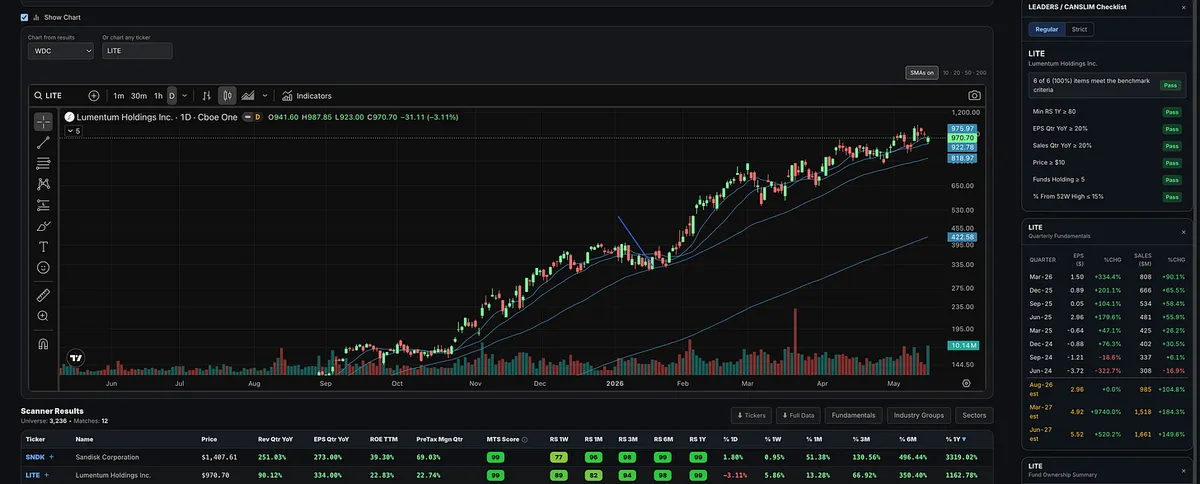
NVIDIA announced its planned $2 billion investment in Lumentum, ticker LITE, on March 2, 2026.

But LITE was already a major leader before that headline ever came out.

I was buying it and writing about it back in January when it was pulling back to the 50-day moving average.

Why?

Not because I knew NVIDIA was going to invest $2 billion.

I had no idea.

It was because LITE already had almost everything we look for:

  • Strong earnings growth.

  • Strong sales growth.

  • A 99 relative strength rating.

  • Accelerating institutional ownership.

  • Leadership in a top industry group.

  • Alignment with the broader AI theme.

That is the lesson.

You do not need to know everything about a company before the move happens.

You do not need to chase every headline.

In many cases, by the time the news confirms what is happening, the stock has already been under accumulation for weeks or months.

The process finds the clues before the headlines explain them.

Many of the biggest winners I have traded were not names I knew deeply at the time. They were not always comfortable. They were not always obvious, but they had the characteristics that big winning stocks tend to show before the crowd fully understands the story.

If you only trade names you are already comfortable with, you may miss many of the best opportunities.

The process often tells the story before the news does.

View on Substack ↗

The Leaders Were Hiding in Plain Sight

Back in January, when I first started sharing names, SNDK, MU, STX, and WDC were some of the stocks I kept coming back to.

Why?

Because they checked almost every box.

  • They were aligned with the dominant bull market theme: AI.

  • They were sitting inside a hot industry group.

  • They were among the strongest stocks in that group.

  • They had explosive earnings growth, big sales growth, strong margins, high return on equity, and elite relative strength.

That is not complicated. That is exactly what the legendary growth stock traders have been teaching for decades.

Look for the strongest stocks, in the strongest groups, supported by the strongest fundamentals, during a confirmed bull market.

Were there other high-flying names?

Of course.

But many of them did not have all the ingredients these names had.

The only major O’Neil-style box these stocks have not consistently checked is the three-year annual EPS growth requirement of 25% or greater each year.

But outside of that, they had almost everything you want to see in a potential market leader.

And today, finding these names is easier than ever.