
Momentum Trading Strategy

Notes

Risk Management & Position Sizing

Notes whose main point is limiting losses and deciding how much to buy and how much to risk on each trade.

Showing 201–220 of 224 notes

View on Substack ↗

Victor Sperandeo on Surviving a Trading Slump

Victor Sperandeo once shared a lesson he borrowed from baseball legend Ty Cobb.

“Ty Cobb once was asked why he never had slumps. He said that whenever he felt himself getting into a slump, he wouldn’t try to get a hit, but he would simply try to make contact with the ball. To relate that concept to trading, when you’re in a slump, try to be patient and wait for a trade that you feel very confident about and keep the bet size small. Your goal should not be to make lots of money but rather to get your confidence back by making correct decisions.”

That mindset is timeless.

When traders start pressing, they usually make things worse. They swing harder. They force trades. They try to make the money back quickly.

Sperandeo’s lesson is the opposite.

When you’re off your game, the goal is not profits. The goal is making contact. Small size. High quality setups. Process focused.

Confidence returns naturally once you start doing the right things again.

That is how professionals survive drawdowns and stay in the game long enough to catch the next big run.
View on Substack ↗

High Win Rates Are a Red Flag

One thing that always stood out to me from reading the Market Wizards books is that most of the traders interviewed did not have high win rates. The same is true when you study the best momentum, swing, and position traders today.

High win rates are not common among the best performers.

The traders who succeed over decades aren’t winning most of the time. They’re winning big when they’re right and keeping losses small when they’re wrong. That asymmetry is what drives long-term success, not an impressive-looking percentage.

Yet many of these traders made extraordinary amounts of money.

Why? Because they focused on asymmetry, not accuracy.

When someone leads with a 75% or 80% win rate, my first reaction isn’t admiration. It’s caution. High win rates often hide small profit targets, excessive risk, or strategies that break down when market conditions change or when less experienced traders try to replicate them.

The best traders aren’t obsessed with being right. They focus on finding low-risk, high-reward opportunities that produce positive expectancy over time. They cut losses quickly and let winners run.

Most operate with win rates around 30 to 45 percent, and in strong market environments maybe 50 to 65 percent at best.

They accept frequent small losses, wait patiently, and press hard only when the odds are clearly in their favor.

That mindset, more than any indicator or system, is what keeps them in the game long term.

View on Substack ↗

Larry Hite on Risk and Volatility

Larry Hite once shared a lesson from Ed Seykota that perfectly captures the reality of risk management:

“You can risk 1 percent of your capital, you can risk 5 percent, or you can risk 10 percent. But the more you risk, the more volatile your results will be.”

It’s a simple truth many traders overlook. Higher risk doesn’t just increase potential returns. It magnifies drawdowns.

Position sizing isn’t about being conservative. It’s about staying in the game long enough for your edge to actually play out.

View on Substack ↗

“Learn to take losses. The most important thing in making money is not letting them get out of hand. And don’t increase your position size until you’ve doubled or tripled your capital. Most people make the mistake of betting bigger as soon as they start making money. That’s a quick way to get wiped out.”— Marty Schwartz, Market Wizards

View on Substack ↗

The Lessons From an Anonymous Pit Legend That Every Trader Should Know

The Phantom of the Pits was written anonymously by a pit trader and it sums up many of the same lessons we have heard from the greats for more than 100 years. His approach focuses heavily on mindset, risk, and behavior, which is why so many traders still study his work today.

I broke down the core ideas from his book, including why he believed small risk at the start and adds only after confirmation created a safer way to build size. Plenty of traders succeed using different methods, but Phantom’s perspective is valuable because it explains the psychology behind why his rules worked for him and many others on the floor.

If you want a clear look at how he thought about risk, confirmation, and survival, here are the lessons from his book.

Read: https://tradingmomentum.substack.com/p/trading-lessons-from-the-phantom

ArticleTrading Lessons from The Phantom of the Pits
View on Substack ↗

The One Thing Almost Every Market Wizard Gets Right

Quick question:

Do you think it's more important to grow your account fast, or to avoid the big drawdowns that erase months or even years of progress?

If you leaned toward minimizing drawdowns, you already think like the Market Wizards.

When you study the greats, the pattern is clear. As they evolved, almost all of them shifted their focus from trying to increase returns to finding ways to reduce drawdowns. They improved their strategies by cutting risk, tightening exits, reducing size, and avoiding the environments that historically hurt them.

Many of them willingly gave up growth to smooth their equity curve.

Professionals are far more impressed by how much someone risked compared to what they earned. They judge a trader by the efficiency of the return, not the size of it.

The key metrics they care about:

  • Max Drawdown

  • MAR or Calmar ratio

  • Risk of Ruin

  • Time Under Water

  • Recovery Factor

  • Ulcer Index and Ulcer Performance Index

  • MAE (Maximum Adverse Excursion)

  • Intra-trade Drawdown

  • Heat on open positions

MAE and Heat expose a critical truth. Some traders close with small losses, but their trades were down 50 or 70 percent while open. On paper they look disciplined. In reality they were praying, adding, moving stops, or risking ruin.

One of the most interesting examples in Unknown Market Wizards was Amrit Sall, the sniper-style trader who had huge winners, sometimes 20R or more, yet extremely low drawdowns and almost no heat. His Sharpe ratio looked only average because the Sharpe formula penalizes upside volatility the same as downside volatility, treating his massive gains as risk. The adjusted Sortino ratio told the real story. It highlighted his incredible downside risk control because he rarely experienced meaningful adverse movement. He focused on low risk, huge reward opportunities with very small drawdowns and massive upside potential.

This exposed a major flaw in the Sharpe ratio. It rewards frequent small gains that often hide large tail risk, and it punishes precise traders who risk very little and occasionally win big.

Professionals avoid big losses. They respect traders who risk almost nothing and still produce meaningful returns.

Growth is easy to chase. Protecting capital and reducing drawdowns is what actually builds wealth.

View on Substack ↗

Dr. Van Tharp’s Marble Game proves the power of position sizing in the simplest way imaginable.

Give 10 people the exact same trades: same entries, same exits, same starting capital and you’ll end up with wildly different results.

Some will make millions…

Others will go broke.

The difference?

Not the system.

Not the market.

Not “luck.”

Position size.

Find out why and play the game yourself.

https://tradingmomentum.substack.com/p/the-van-tharp-marble-game-the-single

ArticleThe Van Tharp Marble Game: The Single Most Important Lesson in Trading
View on Substack ↗

Trading Rules Paul Tudor Jones Lives By

from Market Wizards

  • “Don’t ever average losers.”“Losers average losers.”

  • “Decrease your trading volume when you are trading poorly; increase your volume when you are trading well.”

  • “Never trade in situations where you don’t have control. For example, I don’t risk significant amounts of money in front of key reports, since that is gambling, not trading.”

  • “If you have a losing position that is making you uncomfortable, the solution is very simple: Get out, because you can always get back in. There is nothing better than a fresh start.”

  • “Don’t be too concerned about where you got into a position. The only relevant question is whether you are bullish or bearish on the position that day. Always think of your entry point as last night’s close.”

  • “The most important rule of trading is to play great defense, not great offense.”

  • “Don’t be a hero. Don’t have an ego. Always question yourself and your ability. Don’t ever feel that you are very good. The second you do, you are dead.”

  • “Don’t focus on making money; focus on protecting what you have.”

  • “When I am trading poorly, I keep reducing my position size. That way, I will be trading my smallest position size when my trading is worst.”

  • “I think one of my strengths is that I view anything that has happened up to the present point in time as history. I really don’t care about the mistake I made three seconds ago in the market. What I care about is what I am going to do from the next moment on. I try to avoid any emotional attachment to a market.”

View on Substack ↗

The Art of Sleeping Well: Risk Management Like Bruce Kovner

“Whenever I enter a position, I have a predetermined stop. That is the only way I can sleep. I know where I’m getting out before I get in. The position size on a trade is determined by the stop, and the stop is determined on a technical basis. For example, if the market is in the midst of a trading range, it makes no sense to put your stop within that range, since you are likely to be taken out. I always place my stop beyond some technical barrier.” — Bruce Kovner, Market Wizards

The Lesson

This quote captures one of the most timeless principles in trading: control risk first, profit comes second. Kovner didn’t guess where the market might go; he defined exactly where he’d be wrong before entering the trade.

The Example: Translating the Quote Into Action

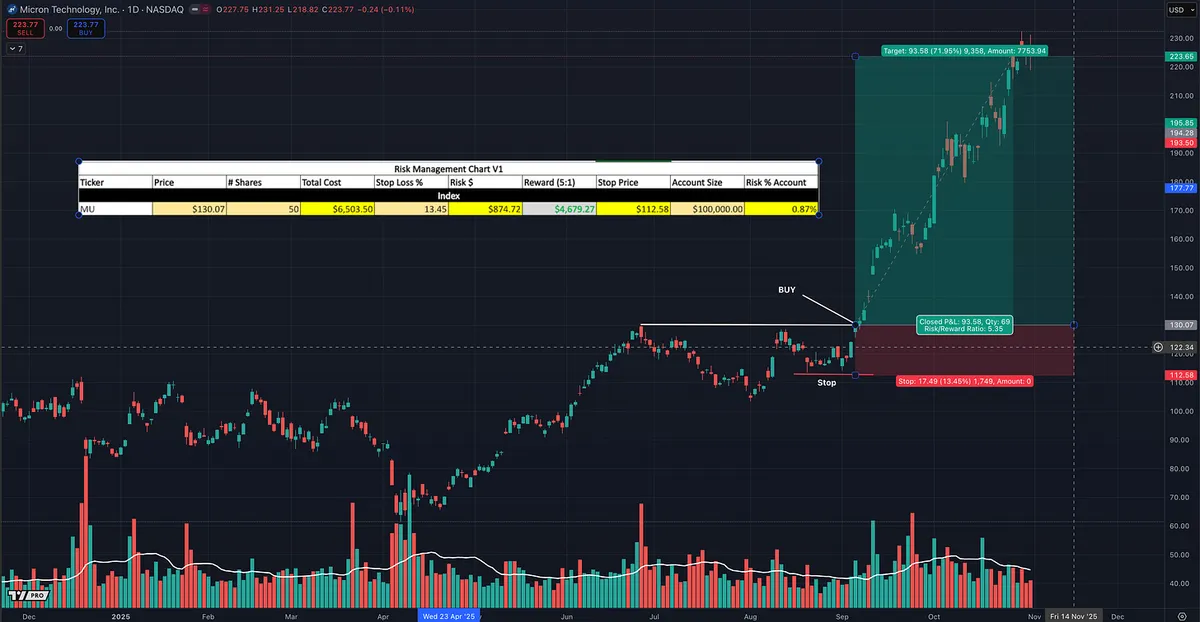
Let’s bring this to life with Micron (MU).

  • Entry: $130.07

  • Stop: $112.58

  • Stop Loss %: 13.45%

  • Account Size: $100,000

  • Target Risk per Trade: 1% (or $1,000)

If we simply bought any random number of shares, a 13.45% stop could easily blow through our target risk. But instead, we let the chart dictate where the stop goes — just below a key technical level — and then we adjust our position size so that the dollar loss stays within 1% of the account.

That’s how we arrive at 50 shares, risking $874.72 total.

Why the 13.45% Stop Makes Sense

Looking at the chart, you can see how the stop sits below prior support and the breakout zone — a level where, if price falls back through, the trade idea is invalidated. That’s exactly what Kovner meant by placing your stop beyond a technical barrier.

Setting the stop inside the range would’ve exposed us to random volatility and a likely premature exit. By respecting market structure, we give the trade room to breathe — but by managing position size, we keep risk capped and consistent.

The Takeaway

The professional mindset isn’t about predicting the next big move — it’s about controlling the downside so you can stay in the game long enough to catch the upside.

Every trade starts with two questions:

  1. Where am I wrong? → defines your stop.

  2. How much am I willing to lose? → defines your position size.

When you combine those answers, you get clarity, consistency, and, as Kovner said, the ability to sleep at night.

View on Substack ↗

It’s Not About How Often You Win — It’s About How Big You Win.

Most people focus on being right often, not being right big. In reality, the majority of the best traders understand that you don’t need a high win rate to generate extraordinary returns. You just need to win big when you’re right and lose small when you’re wrong.

Stanley Druckenmiller is a perfect example:

“The way to build long-term returns is through preservation of capital and home runs.”

Over three decades, he averaged more than 30% annual returns managing billions, not because he was always right, but because his winners were big enough to pay for the losers. He focused on low-risk, high-reward trades.

View on Substack ↗

The Diversification Delusion

“Diversification is a hedge for ignorance. I think you are much better off owning a few stocks and knowing a great deal about them.”

— William O’Neil

“Diversification is protection against ignorance. It makes little sense if you know what you’re doing.”

— Warren Buffett

Two completely different types of investors — O’Neil, a growth and momentum trader, and Buffett, a long-term value investor, yet both came to the same conclusion.

Most people think diversification reduces risk. But for those who actually know what they’re doing, it often does the opposite. It dilutes focus, weakens conviction, and hides bad decisions behind averages.

Real safety doesn’t come from owning more. It comes from understanding more — from knowing exactly what you own and why.

View on Substack ↗

Everyone’s screaming “Crash is coming!” 🚨

Here’s the thing… if you actually have a strategy, it doesn’t matter.

Stops protect you.

Position sizing saves you.

Patience pays you.

The people panicking? They’re just showing their hand — over-leveraged, no plan, no risk management.

Markets crash. Markets recover. Traders with discipline survive both.