Momentum Trading Strategy

Notes

Becoming a Better Trader

Building and improving your trading process over time: how to learn, which method to use, and how to measure progress.

Showing 81–100 of 217 notes

View on Substack ↗

The Real Holy Grail in Trading

One of the easiest ways to spot an inexperienced trader is when they act like their strategy is the only way to make money.

Maybe they are not a complete beginner anymore, but they are still inexperienced if they believe their style is the only style that works.

Anyone who has been around this game long enough knows there are many different ways to make millions in the markets.

Read the Market Wizards books and you will see it clearly.

Some of the best traders are discretionary. Some are systematic. Some are quants. Some are fully technical. Some are fully fundamental. Some are techno-fundamental and use both.

There are day traders, swing traders, position traders, macro traders, futures traders, stock traders, options traders, and short sellers who have all built incredible records doing things completely different.

My lane is growth stock momentum trading.

I primarily trade as a swing trader and position trader. I use technicals and fundamentals, and I would say my style is most similar to traders like William O’Neil, Mark Minervini, and Dan Zanger.

That style fits my personality, my strengths, and my lifestyle.

I actually love day trading, but having four kids and businesses outside of trading, I have found that it does not fit the season of life I am in. It can easily pull me into a place that is not healthy or sustainable for me.

So regardless of the method I use, I know someone else can be wildly successful trading a completely different way.

That is why I stay in my lane.

I am here for people who align with my style or want to learn it. I am not here to pretend it is the only way to make money.

That is why I laugh when I see traders on here pushing their method like it is the holy grail.

To experienced traders, that does not look confident.

It looks ignorant.

Because the real pros know the truth.

The common thread between great traders is not that they all trade the same setup, the same timeframe, the same asset class, or the same strategy.

They don’t.

The common thread is risk management, position sizing, discipline, and the ability to admit when they are wrong and cut losses.

That is the real holy grail.

So when you see traders constantly talking about risk, position sizing, cutting losses, protecting capital, and surviving long enough for their edge to play out, pay attention.

Those are usually the ones who actually know what they are talking about.
View on Substack ↗

Shiny Object Syndrome Is Killing Your Trading

There are many different ways to make money in the markets.

You can trade fundamentals, technicals, or a combination of both.

Value, growth stocks, trend following, mean reversion, the list goes on.

There is not only one way to win.

But eventually, you have to pick a lane.

At some point, you have to commit to one method, turn the blinders on, and dedicate yourself to becoming excellent at that system.

Most traders never do this.

They bounce from strategy to strategy.

Then they find another indicator, another guru, another screener, another setup.

And after years of doing this, they still wonder why they have not developed real skill.

But skill is not built by bouncing around.

Skill is built through focused practice on your craft.

Learning the same system so deeply that you start to understand its rhythm, strengths, weaknesses, and personality.

I know people who have been “trading” for 10 years and still are not successful because they never truly committed to anything.

And I know others who spent 3 years focused on one sound strategy and became far more skilled.

Not because they were smarter.

Because they stopped chasing everything.

There are many ways to make it in the markets.

But bouncing around forever is not one of them.

View on Substack ↗

You Have Not Earned the Right to Trade Larger Yet

Most traders skip the step that would probably save them.

Many leading trading firms do not just hand traders money and tell them to go figure it out.

They make them trade in simulation first.

Not for a day. Not for a week.

Until they prove they can actually trade the strategy.

Then, when they go live, their size is small.

Very small.

Only after they show consistency does the firm gradually increase their buying power.

You must earn the right to trade larger.

Now compare that to what most traders do.

They learn a setup on YouTube, fund an account, take full-size trades, have no clue how to use position sizing, lose money, change strategies, repeat the cycle, and wonder why they cannot find consistency.

If you have not found success in the markets, I can almost guarantee you have not followed this process.

Why not?

Stop wasting time and commit to doing it the right way, or save your money and do something else.

View on Substack ↗

Stop Waiting for Someone to Hand You the Next Big Winner

If you are struggling to find the big winning stocks, you do not need to wait around for me or anyone else to tell you the names.

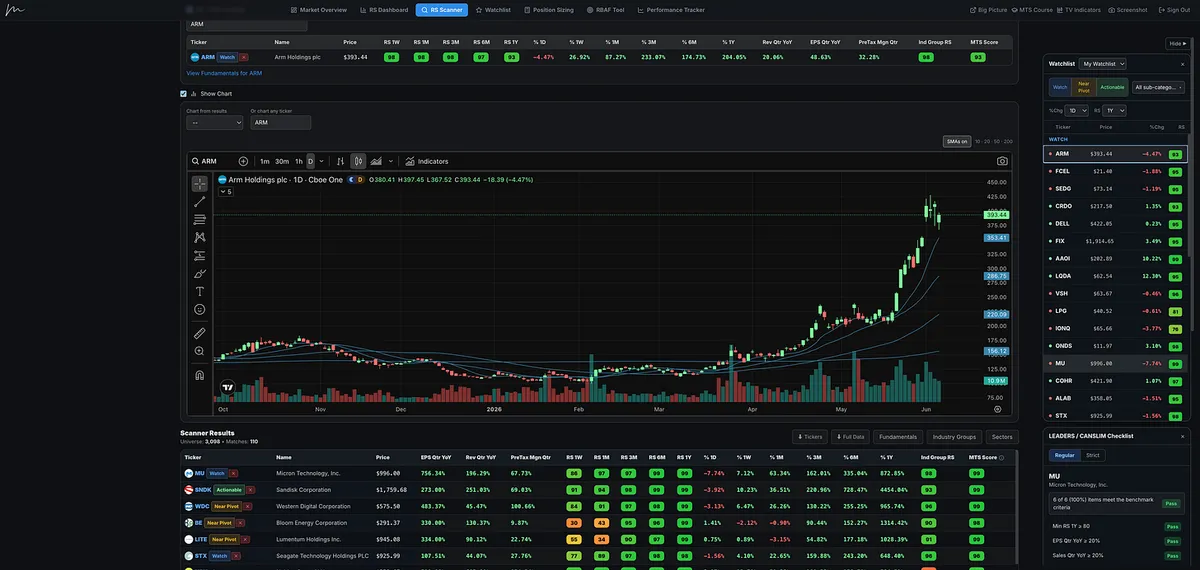
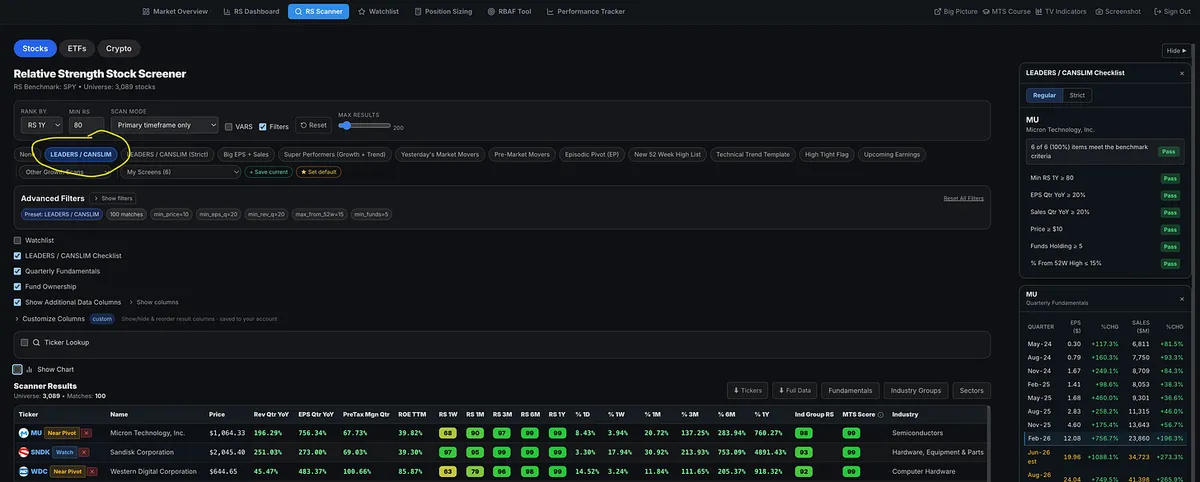
Open the Relative Strength Stock Screener and click the Leader / CANSLIM preset stock screen.

You will immediately see many of the market’s strongest names near the top of the list.

As you scroll through the list, some names will be extended. Those go on your watchlist so you can wait for the next proper pullback or setup.

Some will be near pivot points.

Some will already be actionable.

That is the entire point of the screener.

It is not there to overwhelm you with tickers. It is there to help you quickly identify where the real leadership is.

This is the same exact process I have used to find and share many of the biggest winners since January.

Names like:

SNDK

MU

AAOI

AXTI

DELL

CIEN

LITE

WDC

STX

SIMO

and many more!

Your job is to build the habit of checking the list, following the leaders, managing risk, and being ready when the setup appears.

Everything you need to learn the process is inside the Momentum Trading Strategy Course. I also provide a list of books that teach many of the same timeless principles.

Learn the process.

Use the tools.

Trust yourself.

You can do this.

View on Substack ↗

Your Trading Is Too Complicated

Steve Jobs built around focus and simplicity.

Say no. Remove what does not matter. Make the product so clean that the user knows exactly what to do.

Elon Musk has pushed a similar idea from an engineering angle.

Question everything. Delete what is unnecessary. Simplify.

Trading is not much different.

Most traders think the market is an intellectual battle.

More indicators. More opinions. More news. More podcasts. More setups. More screens. More tickers.

But more information does not always create better decisions.

A lot of the time, it creates hesitation, confusion, and emotional noise.

The brain under pressure does not need more complexity.

It needs clarity.

That is one of the biggest psychological traps in trading.

Complexity feels intelligent.

Simplicity feels too basic.

So traders keep adding more and more to their process because it gives them the feeling of control.

But feeling in control and actually being in control are two different things.

  • Understand the general market environment.

  • Find the strongest stocks in the strongest groups.

  • Wait for proper setups.

  • Define your risk.

  • Size correctly with proper position sizing strategies.

  • Cut losses.

  • Sit with winners.

  • Repeat.

That is not sexy.

But it works a lot better than constantly adding more fluff to avoid doing the boring simple things.

Steve Jobs simplified products.

Elon Musk simplifies systems.

Traders should simplify their process.

View on Substack ↗

Uncommon Results Require Uncommon Behavior

Momentum and growth stock trading can look like following the herd.

In one sense, it is.

We are trying to identify where money is flowing, where leadership is developing, and where institutions are accumulating shares. We want to be in the strongest stocks when the market is rewarding strength.

But the actual strategy and execution are almost the complete opposite of how most people trade and invest.

Most people have no real game plan.

  • They buy because they like a story.

  • They chase tips.

  • They average down.

  • They hold and hope.

  • They do not manage risk.

  • They do not know where they are wrong.

  • They do not have sell rules.

  • They do not have a real process for position sizing, entries, exits, or exposure.

So while growth stock investors may seem like we are part of the herd, in reality, this style represents a very small part of the overall market.

The majority of investors are not operating this way.

That is one reason I believe so many U.S. Investing Champions and Market Wizards have used some version of this approach. They are not just buying strong stocks. They are applying rules, risk management, discipline, and a repeatable process.

And I think this applies to most areas of life.

  • Most people say they want freedom, but they are terrified of taking ownership of their future.

  • Most people think starting a business is risky, but I think relying entirely on one paycheck can be risky too.

  • Most people know they should eat better, exercise, and take care of themselves, but they do not consistently do it.

The person who does usually ends up with a very different life.

The point is not to be contrarian just for the sake of being contrarian.

The point is this:

If you are doing things the same way as the majority, there is a good chance you are going to get the same results as the majority.

In the market, finding strong stocks is only part of it.

The real separation comes from having a strategy, system, and process when most people do not.

Whether it is trading, business, health, or life, the rule is usually the same:

If you want uncommon results, you cannot follow common behavior.

View on Substack ↗

The Trading Account That Saved Me From Myself

I love trading and markets.

Some people might even call it an obsession.

But a long time ago, I analyzed my own trading data and realized something important:

Most of my money came from a small number of trades.

The A+ setups. The best market environments. The times when I was extremely selective.

The rest of my trades?

Small losses. Flat trades. Small gains. A lot of activity that did not really move the needle.

So why take them at all?

Because I love the markets.

But here’s the key: I separated that activity from my serious trading account.

I have my primary account, where I only want my best ideas, best setups, proper position sizing, and strict risk management.

Then I have a smaller account where I can stay engaged, test ideas, experiment, and have fun.

It is money I am willing to lose. If that account went to zero, it would not affect my wealth, my mindset, or my real trading process.

I think a lot of traders could benefit from this kind of honesty.

Many people say they are trading to make money, but their behavior says they are really trading for action.

For excitement. For stimulation. For the feeling of being involved.

And if you are not aware of that, it can cause a lot of damage.

Sometimes the answer is not pretending you suddenly have perfect patience.

Sometimes the answer is building a system around who you actually are.

Know yourself.

Know which trades actually make you money.

Know when you are trading for edge and when you are trading for fun.

View on Substack ↗

A lot has changed inside the MTS web app over the last month.

Here are a few of the recent updates:

  • Saved scans.

  • Custom columns.

  • Watchlist side panel.

  • Journal notes and images.

  • IPO filters.

  • Sector and industry group exclusions.

  • Industry group ranking by timeframe.

  • RS dashboard sorting upgrade.

  • MTS Scores by timeframe.

  • Sales Ratings.

  • Watchlist subcategories.

And this is just from the last month.

Check it out.

https://tradingmomentum.substack.com/p/big-updates-just-dropped-inside-the

ArticleBig Updates Just Dropped Inside the Momentum Trading Strategy Web App
View on Substack ↗

Most Traders Don’t Need More Information. They Need the Right Path.

A lot of people ask me where to start.

  • What books should I read?

  • What should I study first?

  • How do I avoid wasting years chasing the wrong things?

I get it, because I was there too.

Most of us did not struggle because we were lazy. We struggled because we were overwhelmed, distracted, and constantly pulled toward the wrong information.

In today’s world, the problem is not a lack of information.

The problem is the abundance of information has made it harder to find the right information.

Back in November, I wrote a post called:

If I Were Starting Over Again: A Beginner’s Roadmap to Growth Stock Investing and Momentum Trading

A lot of new people here probably missed it, so I’m resharing it.

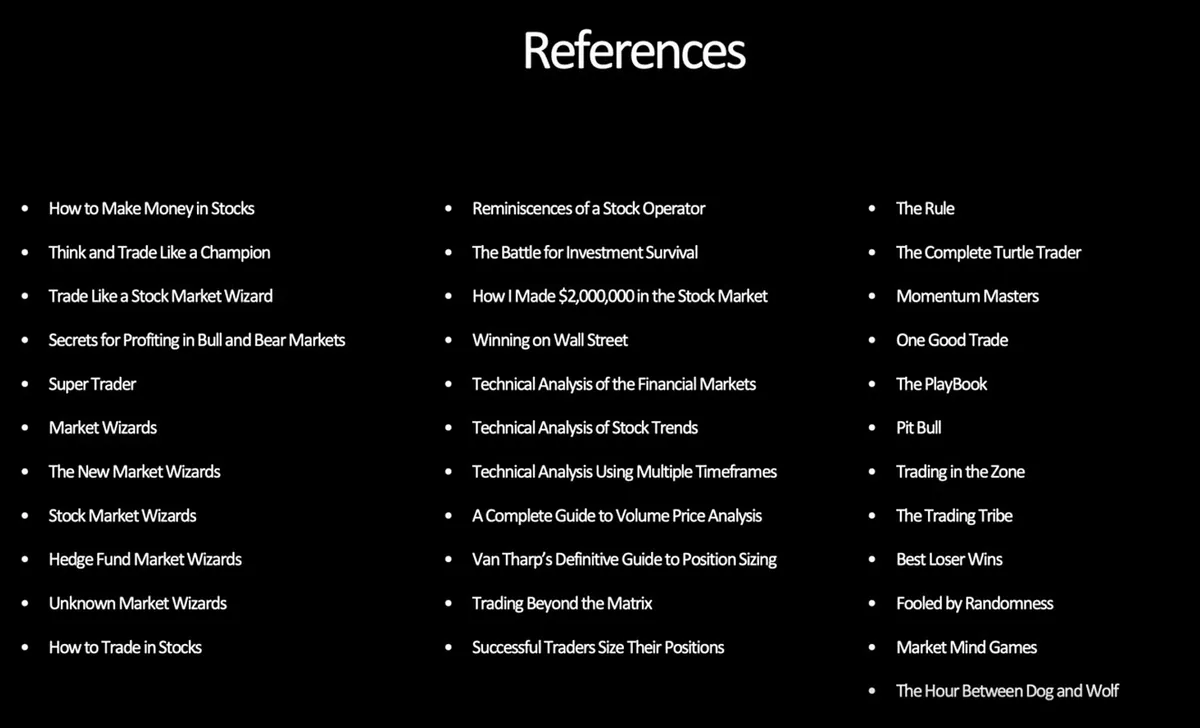
The screenshot below shows just some of the great trading books and references that have had a positive impact on my development over the years.

This post is not everything I have learned. It is not meant to overwhelm you. It is meant to give you a clear starting path, the kind of path I wish I had when I first started.

Many traders spend years failing, struggling, and searching before they finally find the right sources.

This can help shorten that journey.

Not by doing the work for you.

But by pointing you in the right direction before you waste years chasing noise.

If you’re newer to trading, investing, or momentum stocks, start here.

Read the post. Save it. Study the books. Build the foundation first.

https://tradingmomentum.substack.com/p/if-i-were-starting-over-a-beginners

ArticleIf I Were Starting Over: A Beginner’s Roadmap to Growth Stock Investing & Momentum Trading
View on Substack ↗

Your Trading Is Only as Strong as Your Weakest Link

One reason I see so many traders struggle is because they are usually missing one critical piece of the puzzle.

They become obsessed with setups, but ignore quality stock selection.

Or they get good at finding strong stocks, but have no patience or precision with their entries.

Or they do both well, find great stocks and wait for good setups, but then trade aggressively in a poor market environment and give back weeks or months of progress.

That is the part most people do not want to hear.

The market does not just reward what you are good at.

It exposes what you are weak at.

If your stock selection is weak, the market will punish you.

If your entries are sloppy, the market will punish you.

If your risk management is emotional, the market will punish you.

If you ignore the general market, the market will punish you.

Every piece matters.

  • The setup matters.

  • The stock matters.

  • The entry matters.

  • The market environment matters.

  • The position size matters.

  • The sell rules matter.

  • The review process matters.

Most traders keep working on the part they already like because it feels good and productive. They study more charts, look for more setups, follow more stock ideas, or keep searching for the next big winner.

The real growth usually comes from working on the part you avoid.

That is probably where the leak is.

If you want to improve, stop asking, “What is the next stock?”

Start asking:

“Where is my process weakest?”

Because the part of your process you avoid is probably the exact part holding you back.

The market will find it eventually.

Better to find it first.

View on Substack ↗

You Do Not Have to Like Someone to Learn From Them

A lot of people hold themselves back from learning because they take everything too personally.

They think if they do not like someone, they cannot learn from them.

That is a mistake.

Sometimes the person you can learn the most from is also someone you would never choose to spend time with.

Maybe they are arrogant.

Maybe they are difficult.

Maybe their personality annoys you.

Maybe you simply do not like the way they carry themselves.

That does not mean they have nothing to teach you.

Marcus Aurelius understood this well.

In Book 2 of Meditations, he reminds himself that the people he deals with will often be difficult, arrogant, ungrateful, dishonest, jealous, and frustrating.

But the point was not to complain about them.

The point was to prepare himself.

He could not control their character, their attitude, or their behavior. He could only control whether he allowed those things to disturb his own judgment and actions.

You do not have to let someone’s personality block your ability to extract value.

I have had people in my life who were extremely skilled at certain things, but were not great people to be around. I have had bosses in the past who were good at parts of the job, but personally, I could not stand them.

It would have been easy to shut them off completely and say, “I do not like this person, so I am not listening to anything they say.”

But that would have only hurt me.

Instead, I tried to separate the lesson from the person.

I did not have to admire them.

I did not have to agree with everything they did.

I did not have to become like them.

But I could still pay attention to what they were good at and take something useful from it.

Trading is the same way.

There are traders I have learned from who I probably would not get along with personally. Some annoy me. Some communicate in a way I do not like. Some have personalities that do not resonate with me at all.

But they still had lessons worth taking.

A setup.

A risk rule.

A way of thinking.

A way of managing trades.

A way of staying disciplined.

A mistake they made that I could avoid.

If you only allow yourself to learn from people you like, you are limiting your own growth.

You do not need to worship people, but you can extract wisdom from them.

Take what is useful.

Leave what is not.

And keep getting better.

One of the biggest signs of personal growth is being able to learn from someone without needing to like them, follow them, agree with them, or become them.

I challenge you to do the same.

Stop making learning so personal.

Your growth matters more than your opinion of the teacher.

View on Substack ↗

New Feature Added: Watchlists Are Now Inside the RS Screener

Another update has been added to the Relative Strength Stock Screener.

You can now view and manage your watchlists directly inside the screener through the new Watchlist Panel on the right side of the screen.

This means you no longer have to jump back and forth between the Relative Strength Screener and the Watchlist tab. Your watchlists are now accessible while screening, making it easier to review candidates, organize ideas, and move stocks through your workflow.

View on Substack ↗

AI Won’t Make You a Better Trader or Growth Stock Investor

AI is great.

I use AI in several of my other businesses, and it is incredibly useful. It helps with content, coding, research, websites, images, and all kinds of tasks that save time. It makes me more productive, and frankly, it allows us to do more with fewer people.

But trading?

I have not seen AI add one single thing to my actual edge.

And deep down, most experienced traders already know this.

The people who have spent years in markets know that the same things that worked 10, 20, and 30 years ago are still what work today.

Charts may look nicer. Platforms are faster. Commissions are lower. Software looks better.

But the game has not changed nearly as much as people want you to believe.

Great traders are still studying price, volume, leadership, fundamentals, risk, entries, exits, position sizing, market environment, and their own behavior.

That is the work.

And that is the part most people want to skip.

So now AI has become the new shortcut.

Before AI, it was indicators.

People wanted the perfect indicator to tell them when to buy and sell. They wanted a signal, an arrow, or a magic formula to replace skill.

Now the same type of person is looking for AI to do the same thing.

But here is the question nobody wants to answer:

Where are all the wildly successful Indicator or AI traders?

If AI is really giving retail traders some incredible edge, where are the people quietly printing money with it?

The truth is, most of the AI hype in trading is being sold to people who do not yet have enough experience to know what they are being sold.

AI can summarize a stock faster, help organize information better, code tools, streamline your workflow, but it is NOT going to magically make you a consistently profitable trader.

Maybe one day AI becomes a real edge in the market, and changes stuff.

But that’s not right now.

The market still rewards what it has always rewarded: discipline, process, strategy, proven setups, risk management, position sizing, and the ability to identify the characteristics of true market leaders.

And the market still punishes people looking for shortcuts.

So yes, use AI.

Use better tools.

Use better software.

Use anything that helps you move faster and stay organized.

But do not confuse a better tool with a better trader.

Sorry to tell you, but there is no shortcut around the real work. If you want to win in this game and make money, you have to actually learn how to play it.

View on Substack ↗

The Best Traders Didn’t Invent the Game. They Mastered It.

What gives you the better odds?

Trying to find someone who claims they invented a new cutting-edge way to beat the market?

Or learning the same time-tested principles that have worked for generations?

Great athletes don’t invent how to play the game.

They model the greats before them.

They master the basics.

They execute better.

A great surgeon didn’t invent most of what they do.

They studied the craft, repeated the process, and mastered it through years of disciplined execution.

A great businessman is often the same way.

People call them geniuses, but many of them are simply better at executing principles that existed long before they were alive.

Trading is no different.

But for some reason, traders are constantly looking for someone who claims they found a revolutionary new way to beat the market.

I think that is usually the wrong search.

You are far better off mastering what has already worked.

I could package this up and pretend I invented some secret strategy.

I could feed my ego and make it sound like this is all mine.

But that would not be true.

I learned from the greats.

O’Neil. Livermore. Darvas. Minervini. Zanger. And many others.

Just like great ballplayers study the hitters before them, I studied the traders before me.

Then I spent 20 years trading, making mistakes, improving, and learning how to execute the process in real markets.

That is what Momentum Trading Strategy is built around.

A time-tested process passed down from the great traders who came before us.

So ask yourself:

What is more likely to bring you success?

Someone claiming they found a brand-new way to beat the market?

Or putting in the work to master principles that have stood the test of time?

If you are ready to do the work, become a paid subscriber to Momentum Trading Strategy and get access to the full course and the trading software built to support what you learn.

You will get the process, the tools, and the structure to help you find leadership, manage risk, build watchlists, review trades, and start trading with a real plan.

Will you be one that carries the torch forward?

View on Substack ↗

The Multi-Bagger Irony

A lot of stock newsletters sell people on the hope of finding the next multi-bagger.

A 100%, 200%, or 300% winner.

Many talk about holding for years to get the big returns.

What people don't realize is this:

By the time you figure out they were full of it, they already made plenty of money selling you the hope.

The funny thing is, I don't even teach or claim to give people multi-baggers.

But many investors would likely get similar or better results by learning how to identify true growth stock leadership, proper setups, institutional demand, and strong price action.

Here are a few names I mentioned in January and early February:

• AAOI +302%

• AXTI +294%

• SNDK +249%

• DELL +214%

• MU +160%

• LITE +155%

• CIEN +147%

• STRL +127%

• STX +126%

• WDC +124%

• INTC +101%

• AMD +101%

These were discussed in the paid subscriber chat and watchlist posts.

But to be clear, this is not what I do here.

I'm not telling you to blindly buy a stock and hold it until it becomes a multi-bagger.

The goal is to teach you how to find leadership, manage risk, identify proper entries, and build a repeatable process.

View on Substack ↗

Copying Traders Won’t Make You Rich. Learning the Way Might.

At this point in my trading, I don’t pay attention to what anyone else is doing.

But recently, I looked around and noticed something interesting.

Some of the traders I learned from, including Dan Zanger, recently were buying many of the same names, around the same areas, using the same types of setups I was seeing.

Names like: SNDK, DELL, MU, LITE

Why?

Because we learned from the same source material.

The same books. The same legends. The same principles. The same market truths.

When you truly learn a strategy, your decisions start to look similar to others who have learned the same way.

To outsiders, it can look like people are copying each other.

But that is not what is happening.

Will you be one of the few who carries the torch forward?

The traders who actually learn the process, study the patterns, understand the risk, and develop their own conviction are the ones who carry the torch forward.

That is how great trading knowledge gets passed down from one generation to the next.

Will you be one that carries the torch forward?

View on Substack ↗

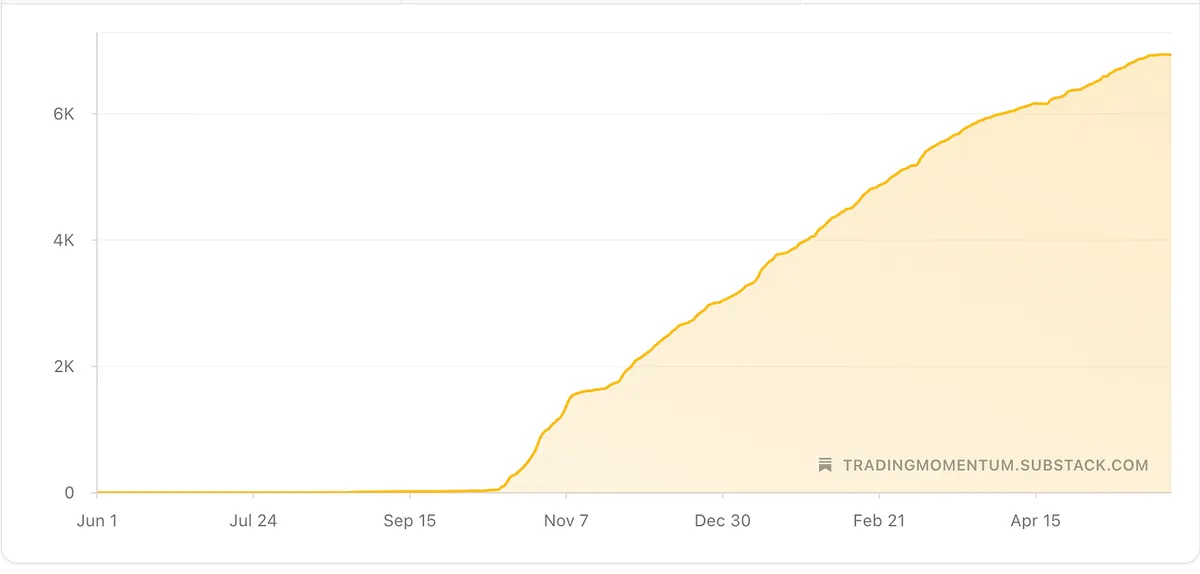
From 0 to #46 New Bestseller

A few months ago, Momentum Trading Strategy didn't exist.

Today:

• 6,900+ subscribers

• #46 New Bestseller on Substack

• #54 in Finance

Thank you to everyone who has subscribed, shared posts, liked articles, commented, provided feedback, and supported the publication.

What started as a few articles about momentum trading and growth stock investing has grown into a complete ecosystem:

• Weekly Big Picture Market Pulse Newsletter

• Momentum Trading Strategy Course

• Relative Strength Stock Screener

• Trading Journal & Analytics

• Risk Management Tools

• MTS Chart Indicators

• Market Overview Dashboard

• Private Chat & Market Commentary

Most importantly, we’re building a community of traders focused on process, discipline, risk management, and continuous improvement.

We’re just getting started.

Thank you for being part of the journey.

View on Substack ↗

The Platform Built to Help Traders Trade With a Real Process

I want to say thank you to all of the paid subscribers who have helped make the Momentum Trading Strategy software better.

From feature recommendations, to new ideas, to testing, to finding simple ways to improve the platform, so much of what has been built came directly from your feedback.

You are not just improving the platform for yourself.

You are helping build a better trading tool for everyone who uses it.

Momentum Trading Strategy has grown from a few educational articles into a full course and complete software platform.

A complete trading system with the software to support it.

From understanding the big picture, to finding relative strength leaders, building watchlists, managing risk, planning trades, managing trades, and reviewing results, the goal is simple:

Help traders start trading with a real process.

View on Substack ↗

Most Traders Are Working Too Hard

Ever notice how the harder most people try in the stock market, the worse their results seem to get?

The problem usually isn't effort.

It's where the effort is being spent.

You've probably heard of the 80/20 Principle:

80% of results come from 20% of actions.

The market is no different.

People spend endless hours screening for stocks, searching hidden corners of the market, reading news, and doing more research.

But if you've been following along, many of the strongest names right now are the same names, in the same industry groups, that were showing strength months ago, and in some cases, even a year ago.

That’s why I haven’t been posting many new names recently.

The names that are doing amazing are mostly names I have already mentioned several times since starting this Substack.

The strongest stocks usually tell you they are strong before everyone agrees.

Many traders are just making this harder than it has to be.

And the funny thing is, by constantly searching for “something else,” they often hurt their own results.

They move away from leadership.

They buy weaker names.

They increase their fail rate.

They take more losses.

Because the market is difficult, people assume success requires more complexity.

In reality, success often comes from doing a few simple, boring, important things exceptionally well, over and over again.

Spend some time identifying the 20% that produces 80% of your results.

Then do more of that.

And cut the waste.

View on Substack ↗

Marty Schwartz said:

“I used fundamentals for nine years and got rich as a technician.”

Why?

Because technicians are forced to respect price.

They are forced to respect trend.

They are forced to admit when the market is proving them wrong.

Fundamentals and macro may help explain the story.

But price tells you if the story actually matters.

Price is king.