Momentum Trading Strategy

Notes

Becoming a Better Trader

Building and improving your trading process over time: how to learn, which method to use, and how to measure progress.

Showing 61–80 of 217 notes

View on Substack ↗

Mark Minervini’s Brutally Honest Formula for Success

think this is one of the best pieces of advice Minervini has ever shared because it addresses the biggest obstacle most traders face: their ego.

Yes, Minervini built on William O’Neil’s foundation, and many of the core principles are very similar. But this mindset advice stands on its own:

“I think it’s time to repeat my personal formula for success;

  1. Admit you suck.

  2. Believe you can be great.

  3. Find someone great.

  4. Shut up and listen.” -Mark Minervini

There is a lot of wisdom packed into those four lines.

1. Admit you suck. Not because you’re incapable, but because honest self-assessment is where improvement begins. If you think you already know enough, you’ve stopped learning.

2. Believe you can be great. Humility without confidence leads to quitting. Confidence without humility leads to arrogance. You need both.

3. Find someone great. Success leaves clues. There is no reason to reinvent what already works. O’Neil learned from earlier market operators. Minervini learned from O’Neil. David Ryan learned from O’Neil. The greatest traders almost always stand on someone else’s shoulders before developing their own style.

4. Shut up and listen. This is the step many people skip. They want to debate every rule, modify every technique, and create their own system before they’ve ever mastered one that has already been proven.

The irony is that the traders who eventually develop unique approaches are often the very ones who first spent years following someone else’s proven methodology with discipline. They earned the right to innovate because they first learned what actually works.

That lesson is as valuable today as it was when O’Neil first started teaching CAN SLIM.

View on Substack ↗

I Read the New Market Wizards Book Days After It Came Out. The Most Important Lesson Was That There Was Nothing New.

I read the newest Market Wizards book within a few days of its release.

I loved it, just like I loved the earlier books.

But honestly, I did not learn a single major lesson that I had not already learned from the older ones.

Does that mean reading it was a waste of time?

Not at all.

We do not stop working out once we get in shape. We keep training to maintain it.

We do not master a craft once and then walk away from it. We keep practicing, reviewing, and sharpening the same core skills.

Trading is no different.

Some books are not valuable because they introduce a brand-new idea. They are valuable because they reinforce the truths that matter most.

That is how I viewed the newest Market Wizards book.

The fact that it did not contain some revolutionary new secret was actually the biggest takeaway.

It showed, once again, that the most important market principles do not change. Risk management, discipline, patience, adaptability, emotional control, and protecting capital continue to be passed down from one generation of great traders to the next.

Many of today’s Market Wizards grew up reading the original Market Wizards books themselves.

Now they are repeating many of the same lessons in their own words, through their own experiences.

That is not a weakness.

That is confirmation.

The market changes. The participants change. The technology changes.

But the core truths of successful trading remain remarkably consistent.

Sometimes the most important thing a new book can teach you is that the old lessons are still the right ones.

View on Substack ↗

Not Every Note Is Written for You

One thing to keep in mind as you follow my Notes:

Not every Note is meant for every trader.

There is a wide range of experience here. Some people are opening their first chart. Others have been trading for years. Naturally, some Notes will cover beginner concepts, while others will be geared toward traders with more experience.

If a Note feels too simple, it probably wasn't written for where you are today. Just skip it.

If a Note feels over your head, that's okay too. Save it and come back to it later. As your knowledge grows, it may make much more sense the second time around.

The foundation of what I teach is in the MTS Course and the books I've shared over the years. Those are structured resources designed to build your understanding from the ground up.

My Notes are different.

They're simply scattered thoughts, observations, reminders, market lessons, and ideas that cross my mind throughout the day. Some may provide something valuable to you. Others may not.

That's all they are.

So don't take every Note so personally. Not every Note is written for you, and that's okay.

View on Substack ↗

You Don’t Need Your Own Trading System Yet

I received a few comments from people who thought this contradicted something I have said before: every trader eventually needs to find their own way.

It does not.

What I am saying is that beginners can find enormous success by first learning and following someone else’s proven system as closely as possible.

Look at David Ryan.

Ryan learned directly from William O’Neil, worked as his assistant, and achieved extraordinary success applying O’Neil’s methodology. Decades later, Ryan said:

“I have never really deviated from the basic high-growth stock approach I’ve used since working at William O’Neil & Co.”

That is important because developing a completely original trading style is not a requirement.

Some traders eventually branch off, make adjustments, and develop a style that becomes distinctly their own. Others may continue trading the same proven methodology for their entire careers.

Both paths are legitimate.

The key distinction is that successful traders usually do not begin by changing rules they barely understand.

They first learn the system. They follow it. They gain experience across different market environments. They study their trades and understand why the rules exist.

Only then are they qualified to decide whether a change is actually an improvement.

Beginners often reverse that process.

They start with a proven strategy, immediately alter the entries, exits, filters, position sizing, and risk rules, and then blame the original system when their modified version fails.

They believe they are expressing their individual trading style. In reality, they may be removing the very components that gave the strategy positive expectancy.

There is nothing wrong with adapting a system, but every meaningful change creates a new version of that system, and that new version must be tested and validated.

You need to know whether it works over a meaningful sample of trades, across different market environments, and after accounting for losses, drawdowns, and execution mistakes.

Until you have that evidence, the modification is not an improvement. It is an unproven idea.

Many traders learned that lesson by blowing up accounts, suffering years of unnecessary losses, or abandoning strategies that would have worked if they had simply followed the rules.

You do not have to learn that lesson with your entire account.

Test your changes with small amounts of capital. Track the results. Compare them against the original system. Prove that the adjustment improves expectancy rather than merely making the strategy feel more comfortable.

Yes, every trader may eventually find their own way.

But that does not mean every trader must invent a new methodology.

For many traders, the smarter path is to first master a system that has already been proven to work.

Saying, “I trade my own way,” does not automatically make that way valid. A personal trading style is not a real edge simply because it feels natural or makes sense to you. Unless you have tracked it over a meaningful sample of trades, measured its expectancy, studied its drawdowns, and verified that it works across different market environments, you are not trading a proven personal system. You are trading an untested idea.

You may eventually adapt a proven methodology, or you may never need to, but do not use “finding your own way” to justify ignoring proven rules without doing the work required to prove that your changes actually work.

Quoting Momentum Trading StrategyMost Traders Are Using an Unproven System Without Realizing It Many beginner traders do not start with a real system at all. They trade what feels right, copy ideas they see online, combine random setups, or change rules before they fully understand them. Others begin with a proven system, but quickly start modifyin…
View on Substack ↗

Most Traders Are Using an Unproven System Without Realizing It

Many beginner traders do not start with a real system at all.

They trade what feels right, copy ideas they see online, combine random setups, or change rules before they fully understand them.

Others begin with a proven system, but quickly start modifying the entries, exits, filters, and risk rules.

There is nothing wrong with adapting a system to fit your own style. Many successful traders started with William O’Neil’s methodology and refined it over time.

But they spent years studying, testing, tracking results, and validating those changes.

Beginner traders often skip that work entirely.

They change the rules, never prove the new method has positive expectancy, and then wonder why they are not finding success.

If you are not willing to put in the work required to build and validate your own system, you are probably better off mastering one that has already been proven to work.

William O’Neil’s CAN SLIM system is one I highly recommend.

View on Substack ↗

The Best Traders Are Not Chasing What Is Working Today

The best traders and investors across every style have one thing in common.

They have dedicated themselves to a strategy.

They are not constantly abandoning their approach to chase whatever has performed best over the past few months.

Value investors do not suddenly become growth investors because growth stocks are leading.

Growth investors do not suddenly become value investors because defensive stocks are holding up better.

Trend followers do not become bottom fishers every time the market pulls back.

They understand something most newer traders completely miss.

No strategy works in every market environment all of the time.

Dr. Van Tharp emphasized this repeatedly. Every trading system performs differently depending on the market environment.

A strategy built for strong, trending markets will often struggle during sideways, rotational, or highly volatile periods.

That does not automatically mean the strategy is broken.

It may simply mean the current environment is not providing the conditions the strategy was designed to exploit.

Most traders never stay with one approach long enough to understand this.

They use a strategy during the wrong environment, experience a difficult stretch, assume it no longer works, and jump to the next shiny object.

Then they repeat the same cycle again.

They are always learning something new, but never mastering anything.

The goal is not to find a strategy that works perfectly in every environment.

That strategy does not exist.

The goal is to understand your strategy deeply enough to know when conditions are favorable, when to press harder, when to reduce exposure, and when to protect your capital.

Mastery comes from dedication, repetition, review, and adaptation.

Not constant reinvention.

The traders who survive long enough to become great usually stop searching for the perfect strategy.

They commit to a proven one and learn exactly when it should be used.

View on Substack ↗

Experience Can Make You Worse at Trading

Most traders assume that more years in the market automatically means more skill.

It doesn’t always.

William O’Neil warned that “experience is harmful if it continuously reinforces your bad habits.”

Read that again.

If you never seriously review your entries, exits, losses, position sizes, missed trades, and broken rules, you are not gaining experience.

You are likely repeating the same mistakes with more confidence.

You have probably spent hundreds of hours studying the greatest winning stocks.

But how many hours have you spent studying your own decisions?

A trader with two or three years of honest review can become far more dangerous than a trader with twenty years of repeating the same mistakes.

Your losses are only tuition when you actually learn from them.

Otherwise, you are just paying the same bill again.

There is a popular saying that insanity is doing the same thing over and over while expecting different results.

Don’t do that.

This is not a bureaucratic government job that promotes you based on time served.

The market does not pay you for experience.

It pays you for corrected experience.

View on Substack ↗

There Is No Shortcut to Becoming a Better Trader

I get a lot of trading questions, and I can usually tell who has built a real foundation and who is trying to learn everything from short videos, alerts, and scattered articles.

That is one of the reasons I created the Momentum Trading Strategy Course.

But you still have to do the work.

You have to watch the two and three hour lessons. You have to read the great trading books several times. I cannot remember how many times I have read William O’Neil’s How to Make Money in Stocks, and I still continuously review it like a user manual.

That foundation is what makes shorter-form content useful. You can connect each takeaway to a larger process instead of simply collecting random tips.

I was fortunate enough to take a course that cost around $5,000 and use software that cost roughly $150 per month. Many traders are not in a position to do that, so I created a more affordable course covering many of the same foundational concepts, along with software that provides many of the same capabilities.

I did not create another alert service because alerts did not help me achieve long-term success. I have also never heard a Market Wizard say that blindly following someone else’s trades is the path to becoming a great trader.

Momentum Trading Strategy is not here to replace William O’Neil, Mark Minervini, great trading books, or any other legitimate resource.

It is here to add to them.

I do not believe there is one book, one course, or one mentor that will take you to the level you want.

The good news is that everything stacks.

The hard truth is that there is no shortcut.

View on Substack ↗

The Outliers Are the Edge

I saw someone suggest removing the few percent of trades from a backtest. Their argument was that if the strategy falls apart, then a few lucky outliers were carrying the entire equity curve, and that is not something they want to see.

That test may fit their style. It can also be a useful way to understand how dependent a strategy is on its largest winners, but for many growth stock investors, momentum traders, and trend followers, those outliers are exactly what the strategy is designed to capture.

The strategy is asymmetric by design:

Many small losses. Plenty of scratches. Some modest winners and a small number of exceptional trades that drive a large portion of the long-term returns.

The goal is not to predict which trade will become a 10R, 20R, or even larger winner. The goal is to control risk on every trade, remain consistent, and stay positioned long enough to capture those rare moves when they appear.

A strategy that depends on a few major winners is not automatically the result of luck. When a disciplined process repeatedly captures outlier winners across a meaningful number of trades, different market environments, and many years, those winners are evidence of how the edge expresses itself.

They are not separate from the edge. They are the edge.

The broader principle runs through the approaches associated with traders and investors such as Stanley Druckenmiller, Mark Minervini, William O’Neil, and many of the Market Wizards: protect capital, cut losses, and allow exceptional opportunities to make a meaningful difference.

That is exactly how an asymmetric strategy is supposed to work. The outlier winners are not flaws in the system. They are the payoff the system is designed to capture. When the process produces them repeatedly across years, that is not merely luck. That is the edge.

View on Substack ↗

Three New Research Panels Are Now Live

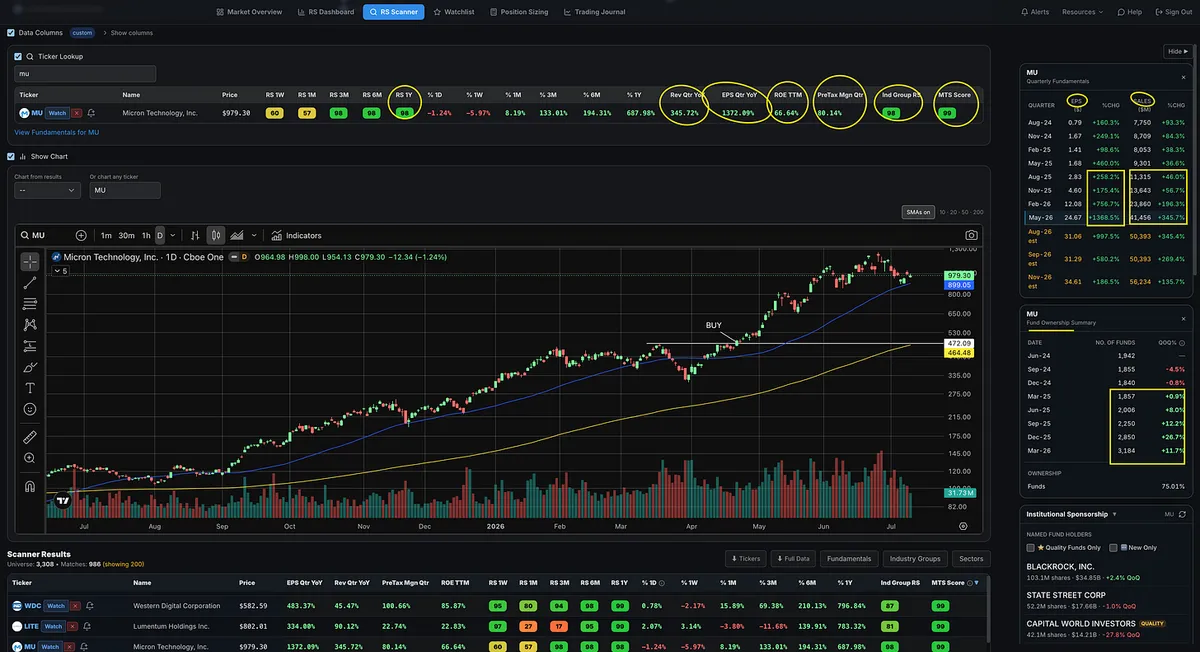
We added three new side panels to the Momentum Trading Strategy software this week: Historical RS, Institutional Sponsorship, and Surprises & Revisions.

Each panel is designed to provide an additional layer of research beyond the headline earnings, sales, relative strength, and fund ownership numbers you already see in the scanner.

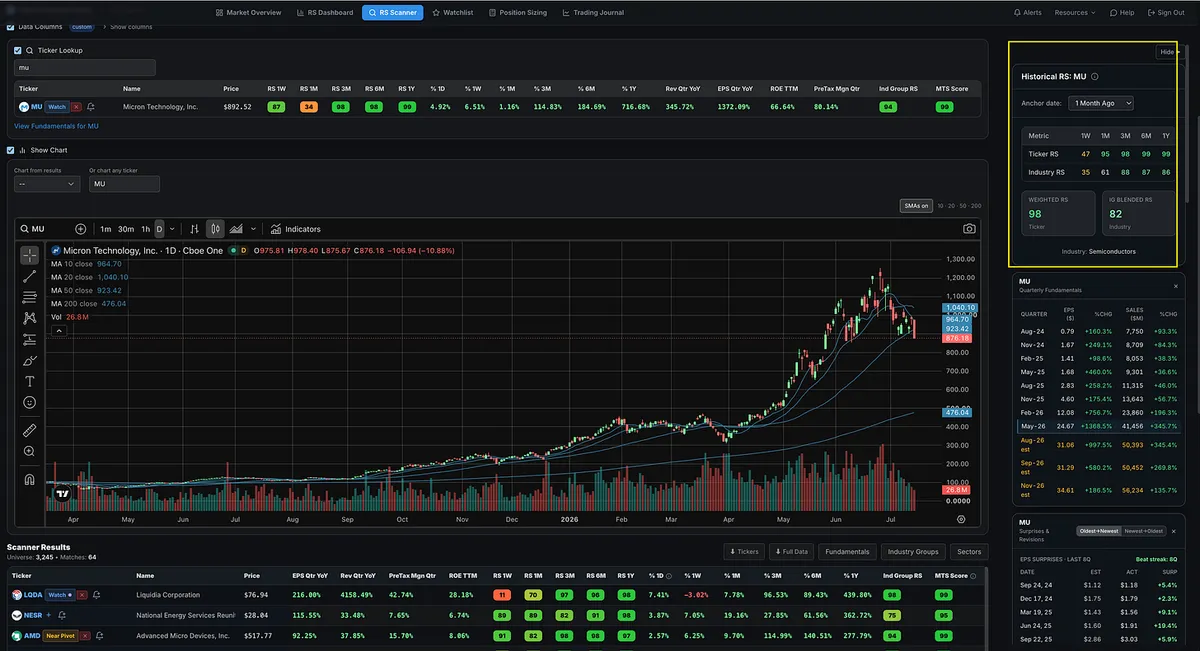
Historical RS

The Relative Strength readings currently displayed in the software show a stock’s performance ending today.

For example, the one-month RS measures relative performance over the month ending today. The three-month RS measures the three months ending today, and the same applies to the one-week, six-month, and one-year readings.

The new Historical RS panel allows you to change the anchor date and see what those readings looked like at an earlier point in time.

For example, you can select one year ago and see what the stock’s one-month, three-month, six-month, and one-year RS readings were as of that date. You could also go back six months and see what the three-month RS looked like at that specific point.

The panel also displays the stock’s Weighted RS score, its Industry Group Blended RS score, and the company’s industry.

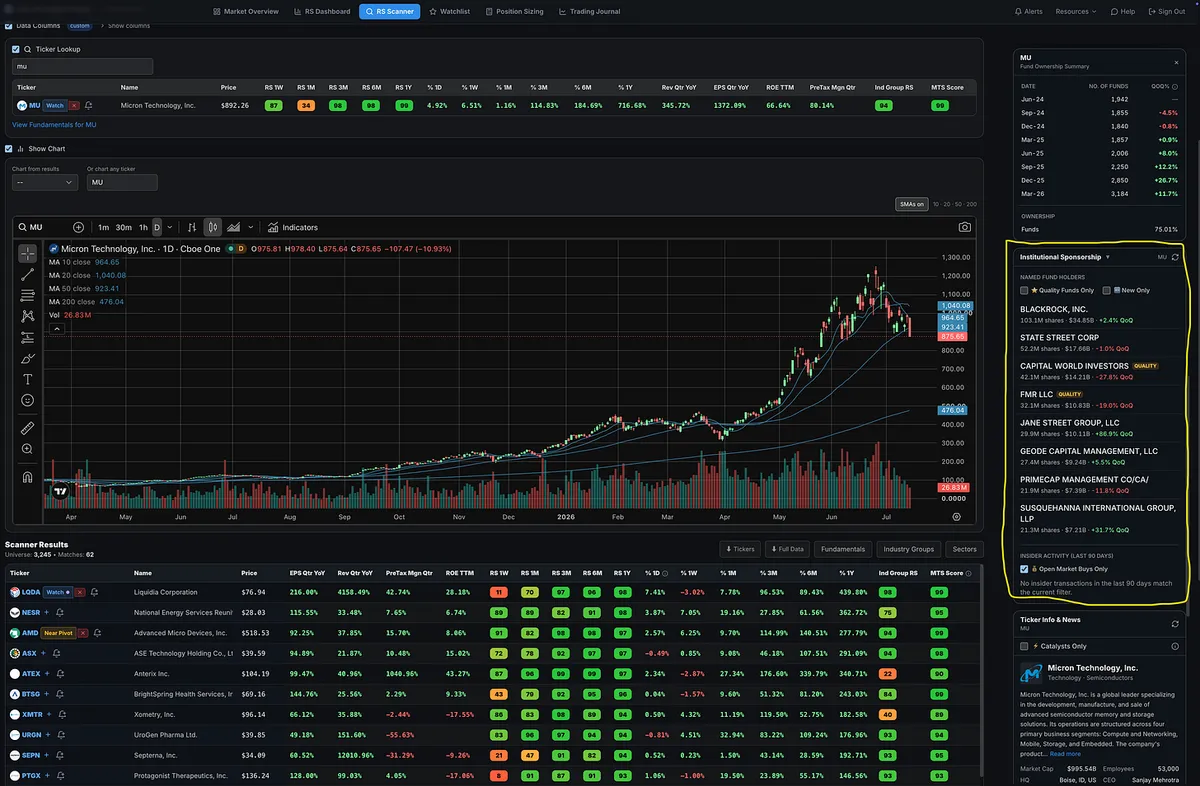
Institutional Sponsorship

We already displayed quarterly fund ownership, including the number of funds holding a stock and the quarter-over-quarter percentage change.

That allows you to see whether institutional ownership has been increasing or decreasing over several quarters.

The new Institutional Sponsorship panel takes the research one level deeper by showing the specific institutions involved in the stock.

O’Neil explained that it is not enough to know how many institutions own a company. Investors should also examine which institutions are involved, whether better-performing funds are participating, whether those funds have recently established positions, and whether the overall number of sponsors is increasing.

The panel gives you a clearer view of who is behind the ownership numbers and provides a starting point for evaluating the quality of that sponsorship.

A recognizable fund name does not automatically make the sponsorship high quality, but seeing the specific institutions involved gives you considerably more information than the fund count alone.

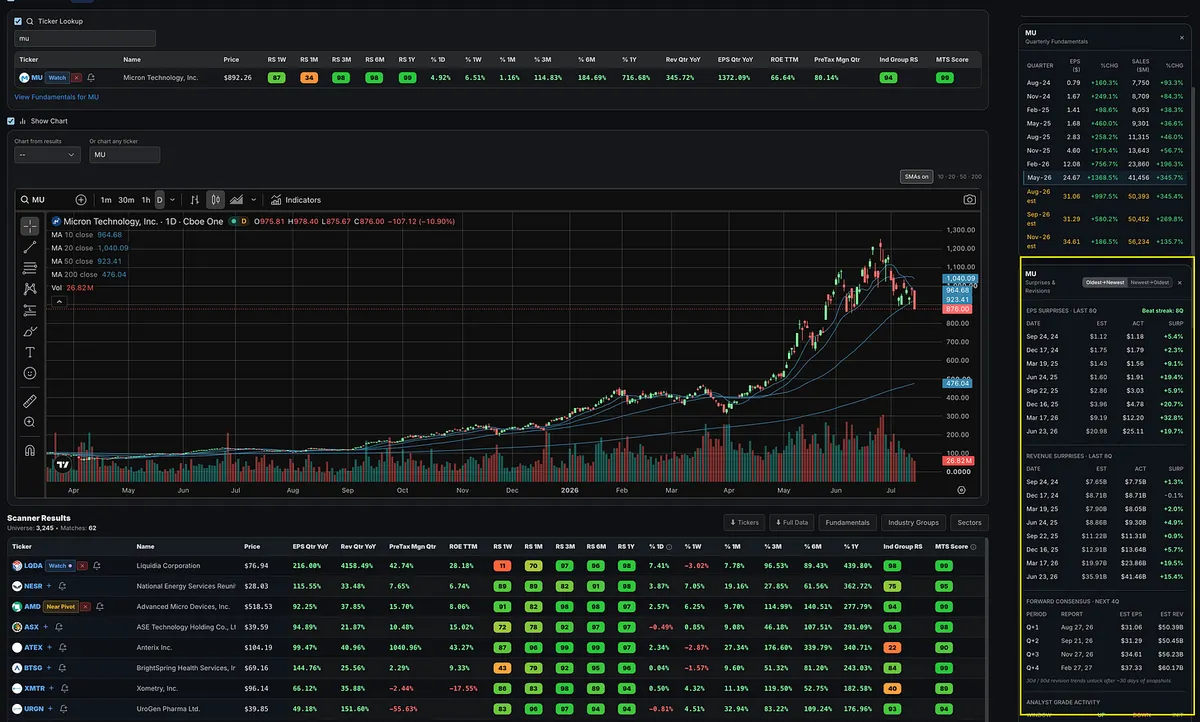
Surprises & Revisions

Strong quarterly earnings and sales growth remain the primary fundamental numbers we care about.

However, O’Neil also discussed the value of tracking earnings surprises and changes in analyst estimates as a secondary layer of research.

The new Surprises & Revisions panel displays earnings surprises, sales surprises, estimate revisions, and recent analyst upgrade and downgrade activity.

Some of the market’s strongest growth stocks can repeatedly report results well above expectations while analysts continue raising their future estimates. We saw this in names such as MU and SNDK during their strongest periods of earnings and sales growth.

That combination can help identify a company whose business is improving faster than the market originally expected.

Analyst upgrades and downgrades are also included because an unexpected change in opinion can sometimes act as a short-term news catalyst. However, these ratings should never be treated as standalone buy or sell signals. O’Neil repeatedly warned against blindly following analyst recommendations.

These panels do not replace the primary work of studying the chart, earnings and sales growth, price action, market direction, industry-group leadership, and the primary CAN SLIM criteria.

They simply give you more ways to dig beneath the surface and better understand the companies you are researching.

View on Substack ↗

The Longer You Trade, the Less You Trade

The longer you trade, the more you may notice that you trade less.

This may not apply to everyone, but many highly experienced traders will tell you the same thing. As you gain experience and trading wisdom, you become more selective, not only about the stocks you trade, but also about when your strategy works best.

You stop trying to force trades during unfavorable periods. You begin to recognize the market environments where your setups have the greatest edge, and you become more comfortable sitting on your hands when those conditions are missing.

The interesting part is that even with less activity, you may make just as much, if not more, while taking fewer trades.

Beginners often believe they need to be constantly active. They either do not yet understand when their strategy works best, or they keep trying to force it during less desirable market conditions.

So how do you learn when you trade best?

Track your data.

Study how your results change across different market environments. Look at when your setups perform well, when they struggle, and when you should reduce exposure or stay out completely.

This is closely related to what Dr. Van Tharp taught when he described six different market types. It is unrealistic to expect one trading strategy to work equally well in every market environment.

The goal is not to trade more.

The goal is to trade when your edge is actually present.

View on Substack ↗

When the Screens Go Cold, Hit the Books

You can always find something moving in any market, but the quality of what is showing up on my screens has changed significantly from April, May, and even early June.

When you run the same screens every day, you can see the change in real time. The number of high-quality growth setups has narrowed, and the overall opportunity set is simply less attractive.

That does not mean there is nothing to trade. Some traders will always find something. For me, though, this is usually a signal to reduce activity, step back, study, refine my watch lists, and relax until the individual stocks on my screens begin improving again.

Time to hit the beach and hit the books.

View on Substack ↗

You Can Have 20 Years of Trading Experience and Still Be Blind to Market History

You can have 15 or 20 years of trading experience and still have spent your entire career inside one secular bull market.

You did not trade through 2008. You did not trade the dot-com collapse. You did not experience many of the bubbles, crashes, and violent market periods that came before.

That should humble every trader.

Even I almost fell for the idea that today’s leaders, with their huge price moves and high ADRs, were somehow different from the past.

They are not.

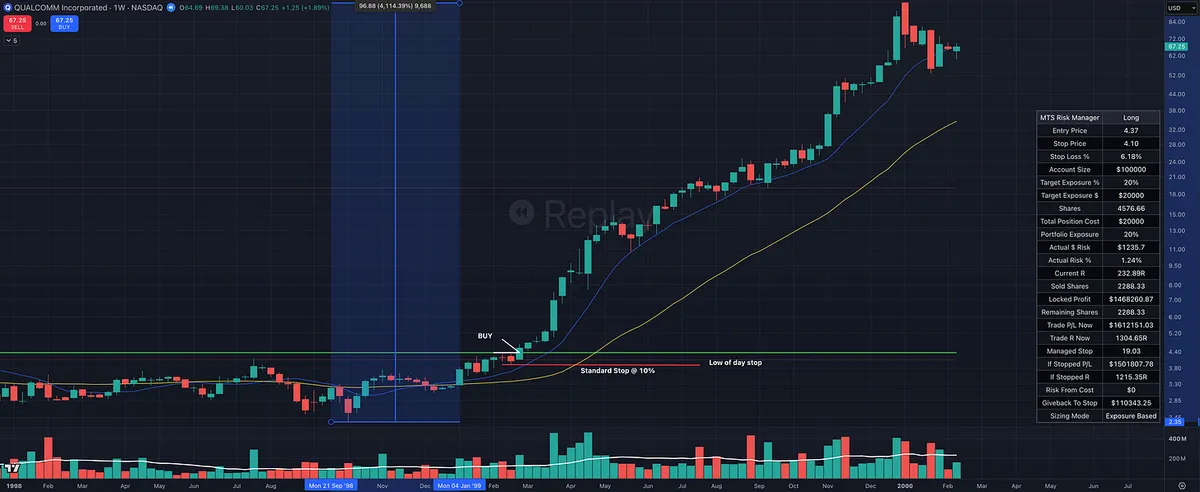
Pull up Qualcomm from 1999 and early 2000. The volatility was just as extreme, if not more.

That is why William O’Neil’s work remains so foundational.

The tickers change. The market does not, because human nature does not.

View on Substack ↗

The Flashy Stuff Gets Attention. The Boring Stuff Makes Money.

Most traders want the same things.

  • The next big stock.

  • The perfect setup.

  • A new indicator.

  • A screenshot of someone else’s exact buy and sell.

That is the content that gets attention.

It is also why so many traders stay stuck.

If following someone else’s trades were enough, far more traders would already be rich.

They are not.

Nearly every great trader I have studied has warned against searching for shortcuts, yet beginners continue doing the exact opposite.

Why doesn’t it work?

Because identifying the stock was never the hardest part.

The hard part is knowing how to enter, position size, manage risk, sit through normal volatility, sell into strength, raise stops, and avoid destroying the trade with emotion.

That is the boring stuff.

Learn the characteristics shared by history’s greatest growth stocks, and you will not need someone else to hand you tickers.

Learn what real setups look like, how supply and demand appear on a chart, and how to identify low-risk, high-probability entries. Then you can make your own decisions.

Study what the best traders consistently teach about risk management, position sizing, cutting losses, protecting capital, and managing winners.

Understand expectancy and trading metrics so you can evaluate your own results.

There are many different trading systems that work, but none work without mastering the basics.

The military taught me the same lesson.

Elite special operations units do not succeed because they discovered secret versions of physical fitness, marksmanship, communication, or battle drills.

That is what the movies show and what most people believe.

The reality is that they master the same fundamentals at a much higher standard.

They train harder.

They repeat the basics more often.

They remain disciplined when tired, stressed, and uncomfortable.

They master what everyone else overlooks.

Trading is no different.

Great traders are not great because they found one magical setup or gained access to a secret indicator.

  • They are great because they execute the basic principles better than everyone else.

  • They cut losses.

  • They size positions correctly.

  • They protect capital.

  • They follow their rules.

  • They review their trades.

  • They repeat the process long after everyone else gets bored and starts searching for another shortcut.

The flashy content may help you discover a stock.

The boring work is what allows you to profit from it.

You do not need another ticker.

You need to master what happens before you buy, while you hold, and after you sell.

That is where consistent profitability is built.

Unfortunately, it is also the part almost nobody wants to hear about.

Until they finally realize there is no shortcut around it.

View on Substack ↗

Most Traders Learn the Pieces. Few Put Them Together.

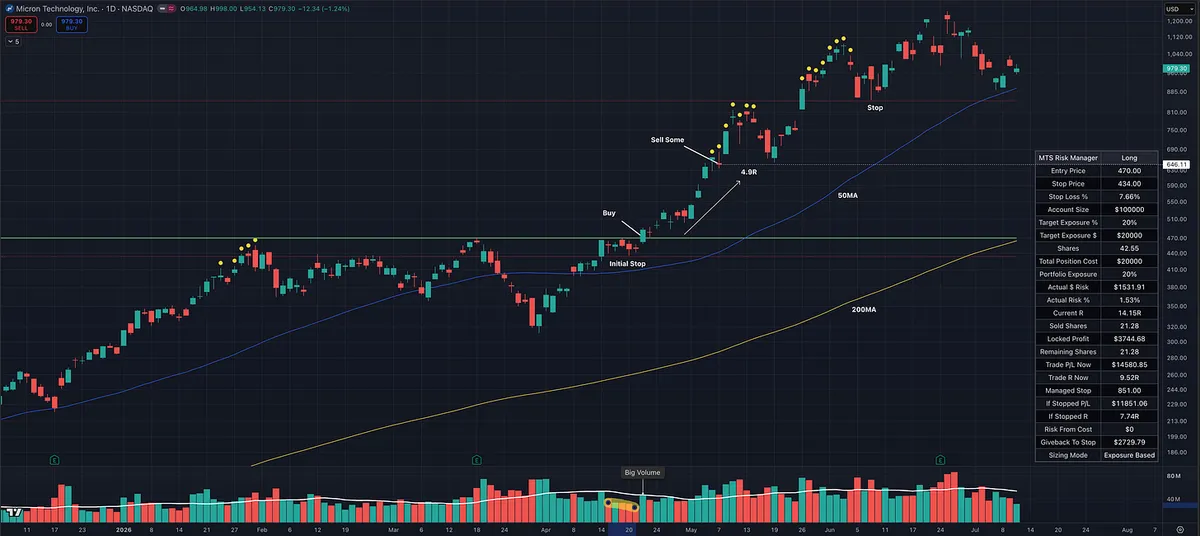
This chart shows how several critical trading principles can come together in one trade.

William O’Neil: Use relative strength, growth fundamentals such as powerful earnings and sales growth, institutional sponsorship, and industry leadership to find stocks with the characteristics of history’s biggest winners. Then wait for a proper setup and let the chart determine the initial stop.

Anna Coulling: Study the relationship between price and volume. Volume dried up as the stock tightened in the handle, then expanded as it broke into new highs.

Dr. Van Tharp: Define the risk first, calculate the correct position size, and measure the trade in R multiples.

Mark Minervini: Sell some into strength, raise the stop as the trade proves itself, and finance the rest of the trade.

George Soros: His risk-first philosophy reinforces the goal of protecting principal and reaching a point where you are managing accumulated profits instead of continuing to risk your original capital.

The process shown on this chart:

  1. Use the RS Scanner to identify the leader.

  2. Wait for a proper chart setup.

  3. Confirm the setup through price and volume.

  4. Identify the initial stop from the chart.

  5. Position size based on the technical stop level and acceptable account risk.

  6. Sell some into strength to reduce the remaining risk.

  7. Raise the stop to breakeven when the price action allows.

  8. Manage the trade through higher highs and higher lows.

  9. Add to the winner when another low-risk setup appears, or sell some more to lock in additional profits along the way.

  10. Repeat.

This is not the entire trading process. A complete system also includes understanding the general market environment, positive expectancy, analytics, journaling, mindset, continuous review, and more.

But this chart shows how stock selection, chart analysis, position sizing, risk management, and trade management can begin working together within a single trade.

To dive deeper into how these principles fit together, take the Momentum Trading Strategy Course.

View on Substack ↗

Do You Actually Want to Be a Trader?

A lot of people say they want to become traders.

But when you watch how they spend their time, what they enjoy studying, and what naturally holds their attention, many of them seem far more interested in being analysts.

Those are not the same job.

Traders still need to perform analysis. If you trade momentum growth stocks, you need to understand the market environment, price and volume, relative strength, earnings and sales growth, industry leadership, risk, and the quality of the setup.

But the analysis is only there to support the trade.

At some point, the trader must make a decision, accept risk, execute, manage the position, and respond when the market does something unexpected.

A great analyst does not automatically become a great trader.

Read enough of the Market Wizards books and you will see this repeatedly. Someone can understand a company, industry, or market better than almost anyone and still struggle to turn that knowledge into profitable trades.

Meanwhile, a great trader may occasionally look like a terrible analyst.

They can buy something and quickly sell it when the price action changes. They can sound bullish today and cautious tomorrow. They are not trying to defend a prediction or prove how intelligent their original thesis was.

They are trying to make money while controlling risk.

I am not saying this to scare anyone away from trading. I am simply saying that you should step back and ask yourself what you actually want to be.

Some people are pursuing trading primarily because of the money, but their behavior shows that what they truly enjoy is researching, forecasting, studying companies, and explaining the market.

There is nothing wrong with that.

You may be better suited to becoming an analyst, writing a newsletter, building a research service, or sharing your ideas through a platform like Substack.

This is where “know thyself” becomes so important.

For anyone following Momentum Trading Strategy, I want to be clear about what I am.

I am a trader at heart.

You should not follow me because you believe I am the greatest market analyst. There are people who are much better at producing detailed economic forecasts, company research, and deep fundamental analysis.

The Big Picture Market Pulse simply shows you how I evaluate the market as a trader. It is similar to how William O’Neil and Mark Minervini incorporate the market into their trading process through the “M” in CANSLIM.

My software is also an extension of how I trade.

It takes much of what I was already doing through MarketSurge and TradingView and combines it with the features, organization, ratings, risk tools, and workflow I always wished I had.

The software supports the system.

The Momentum Trading Strategy course teaches the system.

The market analysis helps guide you through the environment in which that system is being applied.

Over time, because I love the markets, I have gone deeper into certain areas of market analysis. I have learned from traders and authors such as Martin Zweig and incorporated some of those ideas into the way I view the bigger picture.

But at the end of the day, I am still a trader.

I was a trader before Substack.

And whenever I eventually get tired of posting on Substack, I will still be trading.

That is what brings me joy.

That is what I am good at.

That is what I genuinely want to do.

A lot of people are trying desperately to become traders when, deep down, they may simply love being analysts.

There is nothing wrong with either path.

Just make sure you are pursuing the one that actually fits you.

View on Substack ↗

The Human Eye Still Wins

I get a lot of questions from people asking if there are indicators, AI tools, or software platforms that can automatically spot chart patterns and setups.

Bottom line:

I have yet to find anything good enough to replace the human eye.

And trust me, I would love if it existed.

If there were a tool that could accurately identify the best setups, VCPs, tight areas, proper pivots, and actionable patterns with consistency, I’d be one of the first people using it.

Then I could spend a little more time on the beach with my kids instead of reviewing charts.

But I have tried quite a few of them.

MarketSurge, TradingView, TrendSpider, and plenty of others all have some form of pattern recognition.

Some are useful for basic visual cues.

But none of them are good enough to fully rely on.

They miss too many great setups.

They flag too many bad ones.

And they still do not understand the most important part:

Context, supply, and demand.

A pattern is not just a shape.

Even when these tools spot the general structure, they still struggle to factor in everything that actually matters: volume price analysis, price tightening, volume drying up on the contraction, volume surging on the way up, and whether the stock is actually under accumulation.

Small differences matter.

That is what makes this so hard to quantify.

A good setup may not show up.

A bad setup may get flagged.

Trading is both art and science.

Maybe one day we will be replaced by some amazing software, but that time is not now.

The best traders are NOT still reviewing charts because they are dinosaurs who refuse to adapt to new technology. Some of the best traders are actually the most adaptable people in the market.

They still review charts because the software does not work well enough yet.

Period.

The best way to see supply and demand at work is still simple:

Look at price and volume.

Software can help narrow the list.

But the human eye still has to judge the setup.

View on Substack ↗

The Biggest Lie in Trading Is That Someone Else Has the Secret.

Everyone understands this in almost every profession.

Want to become a great surgeon?

Study the best surgeons.

Want to become a great hitter in baseball?

Study great hitters and put in thousands of quality reps.

Nobody expects a secret shortcut.

Yet the moment people enter the stock market, they start searching for a hidden algorithm, black box system, or magic indicator.

Yes, temporary market inefficiencies have existed. Many disappeared as technology improved.

But that’s not what traders like William O’Neil or Mark Minervini built their careers on.

Their edge wasn’t secrecy.

It was mastering timeless principles rooted in human behavior, supply and demand, leadership, and disciplined risk management.

Those principles have worked for decades because people haven’t changed.

The biggest edge isn’t finding a secret.

It’s becoming exceptionally good at executing principles that most people never stick with long enough to master.

View on Substack ↗

The Great Investing Paradox: The Longer You Hold, the More You Have to Predict

I recently listened to the founder of Perplexity.

When asked what AI and the future will look like, he basically said, “It’s very hard to know.”

His point was simple.

If you went back just five years, even many of the smartest people in AI would not have predicted the exact state we are in today.

They would not have predicted the breakthroughs.

They would not have predicted the bottlenecks.

They would not have predicted the demand for compute, chips, power, and infrastructure.

Because if they had, they would have already secured the compute, bought the chips, locked up the power, and built the capacity years ago.

But they didn’t.

Everything is reactive to the demand we are seeing today.

And that is just five years.

That got me thinking.

If some of the smartest people in the world cannot reliably predict where AI will be in five years, why do so many investors believe it is easy to predict which individual companies will dominate over the next 5, 10 or 20 years?

This is one of the reasons I have always preferred swing and position trading.

Not because I am trying to predict the future.

Because I am trying not to.

I am not trying to forecast what a company will look like a decade from now.

I am looking at what institutions are doing today.

  • Is the stock under accumulation?

  • Is relative strength improving?

  • Are earnings and sales accelerating?

  • Is price confirming the story?

If the answer is yes, I participate.

If demand disappears, I leave.

The market tells me when I am right, and it tells me when I am wrong.

I do not need to predict the future.

I need to manage risk and follow the evidence.

Ironically, many people think trading is harder than investing.

I think they are confusing psychology with prediction.

Trading is emotionally harder because you have to admit when you are wrong, cut losses, and follow rules with discipline.

But long-term investing in individual companies often requires making far bigger assumptions about a future that nobody can truly know.

For me, the sweet spot has always been swing and position trading.

Long enough to capture meaningful trends.

Short enough that I am not pretending I know what the world will look like 10 years from now.

I do not get paid for predicting the future.

I get paid for aligning myself with the market while the evidence is there and leaving when it isn’t.

View on Substack ↗

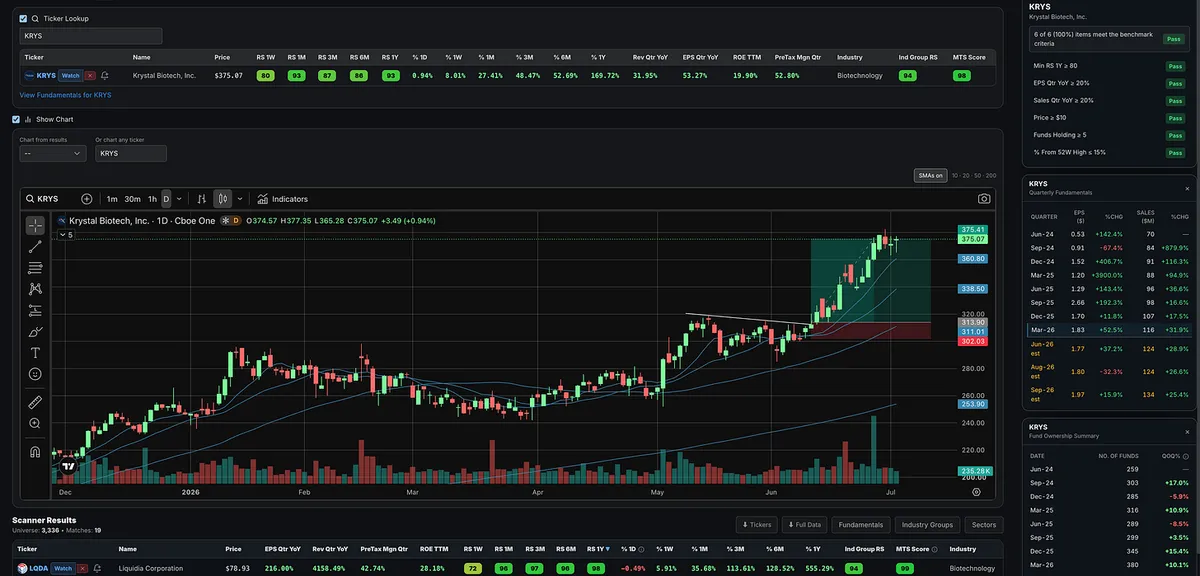
One of the Most Underrated Parts of MTS

A Substack member brought KRYS to my attention, and to everyone in the group chat, back in May after the earnings catalyst.

This is exactly the type of stock we are trying to find.

Big earnings and sales growth. Strong relative strength. Fund ownership increasing. 19.9% ROE. 52.8% margins.

He also caught what turned out to be a leading industry group earlier than most. That’s important because the best stocks usually come from the best groups.

This is one of the most underrated parts of Momentum Trading Strategy.

It is not just the course, the stock screener, or the market analysis. It is also having like-minded traders sharing quality ideas in a professional way.