Momentum Trading Strategy

Notes

Becoming a Better Trader

Building and improving your trading process over time: how to learn, which method to use, and how to measure progress.

Showing 1–6 of 6 notes

$QQQ ×
View on Substack ↗

Calling Yourself an Investor Does Not Remove the Risk

A lot of people believe investing is automatically safer than trading.

That is not necessarily true.

What often happens is someone fails at trading, pushes out their timeframe, stops using stops, and starts calling themselves an investor.

Now instead of taking a small loss, they are “holding for the long term.”

Instead of admitting the trade failed, they convince themselves they own a great company.

Instead of following a process, they hide behind a label.

There is nothing wrong with passive investing.

If someone does not want to trade, I completely understand buying broad market ETFs like SPY or QQQ and passively investing into the major indexes over time.

That is very different from buying individual stocks with no rules.

Individual stocks are not the same as owning the market.

  • A single company can break down.

  • A former leader can lose institutional support.

  • A growth story can slow.

  • A stock can go sideways for years.

  • A stock can decline 50%, 70%, or 90% and never come back.

So if you are going to buy individual stocks, even on a longer timeframe, you still need a system.

  • You need to know when you are wrong.

  • You need rules for cutting losses.

  • You need rules for letting winners run.

You need a process for separating normal volatility from real deterioration.

That is why so many “investors” underperform the market.

They are not really investing with a disciplined strategy.

They are just holding stocks and hoping time fixes bad decisions.

When you read Market Wizards, you see traders and investors with different styles, different timeframes, and different methods.

But almost none of them are simply buying individual stocks, holding them for years, ignoring losses, and operating with no exit plan.

  • They have rules.

  • They manage risk.

  • They protect capital.

They understand that being on a longer timeframe does not eliminate the need for discipline.

Calling yourself an investor does not make individual stock risk disappear.

If you do not have a plan to cut losses and let winners run, you do not have a safer strategy.

You just have a slower-moving mistake.
View on Substack ↗

The 4 Rules That Separate Average Investors From Superperformers

Most people are taught the wrong things about the stock market.

Turn on financial TV and you will hear the same advice repeated over and over:

You cannot time the market. Diversify widely. Buy and hold. Trade less.

But traders who achieve true superperformance do something very different.

Mark Minervini laid out four key principles that helped him turn a small account into millions and win the U.S. Investing Championship.

Here they are.

1. Yes, You Can Time the Market

Most experts say market timing is impossible.

Yet every great trader times the market.

Not by predicting the future.

By waiting for specific conditions and precise setups.

When the odds are in your favor, you act.

When they are not, you stay out.

Timing is everything because asymmetric opportunities require precision.

2. Overdiversification Kills Performance

Owning too many stocks dilutes your results.

If you want broad diversification, you might as well just buy an index ETF like SPY or QQQ.

Great traders focus on a small number of high-conviction opportunities.

Concentration is what allows a big winner to actually move your portfolio.

3. Turnover Is an Advantage

Wall Street funds often hold positions for long periods.

Not because it is optimal.

Because they have billions to manage.

Individual traders have a massive advantage.

You can enter quickly. You can exit quickly. You can move capital to the best opportunities.

Flexibility is one of your greatest edges.

4. Always Demand Asymmetric Risk vs Reward

Superperformance comes from repeatedly taking trades where the potential reward greatly outweighs the risk.

Small losses are part of the process.

The goal is simple.

Lose small. Win big.

A trading system built around low risk entries and large upside potential allows a few big winners to drive your results.

Most investors try to be right most of the time.

Great traders focus on making sure their winners are much bigger than their losers.

That is how superperformance is built.

View on Substack ↗

Winning in Trading Demands Everything and Promises Nothing

Most people fail at trading because they start by treating it like a get rich quick game. When they realize it isn’t, they move on. This happens every cycle. A new group comes in, then quietly leaves.

Because of that, the hard truth is that most people would be better off consistently putting money each month into a simple ETF like SPY or QQQ and letting time do the work.

For the few who stay, the path looks very different.

They get their ass kicked.

They hit the books.

They get their ass kicked again.

They study more, test, execute, and eventually find a method with a real edge.

Just as important, they learn when and how to use that edge. That’s what gives them a chance.

Winning long term at trading requires far more than most people realize. It’s total commitment with no guarantees. It reminds me of a video I showed my boys who compete in sports:

“Winning requires all of you, and more, but it promises you nothing.”

-Lewis Caralla

View on Substack ↗

Most People Are On the Slow Path and Don’t Know It

Fun fact: About 70 percent of people click their 401k default options, and another 30 percent try to manage things themselves. But here is the shocking part. Ninety five percent of professional fund managers cannot beat SPY or QQQ long term, and 70 to 90 percent of individual brokerage accounts fail to make money at all.

If you simply avoid the default and choose QQQ for long term growth, and move to SPY as you get closer to retirement, you instantly put yourself in the top tier of all retirement accounts. No trading. No stock picking. No timing. Just choosing a better index.

I just published a full breakdown showing why even William O’Neil told most people to keep it simple, along with two charts that make this reality impossible to ignore. One shows QQQ vs a typical 401k fund since 2006. The other shows what 1,000 dollars per month would have grown into with each one. The difference is life changing.

Read the full post here: https://tradingmomentum.substack.com/p/even-william-oneil-knew-most-people

ArticleEven William O'Neil Knew Most People Should Keep It Simple
View on Substack ↗

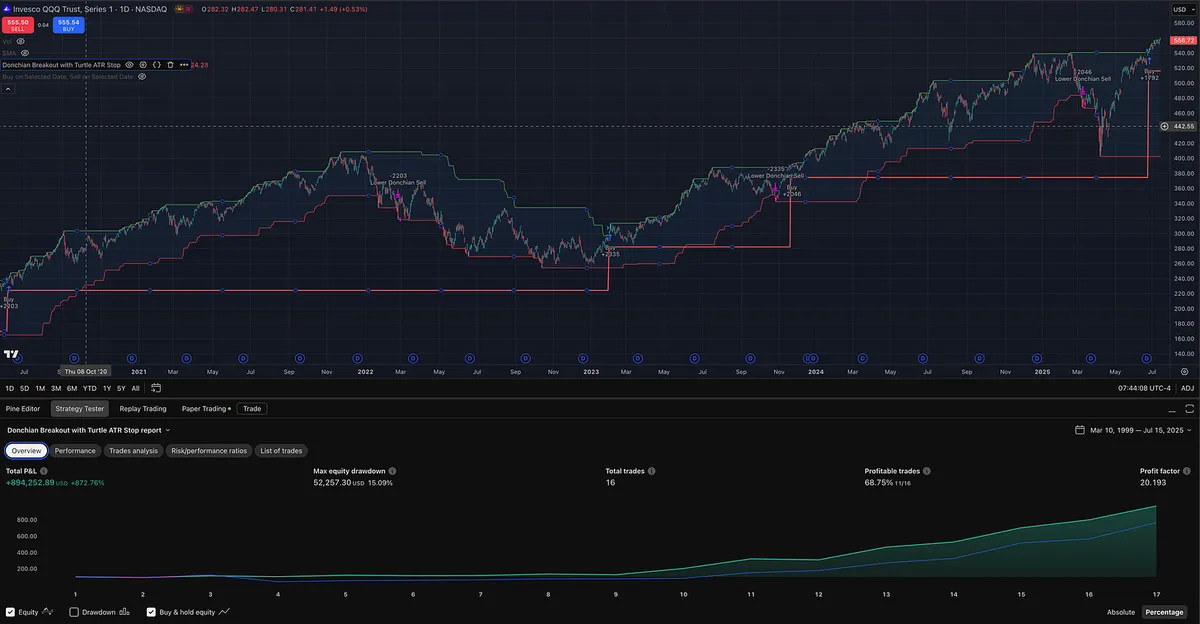
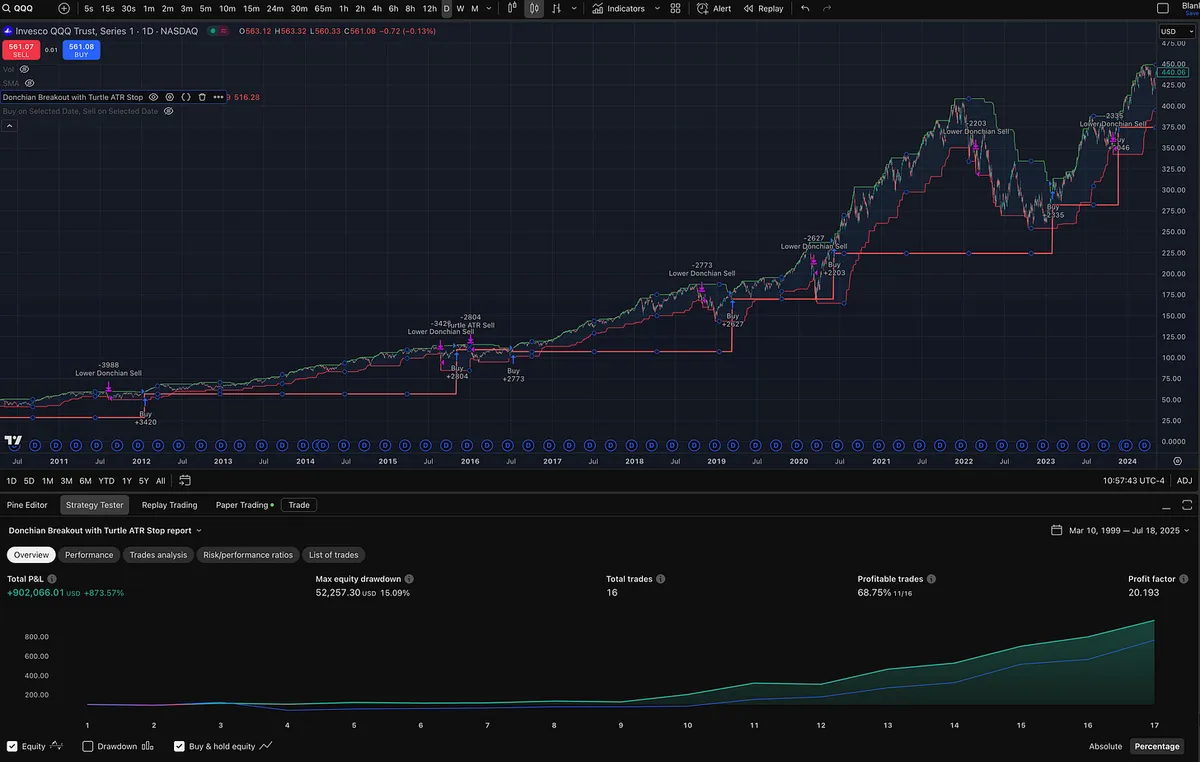
Most X macro chatter is mental masturbation—lots of talk, little action, few excellent results. Most would be better off doing something simple like the Donchian Breakout + ATR Stop Strategy with QQQ: +870% since 1999, -15% drawdown vs. buy-and-hold’s -55%. Simple and works.

View on Substack ↗

📈 Would You Be Happy With These Results? Imagine following a simple rules-based strategy to trade the Nasdaq-100...

✅ +870% total return ✅ 15% max drawdown ✅ Profit factor: 20.19 ✅ 68.75% win rate ✅ Only 16 trades in 26 years

This is the performance of a Donchian Breakout + Turtle ATR Stop strategy trading $QQQ from 1999 to 2025. It also performs well going all the way back to 1985.

No prediction. No guessing. Just trend-following rules that ride big winners and cut losses quickly.

💡Would you trade a system like this? Or stick to buy & hold?

👇 Let me know in the comments.