Momentum Trading Strategy

Notes

Risk Management & Position Sizing

Notes whose main point is limiting losses and deciding how much to buy and how much to risk on each trade.

Showing 141–160 of 224 notes

View on Substack ↗

Using Staggered Stops

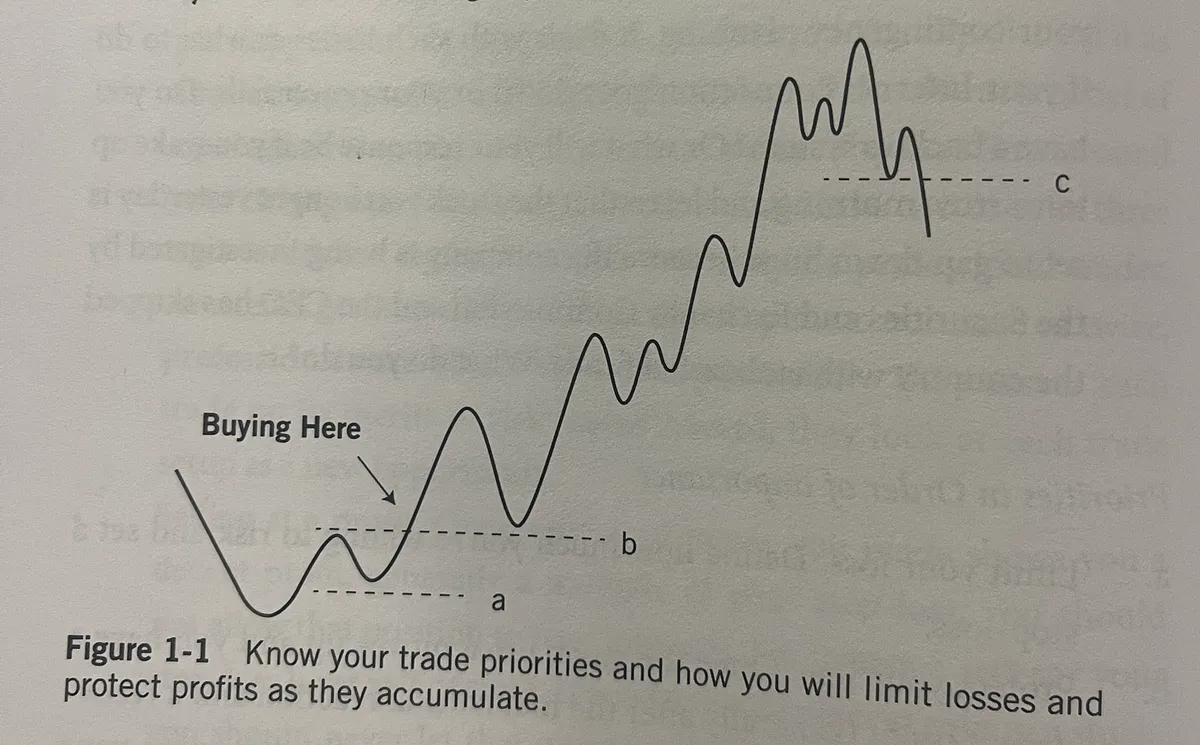
You do not have to set your stop-loss on your entire position at one price.

Instead, you can use staggered or bracketed stops and still mitigate losses at your desired level while giving yourself a better chance of maintaining at least a portion of the position if the stock moves against you.

The total risk remains defined.

The position is simply divided into pieces.

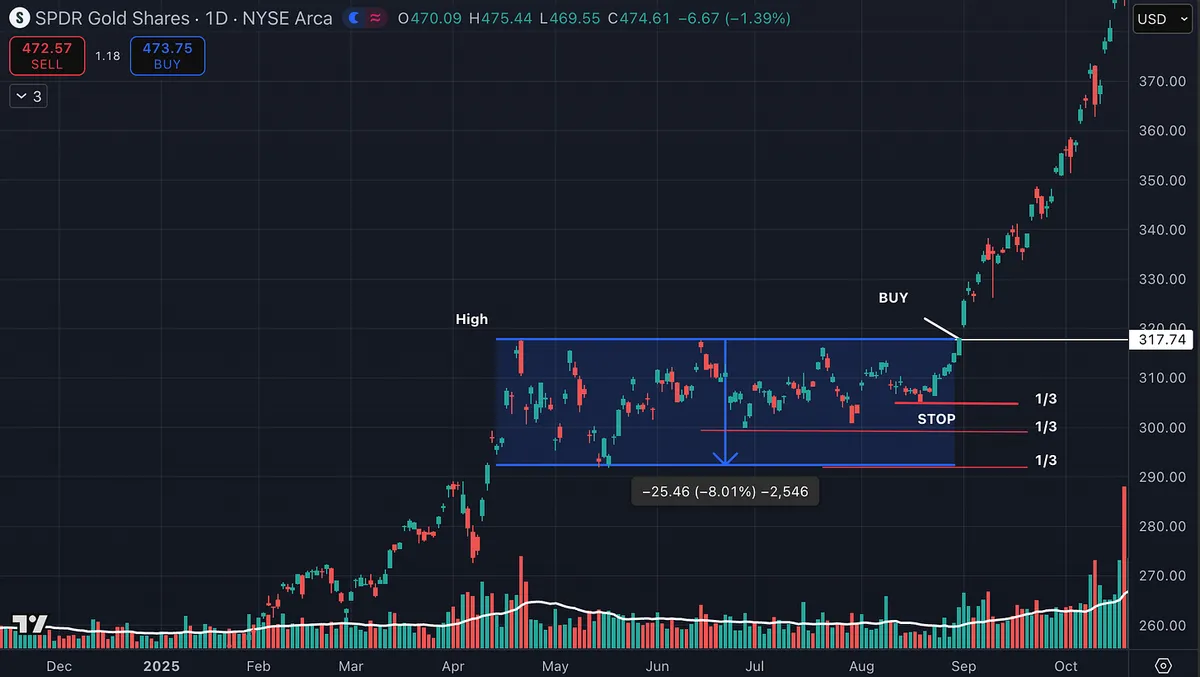
For example, instead of using one stop for the full position, you can divide it into thirds and place stops at different levels while keeping the overall loss within your acceptable range.

In the GLD example shown:

• One third is stopped at 4 percent

• One third is stopped at 6 percent

• One third is stopped at 8 percent

If all three stops are hit, the average loss is 6 percent.

The 4 percent and 6 percent stops are placed around higher low areas within the consolidation.

The 8 percent stop is placed just below the entire consolidation low.

This keeps the total risk defined while giving part of the position more room.

The objective is to maintain your line without getting knocked out of the entire position.

The percentages themselves are not fixed.

They are based on the structure of the stock and the level of risk you are willing to accept.

The concept is simple.

Define total risk. Divide the position. Bracket the stops around logical levels.
View on Substack ↗

Don’t Choose a Win Rate. Discover It.

A lot of people ask me:

“How do I know what my win rate should be?” “Should I aim for 40%? 50%? 60%?”

You don’t choose it.

You discover it.

The best way to figure out your real win rate and risk-reward profile is simple:

Take the setups you naturally like. The market type you prefer. The kinds of stocks you’re drawn to.

And forward test them.

Not backtest.

Forward test.

Actually trade them in the current market.

Use:

  • A small amount of real money or

  • A paper trading account

Then take a large enough sample size. 50 to 100 trades minimum.

Now look at your data:

  • What’s your batting average?

  • What’s your average win in R?

  • What’s your average loss in R?

  • What’s your largest winner?

  • What’s your largest loser?

Two things happen.

First, you’ll know whether you actually have positive expectancy.

Second, you’ll know what kind of trader you really are.

Maybe you’re a 35% trader with 4R winners. Maybe you’re a 55% trader with 1.8R winners.

Neither is better.

But now you’re not guessing.

Now your position sizing, risk management, and expectations are based on evidence.

Think of it as market research.

You’re not “trying to make money” during this phase.

You’re collecting statistical proof.

Stop trying to pick a win rate.

Build a process. Forward test it. Let the numbers tell you who you are.

View on Substack ↗

Stop Asking If 30% or 60% Is Better.

It’s the wrong question.

You can get rich with a 30% win rate. You can get rich with a 60% win rate.

You can go broke with a 30% win rate. You can go broke with a 60% win rate.

Neither is better.

A 30% trader gets rich if:

  • Losses are small

  • Winners are 3R, 4R, 5R

  • Outliers are allowed to expand

That same 30% trader goes broke if:

  • Winners are cut early

  • Losses drift

  • Risk is inconsistent

A 60% trader gets rich if:

  • Risk is controlled

  • Winners are at least 1.5R to 2R

  • No single loss wipes out progress

That same 60% trader goes broke if:

  • Reward equals risk

  • One oversized loss slips through

  • Discipline fades

The market does not reward win rate.

It rewards positive expectancy.

Your job is not to choose 30% or 60%.

Your job is to build a style that fits your personality, matches market conditions, and produces winners large enough to pay for losers.

Win rate is a characteristic.

Expectancy is the edge.

View on Substack ↗

Most Traders Do Not Have a Contingency Plan

When you enter a trade, do you know exactly what you will do if you are wrong?

Not roughly. Exactly.

Always go in with a plan.

Before you enter, you must define:

• Your entry

• Your stop

• Your dollar risk

• Your position size

• How you will manage the trade

• How you will sell into strength

• What invalidates the setup

• Your disaster plan

• Your reentry criteria

If you cannot answer those six questions, you are not trading.

You are reacting emotionally.

Good trading requires preparation, just like any other professional discipline.

Risk first thinking changes everything. The first question is not how much you can make. The first question is how much you will lose if you are wrong.

Position sizing is essential because we do not argue with the chart. Price reflects supply and demand. Your stop belongs below support or at the level that proves you are wrong.

Without proper position sizing, you either:

• Place stops based on arbitrary percentages

• Risk more than your tolerance allows

• Or move stops when pressure builds

Position sizing allows you to keep losses small and controlled.

Small losses preserve confidence. Large losses create trauma.

Contingency planning is what professionals do.

You do not rise to the level of your ambition. You fall to the level of your preparation.

Many of you are not treating trading like a business and then wondering why you do not have consistent results.

Study what great traders did. Focus on their preparation and planning, not just their returns.

The market rewards preparation.

View on Substack ↗

Survival Before Performance

Most traders focus on making money.

Gerald Loeb focused on survival.

He made that clear in The Battle for Investment Survival when he wrote that the reader should understand “the hazards of preserving capital and why the book is entitled, The Battle for Investment Survival”.

Loeb framed investing as a battle. Capital must be defended first. Without capital, there is no opportunity to compound.

William O’Neil carried that lesson forward.

In How to Make Money in Stocks, O’Neil recounts discussing loss cutting directly with Loeb:

“In his first work, The Battle for Investment Survival, Loeb advocated cutting all losses at 10%. I was curious and asked him if he always followed the 10% loss policy himself. ‘I would hope,’ he replied, ‘to be out long before they ever reach 10%.’ Loeb made millions in the market.”

That exchange is foundational.

Loeb emphasized survival. O’Neil refined it.

O’Neil tightened the rule even further:

“Always, without Exception, Limit Losses to 7% or 8% of Your Cost.”

This is not defensive thinking. It is offensive discipline.

Loeb warned against reckless attempts to “make a killing,” noting that such efforts carry the same supercharged speed on the downside . O’Neil similarly teaches that holding big losses clouds judgment and prevents objective decision-making .

The connection between the two books is clear:

Preserve capital. Cut losses quickly. Let strength prove itself. Compound only when conditions are favorable.

Survival is not separate from performance.

Survival makes performance possible.

Protect capital first. Performance follows.

View on Substack ↗

The Dangerous Obsession With Win Rate

Be honest.

You feel better when you win often.

That’s why win rate feels important.

But the market doesn’t pay you for being right.

It pays you for asymmetric outcomes.

I just published a deep breakdown showing:

• Why 50% win rate can lose money

• Why 30% can outperform 70%

• How compounding explodes when winners are larger than losers

• Why controlling drawdowns is everything

With real numbers. Real math.

If you trade or invest, this is required reading.

https://tradingmomentum.substack.com/p/why-your-win-rate-is-lying-to-you

ArticleWhy Your Win Rate Is Lying to You
View on Substack ↗

You Don’t Need To Be An Analyst To Make Money In The Market

One of the biggest myths in investing is that you need to be a brilliant analyst to make money.

You don’t.

In fact, there is a reason many of the greatest traders were not traditional analysts.

And there is a reason many brilliant analysts never made consistent money.

In Market Wizards, Paul Tudor Jones makes it clear what matters most:

“Don’t focus on making money; focus on protecting what you have.”

Notice what that is not about.

It is not about forecasting GDP. It is not about dissecting balance sheets. It is not about predicting earnings five quarters out.

It is about risk.

Across Market Wizards, the common thread among the top traders is not analytical brilliance.

It is discipline.

It is risk control.

It is reacting to price.

Many of them openly admit they are not economists. They are not trying to predict the future. They are responding to what the market is doing now.

William O’Neil makes a similar distinction in How to Make Money in Stocks.

He emphasizes that the market is driven by institutional accumulation and supply and demand. The greatest winners are identified through price, volume, and earnings growth, not personal opinion or deep macro forecasts .

O’Neil built an entire system around this criteria.

Relative strength. Quarterly earnings acceleration. Industry group leadership. Chart patterns.

Not intellectual debate.

Mark Minervini reinforces this in Trade Like a Stock Market Wizard. His framework is not about predicting which company “should” succeed. It is about identifying when institutions are accumulating and managing risk with precision.

There is a subtle but critical difference between being an analyst and being a trader.

Analysts try to be right.

Professional traders try to manage risk.

Analysts often anchor to their thesis.

Professional traders anchor to price behavior.

Many of the brightest minds on Wall Street have produced extraordinary research and still failed to generate consistent returns.

Because analysis alone does not equal execution.

Execution requires:

Defined risk. Position sizing. Sell discipline. Adaptability.

You do not need to be the smartest analyst in the room.

You need to:

Identify institutional demand. Align with leadership. Cut losses quickly. Let winners run.

The market does not reward intelligence alone.

It rewards disciplined execution applied over time.

And that is why so many of the greatest market operators were not known for analysis.

They were known for managing money.

View on Substack ↗

Trade Your Biggest When You’re Trading Your Best

Most traders do the opposite of what they should.

They press when they are cold.

They hesitate when they are hot.

Professionals do the reverse.

When you are trading well, seeing the market clearly, executing cleanly, and building a cushion, that is when you can responsibly increase exposure.

When you are struggling, you cut back.

If you keep struggling, you cut back more.

If you are really off, you go to cash and step away.

This is not about ego.

It is about self-awareness.

You earn the right to trade bigger.

You lose that right when your performance deteriorates.

High conviction trades. A+ setups. Strong market tone. A cushion of profits behind you.

That is when size can increase.

But when you are out of sync, even good setups can fail in your hands.

That is your signal.

Reduce exposure.

Lower position size.

Simplify.

Zoom out.

Both O’Neil and Minervini emphasize capital preservation and staying aligned with market conditions. They stress that no setup works in all environments and that risk control is always first.

But here is the part nobody can give you:

No book can tell you exactly when to scale up.

No system can automatically tell you when to step back.

IBD cannot tell you.

I cannot tell you.

You have to develop the awareness to recognize when you are in sync and when you are not.

Because no strategy, no pattern, no edge works if the operator behind it lacks self-management.

This is a performance business.

Size is a privilege.

You build it through discipline.

And you protect it through restraint.

View on Substack ↗

Trading Is Like An Insurance Company…

An insurance company cannot predict which specific house will burn down this year.

But it can predict, with remarkable accuracy, how many houses out of 100,000 will burn down.

That is how it stays in business.

Trading works the same way.

You cannot predict with certainty which individual trade will become a huge winner.

You cannot know in advance which breakout will fail.

But over a large enough sample size, if you have a structured edge and controlled risk, you can predict that your system will produce positive expectancy.

Now here is the nuance.

We are not randomly insuring houses.

We are underwriting selectively.

When we see:

A powerful expansion in price on heavy volume. Followed by orderly contraction. Volatility tightening with volume drying up. Then a breakout on explosive demand. Combined with strong earnings, sales growth, and institutional sponsorship.

That is not random.

That is supply being absorbed.

That is institutions accumulating.

That is probability increasing.

In that sense, we are forecasting.

We are identifying conditions that historically precede large moves.

We are stacking the odds in our favor.

But we still operate with humility.

Even the cleanest VCP setup can fail.

Even the strongest CANSLIM characteristics can disappoint.

That is why we never base our performance or confidence on a single trade.

Insurance companies do not rely on one policy.

They rely on the law of large numbers.

Professional traders operate the same way.

Over hundreds or thousands of trades:

There will be small losses. There will be break-even trades. There will be modest winners. And occasionally, there will be outliers.

Those outliers drive performance.

You do not predict them with certainty.

You position for them with probability.

The goal is not to be right every time.

The goal is to consistently take high-quality setups where:

If you are wrong, the loss is small. If you are right, the upside can be significant.

That is not gambling.

That is asymmetric probability applied over time.

You increase the odds.

You control the downside.

And you let the math work in your favor.

View on Substack ↗

Why Most Traders Fail Before They Even Enter The Trade

Let me ask you something.

Before you enter a trade, do you know:

Exactly where you are wrong?

Exactly what you will do if stopped out?

Exactly how you will reenter if it resets? Exactly how you will sell into strength?

Exactly what happens if the market gaps against you?

If you hesitated on any of those, you are not trading.

You are hoping.

Mark Minervini makes this crystal clear in Trade Like a Stock Market Wizard:

“Before entering any trade, you should have a specific plan that includes your entry point, your initial stop-loss, your profit objective, and your contingency plan.”

That is the difference between professionals and amateurs.

Professionals operate on contingencies.

1. The Initial Stop Loss

The only certainty in a trade is risk.

Minervini defines the stop first. Position size is calculated from that stop. If the stock violates the level that invalidates the setup, you exit.

No debate. No emotion.

2. The Reentry Plan

Most traders make this mistake:

They get stopped out and emotionally discard the stock.

Minervini teaches that a failed breakout can reset into a new entry. A pivot failure does not always mean base failure.

If fundamentals remain intact and structure repairs itself, you reenter.

This is how you catch the move that makes your year.

3. Selling At A Profit

You do not sell because you are up.

You sell because the stock becomes extended, climactic, or abnormal.

You sell partial positions into strength.

You protect gains when character changes.

You let the remainder work.

4. The Disaster Plan

This is what separates serious traders from hobbyists.

What happens if the stock gaps below your stop?

What happens during a market event?

Minervini plans for that in advance.

Hope is not a strategy.

Contingencies are.

View on Substack ↗

The Only Thing You Control In A Trade

I am always surprised by how much emphasis traders place on price targets.

It is one of the clearest signs of inexperience.

The only thing that is certain in any trade is how much you are willing to lose.

Everything else is speculation.

William O’Neil built an entire system around cutting losses quickly. He was clear that you must always know where you are wrong before you enter a trade. Protecting capital is not optional. It is foundational.

Mark Minervini reinforces this in Trade Like a Stock Market Wizard. Risk is defined first. Position size is calculated from the stop. Expectancy is built over a large sample of trades.

Neither of them teach predicting how far a stock will go.

Because you cannot know.

Anyone who has traded long enough understands this reality:

Some stocks you expect to be huge winners fail.

Some trades you had modest expectations for become extraordinary.

The outliers are unpredictable.

Over hundreds and thousands of trades, positive expectancy is built from:

Small, controlled losses.

Breakeven trades.

Modest 1R to 3R gains.

And occasionally, a very large winner.

That large winner is what drives performance.

You do not identify it in advance with a price target.

You identify it by letting it act right and continue to hold as long as it behaves constructively.

Rigid price targets can interfere with this process.

They can cause you to:

Sell your best stock too early.

Refuse to trim when weakness appears because the target was not reached.

Anchor to a number instead of reading price and volume.

Professionals think in terms of risk and probability.

They focus on the downside because that is what they can control.

They let the market determine the upside.

When fundamentals, technical structure, and market tone align, the probability increases. That is the edge.

But the size of the move is never known in advance.

Define the risk.

Manage the position.

Let strength prove itself.

The only certainty in a trade is the loss you are willing to take.

Everything else is earned by discipline.

View on Substack ↗

Why Elite Traders Work on Winners More Than Losses

After reading and listening to thousands of hours of interviews with great traders, one pattern stands out.

Many of them say they are working to improve getting more out of their winners.

I cannot recall many saying they struggle with cutting losses.

That tells you something.

Now, do not misunderstand.

These traders absolutely let winners run. That is why they survive. That is why they can pay for their losers. Most of them have win rates under 50 percent.

They already understand that a small number of trades drive the majority of profits.

And yet, they still analyze how they can extract more from their best positions.

Why?

Because of how they are wired.

Paul Tudor Jones said it clearly:

“The most important rule of trading is to play great defense, not great offense.”

The best traders think about risk first.

Where am I wrong? How much can I lose? How do I protect capital?

That mindset makes cutting losses almost automatic.

Defense becomes instinct.

But letting winners expand requires tolerating open profit volatility.

It requires sitting through pullbacks.

It requires not grabbing gains too quickly.

For someone focused on protecting capital, open profit feels like something that must be defended.

So even elite traders study how to stay in their best trades longer.

Not because they are bad at it.

But because their default setting is risk control.

Protect the downside first.

Then learn to press your advantage when the market gives it.

Play great defense.

Then allow offense to work when it matters.

View on Substack ↗

Buying Pullbacks vs Buying Breakouts

Most traders think you have to pick one.

You don’t.

You just need to know what each one does for you.

Buying Breakouts

You buy strength.

You buy as price clears resistance.

You buy as the stock moves into new high ground.

Why I use it:

• It confirms demand

• Overhead supply is gone

• Risk is clearly defined below the pivot

• Momentum is aligned

Breakouts increase probability.

When the market is in a strong uptrend, this is the cleanest way to initiate a position.

But there is a tradeoff.

• You pay up

• Everyone sees the same level

• Shakeouts are common

• Cost basis rises quickly if you keep adding

Breakouts are powerful.

They are also crowded.

Buying Pullbacks

You are not buying weakness in a downtrend.

You are buying weakness inside a confirmed uptrend.

Higher highs. Higher lows.

Rising 10-day, 21-day, or 50-day moving average.

Why I use it:

• Lower cost basis

• Better risk to reward

• Easier to accumulate shares

• Less competition

• Opportunity to add size without chasing

But the key to buying pullbacks is not guessing.

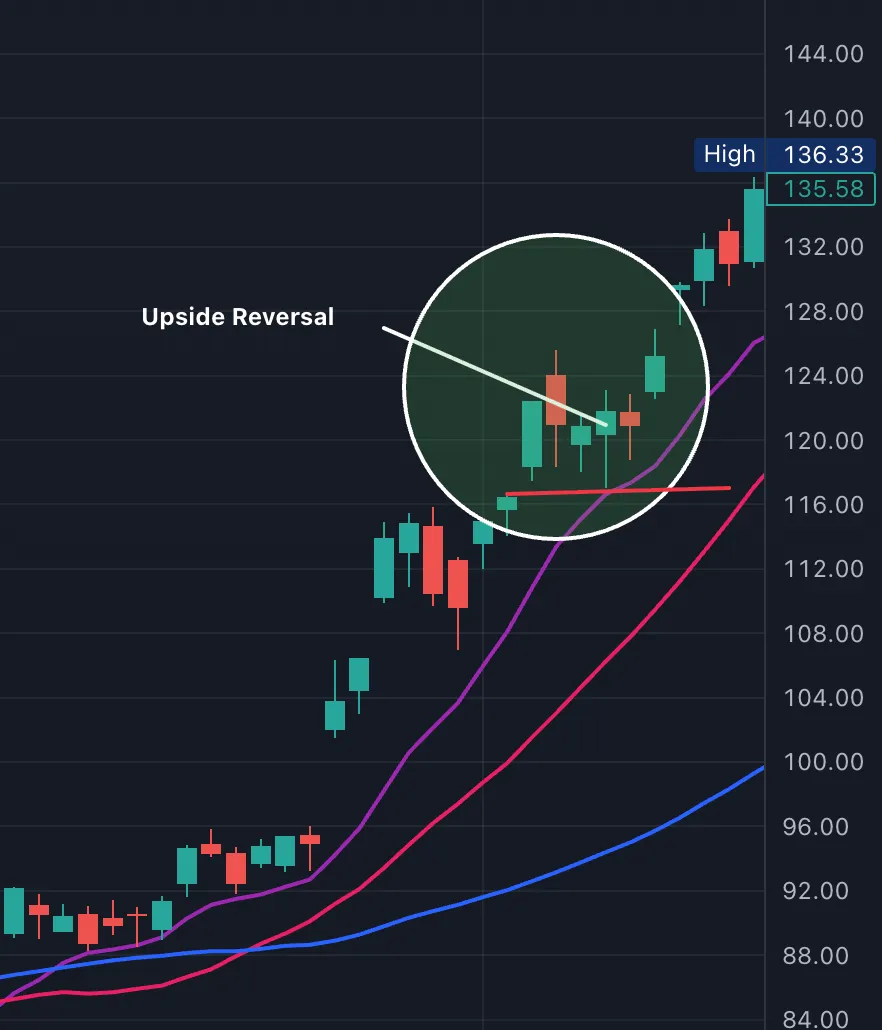
It is waiting for an upside reversal at support.

A shakeout.

A reclaim.

A strong close near the highs of the day.

That upside reversal becomes your signal.

The low of that reversal day becomes your stop.

If price undercuts it, you are wrong.

Without that trigger, you are just catching a falling knife.

Pullbacks improve positioning.

But they require:

• A strong general market

• A stock in a defined uptrend

• Clear support levels

• Absolute risk control

If support breaks, you are wrong.

How I Actually Trade It

Many times I do both.

I buy the traditional breakout.

Then I add on pullbacks.

Breakouts get me involved. Pullbacks help me build size.

If the stock is truly a leader, it will:

• Break out

• Pull back to the 10, 21, or 50

• Stage an upside reversal

• Resume higher

That is where real position building happens.

The goal is not to be right once.

The goal is to build size in the right stock while controlling risk.

Some uptrends reward breakouts more.

Some reward pullbacks more.

You need to be aware of what is working best right now.

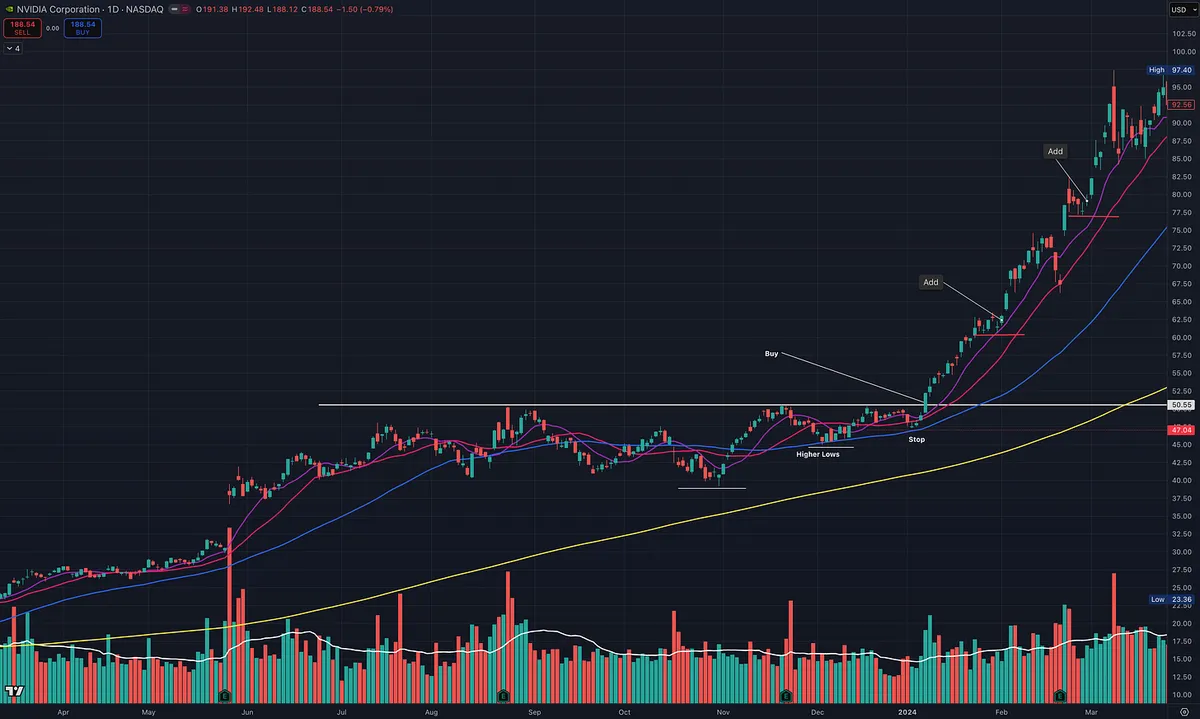
NVDA Example

NVDA provided a textbook example of this sequence.

Flat base breakout from VCP to initiate.

Then a controlled pullback into the rising 10-day.

On that pullback, price:

• Touched support

• Reversed higher

• Closed above the prior day’s close

• Traded above the prior day’s high

That is buying a pullback within an uptrend.

The low of that reversal day or low of pullback becomes the stop.

Breakout to get involved.

Pullback to add.

That is how real leaders let you build a position.

View on Substack ↗

Know Your Exit First

“I know where I’m getting out before I get in.”

Bruce Kovner, Market Wizards

Most traders do the opposite.

They focus on the entry.

They imagine the upside.

They assume they will figure the rest out later.

Kovner knew that later is too late.

If you do not know where you are wrong,

you do not know how much you are risking.

And if you do not know how much you are risking,

the trade already controls you.

Professionals decide risk first.

Everything else is secondary.

That is how losses stay small

and decisions stay calm.

View on Substack ↗

Why Averaging Down Fails

“Losers average losers.”

Paul Tudor Jones, Market Wizards

This is how it actually happens.

You average down.

And you get away with it.

Then you do it again.

And again.

Most of the time there is no real reason.

You did not want to take the loss.

You thought your timing was off.

You saw a lower price and added.

And very often, it works.

You get out at breakeven.

Sometimes you even make money.

That success is the problem.

Because it teaches you that delaying the loss is acceptable.

So the behavior repeats.

Until one time it does not bounce.

The position is too big.

The loss is too deep.

At that point you are no longer managing risk.

You are managing damage.

That is how small losses turn into massive ones.

That is how accounts lose 80 percent.

That is how accounts get blown.

Not from one bad trade.

From getting away with the same mistake too many times.

The market eventually collects.

View on Substack ↗

Losses Are the Cost of Doing Business

“Losing is part of the business. If you cannot accept that, you cannot win.” -Marty Schwartz

Profitable traders do not avoid losses.

They plan for them.

Losses are not signals to rethink your identity.

They are expenses required to operate in uncertain markets.

When losses are expected:

  • position size stays disciplined

  • rules stay intact

  • confidence stays neutral

When losses are resisted:

  • emotions take control

  • process breaks down

  • drawdowns accelerate

The goal is not to eliminate losses.

The goal is to make sure no single loss can damage the business.

That is how professionals survive long enough to compound.

View on Substack ↗

The Dividend Lie That Keeps Investors Poor

Imagine this.

You invest $250,000 into a stock paying a 4% dividend. That’s about $830 per month in income.

Six months later, the stock is down 30%.

Your position is now worth $175,000. You’re down $75,000.

But instead of focusing on that, you say:

“It’s not that bad. We’ve made almost $5,000 in dividends.”

You focus on the income. You ignore the drawdown. You remind yourself the dividends are reliable.

They’re also taxable.

And when doubt shows up, the final excuse appears:

“The stock will come back. They always do.”

Be honest. If you explained this clearly to any Market Wizard, would they buy it?

Or would they hear what it really is, a $75,000 loss being rationalized by a few checks?

This is how most dividend investors think.

Income feels like progress. Drawdowns feel temporary. Price feels irrelevant. Yield feels like protection.

Dividends don’t fix bad entries, broken trends, or poor allocation. They often just delay the decision that actually matters.

A 3 to 4 percent yield does not offset a 30 to 40 percent drawdown. It only makes the loss easier to tolerate.

Price is reality, and confusing comfort with discipline is how capital quietly disappears.

View on Substack ↗

Why Starting With Too Much Money Is One of the Biggest Trading Mistakes

Many of the traders featured in Market Wizards built their fortunes starting with only a few thousand dollars or a reasonably sized account.

That is not a coincidence.

One of the biggest problems in trading happens when someone enters the market with a large amount of money after being very successful in another career. In many cases, they are almost guaranteed to lose it.

Trading is a high performance skill. Like elite athletics or surgeons, it demands precision, repetition, and emotional control. But unlike most high paying careers, trading directly attacks your emotions every single day.

Ego. Fear. Overconfidence. The need to be right. The pain of loss.

Those pressures scale with account size.

That is why starting small matters.

As Richard Dennis put it, “Trade small because that’s when you are as bad as you are ever going to be.”

When you are new, your process is incomplete. Your discipline is untested. You do not yet know how you will react when trades go against you. Trading small protects you while you are still learning.

If you cannot trade well with a small account, adding more money will not fix the problem. It will magnify it. Larger size increases emotional pressure and makes it far more likely that you abandon rules at exactly the wrong time.

This is why so many great traders emphasize starting small.

If you can consistently manage risk, follow rules, and grow a few thousand dollars, the skill is real. If you cannot do that, you will not suddenly succeed with a few million.

The market does not care how successful you were elsewhere. It only rewards discipline, humility, and execution.

And those traits are best developed when the stakes are small.

View on Substack ↗

You Don’t Need to Be Right to Make Money in the Market

I always laugh when I see people talking trash because someone said they were long or short a stock and price went the other direction.

What those people don’t understand is this.

You don’t need to be right very often to be successful in the market.

In fact, many of the best Market Wizards were only right about 30% of the time.

Let that sink in.

You can be long a stock for a few weeks, get into the money, sell some into strength, and raise stops. When the stock eventually turns against you, you get stopped out.

And guess what.

You still made money.

Meanwhile, the comment section lights up.

“See, he was wrong.”

“How does he feel now?”

LOL.

Those reactions are the tell. They reveal who has never managed risk, never scaled out of a position, and never understood how professionals actually trade.

Real trading is not about calling tops and bottoms.

It is not about being right on every opinion.

It is not about ego.

It is about position sizing, risk management , and protecting capital.

If you can:

  • Cut losses fast

  • Let winners work

  • Take money off the table into strength

  • Raise stops as price moves in your favor

You can be wrong more than you are right and still make very good money.

The people obsessed with being “right” are the same ones who hold losers too long, never lock in gains, and trade opinions instead of price.

They are almost guaranteed to struggle long term.

The market does not pay you for being right.

It pays you for managing risk.

And that is why the loudest critics are almost always the least profitable.