Momentum Trading Strategy

Notes

Risk Management & Position Sizing

Notes whose main point is limiting losses and deciding how much to buy and how much to risk on each trade.

Showing 121–140 of 224 notes

View on Substack ↗

The 4 Rules That Quietly Protect the Best Traders in the World

Everyone wants to talk about how to make big money in stocks.

Almost nobody talks about how the best traders protect their profits.

Mark Minervini explains that the real difference between average traders and superperformers is how they control drawdowns.

One bad year can erase years of progress.

Example:

$100 → +50% = $150 $150 → +50% = $225 $225 → −50% = $112

Three years of work… almost gone.

That’s why great traders focus just as much on defense as offense.

Here are four rules Minervini uses to limit drawdowns.

1. Sell Into Strength

Amateurs get greedy when a stock runs.

Professionals sell when buyers are eager.

Waiting too long often means watching a 30% gain turn into nothing.

Selling into strength keeps your equity curve stair-stepping higher.

2. Trade Small Before You Trade Big

When things are working, increase size.

When things aren’t, scale down immediately.

Most traders do the opposite.

They revenge trade and double down after losses.

Professionals let profits finance larger trades.

3. Always Trade With the Trend

Never fight the market.

Minervini puts it simply:

He never buys falling stocks.

He waits for stocks to turn and move in his direction.

Trading with the trend dramatically increases the probability of success.

4. Protect Breakeven Once You Have a Gain

Once a trade works, protect your capital.

Move your stop up.

Remove the possibility of turning a good trade into a loss.

The goal is simple.

Keep losses small. Protect gains. Let winners do the heavy lifting.

Superperformance isn’t just about finding big winners.

It’s about making sure one mistake never destroys months of progress.
View on Substack ↗

The Real Secret to Winning Big in the Stock Market

Most traders think success comes from being right most of the time.

It doesn’t.

In fact, trying to be right all the time is what destroys many accounts.

William O’Neil said it best:

“The whole secret to winning big in the stock market is not to be right all the time, but to lose the least amount possible when you’re wrong.”

Great traders understand this.

They don’t try to avoid losses.

They control them.

Small losses are simply the cost of doing business.

Because when you keep losses small, something powerful happens.

Just a few big winners can more than make up for many small mistakes.

That’s the math behind superperformance.

Cut losses quickly.

Let winners grow.

And remember.

You don’t need to be right all the time.

You just need to make sure that when you’re wrong, it doesn’t hurt much.

View on Substack ↗

The 4 Rules That Separate Average Investors From Superperformers

Most people are taught the wrong things about the stock market.

Turn on financial TV and you will hear the same advice repeated over and over:

You cannot time the market. Diversify widely. Buy and hold. Trade less.

But traders who achieve true superperformance do something very different.

Mark Minervini laid out four key principles that helped him turn a small account into millions and win the U.S. Investing Championship.

Here they are.

1. Yes, You Can Time the Market

Most experts say market timing is impossible.

Yet every great trader times the market.

Not by predicting the future.

By waiting for specific conditions and precise setups.

When the odds are in your favor, you act.

When they are not, you stay out.

Timing is everything because asymmetric opportunities require precision.

2. Overdiversification Kills Performance

Owning too many stocks dilutes your results.

If you want broad diversification, you might as well just buy an index ETF like SPY or QQQ.

Great traders focus on a small number of high-conviction opportunities.

Concentration is what allows a big winner to actually move your portfolio.

3. Turnover Is an Advantage

Wall Street funds often hold positions for long periods.

Not because it is optimal.

Because they have billions to manage.

Individual traders have a massive advantage.

You can enter quickly. You can exit quickly. You can move capital to the best opportunities.

Flexibility is one of your greatest edges.

4. Always Demand Asymmetric Risk vs Reward

Superperformance comes from repeatedly taking trades where the potential reward greatly outweighs the risk.

Small losses are part of the process.

The goal is simple.

Lose small. Win big.

A trading system built around low risk entries and large upside potential allows a few big winners to drive your results.

Most investors try to be right most of the time.

Great traders focus on making sure their winners are much bigger than their losers.

That is how superperformance is built.

View on Substack ↗

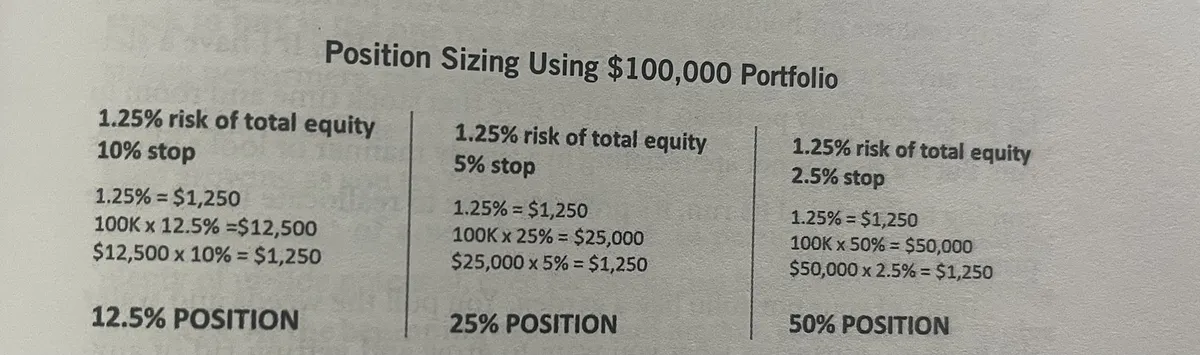
Mark Minervini’s Position Sizing Guidelines

One of the biggest differences between amateur traders and professionals is how they manage risk and position size.

Many traders focus entirely on finding the right stock.

But traders like Mark Minervini emphasize that position sizing and risk control are just as important as stock selection.

In Think and Trade Like a Champion, Minervini outlines several practical guidelines for managing position size and portfolio risk.

Here are the key principles.

Risk Per Trade

Minervini typically risks about:

1.25% – 2.5% of total equity per trade

This means if a trade hits your stop, the total loss should only represent a small percentage of your overall portfolio.

This approach keeps a string of losing trades from doing serious damage to your capital.

Maximum Stop Size

Stops should generally not exceed about 10%.

However, in most cases Minervini notes that average losses should be closer to 5–6%.

Keeping losses small is critical because it allows you to stay in the game long enough to catch the big winners.

Position Size Limits

Even in strong conviction trades, Minervini avoids excessive concentration.

His guidelines include:

• Never take a position larger than 50% of the portfolio

• Ideal position size in top ideas: 20–25%

This allows a trader to press their best ideas while still maintaining diversification.

Number of Positions

Minervini also keeps the number of positions relatively focused.

Typical portfolio structure:

• 10–12 positions for individual traders

• 16–20 positions for larger professional portfolios

This ensures that the portfolio is concentrated enough to benefit from winners, but not so concentrated that one mistake causes major damage.

The Bigger Lesson

The real takeaway from these guidelines is simple.

Successful traders don’t just focus on what to buy.

They also focus heavily on:

• How much to buy

• How much to risk

• How many positions to hold

Because in the end, position sizing is how you survive long enough to generate super performance.

View on Substack ↗

Why Most Traders Lose After a Losing Streak

“When you understand what’s involved in winning, as do professional gamblers, you’ll tend to bet more during a winning streak and less during a losing streak. However, the average person does exactly the opposite: they bet more after a series of losses and less after a series of wins.” — Dr. Van Tharp

This simple idea explains a lot about why most traders struggle.

Professionals understand that performance clusters.

When things are working, it usually means the environment is favorable for their strategy. That’s when they lean in and press their edge.

When things aren’t working, it usually means the market conditions have changed. That’s when professionals reduce risk and protect capital.

But most traders do the opposite.

After a string of losses they start forcing trades, increasing size, and trying to “make it back.”

After a few wins they become cautious, take profits too quickly, or reduce size because they’re afraid of giving gains back.

In other words, they press when they should defend and defend when they should press.

Winning traders flip that behavior.

They stay disciplined during drawdowns and aggressive when their edge is working.

Understanding this shift alone can dramatically change the way you approach risk, position sizing, and consistency in the market.

View on Substack ↗

Under Trade, Under Trade, Under Trade

“First, I would say that risk management is the most important thing to be well understood. Under trade, under trade, under trade is my second piece of advice. Whatever you think your position ought to be, cut it at least in half. My experience with novice traders is that they trade three to five times too big. They are taking 5 to 10 percent risks on a trade when they should be taking 1 to 2 percent risks.”  -Bruce Kovner

View on Substack ↗

The Most Important Trading Skill Nobody Talks About: Position Sizing

Most traders obsess over finding the perfect entry.

But the truth is, position sizing is what determines whether you survive long enough to compound real gains.

I receive a lot of questions about this because it is rarely discussed in detail in most trading books. There are several ways to position size and manage risk, but here is a very basic example that should help illustrate the concept.

Below is a response I recently sent to a reader.

—

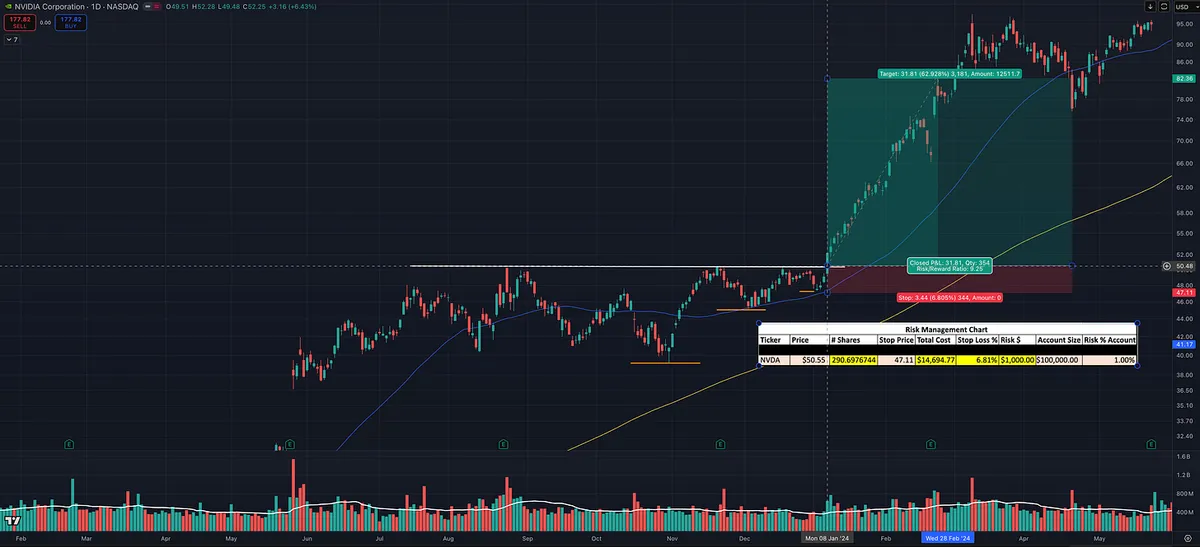
Here’s a simple method I use (see chart).

Let’s say I want to buy a breakout in NVDA at $50.55. I would place my stop at a technical level, right under the previous higher low and near the 50 day moving average at $47.11.

I always base my stop on technical level, not on the percentage I want to lose.

Bruce Kovner said it well in Market Wizards:

“Whenever I enter a position, I have a predetermined stop. That is the only way I can sleep. I know where I’m getting out before I get in. The position size on a trade is determined by the stop, and the stop is determined on a technical basis.”

In this example, the distance from entry ($50.55) to the stop ($47.11) is about 6.81%, which happens to be under the 8% rule that William O’Neil talks about, but that percentage alone does not determine your overall risk.

Once you know your entry and stop, then you determine position size based on how much of your portfolio you are willing to risk.

For example:

If you have a $100,000 account and you only want to risk 1% on the trade, that means you are risking $1,000 total.

With the stop distance in this example, that would equal about 290 shares ($14.6k worth).

Now let’s say you don’t want about $14,600 (14.6% of your account) tied up in this one trade. You could instead calculate position size based on portfolio exposure.

For example:

• If you only want 10% of your account in NVDA, you would buy about 197 shares, risking roughly 0.68% of the account if the stop is hit.

• If you’ve been doing well and want to press harder with 25% of your account, you could take about 494 shares, risking roughly 1.7% of the account if the stop gets hit.

Hopefully that helps.

A lot of people misunderstand the 8% rule from William O’Neil. That rule refers to the distance from entry to the stop, not necessarily the percentage of your total portfolio you are risking on the trade.

View on Substack ↗

The Small Loss Rule

“If you can’t take a small loss, sooner or later you will take the mother of all losses.” — Ed Seykota

This is one of the most important lessons in trading.

The market does not punish you for being wrong.

It punishes you for staying wrong too long.

Small losses are simply the cost of doing business. Every professional trader takes them.

The difference between successful traders and struggling ones is simple:

• Pros cut losses quickly

• Amateurs hope losses come back

Hope is not a strategy.

Capital preservation is.

Take the small loss.

Protect your capital so you can stay in the game long enough to catch the big winners.

View on Substack ↗

How I Think About Portfolio Exposure

Great question from someone today, so I thought I’d share the response.

Sometimes I do a poor job explaining things in my posts, so hopefully this clarifies how I think about portfolio exposure and position sizing.

—

If my portfolio is only 20-40% invested and I’m in a drawdown or my trades aren’t working, it usually means the market environment isn’t supportive. In that case it makes no sense to increase exposure. I should actually be reducing exposure or even moving to cash.

When the market environment is supportive, like during a Stage 2 uptrend, and individual trades are working, that’s when I increase overall portfolio exposure. Sometimes that can reach 100% invested, with individual positions around 25% in the best names.

When the environment is choppy or consolidating, like it has been recently, and trades aren’t working well, I reduce portfolio exposure and take much smaller positions or move to cash.

Of course this is usually a gradual process. As trades begin working better, I may go from 25% exposure to 50%, depending on the quality and quantity of names showing up in my screens.

This is where trading becomes both an art and a science. Every cycle is similar, but never exactly the same. I allow the market and the stocks themselves to guide how aggressive I get.

So results and market conditions dictate how invested I am, similar to the exposure guidelines O’Neil and IBD often talk about.

Trade small and reduce exposure when things aren’t working. Increase exposure and trade bigger when they are.

View on Substack ↗

Ninety-Percent of Any Great Trader Is Going to Be the Risk Control.

Paul Tudor Jones said:

“And then at the end of the day, the most important thing is how good are you at risk control. Ninety-percent of any great trader is going to be the risk control.”

Read that again.

Not pattern recognition. Not IQ. Not predicting the Fed.

Risk control.

Most traders spend 90 percent of their time looking for entries.

The great ones spend 90 percent of their energy controlling downside.

Early in my trading, I obsessed over finding the perfect setup.

Perfect breakout. Perfect VCP. Perfect timing.

But I didn’t obsess over where I was wrong.

And that’s why my equity curve was inconsistent.

The breakthrough came when I flipped the focus.

Before entering, I ask:

Where am I out? How much am I risking? Does this position size reflect the uncertainty?

Because anything can happen.

If your loss is small, you stay in the game. If you stay in the game, you catch the outlier. If you catch the outlier, you compound.

The market does not reward prediction.

It rewards survival.

Ninety percent risk control.

Ten percent everything else.

View on Substack ↗

The Market Does Not Care What You Paid

William O’Neil said something simple that most traders ignore:

Your purchase price means nothing to the market.

But it means everything to your ego.

Early on, I would hold losers because I “wanted my money back.”

The stock would drop 8 percent. Then 12 percent. Then 20 percent.

And instead of asking, “Is this acting right?”

I was thinking, “I just need it back to my cost.”

That one thought cost me more than any pattern mistake ever did.

The best traders in Market Wizards all had one thing in common:

They did not defend positions. They defended capital.

Your cost basis is not support. The 50 day moving average is. The prior breakout level is. Volume behavior is.

The market does not know where you bought.

It only knows supply and demand.

Once I stopped managing my ego and started managing risk, my equity curve changed.

Cut losses at 5 to 8 percent. Add only to strength. Never argue with price.

The market does not reward hope.

It rewards discipline.

Press winners. Cut losers.

View on Substack ↗

Don’t Gamble Into Earnings

Minervini doesn’t gamble. Neither should you.

From Think and Trade Like a Champion:

“My general rule of thumb is never hold a large position going into a major report unless I have a reasonable profit cushion. If I have a 10 percent profit on a stock, then I could usually justify holding into most earnings reports. However, if I have no profit, or worse I’m at a loss, I usually sell the stock or cut down my position size to guard against the possibility of a 10 to 15 percent gap against me. Regardless of how well you know the company, holding into earnings is always a crapshoot.”

This is risk-first thinking.

It’s tempting when a stock is set up properly and earnings are a few days away. Tight action. Constructive base. Volume dry-up. You want to anticipate the breakout.

Don’t.

You must assume the stock can gap down 10–15% just as easily as it can gap up. Overnight risk is outside your control. If you are at breakeven or down, you are exposing capital to an event you cannot manage.

The correct approach is simple:

No cushion → wait. Profit cushion → manage size. Full position with no profit → unnecessary risk.

If the earnings are strong and the stock acts right, you can buy it after the report on proper price and volume action. If it gaps down and breaks the pattern, you avoided a loss.

Risk first. Profit second.

That is how professionals survive long enough to achieve superperformance.

View on Substack ↗

Scale Up When You’re Right. Scale Down When You’re Wrong.

Big success in trading is not one huge bet. It is a series of small wins stacked over time.

I rarely enter the market at full size. I start with a pilot position, usually a quarter position. If the trade works, I add. If I gain traction across multiple trades, I increase overall exposure. If trades do not work, I scale down.

If I am not profitable at 25 percent invested, why would I move to 75 percent or 100 percent?

The goal is simple:

Trade your smallest when you are trading your worst. Trade your largest when you are trading your best.

By scaling up only after wins, profits finance risk. By scaling down after losses, you prevent damage.

That is how you compound money.

This discipline creates superperformance.

View on Substack ↗

“Losers Average Losers.”

Paul Tudor Jones had a sign above his desk:

“Losers average losers.”

I learned why the hard way.

Earlier in my trading, I averaged down.

The stock dropped. I added. It bounced. I got out green.

That win reinforced the behavior.

So I did it again. And again.

Until one day… it didn’t come back.

And I took a major hit.

That pain changed me.

Because averaging down doesn’t just increase size. It increases exposure to weakness.

When it works, it builds a bad habit. When it fails, it can wipe out months of discipline.

I made a decision after that loss:

I will never average down again. And I don’t look back at charts to see “how much I would have made.”

That thinking is poison.

Every bull cycle, traders get rich with bad habits.

Averaging down. Oversizing. Ignoring stops.

And every cycle, most of them disappear.

There’s a reason one of the greatest investors of all time kept that sign above his desk.

Press winners. Cut losers.

View on Substack ↗

To Compound or Not to Compound

Two traders.

Chris and John.

Both start with $100,000. Both take 24 trades. Same entries. Same exits. Same system.

12 trades gain +15%. 12 trades lose −7%. They alternate win/loss for all 24 trades.

Identical performance.

Different capital management.

Chris — Fixed Position (No Compounding)

He risks a fixed amount based on $100,000 every trade.

Each winner: 15% of $100,000 = +$15,000

Each loser: 7% of $100,000 = −$7,000

12 winners = +$180,000 12 losers = −$84,000

Net profit = $96,000

Final account = $196,000 (+96%)

John — Compounds Every Trade

John reinvests everything.

After each 15% win, position size increases. After each 7% loss, it decreases.

Because gains are larger than losses, the positive asymmetry compounds.

After 24 alternating trades:

Final account ≈ $249,000 (+149%)

The Difference

Same system. Same win rate. Same gain/loss profile.

The only difference:

One compounded a positive expectancy edge.

Compounding does not create edge. It magnifies it.

View on Substack ↗

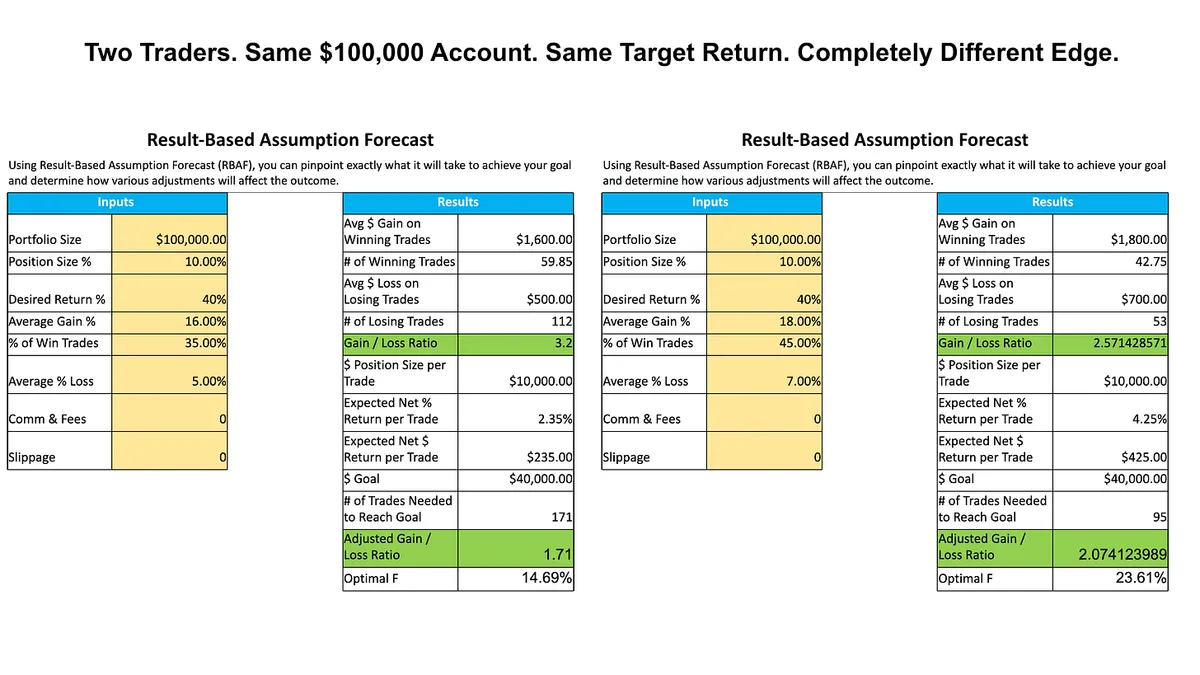
Two Traders. Same $100,000 Account. Same Target Return. Completely Different Edge.

Most traders think performance comes down to win rate.

It doesn’t.

It comes down to expectancy.

Both traders in the image:

  • Start with $100,000

  • Use 10% position size

  • Want a 40% return ($40,000)

But their math tells two completely different stories.

Trader A

  • 35% win rate

  • 16% average gain

  • 5% average loss

  • 3.2 gain/loss ratio

Expectancy:

(0.35 × 16%) − (0.65 × 5%) = 2.35% per trade

At 10% exposure, that’s:

0.235% account growth per trade ≈ $235 per trade

To hit $40,000?

He needs 171 trades.

Lower batting average. Solid asymmetry. Heavy trade frequency required.

Trader B

  • 45% win rate

  • 18% average gain

  • 7% average loss

  • 2.57 gain/loss ratio

Expectancy:

(0.45 × 18%) − (0.55 × 7%) = 4.25% per trade

At 10% exposure:

0.425% account growth per trade ≈ $425 per trade

To hit $40,000?

He needs 95 trades.

Higher win rate. Still asymmetric. Almost half the workload.

The Real Lesson

Win rate alone means nothing.

Trader A actually has the bigger raw R multiple.

Trader B compounds faster because his edge per trade is stronger.

Same capital. Same goal. Same exposure.

Different math.

That’s what Result-Based Assumption Forecast exposes.

You don’t guess your average gain. You don’t guess your win rate. You pull them from real trading data.

The only estimates are:

  • Portfolio size

  • Position size

  • Desired return

Everything else must be earned.

RBAF doesn’t predict the market.

It measures you.

And once you understand your edge, performance stops being hopeful…

It becomes engineered.

View on Substack ↗

Stanley Druckenmiller on What He Learned from George Soros

One of the most important lessons Druckenmiller ever learned came from Soros.

He said:

“It's not whether you're right or wrong, it's how much you make when you're right and how much you lose when you're wrong.”

That is position sizing. That is asymmetric risk. That is the entire game.

You can be wrong a lot and still make a fortune.

What matters is:

  • Pressing your winners

  • Cutting your losers

  • Never letting ego override risk

The amateurs obsess over being right.

The pros obsess over payoff.

View on Substack ↗

What Growth Momentum Traders DON’T Do

There are thousands of posts about what traders should do.

Let’s talk about what we do not do.

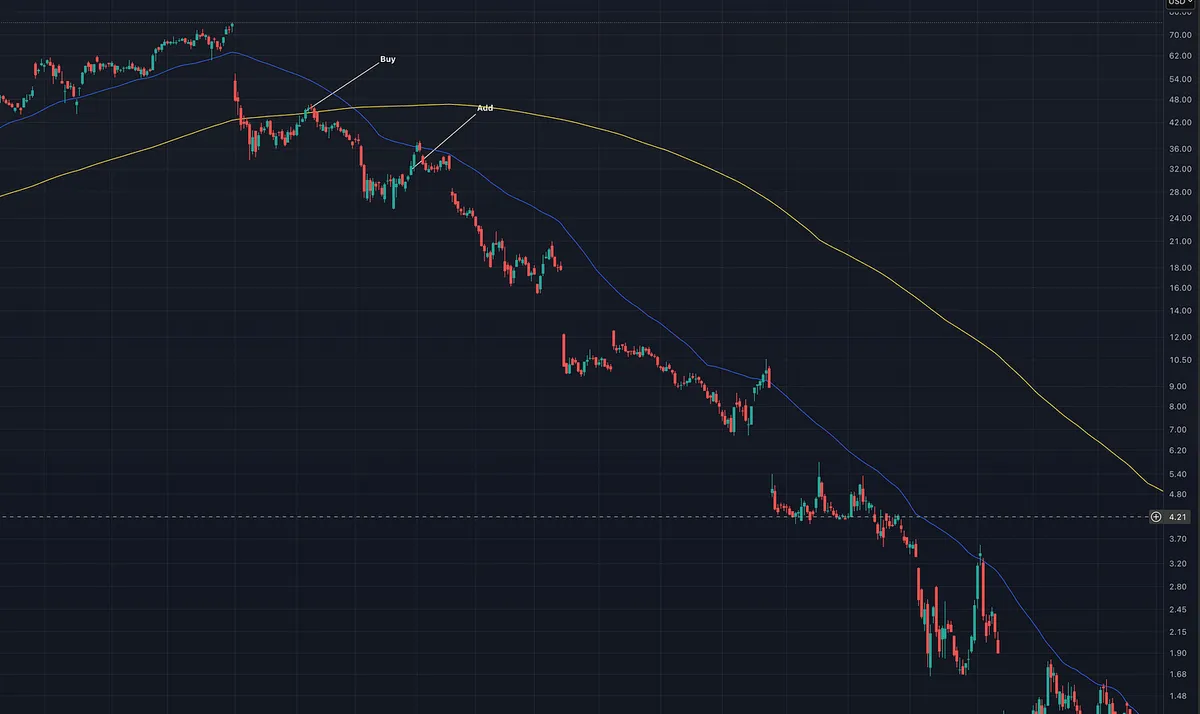
We do not sit through massive Stage 4 declines. We do not average down in broken stocks. We do not marry positions. We do not wait decades to get back to even.

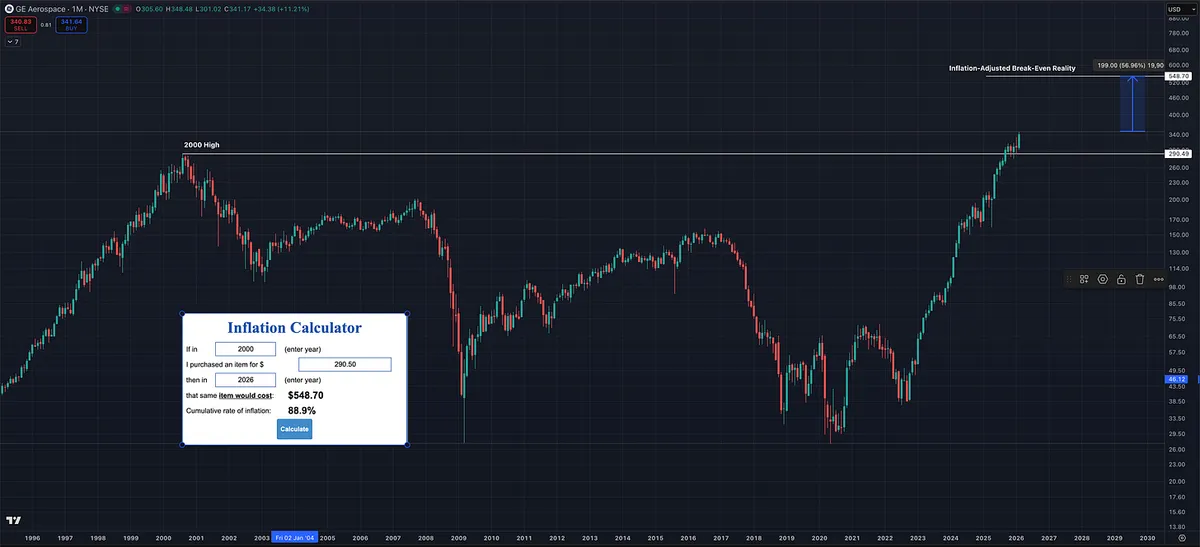
At one time, General Electric was considered one of the safest companies in America. Blue chip. Institutional favorite. A “forever” stock.

It peaked in 2000.

If you bought near the highs and held, you waited decades just to see price approach those levels again. Adjusted for inflation, you are still not truly made whole. From the inflation adjusted breakeven level, the stock would need to rise another 57 percent just to restore purchasing power.

That is the hidden cost of buy and hold without risk management.

This can happen to any stock.

There are no permanent leaders. Capital rotates. Industries evolve. Institutions move on.

Growth momentum trading is built differently.

We cut losses short. We follow the trend. We concentrate in strength. We protect capital.

A great company can be a bad stock. A bad company can be a good stock.

Ideally, we want both at the same time. A strong company in a confirmed Stage 2 advance.

That is where real compounding happens.

William O’Neil said it best:

“There are no good stocks unless they go up in price. If they go down instead, you have to cut your losses fast.”

View on Substack ↗

One of the Most Important Lessons in Trading That Most Ignore

One of the most important lessons in Market Wizards was this from Bruce Kovner:

“Whenever I enter a position, I have a predetermined stop. That is the only way I can sleep. I know where I’m getting out before I get in. The position size on a trade is determined by the stop, and the stop is determined on a technical basis.”

Read that again.

The chart determines the stop. The stop determines the position size.

Most traders invert that.

They choose size first. Then force the stop to fit.

That is not risk management. That is guesswork.

Do you actually know how to implement this inside your own setups?

I break it down step by step with real chart examples and a full walkthrough video.

Read it here → https://tradingmomentum.substack.com/p/most-traders-get-position-sizing

ArticleMost Traders Get Position Sizing Wrong. Here’s the Risk Management Fix.
View on Substack ↗

Most Traders Size Positions Backwards. Here’s the Risk Management Fix.

Most traders don’t blow up because of bad entries.

They blow up because they size positions backwards.

They decide how much they want to risk.

Then they force the stop to fit.

That’s not risk management. That’s guesswork.

I just published a deep breakdown showing:

• How structure defines the stop

• How the stop defines position size

• How exposure caps reshape portfolio risk

• Real chart examples + full walkthrough video

Read it here → https://tradingmomentum.substack.com/p/most-traders-get-position-sizing

ArticleMost Traders Get Position Sizing Wrong. Here’s the Risk Management Fix.