Momentum Trading Strategy

Notes

Risk Management & Position Sizing

Notes whose main point is limiting losses and deciding how much to buy and how much to risk on each trade.

Showing 101–120 of 224 notes

View on Substack ↗

“Relative Strength Doesn’t Work.” Okay.

“It only finds extended names.”

“I don’t want to buy strong stocks because they’ve already moved too much.”

I hear this all the time.

Most of that fear does not come from relative strength being flawed.

It comes from people not knowing how to manage risk, or frankly, not studying big winning stocks cycle after cycle.

If you understand position sizing, proper entries, logical stops, and low-risk, high-reward setups, high relative strength is not something to fear.

It is something that should grab your attention.

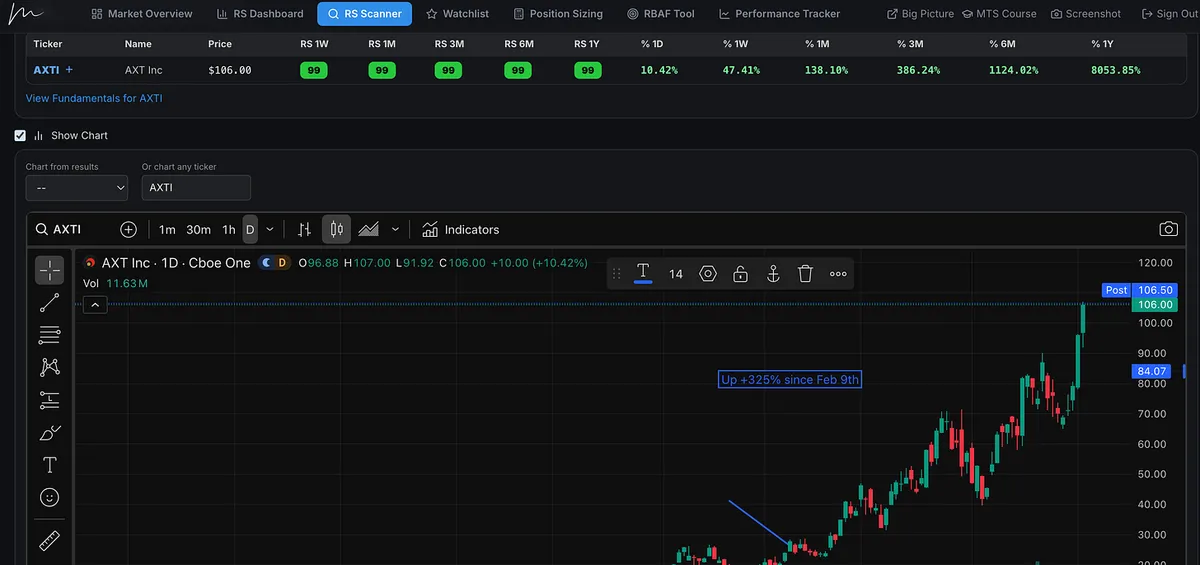
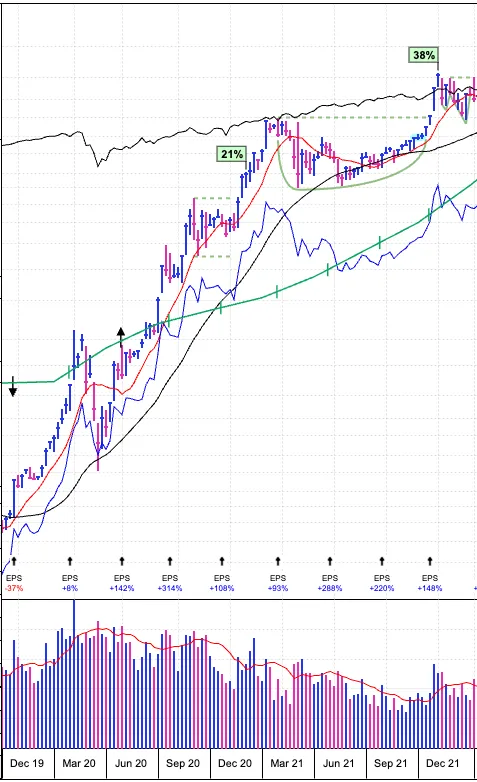
AXTI is a great example.

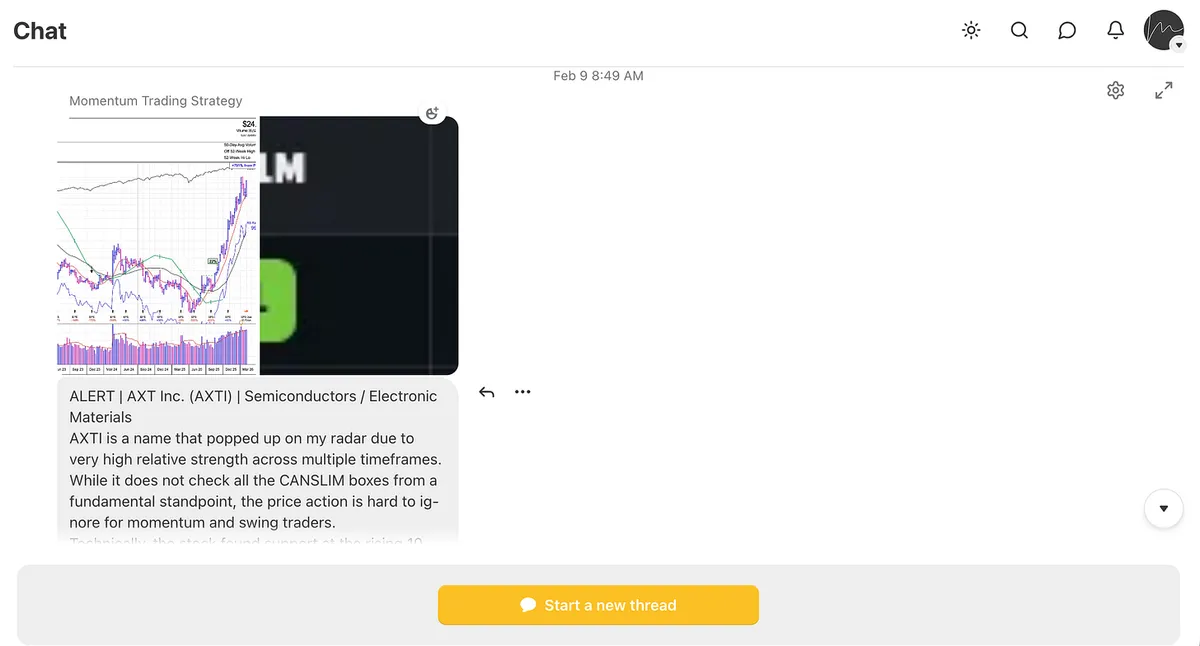
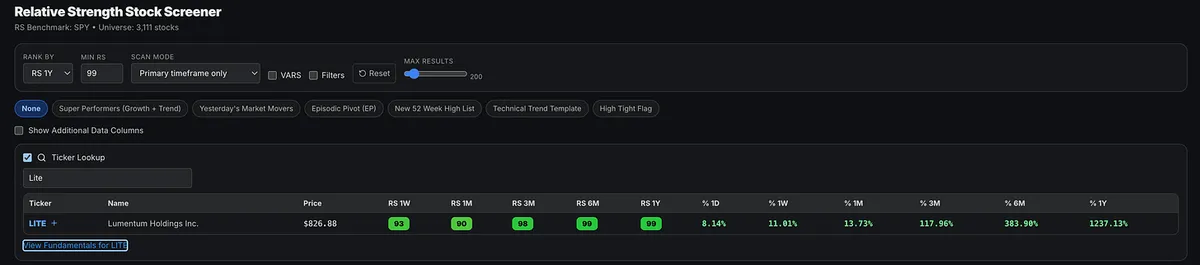
Back in February, it had a 99 RS and was sitting near the top of my Relative Strength Stock Screener.

It kept showing up week after week.

Month after month.

And since then, it has gone up more than 325%.

That is what strong stocks often do.

They go much higher than most people expect.

And weak stocks often go much lower than most people expect.

AXTI also had something else going for it:

A strong stock, in a strong group, aligned with a major bull market theme.

That is a principle that has shown up in market leaders for decades.

Follow relative strength.

Do not fear strength just because other people do not know how to manage risk.

If the trade does not work, you get out with a small loss.

If it works, you have the potential for a huge gain.

View on Substack ↗

Only Traders Understand This Kind of Pain

This story Mark Weinstein told in Market Wizards always makes me laugh.

Only another trader would really understand this.

But underneath the humor, there is a serious lesson. Even some of the best traders went through the same growing pains and made the same mistakes most of us make early on.

And when you read a story like this, you can see the pain usually comes from exactly what Module 6 of the Momentum Trading Strategy Course is going to cover:

Risk management and position sizing.

Almost all the mental stress and pain we experience in trading comes from violating risk management and position sizing principles.

Mark Weinstein, as great as he became, experienced those mistakes early in his career as well:

“Before that trade, I had nearly $1.5 million in my trading account. So I was losing nearly 10 percent of my equity level prior to the trade each day. I was devastated. I felt like I was wounded in a trench and watching myself bleed to death. The market went limit-down five days in a row, and I lost over $600,000. On the fifth day, I remember sitting in a park holding hands with a girl I had picked up, literally crying on her lap. I was practically in a psychotic state. I thought about getting out of the business altogether. I started to think that what everybody was telling me was true, maybe it was just luck that I had made money all those years. I worried that if I continued trading, I could wind up losing it all, and being forced to go back to some job I didn’t like.”

The lesson is simple:

Cut losses fast.

Do not size too big.

Know where you will get out before you get in, and follow the plan.

Prepare for contingencies because things will go wrong.

Risk management and proper position sizing are not optional.

They are the foundation.

View on Substack ↗

Your Trading System Might Not Be the Problem. Your Position Size Might Be.

Most traders think the problem is their entries.

Sometimes it is.

But sometimes the real problem is position size.

You can have the right stock, the right setup, and the right general idea, but if the position is too large, a normal pullback feels like a crisis.

And if the position is too small, even a good edge barely moves the account.

That is why position sizing matters so much.

Years ago, I remember reading about Dr. Van Tharp’s Marble Game.

It was one of the simplest but most impactful exercises I ever did for understanding position sizing.

The lesson was obvious once you saw it play out:

The same system.

The same edge.

The same win rate.

The same distribution of outcomes.

But completely different results depending on how much each player risked per draw.

That is when position sizing really started to click for me.

I’m wrapping up Module 6 of the Momentum Trading Strategy Course, which is focused on risk management and position sizing, and it should be released in the next few days.

While building this module, I realized something:

Most people are probably not going to go buy a bag of 100 marbles and physically play the game.

And most people are probably not going to build an Excel or Google Sheets version either.

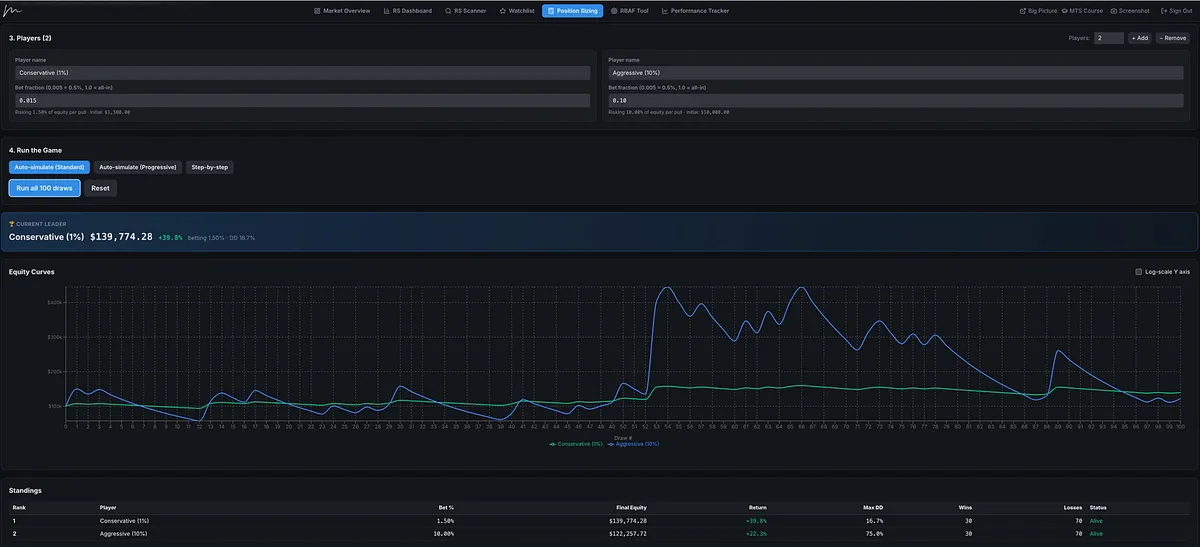
So I built the marble game directly into the Momentum Trading Strategy Web App.

Inside the app, you can run the marble game digitally, test different win rates, different R-multiple distributions, different bet sizes, and compare players side by side.

I also added features that were not part of the original version.

One of the biggest is progressive exposure.

Instead of risking the same percentage on every draw, you can simulate a more realistic approach where bet size increases slightly after the account builds a profit cushion, and then scales back down if drawdown starts to grow.

This is similar to the idea George Soros talked about:

Risking profits is very different from risking principal.

When you are starting with only your original capital, you may want to be more conservative and keep drawdowns smaller.

But after you have built a cushion, especially in a strong market environment, you may be willing to press a little more in order to maximize the opportunity.

Then, while building the marble game, I realized another issue:

A lot of newer traders may not even know what position size makes sense for their strategy.

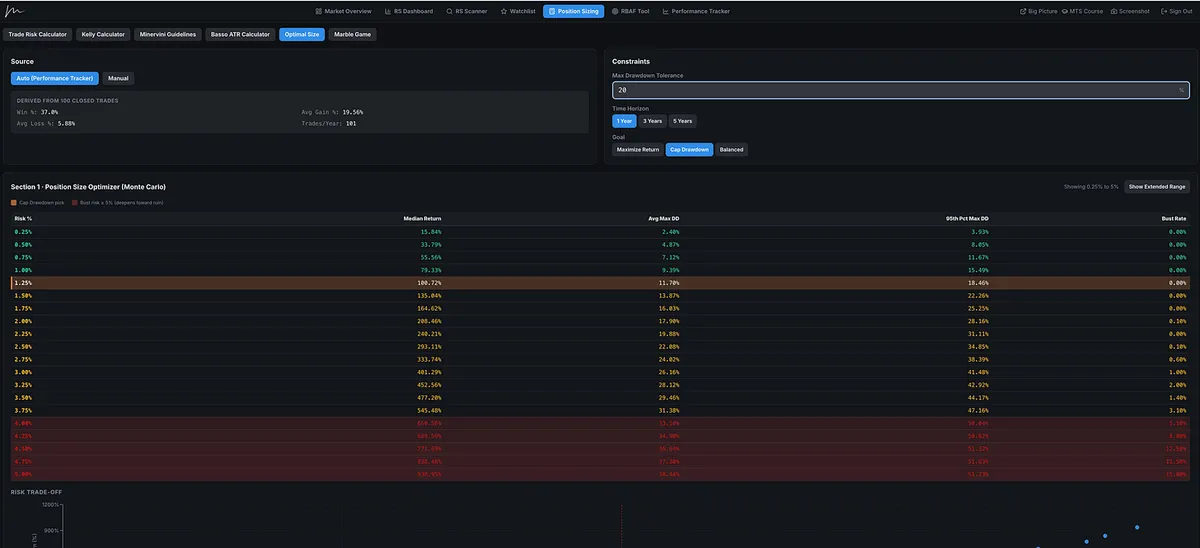
So I also built an Optimal Size tool.

It can pull your actual trading statistics from the performance tracker inside the app, or you can enter your numbers manually.

You input things like win rate, average gain, average loss, and trades per year.

Then it runs Monte Carlo simulations to estimate different position sizes, projected returns, average max drawdowns, 95th percentile max drawdowns, and bust risk.

The goal is not to predict the future.

The goal is to understand the range of possible outcomes based on your trading statistics.

A good system still needs the right size.

Risk too little, and the edge may not move the needle.

Risk too much, and even a positive expectancy system can become untradable.

Position sizing is not just about survival.

It is also about maximizing your system’s profitability while keeping drawdowns within a range you can actually follow.

View on Substack ↗

Do You Know Which Game You’re Playing?

Both traders in this example have an edge, but the source of the edge is different.

Trader A:

Wins 40 percent of the time.

Average gain is 3 times larger than the average loss.

Trader B:

Wins 80 percent of the time.

Average loss is 2 times larger than the average winner.

In this simple example, both can produce the same outcome.

The key lesson is that edge comes from the relationship between win rate, average gain, and average loss.

You do not have to trade like everyone else.

But you do have to know which game you are playing.

If you have a low win rate, your winners must be meaningfully larger than your losers.

But I do not think it is a coincidence that many of the traders in the Market Wizards books who discussed win rate were often below 50% percent, while many rookie and struggling traders are obsessed with having a high win rate.

Beginners want to be right.

Professionals focus on positive expectancy.

View on Substack ↗

Would You Take the Risk?

Mark Minervini uses a simple question to explain risk:

Would you run across the street with your eyes closed for one million dollars?

Maybe once.

But would you do it ten times?

A hundred times?

Of course not, and that is the point.

Trading is not one decision.

You are going to make many trades over time.

A reckless risk might work once, but repeated over many trades, the odds catch up with you.

Do not be a gambler trying to get lucky once.

Many retail traders are trying to find the one trade that changes everything.

Professionals are executing a repeatable process that will compound through trade frequency and time.

They are not trying to survive one lucky event.

They are trying to survive hundreds and thousands of decisions.

View on Substack ↗

If You Can’t Answer These Questions, You’re Not Trading, You’re Gambling.

Every serious trader and investor eventually learns the same lesson:

Risk management is not optional.

It does not matter if you are a macro trader, growth stock investor, momentum trader, trend follower, or systematic trader.

It does not matter what your timeframe is, whether you are a day trader, swing trader, position trader, or multi-year long-term investor.

The strategies may look different.

The timeframes may be different.

The entries may be different.

The exits may be different.

The data that shows positive expectancy may be different.

But the people who survive long enough to compound capital over months, years, and decades all have one thing in common:

They know how they are managing risk.

The tactics are different.

The principle is the same.

Every legitimate strategy has some way of answering the same questions:

  • How much can I lose?

  • Where am I wrong?

  • How will I know I am wrong?

  • How much of my total equity is at risk?

  • What happens if this trade or investment goes completely against me?

  • If the trade goes in my favor, where am I a seller?

  • Am I managing risk based on emotion, or based on a defined process?

Because profitable trading is not just about finding good ideas.

It is about having a positive expectancy system and managing risk so you can stay in the game long enough for that edge to play out.

That means you should know your numbers:

  • What is my average gain?

  • What is my average loss?

  • What is my win rate?

  • What is my gain/loss ratio?

  • What is my adjusted gain/loss ratio?

  • What is my profit factor?

  • What is my expectancy?

  • What is my max drawdown?

  • What is my average MAE, or maximum adverse excursion?

  • What is my average MFE, or maximum favorable excursion?

There are more, but these are a few key metrics.

These are not just trading analytics.

They are survival metrics.

Your average gain, average loss, and win rate tell you whether your system has positive expectancy.

Your profit factor tells you how much you are making for every dollar lost.

Your max drawdown tells you whether you can financially and psychologically survive the difficult periods.

Your MAE tells you how much pain you are allowing trades to go through before they work or fail.

Your MFE tells you how much opportunity you are capturing versus how much you are giving back.

A trader can look profitable on paper but still be carrying hidden risk.

If someone is constantly sitting through massive unrealized losses before a trade finally works, that may show up as a winning trade in the final results.

But the process underneath may be dangerous or may not be sustainable over time.

A system can have positive expectancy and still be nearly impossible to execute if the drawdowns are too large, the volatility is too extreme, the position sizing is too aggressive, or the trader is regularly allowing small mistakes to become big account-threatening losses.

That is why risk management is not just about stop losses.

It is about position sizing.

It is about exposure.

It is about knowing your numbers.

It is about understanding whether your strategy is actually repeatable, or whether you simply got lucky during a favorable stretch.

Different types of investors and traders may manage risk differently, but the successful ones all do it.

And if someone claims they want to be a serious trader or investor but cannot answer these questions, they are probably not operating with a process.

They are gambling.

The market will forgive bad trades.

It will not forgive bad risk management forever.

View on Substack ↗

You Don’t Need One Monster Winner to Have a Monster Year

Everyone wants the 100% winner.

And yes, we study the greatest winning stocks in history because that is where some of the best opportunities are found, both for swing trading and position trading.

But here’s what a lot of traders miss:

You can also compound your way to an exceptional year through a series of smaller winners.

Not every triple-digit year comes from catching one massive stock.

Sometimes it comes from stacking 10%, 15%, or 20% winners while keeping losses contained at 5%, 6%, or 7%.

That is the power of compounding through trade turnover, not just time.

And that is the power of a positive expectancy system.

If your average winner is meaningfully larger than your average loser, you do not need to be right all the time.

And you do not need every trade to be a home run.

A few big winners are great.

But a repeatable process that produces steady winners, controls losses, and turns capital over efficiently can be just as powerful.

The goal is not to predict the one perfect trade.

The goal is to have a strategy where the math can work over and over again.

View on Substack ↗

You Can Sit Out Half the Year, Be Wrong 65% of the Time, and Still Finish Up Triple Digits

Most traders think a big year comes from constantly trading.

It doesn’t.

A big year usually comes from knowing when to press the gas and knowing when to do absolutely nothing.

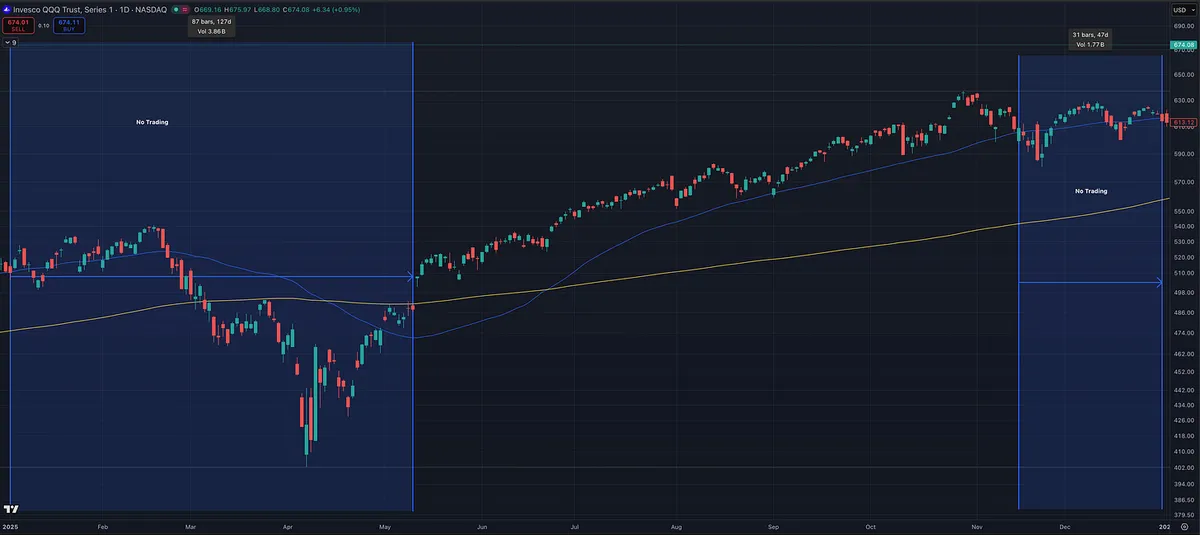
Look at the chart.

The blue areas were no-trade zones.

That is not weakness.

That is discipline.

In this example, the real opportunity window was the Stage 2 uptrend from around May 12, 2025 to November 14, 2025.

That is where the system gets to work.

Here’s the point:

A trader could spend 82 trading days doing nothing, have 104 losing trades, win only 35% of the time, and still have a triple-digit year.

How?

Because the winners are much larger than the losers.

Example:

35% win rate

25% exposure per trade

17% average gain

5% average loss

That means:

A winner adds about +4.25% to the account.

A loser subtracts about -1.25% from the account.

Over the year:

56 wins × 4.25% = +238%

104 losses × 1.25% = -130%

Simple net return: +108%

Estimated compounded return: +178.05%

That is with only a 35% win rate.

Now compare that with a trader who wins more often, but has a smaller gain-to-loss spread.

Example:

50% win rate

25% exposure per trade

14% average gain

7% average loss

A winner adds about +3.5% to the account.

A loser subtracts about -1.75% from the account.

Over the year:

58 wins × 3.5% = +203%

58 losses × 1.75% = -101.5%

Simple net return: +101.5%

Estimated compounded return: +164.14%

That trader could also spend around 120 days not trading at all and still finish with a triple-digit year.

This is why win rate alone is not the game.

The real game is:

Knowing when conditions are right.

Avoiding the chop.

Keeping losses controlled.

Pressing when the market is rewarding your system.

Letting the math work over a large enough sample.

You do not need to trade every day.

You do not need to be right all the time.

You need a system with positive expectancy, enough discipline to sit in cash when conditions are poor, and enough conviction to press when the window opens.

View on Substack ↗

Staggered Stops Can Help You Stay With a Trade Without Losing Control of Risk

Not every trade needs to be all-or-nothing.

Sometimes, instead of putting the entire position at one stop level, you can split the position into pieces and give each piece its own stop.

That is the idea behind staggered stops.

The benefit is flexibility.

A tight first stop can reduce exposure quickly if the trade starts acting wrong.

A wider second or third stop can give the remaining position more room to survive normal volatility, shakeouts, or a quick test of support.

This can be especially useful when the chart has multiple logical stop areas.

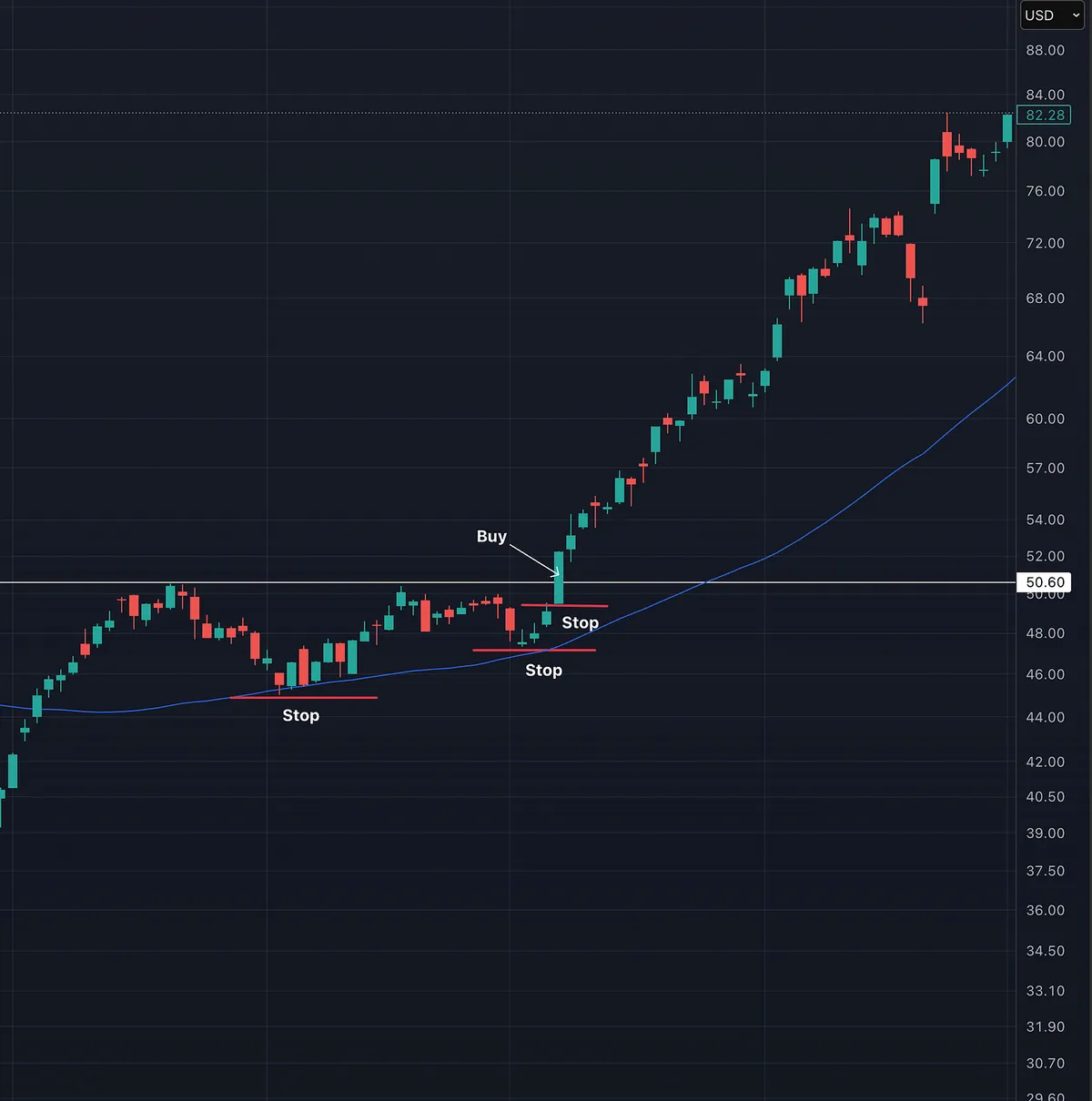
For example, on this chart:

First stop: under the low of the entry day, about 2.5% below entry.

Second stop: below the most recent higher low, about 6.75% below entry.

Third stop: below the prior higher low, about 11% below entry.

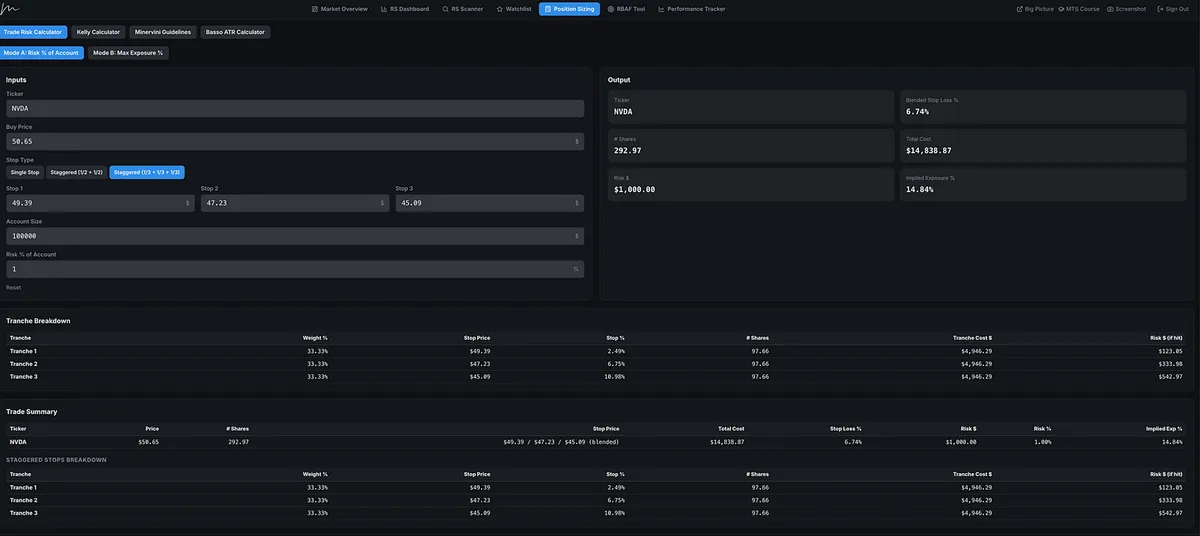
If the position is split into equal thirds, the blended stop is:

(2.5% + 6.75% + 11%) ÷ 3 = 6.75%

So if all three stops are hit, the total loss is roughly 6.75% of the position value, before slippage.

Staggered stops can help you avoid getting completely shaken out on normal noise, but they do not eliminate risk.

They only work if the total position size is based on the blended stop, not the tightest stop.

If you size the full position using the 2.5% stop, but two-thirds of the position are allowed to fall to 6.75% and 11%, your real risk is much larger than you think.

Used correctly, staggered stops let you do two things at once:

Protect part of the position quickly if the trade starts failing.

Give the rest of the trade enough room to prove itself.

Remember:

Stops come from the chart.

Account risk sets the limit.

Position size is based on total trade risk.

And staggered stops should be sized using the weighted average of the stop levels.

View on Substack ↗

New System Will Not Fix Bad Discipline

If you are a newer trader, this is one of the most important things you will read.

It is not fancy. It is not some secret indicator, but many of us took years to understand it, and I wish I had learned it sooner.

A lot of traders study CANSLIM, O’Neil, Minervini, Darvas, and other great growth traders, then jump in before they have the full foundation.

They know what a breakout looks like. They can spot relative strength. They understand the idea of buying leaders.

But they have not mastered the part that keeps you alive.

Position sizing. Risk management. Cutting losses. Managing winners. Knowing when to press and when to back off.

That is where the damage happens.

They take a loss that is too big. They sell a winner too soon. They chase. They ignore stops. They slowly bleed through death by a thousand cuts.

Then they say, “This strategy does not work.”

Or maybe deep down they know it works. They just know they cannot follow the rules.

So they go looking for a new system.

More indicators. More signals. More backtests. More automation.

They think removing discretion will remove emotion.

But even systematic traders need discipline.

Ed Seykota and Richard Dennis did not succeed because their systems replaced discipline. They succeeded because they had enormous discipline.

Seykota could have written a book focused only on coding, backtesting, optimization, or the exact mechanics of trend following. Instead, his major standalone book is about trading psychology.

That alone tells you something.

The system is not usually the hard part. Following it is.

And it is no coincidence that Richard Dennis is often credited with the idea that you could publish trading rules in the newspaper and most people still would not follow them.

Why?

Because the real key is consistency and discipline.

The system fit their personality, but they still had to follow it.

That is the part traders miss.

A systematic approach can work. A discretionary approach can work. CANSLIM can work. Trend following can work.

But none of them work if you cannot follow the rules.

Most of the time, the system is not the real problem. The trader’s behavior is.

How do I know?

Because I have made these mistakes myself, and after years around other traders, I have seen the same patterns repeat over and over.

The root issue is usually simple.

Traders are trying to make too much money too fast. They size too big. They get emotional. Then they blame the strategy when they cannot execute it.

They are not willing to put in the time and effort required to get the results they want, so they drift into gambling.

Maybe not consciously.

But that is what it becomes.

I am not here to tell you what you want to hear. I am here to tell you what you need to hear.

If your position is too large, your rules will feel impossible to follow.

That does not mean the strategy is broken.

It means the risk is too big.

And this is not something you outgrow.

Highly skilled traders still define risk, control exposure, and respect the fact that any trade can fail.

That is the entire point of position sizing.

It keeps you in the game long enough for your system to work.

This is why I created the Momentum Trading Strategy Course.

This is not one trader’s strategy. It is a collection of principles pulled from hundreds of profitable traders, legendary operators, and real market experience.

I am just trying to consolidate it into one place in hopes of saving some traders from wasting the same years many of us wasted before we found the way.

And even if you do not learn from me, maybe I can point you toward other great educators teaching the same principles in a way that finally clicks for you.

The answer is not always to find a new system.

Sometimes the answer is to become the type of trader who can actually follow one.

View on Substack ↗

The Chart Said Yes. The Process Said No

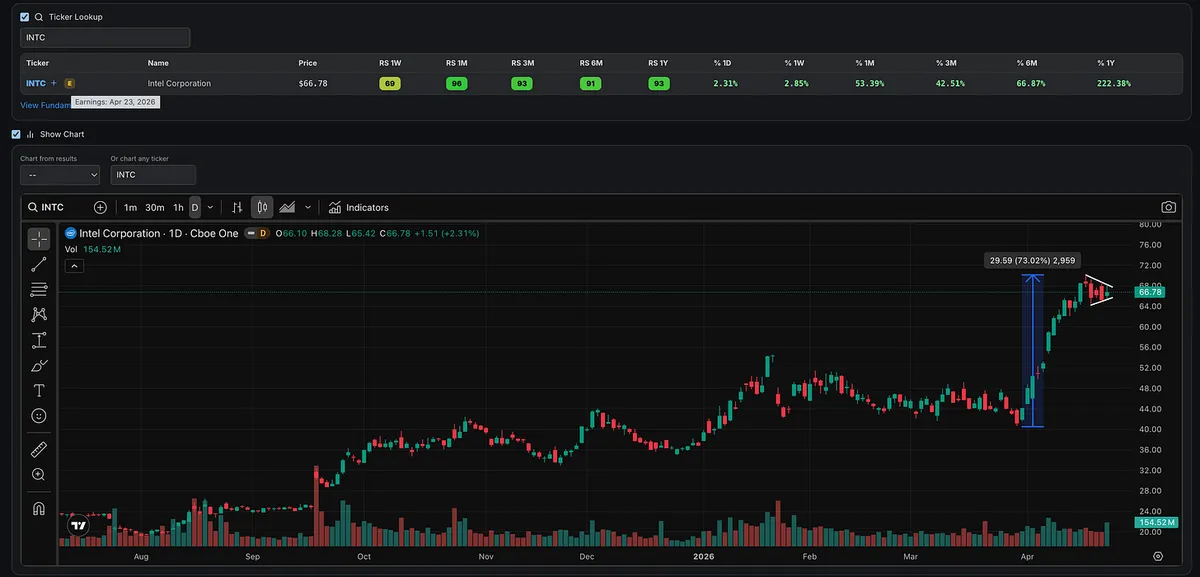
This is exactly the type of setup I look for.

Strong move up. Tight flag/pennant pattern. Volume low in the pullback, then came in at the close.

Everything about this chart was actionable.

But I still said no.

Why?

Because earnings were after the close.

This is where discipline matters most.

Not when the setup is messy. Not when the market is unclear.

But when everything looks perfect… except for one thing.

“Never trade in situations where you don’t have control. For example, I don’t risk significant amounts of money in front of key reports, since that is gambling, not trading.” — Paul Tudor Jones

I wanted to take this trade today.

But that is not part of my process.

The moment you start bending your rules for a “perfect” setup is the moment you start to lose consistency.

Earnings remove control.

Intel can gap up 20%.

It can also gap down 20%.

That’s not trading.

That’s gambling.

View on Substack ↗

Chart Patterns Are Not Magic They Are Math in Your Favor

Why the best setups are about risk first and reward second

Somebody asked me recently…

“What is the real importance of chart patterns?”

It is a fair question.

Because yes, people have studied patterns for decades. They have tried to assign probabilities. They have tried to label what works and what does not.

That is not why I use them.

I use them because they create asymmetric opportunity.

They show me exactly:

where I am buying where I am wrong and what I stand to gain if I am right

If I am wrong, I lose small. If I am right, I make multiples of what I risk.

That is the game.

And this is not new.

Traders like Mark Minervini, Dan Zanger, and Kristjan Kullamägi have used variations of these setups for decades. William O’Neil was documenting these patterns going back over 100 years.

This is not reinventing the wheel. This is following what already works.

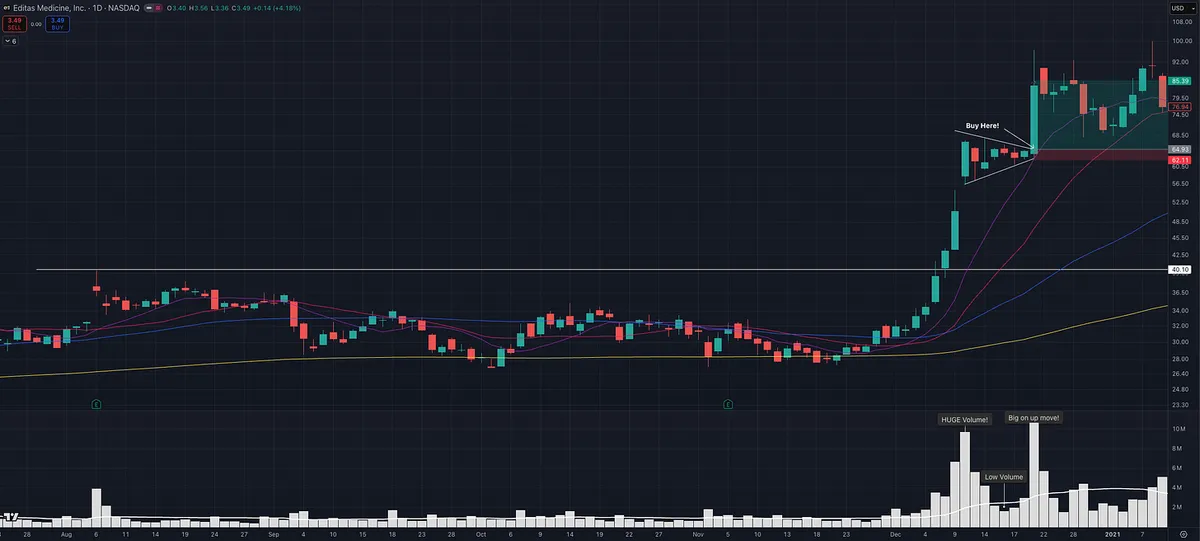
Take this example, EDIT.

You have a stock that explodes higher on massive volume, breaking out of a long base.

Then instead of collapsing, it does something very specific.

It goes sideways. Price tightens. Lower highs. Higher lows.

A squeeze.

That is where the opportunity forms.

That is where risk becomes defined.

That is where the trade becomes asymmetric.

In this case, you are risking roughly 4 percent. If you enter intraday using an opening range breakout, that risk can shrink to 1 to 2 percent.

If you are right, the upside can be 7 to 10 times that risk (or more!).

That is not about being right all the time.

That is about being right enough with the math on your side.

This specific setup is a variation of the Power Play concept from Mark Minervini.

It shows up over and over again.

Different names. Different markets. Same behavior.

And once you understand what you are actually looking at, you stop chasing trades…

and start positioning for opportunity.

👉 This is one of the core setups I break down inside the Momentum Trading Strategy Course.

View on Substack ↗

The Question Nobody Asks Before Buying a Stock

Most people just want the hot stock idea.

They’re willing to pay for a newsletter that gives them tips, analysis, and reasons why a stock is the next big winner.

And there’s nothing wrong with that.

But here’s why it doesn’t work for 99 percent of people.

They can’t answer these simple questions:

How are you managing your risk on that idea?

What is your position size?

When do you sell?

When do you add?

If you go in large, when do you take some off along the way?

How do you prevent it from round tripping?

And the biggest one:

Is this actually a low risk, high reward opportunity?

Meaning if you’re wrong, do you lose a little…

But if you’re right, do you make multiples of that risk?

Here’s the reality.

A lot of these stock ideas are presented in a way that makes them feel almost certain.

Like they can’t fail.

But what if they do?

And there’s another problem most people don’t realize.

Everyone is reading and acting on that same idea at different times.

One moment may offer a low risk, high reward opportunity.

The very next moment, that same stock may not.

Without understanding timing, entries, and risk, you could be buying the exact same name with a completely different outcome.

Most people aren’t factoring that in.

Most people aren’t factoring in anything that leads to long-term, consistent profitability.

They take the idea and just buy a random number of shares or allocate some percentage of their portfolio with no real plan behind it.

No structure.

No risk control.

No exit plan.

That’s the problem.

It’s not the idea.

It’s what you do after you buy it.

And that’s why the majority of investors and traders lose money.

That’s how we’re different.

Here at Momentum Trading Strategy, we’re teaching you how to fish, not just handing you fish.

When we share a name, we’re talking about potential entry points, logical stop locations, and where to sell some into strength.

And if we’re simply sharing a name, that framework has already been taught through our in-depth articles and, more importantly, the full course available to paid subscribers.

So when you enter a trade, whether it becomes a winner or a loser, you know exactly what to do.

Those questions aren’t guesses.

They have answers.

View on Substack ↗

Low Risk. High Reward. That’s The Game

Every style of investing is chasing the same thing:

Asymmetric opportunities.

  • Macro traders.

  • Value investors.

  • Momentum and growth traders.

Different approaches.

Same goal.

Risk a small amount to make a multiple of that risk.

5x. 10x. 15x.

That’s the edge.

George Soros explained this when talking about his famous sterling trade.

He put on a massive position and made over a billion.

But he wasn’t risking the entire amount.

He was risking a small percentage of it.

“the most we could have lost would have been let's say 2 or 3% because it was a you know a high reward, low risk bet.”

That’s the mindset.

Not how much you can make…

But risking a low amount that has high reward opportunity.

This is another concept we teach and show how to implement in the Momentum Trading Strategy Course.

View on Substack ↗

Everything Changes When You’re Playing With Profits

You don’t really get momentum in trading until you have profits to work with.

Because there’s a big difference between risking your capital…

And risking your profits.

This is nothing new. George Soros talked about this in a 1995 interview:

“You can't really get the dynamic going until you have a little profit under your belt because it's very different when you're risking your principal than when you're risking your profit.”

But once you build a cushion…

Everything changes.

You can think clearer. You can let trades work. You can scale properly.

That’s when real runs happen.

The key is protecting your capital early.

When things aren’t working, you reduce risk. You step back. You retrench.

You don’t press.

Because the goal isn’t just to make money.

It’s to get to a position where you’re trading with profits instead of your principal.

And this ties directly into a concept Mark Minervini talks about called financing your risk.

On the individual trade level, when a position moves in your favor and you take partial profits, you’re not just locking in gains.

You’re reducing risk.

In many cases, you’re now financing the rest of the trade with your profits.

You’re no longer risking your original capital. You’ve created a cushion and you can let the remaining position work with far less pressure.

This is one of the main reasons top traders sell into strength.

Not to exit…

But to put themselves in a position where they can stay in the trade longer.

The same principle applies at the portfolio level.

When your trades are working and the market is healthy, you gradually increase exposure.

When your trades start struggling and the market weakens, you reduce exposure.

So you’re managing risk in two ways:

At the individual trade level by financing risk and at the portfolio level through progressive exposure

Same idea.

Protect capital when things aren’t working. Press when they are.

That’s how you stay in the game long enough to catch the big moves.

To learn how to apply this in real time, Module 5 breaks down exactly how to finance risk, including entries, initial stop placement, and how to manage the trade as it develops.

https://tradingmomentum.substack.com/p/momentum-trading-strategy-the-100-026

On SubstackMomentum Trading Strategy: The 100-Year Playbook Behind the Biggest Winning Stocks — Module 5
View on Substack ↗

Is a 5% Stop Too Tight in Today’s Market?

I got a great comment recently:

“It’s just that -5% is not much in today’s markets. Not enough not to get whipsawed. What’s your view?”

Here’s my answer.

I disagree.

There are still plenty of setups where you can risk 5 percent or less.

If that wasn’t the case, traders like Kristjan Kullamägi wouldn’t be as successful as they are.

Same with Mark Minervini. He won the U.S. Investing Championship in 2021. He’s still finding tight entries in today’s market.

It comes down to tactics and timing.

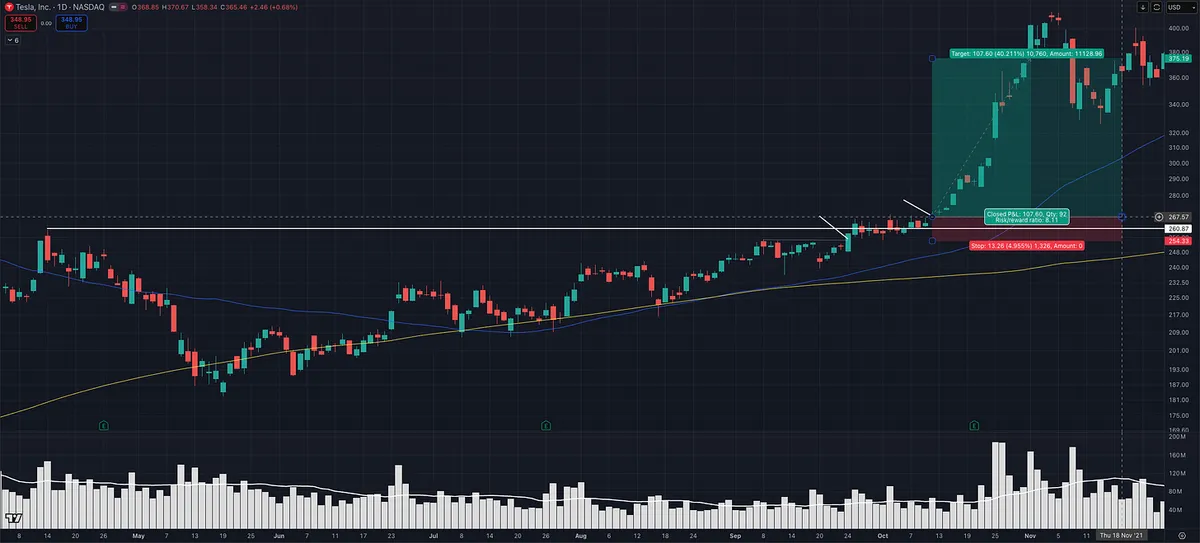
This TSLA example is a good illustration.

On the right side of the base, price was tightening and structure was clean. That created multiple opportunities where risk could be kept at 5 percent or less.

Recently (2025-2026), with many of the big winners already extended in Stage 2 uptrends, it’s a different environment.

If you’re only buying standard breakouts here, then yes, your stop likely needs to be 7 to 10 percent.

But that’s just one way to play it.

A lot of the big winners from 2025 to now in areas like computer data storage and telecom, names like LITE, SNDK, MU, CIEN, WDC, were harder to trade with tight risk using traditional breakout entries.

Their ADR% was higher, and there was less contraction into the pivot, so traders had to adapt.

Pullback entries. Low cheats. Intraday entries like ORB.

Those allow you to define risk much tighter and still participate without getting shaken out.

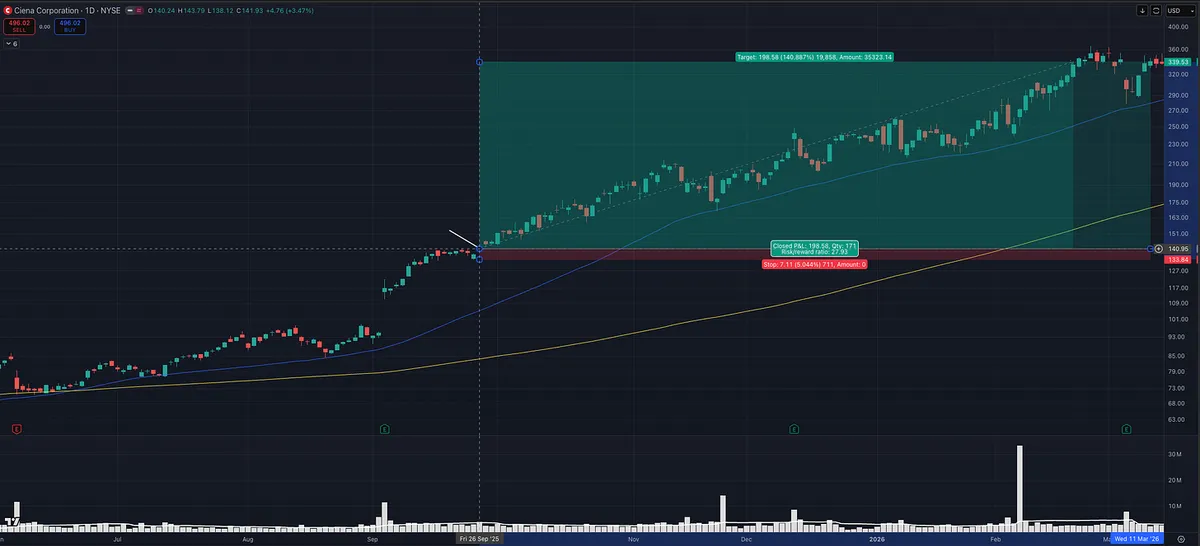
CIEN is another good example.

After an episodic pivot on earnings, price ran, then tightened sideways. That created a clean opportunity to enter with defined, tight risk.

This isn’t about forcing a fixed 5 percent stop on every trade.

It’s about finding entries with proven setups where tight risk actually makes sense.

Timeframe matters. Setup matters. Execution matters.

And just like Minervini, I’m not rigid with it.

Some trades might be 3 percent risk. Some 5 percent. Some 6 to 8 percent depending on the setup.

I’ll even go up to 10 percent and adjust position size, but I prefer tighter risk when the setup allows it.

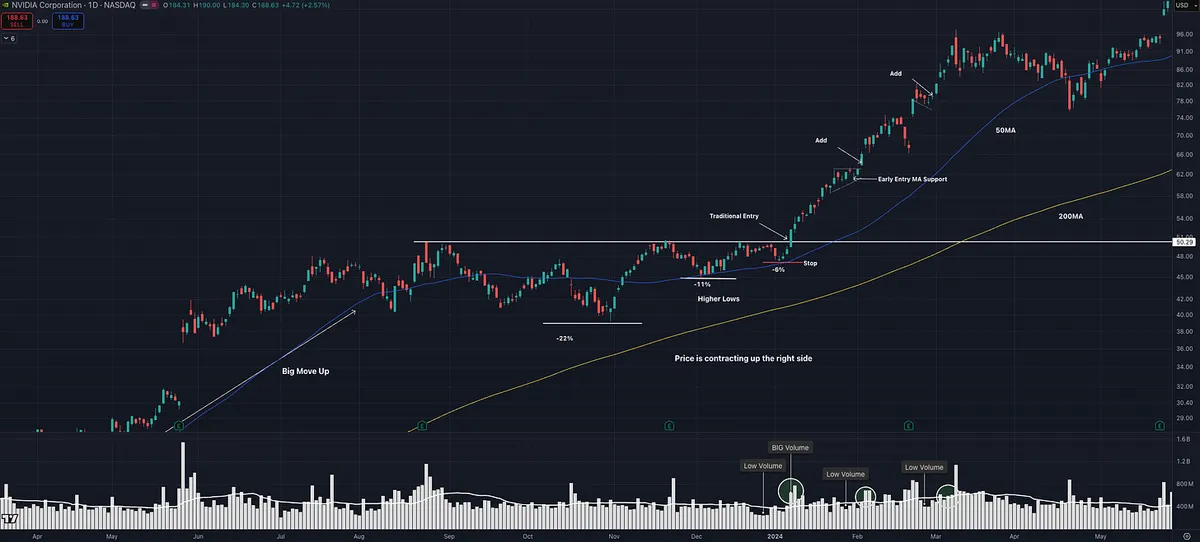
Another good example is NVDA in 2024. I had about 6 percent risk. Someone else could have taken the same trade and used the breakout day opening range low as a stop and risked closer to 1.82 percent and likely wouldn’t have been stopped out.

Like David Ryan often emphasizes, the best trades tend to be hard to buy, work right away, and don’t look back.

The principle stays the same.

Keep losses small. Don’t let one trade do real damage.

And at the end of the day, we all trade differently and that’s ok.

That’s what makes a market.

Different styles can still make money.

View on Substack ↗

The One Rule That Changed Minervini’s Entire Trading Career

Most traders spend all their time trying to find the perfect entry.

They think that’s where the money is made.

It’s not.

In Stock Market Wizards, Mark Minervini said:

“Containing your losses is 90 percent of the battle.”

Read that again.

Not entries. Not stock picking. Not indicators.

Losses.

When Minervini studied his results, he didn’t find that his winners were the problem.

He found that his losers were.

Big losses were doing all the damage.

Cutting those losses didn’t hurt his performance.

It transformed it.

Over a large sample of trades:

A -5% loss is nothing.

A -6% loss is nothing.

A -7% loss is nothing.

They are just business expenses.

But one -25% or -30% loss?

That wipes out multiple winning trades.

That’s what keeps traders stuck.

Most traders think:

“If I cut my losses tight, I’ll miss the big winners.”

Reality:

The best stocks don’t need a lot of room.

They work quickly.

They show strength early.

And if they don’t?

You’re probably wrong.

The difference between average traders and elite traders is simple:

They refuse to take big losses.

They keep every loss small and controlled.

And over time, that one decision compounds into massive performance.

You don’t need to be right all the time.

You just need to make sure when you’re wrong, it doesn’t matter.

View on Substack ↗

You Can Be Right… And Still Blow Up Your Account

The dangerous illusion that destroys even elite traders

Let me ask you something…

Have you ever had a trade where your analysis was perfect… but you still lost money?

Not a small loss.

A painful one. The kind that sticks with you.

If you study Market Wizards, you’ll notice a pattern that shows up again and again.

The big drawdowns. Some of their worst years. The trades they regret the most.

They didn’t come from being wrong.

They came from being right… at the wrong time.

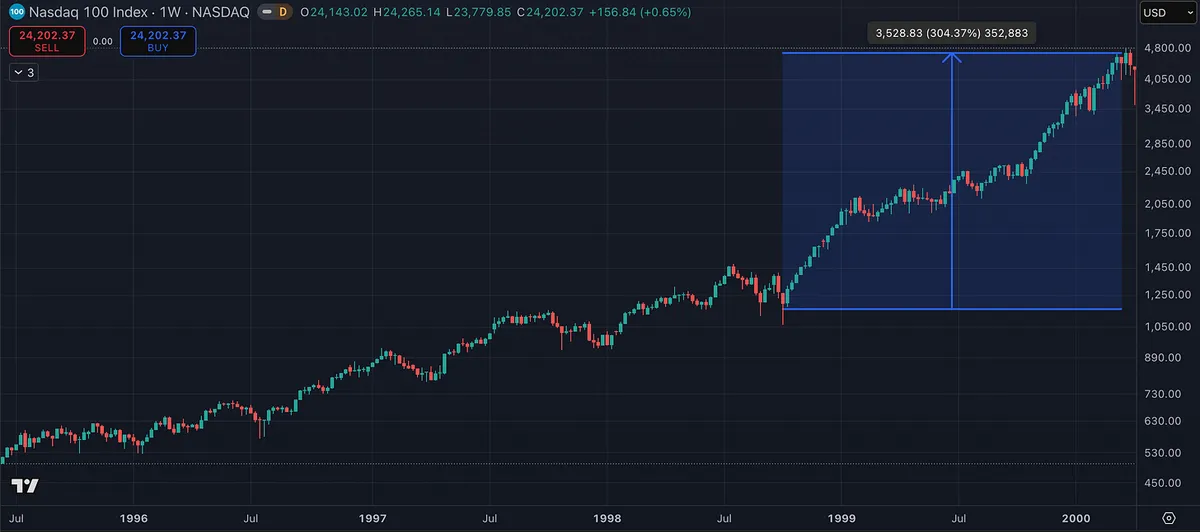
Traders saw the late 90s tech bubble forming.

The analysis was solid.

Valuations were insane. Sentiment was euphoric. The logic checked out.

And yet…

They got crushed.

Why?

Because price kept going higher and they fought it.

They argued with the market.

They were early.

And in trading, being early is the same as being wrong.

This is where most traders break.

You do the research. You build conviction. You feel certain.

And that certainty becomes your biggest mistake.

Remember, the market does not care about your thesis.

It only respects timing and risk.

There’s a principle echoed across almost every top trader:

You can be right on direction and still lose money.

That’s why traders that align with many of the market wizards I write about obsess over one thing:

Risk management.

Because once you understand this, everything changes:

• You stop trying to prove you’re right

• You start reacting to what price is actually doing

• You accept small losses quickly instead of defending bad positions

• You time entries where risk is defined and controlled

And most importantly…

You stop arguing with price.

This is how you survive and build a long career.

Not intelligence. Not research. Not conviction.

But instead managing risk through executing with proper position sizing and timing.

The market will always do one thing better than you:

Stay irrational longer than you can stay solvent.

So the next time you feel certain…

Ask yourself one question:

Am I managing risk…

Or am I trying to be right?

View on Substack ↗

Trading and Entrepreneurship Follow the Same Playbook

Most people think trading is about predicting.

It’s not.

It’s about testing.

Great entrepreneurs don’t wait for certainty. They move with conviction, knowing they could be wrong. Even someone like Jeff Bezos didn’t know which ideas at Amazon would become massive winners. They tested constantly. Many failed. A few changed everything.

That’s exactly how we operate as traders.

We’re not here to be right 100% of the time. That’s impossible.

We’re here to:

• Test ideas with real capital

• Cut losses quickly when we’re wrong

• Add when something proves itself

• Let the real winners run

Our strategy is built on what has worked for decades, but even then, no individual trade is guaranteed to be a winner.

The market decides what works.

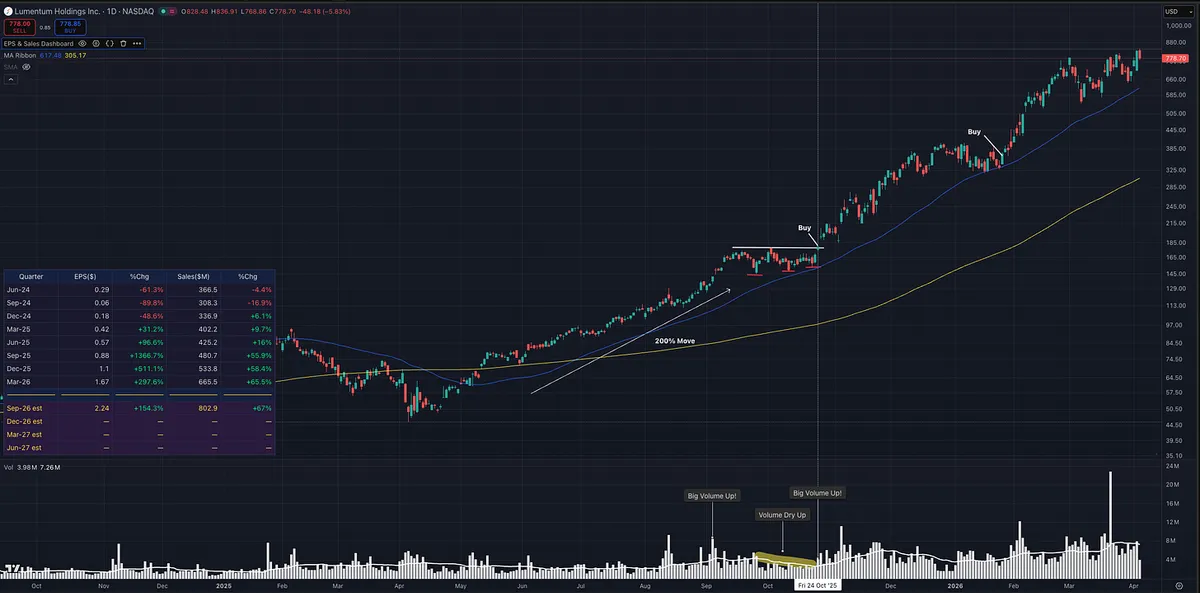
For example, those of you who are paid subscribers heard me talking about LITE back in January, and it has gone up over 125% since then. But here is the honest truth. It was one of many names I was looking at and trading.

There were plenty of other stocks with big earnings, strong sales, and high relative strength just like LITE that did not move.

The difference is simple.

I cut the losers and added to the ones that worked.

I will even continue trading that same name off and on until it clearly shows the move is over.

Just like in business, you don’t go all in on every idea. You place small, calculated bets, watch what gains traction, and then press your advantage when something starts working.

In fact, this is even more important in trading. In business, you can take action to influence outcomes. In the market, you cannot. Once you enter a trade, the market is in control.

So start treating trades like a series of small tests, and let the market tell you which ones deserve more capital.

Cut losers. Press winners.

Whether you're building a company or trading stocks, the principle is the same.

View on Substack ↗

Why Keeping Losses Small Is Everything

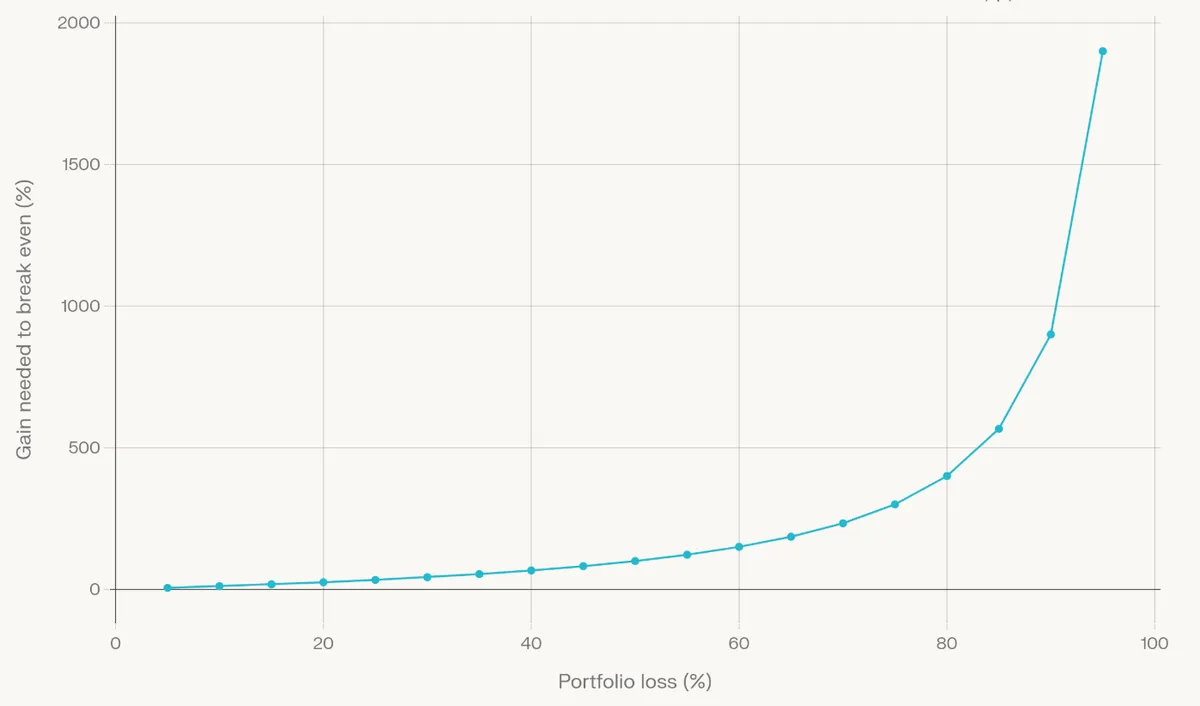
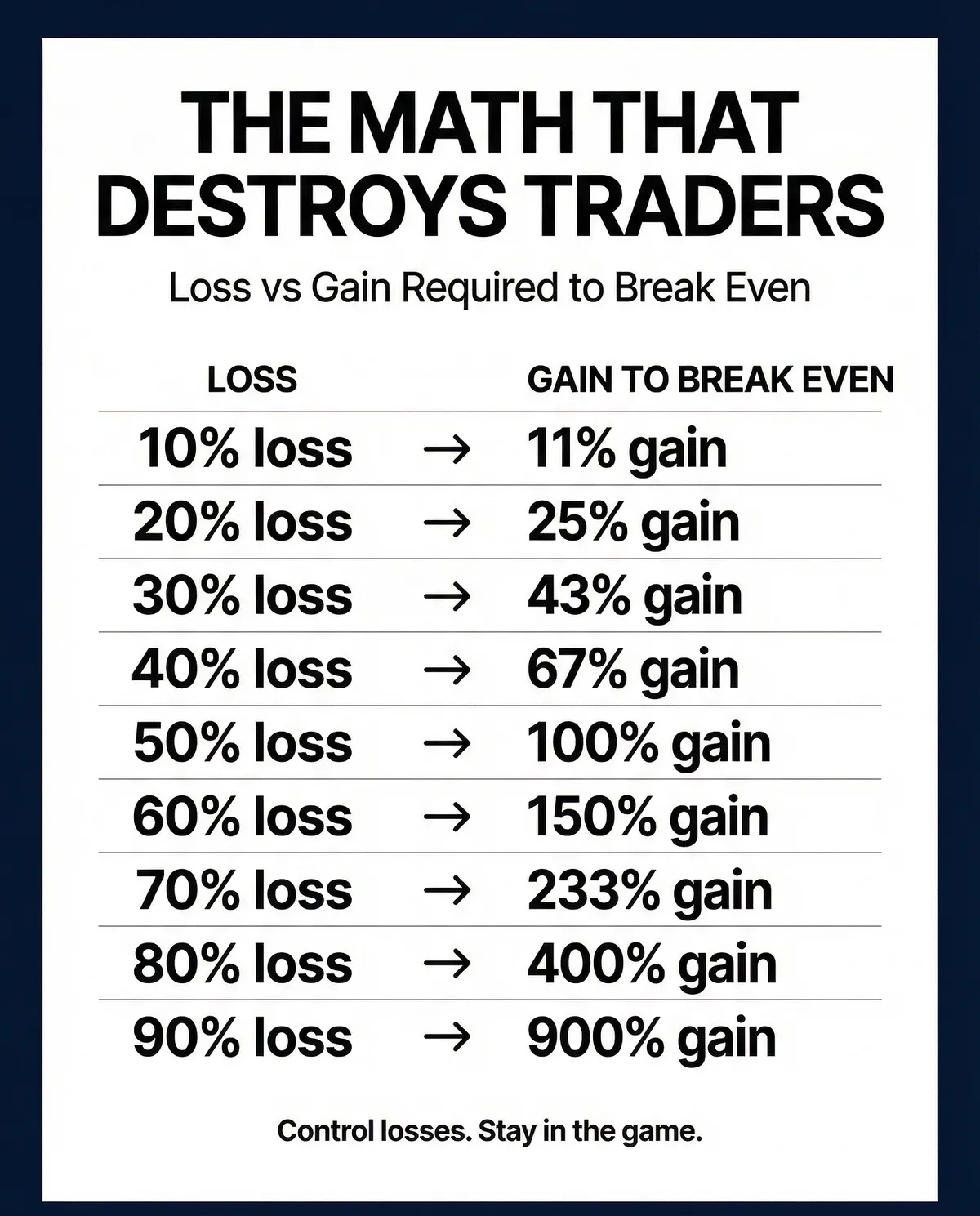
Because the math of recovery is brutal

A 50% loss isn’t just painful.

It’s mathematical damage.

William O’Neil said:

"In the 2007–2009 bear market, the S&P 500 fell 58%, meaning that a 140% rebound will be needed for the index to fully recover. And how easy is it for you to make 100%? Maybe it’s time for you to learn what you’re doing, adopt new rules and methods, and stop doing things that create 50% losses."

Most people read that and move on.

But this is where everything changes.

The market does not punish you with losses. It traps you with recovery.

Because the deeper the loss, the harder the climb.

Down 50%? You need 100% just to get back. Down more? Most never make it.

And yet traders do the same things over and over:

They hold and hope. They average down. They ignore sell rules.

They turn manageable losses into account damage.

This is not a strategy problem.

It is a discipline problem. Or a lack of understanding.

The best traders understand one thing early:

They cut losses fast. They protect capital. They stay in the game.

Because once you are down big, the math is no longer on your side.

Maybe it is time to stop doing the things that create 50% losses.

And start doing the things that prevent them.