
“If you have a losing position that is making you uncomfortable, the solution is very simple: Get out, because you can always get back in. There is nothing better than a fresh start.”
- Paul Tudor Jones
Notes
Risk Management & Position Sizing
Notes whose main point is limiting losses and deciding how much to buy and how much to risk on each trade.
Showing 81–100 of 224 notes
“Don’t increase your position size until you have doubled or tripled your capital. Most people make the mistake of increasing their bets as soon as they start making money. That is a quick way to get wiped out.”
-Marty Schwartz
“I have two basic rules about winning in trading as well as in life:
1. If you don’t bet, you can’t win.
2. If you lose all your chips, you can’t bet.”
- Larry Hite
The Diversification Myth Most Stock Pickers Still Believe
The mainstream financial media has preached diversification for decades.
Most stock pickers still believe it without question, even though most of them fail to keep up with the major indexes.
Warren Buffett, one of the greatest value investors of all time, said:
“Diversification is protection against ignorance. It makes little sense if you know what you are doing.”
William O’Neil, one of the greatest growth stock investors of all time, said:
“Broad diversification is plainly and simply often a hedge for ignorance.”
Think about that.
Buffett was a value investor.
O’Neil was a growth stock investor.
Completely different styles.
Same conclusion.
If your goal is superperformance, most of the greats did not get there by owning everything.
They got there by being selective.
By knowing exactly what they were looking for.
By concentrating when the opportunity deserved it.
By cutting losses when they were wrong.
And by letting their true winners actually matter.
That does not mean reckless concentration.
Reckless concentration is buying a few random stocks with no rules, no sell discipline, and no idea where you are wrong.
That is gambling.
Intelligent concentration is different.
Buffett did it through business quality, valuation, and waiting for exceptional opportunities.
O’Neil did it through earnings growth, sales growth, relative strength, institutional demand, price and volume, and strict sell rules.
Even systematic traders like Ed Seykota were not randomly spreading money everywhere just to feel safe.
They followed a tested edge, managed risk, cut losses, and let winners run.
That is the common thread.
The herd says own more.
The greats say concentrate wisely.
If you want diversification, make it simple. Own the index ETF.
If you are trying to achieve superior performance picking individual stocks, diversification is often NOT the answer.
It is often evidence that you do not have a real process yet.
Focus on the similarities among the greats.
That is usually where the real rules and golden nuggets are found.
Calling Yourself an Investor Does Not Remove the Risk
A lot of people believe investing is automatically safer than trading.
That is not necessarily true.
What often happens is someone fails at trading, pushes out their timeframe, stops using stops, and starts calling themselves an investor.
Now instead of taking a small loss, they are “holding for the long term.”
Instead of admitting the trade failed, they convince themselves they own a great company.
Instead of following a process, they hide behind a label.
There is nothing wrong with passive investing.
If someone does not want to trade, I completely understand buying broad market ETFs like SPY or QQQ and passively investing into the major indexes over time.
That is very different from buying individual stocks with no rules.
Individual stocks are not the same as owning the market.
A single company can break down.
A former leader can lose institutional support.
A growth story can slow.
A stock can go sideways for years.
A stock can decline 50%, 70%, or 90% and never come back.
So if you are going to buy individual stocks, even on a longer timeframe, you still need a system.
You need to know when you are wrong.
You need rules for cutting losses.
You need rules for letting winners run.
You need a process for separating normal volatility from real deterioration.
That is why so many “investors” underperform the market.
They are not really investing with a disciplined strategy.
They are just holding stocks and hoping time fixes bad decisions.
When you read Market Wizards, you see traders and investors with different styles, different timeframes, and different methods.
But almost none of them are simply buying individual stocks, holding them for years, ignoring losses, and operating with no exit plan.
They have rules.
They manage risk.
They protect capital.
They understand that being on a longer timeframe does not eliminate the need for discipline.
Calling yourself an investor does not make individual stock risk disappear.
If you do not have a plan to cut losses and let winners run, you do not have a safer strategy.
You just have a slower-moving mistake.
Making Money Is Not the Hard Part
Bernard Baruch made his fortune in the market long before the Roaring Twenties.
He was also one of the classic market operators William O’Neil studied and learned from while developing his own approach to growth stock investing.
And in Baruch: My Own Story, he gave one of the most important lessons every trader eventually has to learn:
“It’s one thing to make money, and another thing to keep it. In fact, making money is often easier than keeping it.”
That is the part most traders underestimate.
In a strong market, almost everyone can look smart.
Stocks are breaking out. Leadership is expanding. Your watchlist is working. Your account is moving higher. You start thinking the money came only from your skill, when sometimes it came from the environment.
But keeping it?
That requires a completely different level of discipline.
Can you reduce exposure when the tape changes?
Can you stop pressing after a big run?
Can you sit in cash when there is no edge?
Can you avoid turning a great month into a round trip?
That is why the old masters obsessed over risk.
Baruch understood it. Livermore learned it the hard way. Loeb wrote about it. O’Neil built rules around it.
The goal is not just to make money in a good market.
The goal is to keep enough of it that you are still around when the next great opportunity shows up.
Because the market will always offer another chance.
But only to the traders who protected their capital.
Same Trades. Same System. Completely Different Outcome.
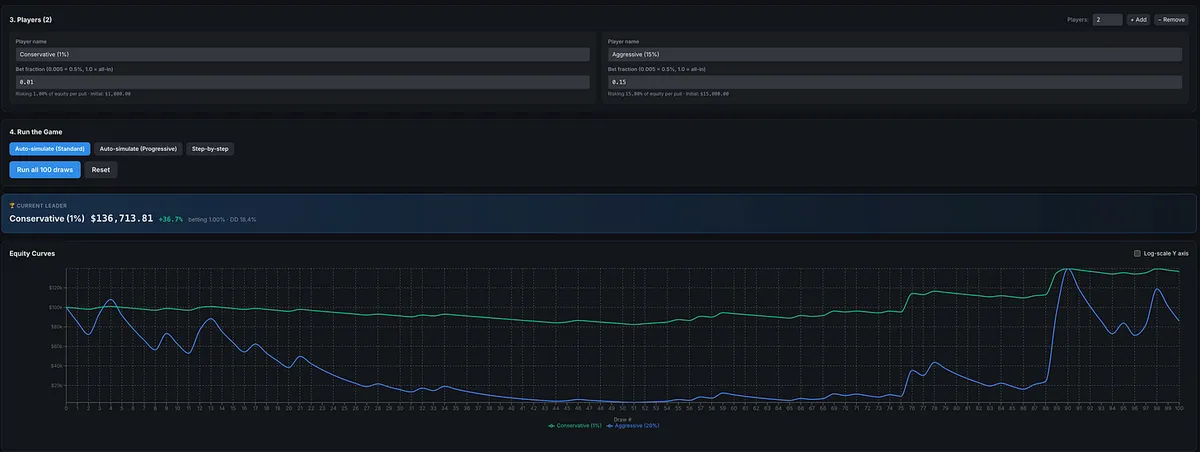
I don’t think most traders truly understand how much position sizing can change their results.
Look at this example.
Two traders take the exact same 100 trades.
Same entries.
Same exits.
Same positive expectancy system.
Same 35% win rate.
The only difference is position sizing.
One risks 1% of equity per trade.
The other risks 15% of equity per trade.
The 1% risk model finishes up 36.7%.
The 15% risk model finishes down -14.1% and experiences a 97% max drawdown.
That is not because the system failed.
That is not because the entries failed.
That is not because the trader needed a better indicator.
The system had a positive expectancy. The winners were larger than the losers. The edge was there.
But the sizing changed everything.
Dr. Van Tharp spent a huge amount of time teaching this concept because position sizing is not some minor detail you add at the end of your strategy. It is one of the key pieces that determines whether your system can actually help you reach your objectives.
A trader can have a positive expectancy system and still destroy the account by betting too aggressively.
This is a drastic example, but it is exactly why many traders need to spend a lot more time understanding position sizing, R-multiples, risk per trade, drawdowns, and how much volatility their account can actually survive.
Most traders obsess over entries.
Van Tharp would tell you the real question is not just what to buy or where to enter.
It is:
How much?
Because two traders can take the same trades and end up with completely different outcomes.
That is exactly why I spent so much time on position sizing inside Module 6: Risk Management & Position Sizing of the Momentum Trading Strategy Course.
Don’t Be One of Them
William O’Neil once said:
“I’ve known at least a dozen educated and otherwise intelligent people who were completely wiped out solely because they would not sell and cut a loss.”
Don’t be one of them.
Most traders do not fail because they are unintelligent. Many fail because they cannot do the one thing every great trader eventually learns to do:
Accept being wrong.
Cut the loss.
Move on.
The Loss Happened Before You Sold
One of the biggest mental traps in trading is thinking a loss is not real until you sell.
But that is not true.
If you bought a stock at $60 and it is now trading at $48, you already have the loss.
Selling does not create the loss.
Selling only converts the position back to cash.
The loss happened when the stock dropped.
This is where a lot of traders get trapped.
They say things like:
“I do not want to take the loss.”
“I will wait until I get back to breakeven.”
“It cannot go much lower.”
But the market does not care where you bought.
The stock does not know your entry price.
And hope is not a strategy.
Every big loss started as a small paper loss.
That is the part traders need to fully understand.
A small paper loss is still a loss.
A large paper loss is still a loss.
The only difference is whether you are willing to admit it while the damage is still manageable.
One of the best questions you can ask yourself is:
If I did not already own this stock, would I buy it today?
If the answer is no, then why am I still holding it?
That question forces honesty.
Because once you are in a losing position, it becomes harder to think clearly. You start defending the stock. You start defending your original decision. You start looking for reasons to hold instead of objectively asking whether the trade still deserves your capital.
The professional does not wait for a paper loss to become a disaster.
The professional treats every loss as real, cuts it when the trade is no longer working, and moves back to cash where they can think clearly again.
That is how you stay in the game.
You Don’t Pick the Big Winner. Your Process Finds It.
Here is something many beginners do not understand.
You can have a real strategy.
You can have a proven method.
You can know exactly what you are looking for.
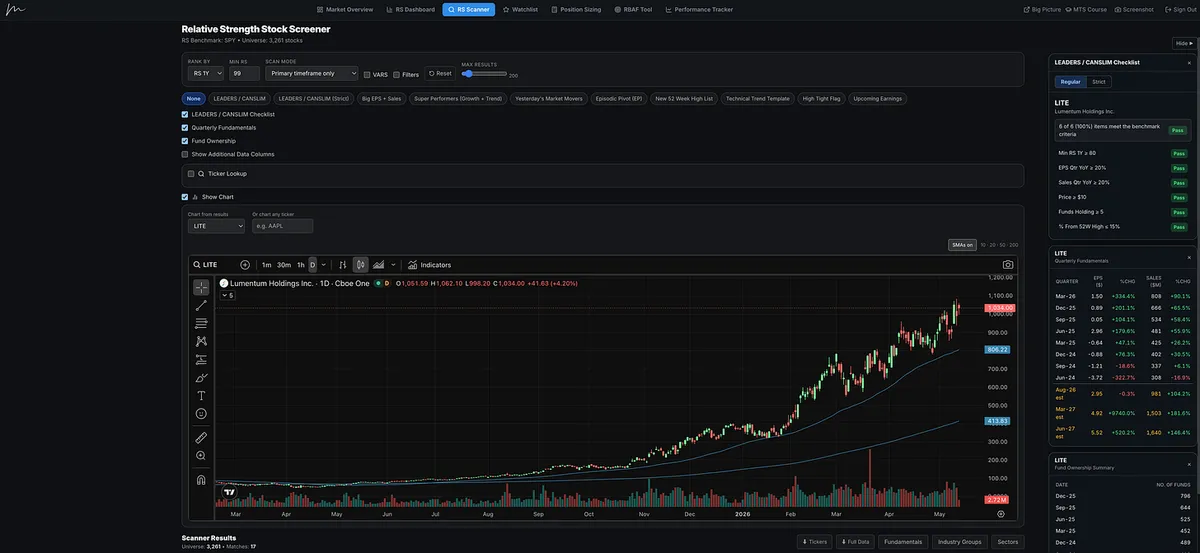
And still, to find the big winner, you may have to take 10 qualified trades.
Six or seven may end up as small losses or break-even trades.
One or two may be average winners.
And then one may turn into something like SNDK or LITE.
That is the part most people miss.
The big winner usually does not announce itself in advance.
At the time of entry, it is just another name that fits the process.
That is why I do not get obsessed with any single stock.
I do not fall in love with the story.
I do not assume this has to be “the one.”
LITE was a big winner for me, but I did not know at the time it was going to be one of the one or two out of ten that really worked.
That is not how this game usually works.
Sometimes you know you have something special early, but most of the time you don’t.
Your job is not to predict with certainty which one will be the monster.
Your job is to follow the process, cut the ones that do not work, and stay with the ones that do.
That is why process beats obsession.
The beginner wants to know which stock is going to be the big winner.
The professional knows the big winner will reveal itself over time.
The Secret Is Losing Small
William O’Neil said it best:
“The whole secret to winning big in the stock market is not to be right all the time, but to lose the least amount possible when you’re wrong.”
That is the game.
If you are taking 20% to 25% gains, then 7% to 8% losses keep the math in your favor.
But in a weaker market, where the best stocks may only give you 10% to 15%, even a normal 7% or 8% loss may be too much.
That is why O’Neil said he would cut every loss at 3%, with no exceptions.
The risk has to match the reward.
The loss has to match the environment.
You do not need to be right all the time.
You need to make sure your losses stay small enough that your winners still matter.
You Do Not Need to Be Right All the Time
“If a speculator is correct half of the time, he is hitting a good average. Even being right 3 or 4 times out of 10 should yield a person a fortune if he has the sense to cut his losses quickly on the ventures where he has been wrong.”
-Bernard Baruch
The Market Wizards Lesson Most Traders Ignore
If you’re wondering why I put so much emphasis on risk management and position sizing, it’s because when you study the traders in Market Wizards, that is one of the few themes almost everyone seems to agree on.
Entries matter.
Stock selection matters.
Market direction matters.
BUT if you cannot manage risk, size positions correctly, and survive the inevitable losing streaks, none of the rest matters for long.
William Eckhardt, the mathematician and legendary futures trader who worked with Richard Dennis and helped develop the famous Turtle Trading experiment, said it clearly when asked what he would do differently if he were starting out again:
“I would concentrate more on money management. To my regret, it was something that I ignored in my early years. Ironically, even though money management is more important than the price model, mathematically, it’s the more tractable problem.”
He also said:
“You shouldn’t plan to risk more than 2 percent on a trade.”
That is why risk management is not some side topic.
It is the foundation.
A trader can have great ideas and still fail if the position size is wrong.
A trader can have a real edge and still blow up if the risk is too large.
The goal is not just to find winning trades.
The goal is to stay in the game long enough for your edge to compound.
The Game That Shows Why Good Trading Strategies Still Fail
A good trading strategy can still fail if the position sizing is wrong.
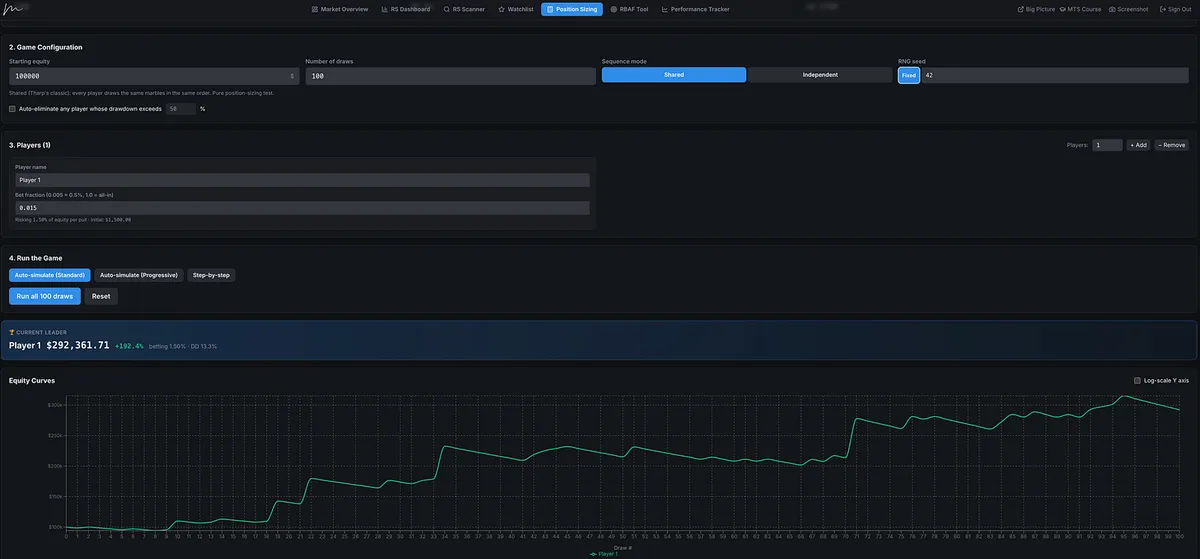
That is the lesson behind Dr. Van Tharp’s Marble Game.
Same system. Same trades. Same winners and losers.
Different position sizes can create completely different outcomes.
One trader compounds steadily. One trader barely grows. One trader goes through a drawdown they would never survive in real life.
I just posted a short article and video walking through how to use the Marble Game inside the Momentum Trading Strategy app, including fixed sizing, progressive exposure, drawdown limits, and how to think about risk in a way that actually fits your trading style.
Hope this helps explain the tool and why position sizing is one of the most important parts of long-term performance.
https://tradingmomentum.substack.com/p/the-position-sizing-game-that-shows
The Market Does Not Pay You for Being Right
Have you ever noticed how badly people want a high win rate trading strategy?
They want to be right.
They want to call the market correctly.
They want to post the perfect chart, nail the exact bottom, predict the breakout, and prove they saw it coming.
The easy answer is ego.
But I think it goes much deeper than that.
Most of us were trained from childhood to believe that being right is the goal.
In school, the kid who gets the most answers right gets the A.
The kid who gets the A gets praised.
The kid who gets the lower grade feels behind, embarrassed, or less capable.
So during some of the most formative years of our lives, we are conditioned to believe this:
More right answers equals more success.
But business, investing, and trading do not work that way.
In the real world, success often comes from being wrong over and over again, while making sure the few times you are right more than pay for the times you were wrong.
Look at Amazon.
The ideas everyone sees today are the winners.
But behind those winners were hundreds, maybe thousands, of tests, experiments, failed ideas, and things that never worked.
The public sees the outcome.
They do not see the graveyard of failed attempts that made the outcome possible.
The same thing happens in venture capital.
Some of the best investors in the world can be wrong on most of their investments.
They know many startups will fail.
They know some will go nowhere.
They also know they do not need to be right on all of them.
They just need the few big winners to pay for everything else.
That is the part most traders never fully absorb.
You do not need to be right all the time.
You need a positive expectancy.
You need risk management.
You need asymmetry.
You need the emotional ability to take a loss without turning it into an identity crisis.
And that is where most people struggle.
Because they are not just fighting the market.
They are fighting years of subconscious programming that says being wrong equals failure.
But in trading, being wrong is not failure.
Being wrong is data.
Being wrong is feedback.
Being wrong is part of the cost of finding the few trades that actually matter.
A baseball player can strike out most of the time and still be one of the best hitters in the world.
A venture investor can miss on most companies and still build a legendary track record.
A trader can have a 35% or 40% win rate and still compound capital if the winners are meaningfully larger than the losers.
But to accept that, you have to think differently.
You have to stop needing every trade idea to validate your intelligence.
You have to stop needing the market to prove you were right.
You have to stop treating every stopped-out trade like a personal insult.
This is why trading psychology matters.
This is why risk management matters.
This is why expectancy matters.
Because the market does not reward the person who needs to be right.
It rewards the person who can be wrong small, stay emotionally neutral, and keep showing up for the few big opportunities that pay for everything.
Most people are not missing the “secret” trading strategy.
They are missing the mindset required to actually follow one.
The hardest part is not finding a setup.
The hardest part is becoming the kind of person who can take losses without falling apart, stay patient without forcing trades, and let the math work without needing constant emotional validation.
That is why low win rate trading strategies are so hard for most people.
Not because they do not work.
But because they require you to unlearn the belief that being right is the same thing as being successful.
In trading, the goal is not to be right.
The goal is to make money when you are right and survive when you are wrong.
Same Strategy. Different Bet Size. Wildly Different Results.
Dr. Van Tharp taught a game called the marble game.
The idea is simple, but the lesson is massive.
You have a trading strategy, represented by 100 marbles.
In this example, the system has a 35% win rate.
Out of 100 trades:
65 are losers at -1R
15 are winners at +1R
7 are winners at +2R
6 are winners at +3R
3 are winners at +5R
2 are winners at +10R
2 are winners at +20R
For anyone new to R multiples, +2R simply means you made two times what you risked.
This is very similar to how many trend-following and momentum strategies actually behave.
Lots of small losers.
Some average winners.
A few massive outlier winners that drive most of the returns.
But here is the catch.
Before you randomly draw the marbles, you have to choose your position size.
You do not know what order the trades are coming in.
Just like real trading.
Everyone can have the exact same strategy, but the only thing they control is how much they risk per trade.
And that one decision can completely change the outcome.
One trader may make very little because they are too conservative.
Another trader may go bust because they are betting too big.
And for every strategy, there is usually a sweet spot where the position sizing works best for the expectancy of the system.
That is why I built this into the Momentum Trading Strategy App.
I wanted to take Van Tharp’s marble game and make it something traders could actually simulate, study, and learn from.
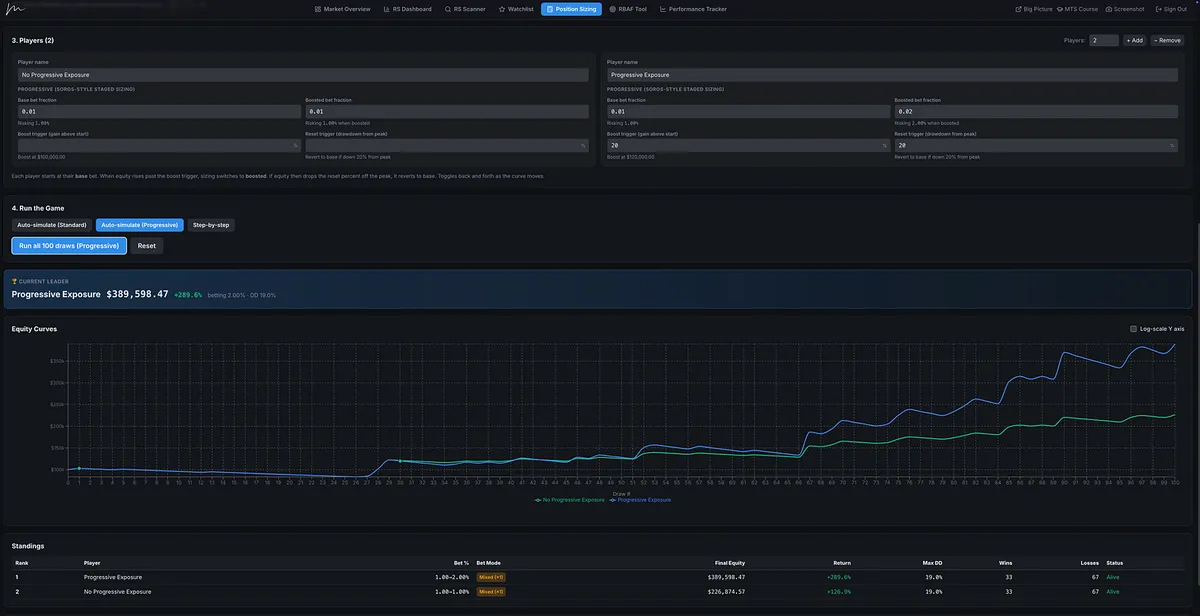
In this example, both traders started by risking 1% of equity per trade.
The first trader kept risking 1% the entire time.
They still did extremely well.
After 100 simulated trades, they were up 126%, with a max drawdown of 19%.
But the second trader used progressive exposure.
They also started at 1%.
But once they were up 20% from the starting equity, they increased risk to 2%.
If they later drew down 20% from their peak, they dropped back to 1%.
Same strategy.
Same trades.
Same draw sequence.
Different exposure rules.
The result?
The progressive exposure trader finished up 289%, with the same max drawdown of 19%.
That is the power of progressive exposure.
You press when the system is working.
You reduce when the equity curve starts moving against you.
This is why position sizing is not some boring side topic.
It can be the difference between underperforming, blowing up, or compounding intelligently.
The strategy matters.
But how you size the strategy matters just as much.
If you want to learn more about these tactics, I go much deeper inside Module 6 of the Momentum Trading Strategy Course: Risk Management & Position Sizing.
https://tradingmomentum.substack.com/p/momentum-trading-strategy-risk-management
The Math That Destroys Traders
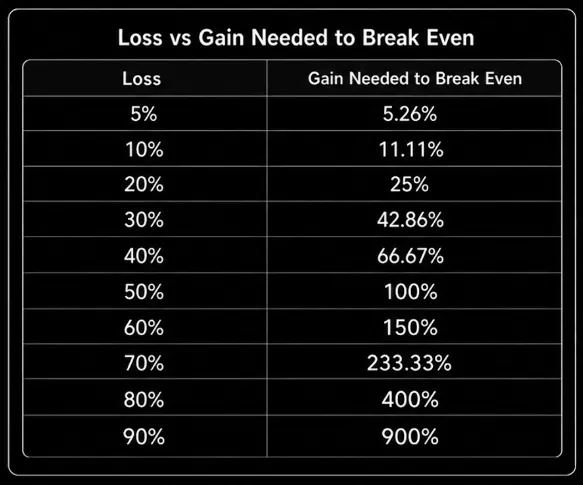
Most of you have probably seen this table before.
But the lesson is worth repeating:
Losses work geometrically against you.
A 10% loss requires an 11.11% gain to get back to break even.
A 20% loss requires a 25% gain.
A 40% loss requires a 66.67% gain.
A 50% loss requires a 100% gain.
And once drawdowns get large, the math starts working brutally against you.
If you have never seen this before and you are actively trading the markets, this is something you should probably prioritize understanding ASAP.
But for those of you who already know this, the real question is:
What are you actually doing about it?
Do your position sizing rules help keep your drawdowns from getting too large?
Does your strategy account for losing streaks?
Are you managing risk in a way that keeps you from needing a massive gain just to get back to break even?
Because knowing this table is not enough.
A lot of traders understand the concept, but their actual execution does nothing to prevent the big losses this table warns about.
And I am not just talking about individual trades.
I am talking about your overall account.
If your account is down 40%, you now need 66.67% just to get back to break even.
That is a completely different problem than being down 10% or 15%.
This is why position sizing matters so much.
In many cases, you do not even have to change the strategy itself.
Same entries.
Same exits.
Same win rate.
Same average gain.
Same average loss.
But change the position size, and the drawdown profile can look completely different.
One version of the same strategy might experience a 10% to 20% drawdown over hundreds of trades.
Another version, with the position size too aggressive, might experience 40%, 50%, or 60% drawdowns.
Same strategy.
Different sizing.
Completely different experience.
Let that sink in.
If you do not understand this, you probably need to spend less time looking for the next hot stock and more time learning how position sizing, drawdowns, and risk management actually work.
This is exactly why I paused doing what I honestly enjoy most to create the Momentum Trading Strategy Course.
I’ll be honest, I do not enjoy making this thing as much as I enjoy tradings, writing about trading, screening for and sharing stocks, and sharing ideas.
It has been a lot harder and more time-consuming than I expected.
But I realized something:
No matter how many strong stock ideas I share, many people will still lose money if they do not have the foundation.
They need to understand position sizing.
They need to understand drawdowns.
They need to understand risk management.
They need to understand trade planning.
They need to understand how to survive the losing streaks that every trader eventually goes through.
So I built the course to teach that foundation.
Then I realized something else:
A lot of people also do not have the tools to actually apply it.
So I built the Momentum Trading Strategy Web App to bring everything together in one place.
Big picture market analysis.
Stock screening.
Finding relative strength and leadership.
Position sizing tools.
Trade planning templates.
Trading journal.
Performance analytics.
Trade review.
The goal is to connect what you learn in the course with the tools needed to actually apply it.
Because finding winners is only one part of trading.
Surviving long enough to benefit from them is the part most traders underestimate.
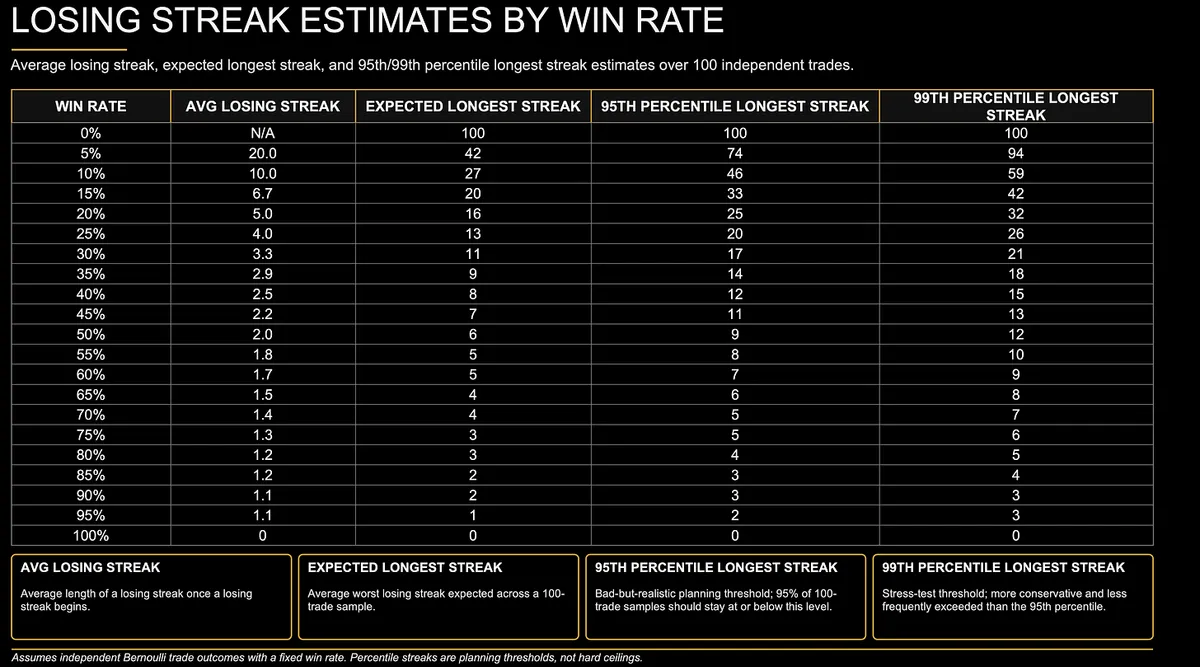
A 50% Win Rate Does Not Mean Win, Loss, Win, Loss
This is one of the biggest misconceptions in trading.
A lot of traders hear “50% win rate” and subconsciously assume the results will show up like this:
Win.
Loss.
Win.
Loss.
Win.
Loss.
But that is not how probability works.
Even with a 50% win rate, you can still run into six, seven, eight, or even nine losses in a row over a large enough sample.
That does not automatically mean the strategy is broken.
It means losing streaks are normal.
The problem is most traders do not plan for them.
They build their risk around the trade they want to win, not the losing streak they are almost guaranteed to experience.
That is where proper position sizing matters.
Position sizing is not just about maximizing returns.
It is about staying alive long enough for your edge to play out.
Because if your system cannot survive a normal losing streak, it does not matter how good your setups are.
It is only a matter of time before one bad sequence takes you out.
This is why I spend so much time on risk management and position sizing in Module 6 of the Momentum Trading Strategy course.
You do not manage risk because you are scared.
You manage risk because losing streaks are part of the game.
Plan for them before they happen.
How to Get Bigger Size Without Taking Bigger Risk
Bruce Kovner said:
“Whenever I enter a position, I have a predetermined stop. That is the only way I can sleep. I know where I’m getting out before I get in. The position size on a trade is determined by the stop, and the stop is determined on a technical basis. For example, if the market is in the midst of a trading range, it makes no sense to put your stop within that range, since you are likely to be taken out. I always place my stop beyond some technical barrier.”
That is one of the most important ideas in trading.
Your stop should not be some random percentage that makes the math look clean.
Your stop should come from the chart.
Where does the trade stop making sense?
Where would the market prove you wrong?
Where is the technical barrier?
That is where the stop belongs.
Then your position size is built around that risk.
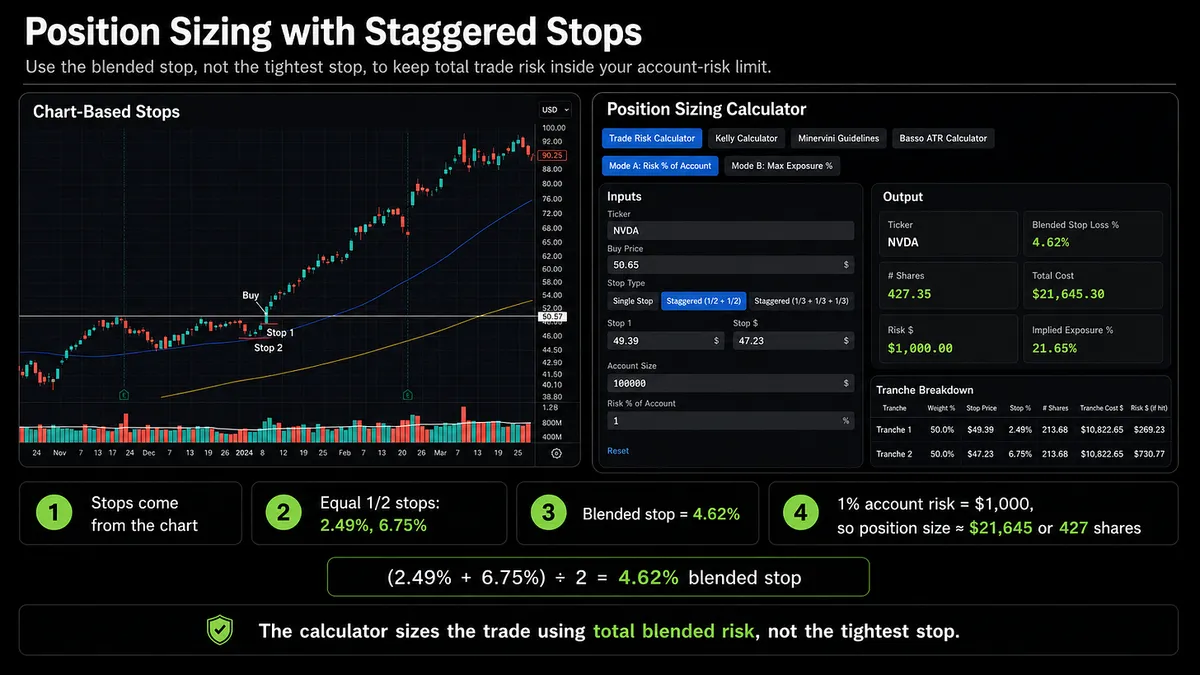
In this example, the standard daily/weekly chart stop is under the prior higher low.
That is Stop 2, about 6.75% below the entry.
If you risk 1% of a $100,000 account using that single stop, your position size would be around 292 shares.
The setup is lining up on multiple timeframes, and it has many of the characteristics you want to see in an A+ setup:
Strong daily and weekly breakout.
Tightening price action.
VCP-style contraction.
Big earnings and sales.
A hot industry group aligned with the bull market theme.
High relative strength.
Then you see an opportunity to use the intraday chart to enter with more precision, similar to how traders like Kristjan Kullamägi and Dan Zanger have done with Opening Range Breakouts (ORB).
In that case, you can use a staggered stop.
Your first stop could be the opening range low.
Your second stop could still be the deeper daily/weekly chart stop.
Half the position uses the tighter intraday stop.
Half the position uses the wider daily/weekly stop.
Same 1% account risk.
More efficient position sizing.
In this example, instead of risking 6.75% on the full position, the blended stop is 4.62%.
So with the same 1% account risk, the position size goes from roughly 292 shares to 427 shares.
That is the power of combining multiple timeframes with proper position sizing.
You are not taking more portfolio risk.
You are using a tighter, more precise entry to increase size while still respecting the deeper chart structure.
This is not something you do randomly.
It is for higher-conviction setups where the stock has the right ingredients.
This is one of the position sizing strategies I cover in Module 6: Risk Management & Position Sizing inside the Momentum Trading Strategy course.
Because managing risk is not just about knowing where your stop is.
It is knowing how your entry, stop, position size, timeframe, and tools all work together.
The Most Boring Part of Trading Is Usually What Separates the Survivors From Everyone Else
Most traders want more charts, more stock picks, more setups, and more names to watch.
But when you study the Market Wizards, one principle keeps showing up across different styles, markets, and time frames:
Risk management.
Bruce Kovner was asked what advice he would give the novice trader.
His answer:
“Risk management is the most important thing to be well understood.”
Then he added the part most traders need to hear:
Most novice traders trade too big.
Whatever position size they think they should trade, they should probably cut it dramatically.
That is the part people skip.
Position sizing is not exciting.
Drawdowns are not exciting.
Losing streaks are not exciting.
Expectancy is not exciting.
But this is often the difference between a trader who survives long enough to compound and a trader who keeps starting over after every account-damaging drawdown.
There are endless charts online.
Endless opinions.
Endless stock ideas.
But very little practical education on how to manage risk, size positions, control exposure, handle losing streaks, and understand whether a strategy actually has positive expectancy.
That is exactly what Module 6 is about.
Risk management.
Position sizing.
Expectancy.
Drawdowns.
Losing streaks.
Portfolio exposure.
When to press.
When to get smaller.
When to move to cash.
I also added Dr. Van Tharp’s Marble Game and Optimal Sizing Calculator inside the Momentum Trading Strategy Web App, so traders can test different systems across win rates, gain/loss ratios, drawdowns, losing streaks, and position sizes.
Because knowing a strategy has an edge is not enough.
Position size can determine whether that edge compounds or eventually destroys the account.
Module 6 is now live for paid subscribers:
https://tradingmomentum.substack.com/p/momentum-trading-strategy-risk-management