Momentum Trading Strategy

Notes

Lessons from Legendary Traders

Notes built around one named market figure's own words or story, such as O'Neil, Livermore, Minervini, Seykota, Druckenmiller, Tudor Jones or other Market Wizards.

Showing 21–40 of 263 notes

View on Substack ↗

Nicolas Darvas: More Information Made Him a Worse Trader

In 1959, Darvas returned to New York after making over half a million dollars while trading abroad through cables.

He expected closer contact with the market to improve his results. Instead, he lost nearly $100,000 in a few weeks.

He watched the ticker, listened to rumors, absorbed other traders’ opinions, and abandoned his rules.

His conclusion:

“My ears were my enemy.”

He left for Paris and told his brokers to send only his usual daily telegram.

That was 1959. Today, the noise arrives through instant news, social media, and AI-generated analysis.

You can consume more information and become less capable of following your process. You can even use AI to hunt for a justification to ignore your own rules.

Before adding another opinion, ask whether it improves your decisions or simply increases your urge to trade.

Darvas had to leave New York to escape the noise. Today, we carry it in our pockets.

View on Substack ↗

Jesse Livermore: A Lower Average Can Become a Bigger Mistake

Jesse Livermore wrote in How to Trade in Stocks:

“Never average losses. Let that thought be written indelibly upon your mind.”

Then he explained the trap.

You buy 100 shares at $50. The stock falls to $47, so you buy another 100 shares to lower your average.

Your average cost improves to $48.50. But you now own twice as much of a stock moving against you.

If it falls to $44, the original shares lose $600. The additional shares lose another $300.

You “improved” your average and increased your loss to $900.

That is why averaging down can feel productive while making the situation worse. You focus on how little the stock needs to recover instead of how much more you stand to lose.

Livermore’s approach was to add as the trade moved in his favor. A losing first purchase was a reason to protect capital, not commit more.

You can always take a fresh entry if the setup returns.

View on Substack ↗

The 604% Fund That Taught William O’Neil to Buy High

One of William O’Neil’s biggest breakthroughs came from studying someone else’s trades.

O’Neil describes researching three leading mutual funds in January 1960. The Dreyfus Fund stood out because its gains were twice those of many competitors. He wanted to understand exactly what Jack Dreyfus was doing.

So he ordered the fund’s quarterly reports and prospectuses from 1957 through 1959, calculated the average prices paid for new holdings, and marked those purchases on stock charts.

After examining more than 100 purchases, O’Neil discovered:

“every stock had been bought at the highest price it had sold for in the past year.”

Those stocks had formed recognizable chart patterns before breaking into new highs. That combination helped shape O’Neil’s early buying rules.

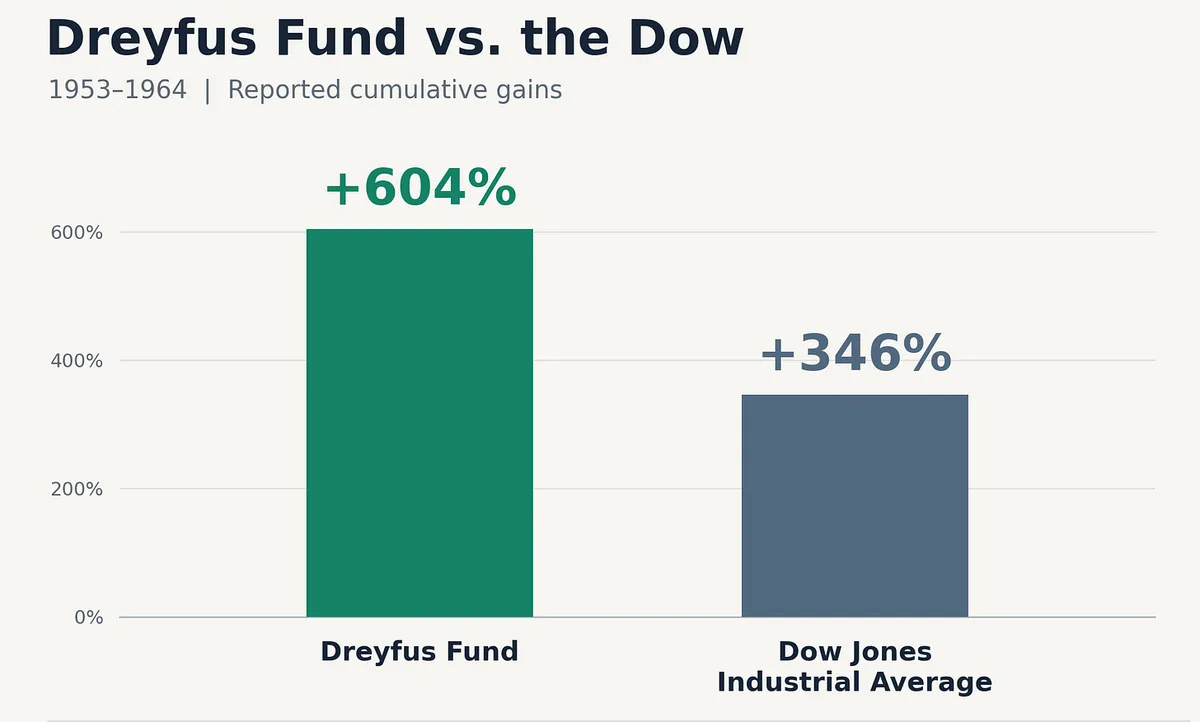
The results explain why he paid attention. From 1953 to 1964, the Dreyfus Fund reportedly returned 604%, compared with 346% for the Dow Jones Industrial Average. Historical reporting also puts its lead over the second-best fund at 102 percentage points.

And the research operation was remarkably simple. O’Neil describes three people recording daily price and volume for hundreds of stocks on oversized charts. He saw those charts himself when he visited Dreyfus’s New York headquarters. Strong quarterly earnings were another common feature of the stocks the fund bought.

Dreyfus also knew when to reduce exposure. He cut the fund’s stock holdings to less than half its assets in early 1957, ahead of the Dow’s roughly 20% decline from July to October. Buying strength went hand in hand with protecting capital.

This is one reason I keep encouraging traders to study the greats. O’Neil examined actual purchases, identified repeatable characteristics, and used that evidence to build his own rules.

Before you dismiss a stock as “too high,” remember what O’Neil found when he studied a fund that was beating the competition.

View on Substack ↗

David Ryan Went From $52K to $16K. Then Made 1,379% in 3 Years

David Ryan knew how to find great stocks.

That wasn’t his problem.

He turned $20,000 into $52,000, then watched the account collapse back to $16,000.

His biggest mistake?

He kept buying the right stocks at the wrong prices.

Ryan was chasing leaders 15% to 20% above proper buy points, getting caught in normal pullbacks, and staying aggressive when the market weakened.

Then he went back and studied his own trades.

That review changed everything.

From 1985 through 1987, Ryan went on to compound a 1,379% return and become a three-time U.S. Investing Champion.

My newest article breaks down exactly how the William O’Neil protégé approaches:

• Finding true growth-stock leaders

• Breakouts vs. pullback buys

• Precise entries

• Adding to winning positions

• Holding major winners

• Cutting failed trades quickly

• Reviewing mistakes so they stop repeating

👇 Read

https://tradingmomentum.substack.com/p/market-wizard-david-ryan-how-he-made

ArticleMarket Wizard David Ryan: How He Made 1,379% in Three Years
View on Substack ↗

What Livermore Really Meant by “Sitting”

A lot of traders know Jesse Livermore’s famous quote:

“It never was my thinking that made the big money for me. It always was my sitting.”

Most people interpret that as letting your winners run, and that is absolutely part of it.

But there is another side to Livermore’s “sitting” that gets overlooked.

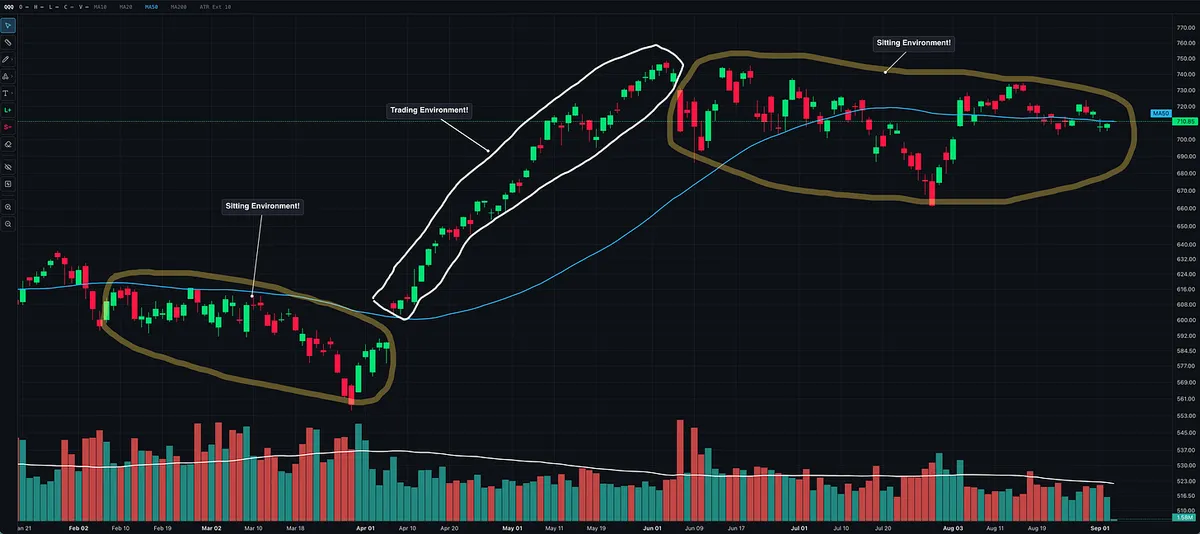
Sometimes sitting means not trading at all.

Not forcing trades when the market is choppy. Not overtrading because you are bored. Not buying something just because you feel like you should be doing something.

Livermore understood that real moves take time, and that a trader has to wait for the right conditions before committing capital.

That reminds me of one of my favorite quotes from Market Wizard Mark Weinstein:

“Although the cheetah is the fastest animal in the world and can catch any animal on the plains, it will wait until it is absolutely sure it can catch its prey. It may hide in the bush for a week, waiting for just the right moment. It will wait for a baby antelope, and not just any baby antelope, but preferably one that is also sick or lame. Only then, when there is no chance it can lose its prey, does it attack. That, to me, is the epitome of professional trading.” 

That is how I think about Livermore’s quote.

Sitting is not passive.

Sometimes it means sitting with a great winner.

Sometimes it means sitting in cash.

And sometimes it means sitting on your hands until the market finally gives you the trade you have been waiting for.

View on Substack ↗

Jesse Livermore Told You Who Would Lose Before He Told You How to Trade

Jesse Livermore did not open How to Trade in Stocks with a setup or a secret entry technique.

He opened with a warning.

“It is not a game for the mentally lazy... nor for the get-rich-quick adventurer. They will die poor.”

Think about that.

Before Livermore taught readers how to trade, he essentially told them who should not trade at all.

For years, people would corner him at dinner parties and ask the same question traders still ask today:

How can I make some money in the market?

What stock should I Buy?

Eventually, Livermore's answer became brutally simple:

“I don't know.”

He wasn't hiding the secret.

He was rejecting the premise.

Because asking a professional speculator how to make quick and easy money in stocks, Livermore argued, was like asking a surgeon how to make quick money in surgery.

There is no shortcut around the work.

What Livermore would offer was a signpost.

Study. Keep records. Think for yourself. Develop emotional control. Wait patiently. Act when the market gives you a legitimate opportunity.

More than 80 years later, traders are still looking for the shortcut Livermore warned them did not exist.

The market does not pay you because you want action.

It pays you when preparation, patience, emotional control, and opportunity finally meet.

That may be the most important lesson in the entire book.

No adventuring. No get-rich-quick mentality. Study the game and put in the work.

View on Substack ↗

When the Market Gets Choppy, Trade Less.

Michael Marcus said it best in Market Wizards:

“I think the secret is cutting down the number of trades you make.”

He was talking about choppier markets and more false breakouts.

His answer was not to force trades. It was to wait for the ones where fundamentals, technicals, and market tone all line up.

Sometimes there are plenty of those opportunities.

Sometimes there are fewer.

When there are fewer, trade less.

View on Substack ↗

Dan Zanger turned $10,775 into more than $18 million. 👀

But the real lesson isn’t the number.

It’s how he traded.

Zanger built his approach around a handful of principles that still matter today:

  • Classic chart patterns and proper bases

  • Breakouts confirmed by price and volume

  • Explosive earnings and sales growth

  • Leadership within strong industry groups

  • Tight risk management and position sizing

  • Cutting failed breakouts quickly

  • Holding the stocks that keep proving themselves

Resharing this breakdown of Dan Zanger’s 10 Golden Rules, along with lessons from Momentum Masters and his broader trading philosophy.

If you trade momentum, growth stocks, or breakouts, there’s a lot worth studying here. Zanger learned from many of the same books and traders we study and teach in the Momentum Trading Strategy Course, including William O’Neil, Nicolas Darvas, and Jesse Livermore.

The patterns may be 100 years old, but human behavior hasn’t changed.

https://tradingmomentum.substack.com/p/dan-zangers-golden-rules-for-trading

ArticleDan Zanger’s Trading Strategy: Chart Patterns, Breakouts & 10 Golden Rules
View on Substack ↗

William O’Neil Warned Us Decades Ago: More Information Is Not the Answer

Decades ago, William O’Neil wrote:

“Lack of information is no longer a viable excuse.”

Even then, O’Neil recognized that individual investors had access to more information than ever. The real challenge was separating relevant facts from the endless opinions, personal biases, and stock promotions competing for their attention.

Now add social media, YouTube, podcasts, Discord, newsletters, financial influencers, and AI-generated analysis.

His warning has never been more relevant.

The problem is not a lack of information. It is determining what deserves your attention and what should be ignored.

Opinions are infinite, but the tape is the only truth.

You do not need more input.

You need rules for what gets ignored.

Focus on:

  • High Relative Strength

  • Strong earnings and sales growth

  • A confirmed market uptrend (Stage 2!)

  • Leading industry groups

  • The strongest stocks within those groups

  • Sound setups and proper buy points

  • CAN SLIM characteristics

Build your process. Run it. Mute the rest.

View on Substack ↗

Most Traders Love the Wrong Part of Trading

One of the shortest answers in Market Wizards may also be one of the most important.

Ed Seykota was asked:

“What traits do you look for to identify the winning trader personality?”

His response:

“1. He/she loves to trade; and 2. He/she loves to win.”

Most people love the idea of trading.

The money. The freedom. The excitement.

Far fewer love the actual process: studying, preparing, managing risk, following rules, and constantly improving.

Winning traders love the game, but they also love winning enough to do what the game requires.

Simple answer. Brutally accurate.

View on Substack ↗

Dan Zanger Studied the Same Playbook

Dan Zanger points directly to William O’Neil’s How to Make Money in Stocks as one of the books he studied repeatedly while learning to trade.

After years of reading it alongside other classic trading books and applying those lessons to real-time charts, Zanger said:

“Things started to gel for me.”

And when you look at what Zanger searches for, the overlap with O’Neil is obvious:

Leading stocks with high relative strength.

Strong price action.

Heavy volume.

Big earnings.

Strong sales growth.

Classic chart patterns.

But Zanger’s story also reinforces the part traders often overlook:

Knowledge means very little without discipline.

The principles have been around for decades.

As Zanger puts it, you need the “fortitude to stick to the rules.”

Knowing the system is one thing. Having the discipline to actually follow it is what makes the difference.

View on Substack ↗

Never Freeze Under Fire: A Trading Lesson From Marty Schwartz

Marty Schwartz learned this lesson in Marine Officer training. I learned the same lesson years later in Army Infantry Officer training and Ranger School.

And both of us carried it into trading.

“Don’t just sit there if you are getting the hell beat out of you. Even retreating is offensive, because you are still doing something.”

That quote is about decisiveness under pressure.

Schwartz came into the 1987 crash long, realized he was wrong, honored his risk points, and got out. He took a painful loss, but protected the capital he would need to make his comeback.

That same principle applies to trading every day.

If a trade is going against you, don’t freeze. Don’t hope. Don’t rationalize. Don’t sit there because taking the loss feels painful.

Cut the loss. Reduce exposure. Go to cash if needed.

Retreating is still action.

Sometimes the best offensive move you can make is to play defense and preserve enough capital to fight another day.

View on Substack ↗

William O’Neil’s First Real Discovery Was the Exact Opposite of “Buy Low”

Most investors are taught the same thing:

Buy low. Sell high.

William O’Neil discovered something very different.

In 1959, O’Neil studied the Dreyfus Fund, which at the time was dramatically outperforming its competitors.

He obtained the fund’s reports, plotted more than 100 of its stock purchases on charts, and laid them all out in front of him.

Then he noticed something that changed the way he looked at stocks forever:

“Every single stock had been bought when it went to a new high price.”

Not some.

Not most.

Every single one.

View on Substack ↗

The Market Wizard the Market Wizards Respected

“I deal in probabilities, not certainties. So, the key was strategy, not preaching.”Martin Zweig, Winning on Wall Street

That might be one of the most important market lessons ever written.

Most investors are trying to predict.

  • Where is the market going?

  • Is the Fed going to cut?

  • Is this the top?

  • Is this the bottom?

  • Is the economy going into recession?

Zweig approached the market differently.

He understood that you don't need certainty to make money. You need probabilities, risk control, and a strategy for what you will do as conditions change.

That distinction is enormous.

Before the 1987 crash, Zweig saw risk increasing, but he didn't pretend he knew exactly what would happen. In fact, he explicitly said he wasn't 100% certain. Instead, he adjusted his strategy, reduced risk, and positioned himself so that if he was wrong, the damage was manageable, and if the market collapsed, he was protected.

That is what great trading looks like.

  • Observe what the market is actually doing.

  • Determine the probabilities.

  • Adjust your exposure as the evidence changes.

  • Protect yourself when risk rises.

  • Get aggressive when the odds move back in your favor.

And if you're wondering how respected Martin Zweig was among great traders, go back and read Market Wizards.

Michael Marcus told Jack Schwager that he liked Zweig's market letters. Schwager then made an interesting observation: “Of the traders I have interviewed, Zweig is probably the one most mentioned.” Marcus responded that Zweig was very solid and that you always got something of value from him.

Bruce Kovner, one of the greatest macro traders ever interviewed by Schwager, specifically praised Zweig's risk control and his refusal to act like he could predict the future. Kovner's description is almost a perfect summary of Zweig's philosophy: Zweig observed what was happening and made rational bets from the evidence.

Richard Dennis was asked which analysts he respected.

His response?

“Zweig, is good.”

Paul Tudor Jones was even more direct. When Schwager asked which market advisers he paid attention to, Jones responded:

“Marty Zweig and Ned Davis are great.”

And David Ryan, three-time U.S. Investing Champion and William O'Neil's protégé, included Winning on Wall Street on his recommended reading list for someone serious about becoming a successful stock trader.

There is a reason so many great traders respected Zweig.

He wasn't trying to sound smart by predicting every turn in the market.

He was trying to survive long enough to exploit the opportunities when the probabilities were in his favor.

That's a very different game.

And a much more profitable one.

You don't need to know what the market is going to do next.

You need to know what you're going to do next based on what the market does.

View on Substack ↗

What If Part of You Doesn’t Actually Want to Win?

This might be one of the most uncomfortable ideas in Market Wizards.

“Are you implying that some people actually want to lose on a subconscious level because it fulfills some other positive intention? How common is that?”

“Half the traders I work with have problems of this nature. I think it’s very common.”

—Dr. Van K. Tharp, Market Wizards

Tharp wasn’t saying traders consciously sit down and decide they want to lose.

He was describing internal conflict. You can consciously want to make money while another part of you wants excitement, wants to avoid failure, wants approval, wants to prove something, or is uncomfortable with the success you say you want. These competing motivations can operate subconsciously and create behaviors that sabotage your trading.

He gives the example of a trader who could consistently make about $75,000 a year, but whenever he became more successful, he would begin sabotaging himself. Tharp believed the trader had subconsciously associated greater success with becoming like his successful but alcoholic father. After working through that conflict, Tharp says the trader made $650,000 in roughly two months.

Think about how this might show up in trading.

You finally get momentum, then suddenly oversize. You abandon your rules after a winning streak. You turn a good trade into a gamble. You keep repeating a mistake you already know is a mistake.

Sometimes the next breakthrough isn’t another technical trading book.

Sometimes you need to figure out why you keep doing the things you already know you shouldn’t be doing.

View on Substack ↗

Why Would You Buy a Stock at New Highs?

“I want to buy it as soon as it goes to new highs.”

—David Ryan, Market Wizards, three-time U.S. Investing Champion and William O’Neil protégé

This is one of the hardest concepts for newer traders to understand.

A stock making new highs feels expensive.

So instead, people naturally want to buy the stock that is down 30%, 40%, or 50% because it looks “cheap.”

But growth stock traders like David Ryan learned to think differently.

A stock breaking into new highs is telling you something important: demand is strong enough to absorb all the available supply and push price into territory where virtually everyone who owns it is sitting on a profit.

There is no wall of trapped shareholders waiting to “get their money back” as price moves higher.

Of course, that doesn’t mean you blindly buy every stock making a new high.

You still want a company in a strong industry group with big earnings, big sales, strong relative strength, institutional accumulation, and excellent price and volume action.

But when all of those pieces come together, the new high isn’t something to fear.

It’s often the confirmation you’ve been waiting for.

The strongest stocks often won’t give you the comfortable pullback you’re waiting for. They break out to new highs and keep moving higher.

View on Substack ↗

The Most Important Rule of Trading

“The most important rule of trading is to play great defense, not great offense. Every day I assume every position I have is wrong. I know where my stop risk points are going to be. I do that so I can define my maximum possible drawdown. Hopefully, I spend the rest of the day enjoying positions that are going in my direction. If they are going against me, then I have a game plan for getting out.”

—Paul Tudor Jones, Market Wizards

Most traders spend far too much time thinking about how much they can make.

Great traders think first about how much they can lose.

That is the lesson here.

Before the upside matters, you should already know where you're wrong, where you're getting out, and how much damage that trade can do to your account.

Once the downside is defined, you’re free to let the market do the rest.

If the stock works, enjoy the ride and manage the winner.

If it doesn’t, there’s no panic, hoping, or negotiating with yourself. You already have a game plan.

Protect the downside first. The upside will take care of itself.

View on Substack ↗

One of the Most Important Lessons I Learned From Mark Minervini

The market can look great.

Other traders can be making money.

IBD or your exposure models can all be telling you to get more aggressive.

But don’t forget progressive exposure.

This is one of the most important lessons I learned from Mark Minervini.

If you’re only 20% invested and you’re not finding success at 20%, what sense does it make to suddenly go to 40%, 60%, or 100% just because the market looks good?

Build exposure based on YOUR own success.

If your positions are working, add exposure.

If new buys are following through, add exposure.

If you’re gaining traction, get more aggressive.

But if things stop working, scale it back.

The market gives you information, but your own portfolio gives you information too.

You don’t need to match someone else’s exposure level.

You need to earn your way into higher exposure through your own results.

As things work, increase. As things stop working, decrease.

Simple concept. Incredibly important in practice.