Momentum Trading Strategy

Notes

Becoming a Better Trader

Building and improving your trading process over time: how to learn, which method to use, and how to measure progress.

Showing 181–200 of 217 notes

View on Substack ↗

Don’t Reinvent the Market. Model What Already Works.

I did exactly what Dr. Van Tharp recommended. I modeled a system that already worked.

Instead of trying to reinvent trading and spending years trying to figure out the markets, I modeled a proven system. In my case, that was CANSLIM.

Once you start with something that already has an edge, the goal shifts. You are no longer guessing. You are proving positive expectancy. You are learning consistency. You are building skill within a framework that has already stood the test of time.

Only after that do small adjustments make sense.

That is how a system becomes personal. Not by guessing. Not by shortcuts. By first getting results.

This is exactly how many great traders developed.

William O’Neil learned from Jesse Livermore, Nicolas Darvas, and Gerald Loeb. Later, traders like Mark Minervini, David Ryan, Dan Zanger, and many other Investing Champions followed the same core principles. Over time, they drifted from doing things exactly like O’Neil.

That part matters.

They did not drift first. They learned first. They proved results first. Then they adapted.

There is a proven system for you to model. You do not need to waste countless years losing money trying to invent one from scratch. That painful path is not a requirement.

Dr. Van Tharp put it perfectly:

“Right now, I consider myself to be an expert modeler. By that, I mean that if someone can do something well, then I can figure out how they do it and teach those skills to anyone else.”

That is the real advantage beginners have, if they choose to use it.

Model what works. Prove consistency. Then make it your own.

View on Substack ↗

Winning in Trading Demands Everything and Promises Nothing

Most people fail at trading because they start by treating it like a get rich quick game. When they realize it isn’t, they move on. This happens every cycle. A new group comes in, then quietly leaves.

Because of that, the hard truth is that most people would be better off consistently putting money each month into a simple ETF like SPY or QQQ and letting time do the work.

For the few who stay, the path looks very different.

They get their ass kicked.

They hit the books.

They get their ass kicked again.

They study more, test, execute, and eventually find a method with a real edge.

Just as important, they learn when and how to use that edge. That’s what gives them a chance.

Winning long term at trading requires far more than most people realize. It’s total commitment with no guarantees. It reminds me of a video I showed my boys who compete in sports:

“Winning requires all of you, and more, but it promises you nothing.”

-Lewis Caralla

View on Substack ↗

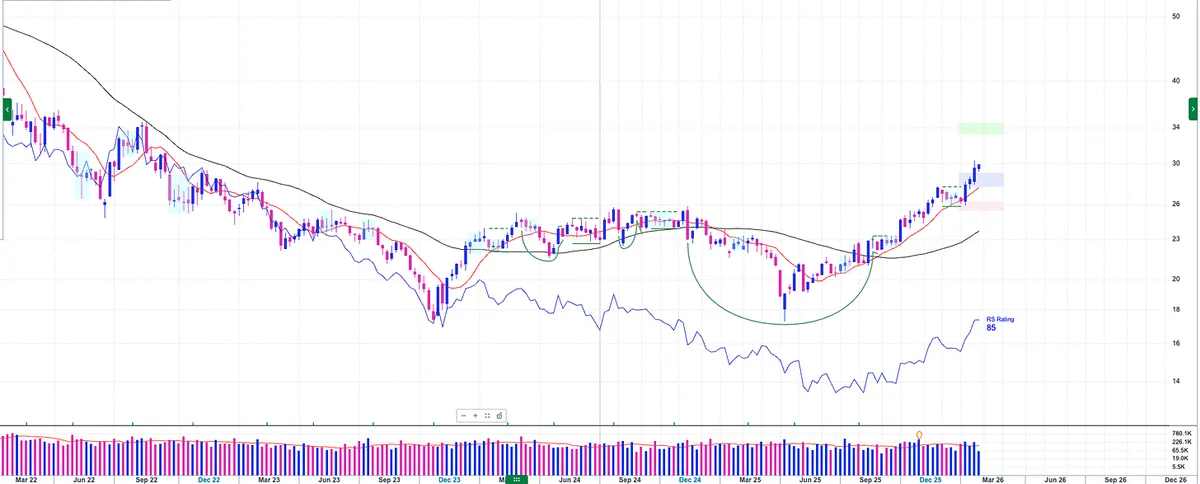
You’ll notice a lot of strong performers inside the IDNA Genomics & Immunology ETF, but I want to be clear about how I approach this area.

Biotech is not my wheelhouse, and I tend to stay selective here. Many biotech names lack consistent earnings and sales, which means they are often traded purely off price action and news catalysts tied to drug data or approvals. That’s a very different game than traditional growth-stock investing.

This is an area where traders like Minervini have expanded over time, and it’s a good example of how many start with a William O’Neil foundation and later branch out once they’ve earned that flexibility through experience.

In my view, biotech should be:

  • Small position size

  • Limited exposure within the portfolio

  • Treated as a tactical trade, not a core holding

This is not where I’d recommend starting. It’s an area you graduate into after proving consistency in safer, earnings-driven growth stocks where risk is easier to define.

Price action always comes first, but process and position sizing matter even more in categories like this.

View on Substack ↗

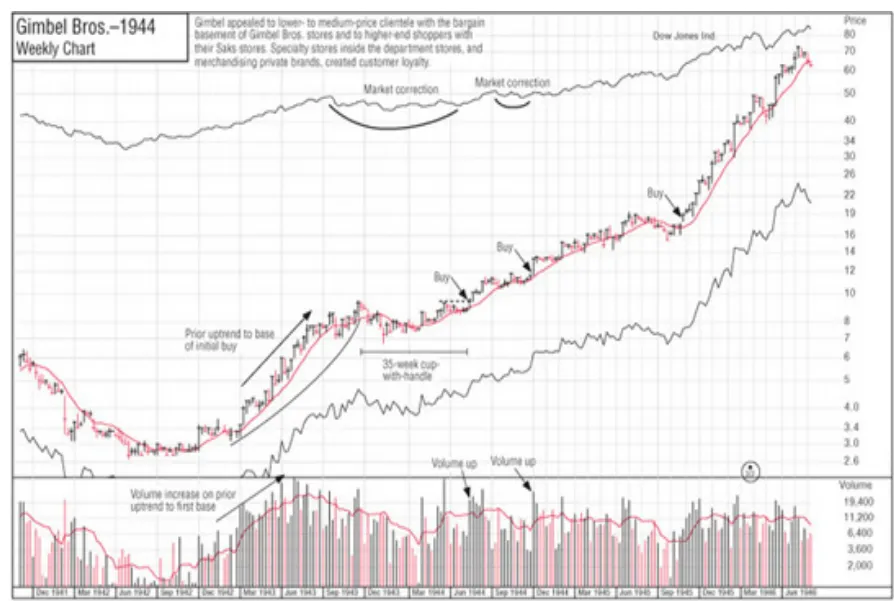
Nothing in the Market Is New

O’Neil studied winners going back to the 1880s.

What shocked him was not change. It was sameness.

  • Cup with handle.

  • Flat base.

  • Double bottom.

“The patterns you see today were there 20, 40, 60, even 100 years ago.”

Different companies. Different industries. Same structure.

View on Substack ↗

The Difference Between a Tip and a Professional Idea

“Few people ever make money by trading on the occasional tips or recommendations of others.” — Jesse Livermore

Livermore was not saying ideas are useless. He was warning people about how they use them.

There is a big difference between how experienced traders share ideas and how newer traders consume them. Professionals talk in themes, sectors, and names, but every trader still does their own work. They plan their own entry, define their own risk, and decide how to manage the trade with confidence. The idea is just a starting point, not an instruction.

Newer traders often do the opposite. They hear a name, feel urgency, and treat it like a signal. They buy because they trust someone else’s process more than their own. When the trade moves against them, they do not know where they are wrong, what to do next, or why they were in the trade to begin with.

That difference matters.

This is why I share watchlists, hot areas, sectors, themes, and sometimes individual stocks, but not as blind buy or sell signals. The intent is education. Sometimes someone mentions a stock I missed. I go do the homework. I build my own plan. Sometimes it aligns closely with how they are trading it. Sometimes it does not. Either way, the decision is mine.

As you gain experience, tips stop feeling like answers and start feeling like prompts. That is when they become useful. That is also what Livermore was warning people about over a century ago.

Signals are easy to give. Education is harder.

One creates dependency. The other builds confidence.

Learn to fish.

View on Substack ↗

Stop Chasing Money. Start Building Skill.

Most traders obsess over outcomes.

P&L. Big winners. Fast money.

That obsession is usually the reason they struggle.

The best traders flip the priorities completely.

They do not focus on making money first.

They focus on process.

Here is the mindset shift that changes everything.

Instead of trying to make money → focus on preserving capital

Your job is survival first. Capital is opportunity. Once it is gone, the game is over.

Instead of hunting home runs → follow a repeatable process

Big winners are a byproduct, not the goal. Consistent execution is what creates them.

Instead of cutting winners and holding losers → cut losers fast and let winners run

Losses are the cost of doing business. Winners are where the edge shows up.

Instead of buying weak stocks → buy strong stocks

Strength attracts more strength. Leaders outperform laggards for a reason.

Instead of trying to get rich quick → compound over time

Small edges, applied over and over, beat one lucky trade every time.

Make these changes and you may realize how much less stressful and more enjoyable trading becomes.

When your focus shifts from money to process, pressure fades. Decisions get clearer. Emotions quiet down.

Then something interesting happens.

Trades begin to compound quietly in the background, building into an account you once thought was unrealistic.

Not because you chased it.

But because you finally focused on doing the right things, consistently.

View on Substack ↗

Most investing content online is mentally stimulating, interesting, or entertaining, but it does very little to actually make you a better investor or trader.

Not all of it. But the majority of what I see.

I have fallen into this trap many times myself.

In the beginning, there is a lot to learn. The learning curve is steep, the information is overwhelming, and consuming content feels necessary. You are trying to understand how markets work, how risk works, and how to even participate correctly.

That phase is real. And it is unavoidable.

But once you get through it, something interesting happens.

What actually works starts to look very simple and very mundane.

Our brains are wired to keep chasing the exciting stuff. The get rich quick ideas. The complex strategies. The endless stream of “knowledge” that feels productive.

We fool ourselves into believing that this level of stimulation is required for success.

It isn’t.

Real progress comes from the boring, repetitive process.

Risk management.

Position sizing.

Patience.

Consistency.

Doing the same things over and over when nothing feels exciting.

That is the part almost no one wants to focus on. And that is exactly why it works.

The content you enjoy consuming is often not the content that actually improves your results.

Once you understand the basics, improvement comes from doing less, not more.

The mundane beats the exciting every time.

View on Substack ↗

Power Law Dynamics Explain Why A Few Trades Matter More Than All the Others

Most traders misunderstand their results because they assume trading returns behave like averages.

They do not.

Trading returns follow power law dynamics. A small number of large winning trades account for the majority of long-term profits, while most trades produce small gains, small losses, or break-even outcomes.

This is why averages are misleading. The mean return is not representative of how money is actually made. One or two exceptional trades can outweigh dozens of ordinary ones and completely skew the statistics.

Those big winners are not a bonus. They are a requirement.

In power law systems, success is driven by extremes, not consistency around the average. Markets behave this way because price movement is driven by feedback, momentum, and participation. When conditions align, trends extend far beyond what feels reasonable, and those rare extensions dominate returns.

This is also why many traders struggle even with solid systems. They cut winners early, reduce size as trades work, or stop trading before the outliers appear. By doing so, they remove the very outcomes their edge depends on.

Markets are also fractal in structure. The same price behavior appears across all timeframes. Trends, consolidations, breakouts, and failures repeat whether you are looking at a five-minute chart or a multi-year chart. The structure stays the same. Only the scale changes.

Power law returns explain why a few trades matter most. Fractal structure explains why the same setups keep appearing.

Put together, the lesson is simple.

Most trades are noise. A few trades drive nearly all meaningful results. Your job is not to optimize for the average trade. Your job is to manage risk well enough to survive the noise and stay positioned for the rare but decisive move.

The goal is not to be right often.

The goal is to still be in the trade when the big winner shows up.

View on Substack ↗

Trading Is Hard. That Doesn’t Mean It Can’t Be Done.

Trading can be learned.

It is difficult. The odds of success are low. Most people quit.

But that is true of many demanding professions.

Very few succeed, not because it is impossible, but because it requires discipline, mentorship, and years of deliberate practice.

The best way to shorten the learning curve is not guessing. It is modeling.

The greatest traders did not invent success from scratch. They studied others. They borrowed frameworks. They refined what already worked.

“Right now, I consider myself to be an expert modeler. By that, I mean that if someone can do something well, then I can figure out how they do it and teach those skills to anyone else.” — Dr. Van K. Tharp

That is the mindset.

You do not need to be a genius. You need to study people who have already done it well.

Trading is not magic. It is a skill.

And like any difficult skill, it rewards those willing to learn from the best, put in the work, and stay in the game long enough to master it.

View on Substack ↗

The Real Key to Winning: Stop Studying Differences and Start Studying Similarities

Most traders spend their time dissecting how great traders are different. Different strategies. Different markets. Different personalities.

That is interesting, but it is not what makes them successful.

The real edge is found in what they all have in common.

Across styles, eras, and markets, every great trader shares the same foundations:

Risk management They protect capital first. Always.

Proper position sizing They never let one trade determine their survival.

Cut losers, let winners run They accept being wrong quickly and stay with what works.

Process over outcome They judge themselves by execution, not by one trade’s result.

Emotional control They do not trade fear, ego, or frustration.

A system with positive expectancy over time They trust probability, not prediction.

Different methods. Same principles.

This is what most people miss.

They chase tactics instead of mastering structure. They hunt for the next setup instead of building discipline. They look for a secret instead of doing the work.

But the market does not reward cleverness. It rewards consistency.

You do not need to trade like someone else. You need to think like a professional.

Control risk. Size properly. Cut losses. Let winners work. Follow a repeatable process. Manage your emotions.

That is not exciting. That is not glamorous.

But it is how real traders win.

If you want better results, stop studying how great traders are different. Start studying what they all do the same.

View on Substack ↗

Tom Baldwin: Trading Is a Profession, Not a Shortcut to Riches

Tom Baldwin once said:

“The average guy might not be a million-dollar trader, but if he stands there for five years, he would have to pick it up. It is just like a job. You don’t start any job and feel comfortable in the first six months.” — Tom Baldwin

Trading can be learned no differently than any other profession.

There is no magic talent.

No shortcut.

No overnight mastery.

What determines how long it takes is not intelligence. It is focus, work ethic, discipline, and dedication.

Most people quit before the learning curve has a chance to work.

They expect comfort too early.

They confuse early struggle with failure.

Every real profession is uncomfortable at first. Every craft requires years of repetition, mistakes, and refinement.

The traders who make it are not the ones who avoid losses. They are the ones who outlast them.

Once you reach consistency, the next phase begins. That is where the real separation happens.

The additional work. The refinement of edge. The discipline around risk. The emotional control.

That is why P&L varies so widely among traders. Not because the market is unfair, but because effort, process, and discipline compound differently for everyone.

You do not need to be extraordinary to succeed. You need to be persistent.

Stand there long enough.

Do the work.

And good things will happen.

View on Substack ↗

Markets Don’t Care About Your Credentials

I always find it funny seeing CPAs handing out investing advice.

I don’t remember a single CPA in any of the Market Wizards books.

No Ed Seykota. No Paul Tudor Jones. No Stan Druckenmiller.

And I don’t recall any of the great value investors either.

No Warren Buffett. No Benjamin Graham. No Peter Lynch.

Not because those people were not intelligent.

But because accounting credentials have nothing to do with market mastery.

Markets do not reward titles.

They reward risk management, discipline, psychology, and execution.

A CPA can tell you how to report your gains.

They cannot tell you how to make them.

And let’s be honest. It does not take a CPA to understand financial statements, business fundamentals, or how companies actually operate.

Some of the greatest investors in history mastered balance sheets, cash flow, and valuation without any credential.

Funny how some people flex the title like it gives them an edge in investing or trading.

I am not trying to attack anyone with a CPA or any other designation.

I am making a simple point. Those titles are not required for success in markets.

That is why this game is so powerful.

Credentials do not matter. Background does not matter. Titles do not matter.

Only the work matters.

And in the end, your P&L is the only credential that counts.

View on Substack ↗

Why Giving Away a Trading System Rarely Changes Anything

Most people think success comes from “the secret.”

The setup. The indicator. The method no one else has.

But Linda Bradford Raschke said something that cuts straight through that illusion:

“I truly feel that I could give away all my secrets and it wouldn’t make any difference. Most people can’t control their emotions or follow a system. Also, most traders wouldn’t follow my system, even if I gave them step by step instructions, because my approach wouldn’t feel right to them… And even if the patterns I follow changed, new ones would be created, and I’m confident I would find them.”

Most traders do not fail because they lack information. They fail because they cannot follow a system when fear, boredom, or ego shows up.

And even when they are handed a proven method, it rarely “feels right,” so they abandon it the moment discomfort appears.

The professionals understand something most never do.

Secrets do not make traders successful. Systems only work for those who can actually follow them.

Finding a system with an edge is the easy part.

Following it is the hard part.

View on Substack ↗

The Market Is Already Talking. Most Investors Are Not Listening.

It still amazes me how many investors do not use charts.

Charts show what the market actually thinks. Not opinions. Not narratives. Not predictions.

Every indicator is built from price and volume. So why not study price and volume directly?

Charts show supply and demand in real time. They reveal crowd psychology as it unfolds. They make strength, weakness, and risk visible.

Price is the only thing that ever makes you money. And price is right there on the chart.

I am not saying fundamentals do not matter. They can help shape your thesis. But leaving charts out of the process hurts performance for most investors.

Because you are choosing to ignore the one thing that reflects all information, emotion, and decision making in the market.

I will leave you with this from William O’Neil:

“Most investors think that charts are hocus-pocus. Only about 5 to 10 percent of investors understand charts. Even a lot of professionals are totally ignorant about charts. Just as a doctor would be foolish not to use X-rays and EKGs, investors would be foolish not to use charts.”

View on Substack ↗

Dr. Van K. Tharp on What Separates Great Traders

Dr. Van K. Tharp once described what truly separates successful traders from everyone else:

“The top traders that I’ve worked with began their careers with an extensive study of the markets. They developed and refined models of how to trade. They mentally rehearsed what they wanted to do extensively until they had the belief that they would win. At this point, they had both the confidence and the commitment necessary to produce success.”

There’s nothing flashy here. No shortcuts. No secret indicator.

Just preparation, repetition, and belief built through deliberate practice.

The best traders don’t rely on hope. They study. They test. They refine a process until it becomes second nature. Then they rehearse it mentally until execution feels automatic.

Confidence doesn’t come from winning a few trades. It comes from knowing exactly what to do when the moment arrives.

That confidence is built over time. It comes from years of hard work, preparation, and execution.

And that’s what ultimately separates professionals from everyone else.

View on Substack ↗

Many ask how I trade differently between my day trading account and my swing/position account.

This is the cleanest explanation I’ve found, from Market Wizards, quoting Mark Weinstein.

Swing & Position Trading

“Although the cheetah is the fastest animal in the world and can catch any animal on the plains, it will wait until it is absolutely sure it can catch its prey. It may hide in the bush for a week, waiting for just the right moment. It will wait for a baby antelope, and not just any baby antelope, but preferably one that is also sick or lame. Only then, when there is no chance it can lose its prey, does it attack. That, to me, is the epitome of professional trading.”

That’s how I treat swing and position trades.

Extreme selectivity. Patience. Waiting for the right setup under the right conditions.

Fewer trades. Higher conviction. Asymmetric payoff.

I’m looking to trade the best CANSLIM names only: big earnings, big sales, top industry groups, clear institutional accumulation, and high relative strength.

Day Trading

“When I trade at home, I often watch the sparrows in my garden. When I feed them bread, they take just a little piece at a time and fly away. They keep on flying back and forth, taking small bits of bread. They may have to make a hundred stabs at a piece of bread to get what a pigeon gets at one time, but that is why a pigeon is a pigeon. You will never be able to shoot a sparrow, it is just too fast. That is the way I day trade.”

Day trading is different.

Quick profits. Raise stops. Leave a portion to run. Repeat.

I’m still trading momentum, but the focus shifts to stocks in play: news catalysts, earnings, new highs, gaps, heavy volume, and high RVOL. Speed and execution matter more than perfection.

Different timeframes. Different filters. Same discipline.

View on Substack ↗

A Quiet Thank You to the Average Investor

Why I Am Grateful for Conventional Wisdom

I am grateful for the conventional wisdom of the stock market and all the strategies that look nothing like mine. The traders who buy dips, average down, ignore trends, or rely on CNBC calls create the inefficiencies that momentum and trend-following traders use to outperform.

When I became consistently profitable, I wanted to explain everything to everyone. Eventually I learned that most people are not listening, and that is fine. If everyone traded like me, the edge would disappear. Markets only work because traders disagree.

This also does not ignore the fact that traders in completely different disciplines can be incredibly successful. Simons as a quant, Buffett as a value investor, and Paul Tudor Jones as a macro trader prove that many paths can work. What they all share is risk management and discipline.

You could argue that different styles succeed because other styles exist. Trend traders need sellers at new highs. Value traders need buyers when they want to sell. Every strategy depends on someone else seeing the world differently.

The diversity of beliefs and behaviors in the market is what makes outperformance possible. Without it, none of us would have an edge.

View on Substack ↗

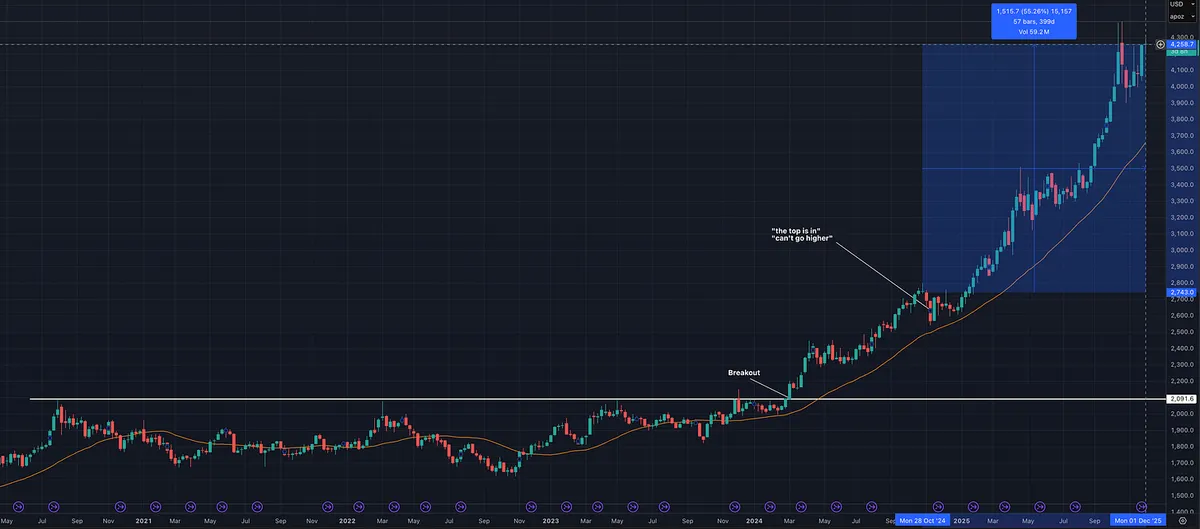
Reflection on Gold: A Lesson in Sentiment Journaling

I remember telling friends and family back in 2024 that it was the year of gold. And I remember just as clearly how everyone insisted the top was in.

But gold kept pushing higher all the way through 2025.

One of the most important lessons I learned years ago is this:

Journal sentiment. Every time you hear strong opinions like “the top is in,” “it can’t go higher,” or “this is the blow off,” write them down. Track the commentary. Capture the mood. Then come back to it months later.

You will be shocked at how often the crowd is wrong.

Doing this has given me more conviction in my process. It helps me trust the setups instead of getting pulled into the noise. And when the market moves in ways that nobody expects, I am no longer surprised. That is just how markets work.

Sentiment lies. Price does not.

View on Substack ↗

Can Regular People Be Taught to Become Millionaire Traders?

Most traders believe success comes from talent. The Turtle experiment proved something very different.

Two Chicago traders once trained a group of complete beginners for two weeks and handed them real capital. Many of those students went on to make millions by following a simple set of rules.

No special background. No genius needed. Just discipline and a system.

I just published a deep dive on the entire experiment, including the real rules they used, how they entered trends, where they placed stops, how they pyramided, and why the lessons still matter today.

Read the full breakdown here:

https://tradingmomentum.substack.com/p/the-100-million-bet-that-rewrote

ArticleThe $100 Million Bet That Rewrote Trading Forever: The True Story of the Turtle Traders