Momentum Trading Strategy

Notes

Becoming a Better Trader

Building and improving your trading process over time: how to learn, which method to use, and how to measure progress.

Showing 201–217 of 217 notes

View on Substack ↗

Plenty of people have asked me what platforms I use and here they are for those that are wondering.

I use these two tools every day, and both have Black Friday deals right now.

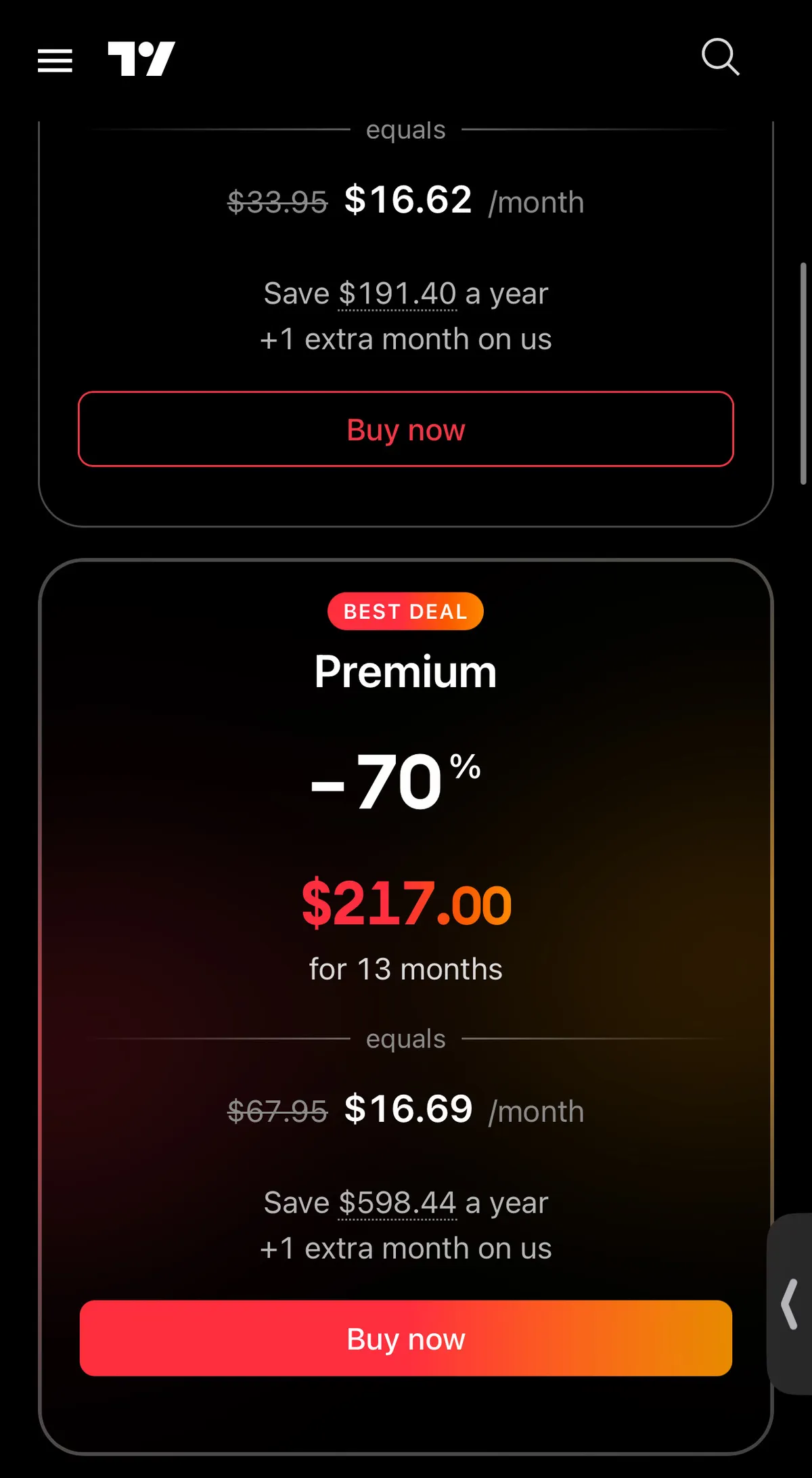
TradingView is 70% off. It is the best affordable charting platform in my opinion.

MarketSurge has a 6 week trial for 49.95. This is where I screen for high relative strength, big earnings, and big sales. It is built on the William O’Neil Investor’s Business Daily framework and is now owned by Dow Jones.

You can make millions using these two platforms if you stay disciplined. They cut out the noise and keep you focused on the data that actually matters.

No affiliate links. Just the real tools I use every day.
View on Substack ↗

Don’t Waste This Pullback

When the market pulls back and everything feels weak, do you still feel the urge to buy something anyway?

If you said yes in your head, you already understand the trap most traders fall into.

Right now we are below key moving averages and making lower lows and lower highs. That is not the time to be buying or fighting the trend. It’s the time to learn and prepare.

This period can be the most beneficial to your long term performance.

Use it to:

• review past winners and losers

• study what actually worked

• identify leaders that are holding up well

• refine your process

• build your watchlists

If the market moves back higher, the names showing strength now usually lead, and you will already be ready.

And if the market moves deeper into this correction, that is still a win. It gives you more time to learn, study, review, and sharpen your edge. It also builds a larger opportunity when we eventually move back up.

It’s a win win for somebody with patience.

Bottom line:

Do not waste this time. This pullback can set up your next big performance jump if you use it well.

View on Substack ↗

The Bitcoin Timeline No One Talks About

Why almost every fantasy return story falls apart in reality

Before you read this, answer this honestly in your head:

Would you hold through a 93 percent crash after seeing life changing gains?

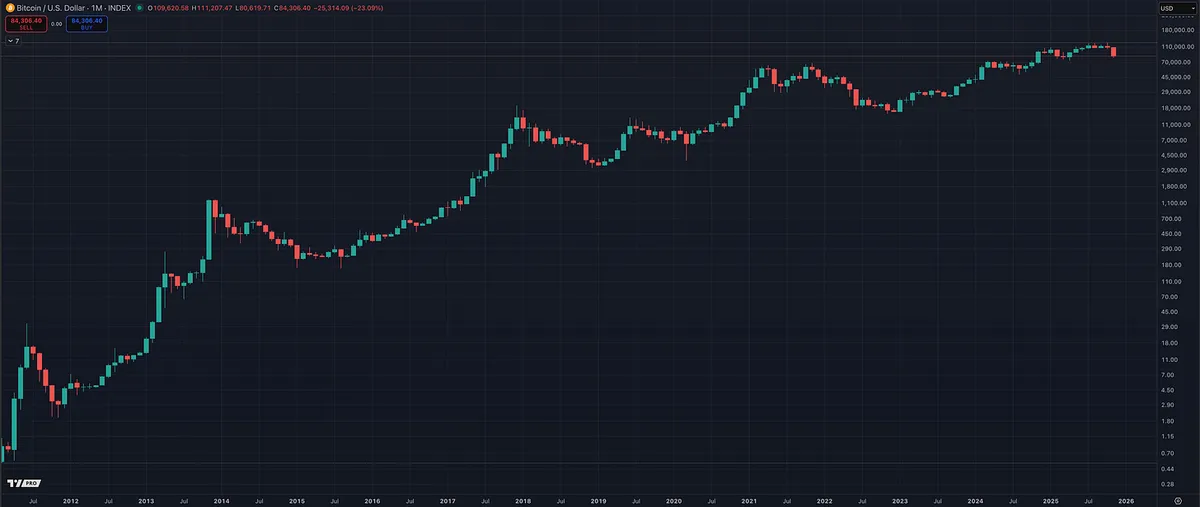
If you bought $100 of Bitcoin in 2010 at twenty-five cents…

And watched it go to $12,000 in 2011… and did nothing

Then watched it crash to $800… and still did nothing

Then watched it spike to $440,000 in 2013… and still did nothing

Then watched it fade back to $80,000… and still did nothing

Then watched $80,000 rocket to $5.6 million… and still did nothing

Then watched $5.6M sink to $1.32M… and still did nothing

Then watched $1.32M explode to $24M… and still did nothing

Then watched $24M crash to $6.2M… and still did nothing

Then watched $6.2M surge to $46M in 2025… and only then decided to “do something”…

Then yes Your lonely $100 bill from 2010 would be worth about $46 million today.

Lesson: This fantasy outcome has more in common with gambling than investing. If you want to be more than lucky, you need a long term strategy that works over and over, compounding not just over time but with each new investment or trade. And remember, it worked in this rare instance with Bitcoin, but imagine how many more times this approach failed completely.

View on Substack ↗

Most People Are On the Slow Path and Don’t Know It

Fun fact: About 70 percent of people click their 401k default options, and another 30 percent try to manage things themselves. But here is the shocking part. Ninety five percent of professional fund managers cannot beat SPY or QQQ long term, and 70 to 90 percent of individual brokerage accounts fail to make money at all.

If you simply avoid the default and choose QQQ for long term growth, and move to SPY as you get closer to retirement, you instantly put yourself in the top tier of all retirement accounts. No trading. No stock picking. No timing. Just choosing a better index.

I just published a full breakdown showing why even William O’Neil told most people to keep it simple, along with two charts that make this reality impossible to ignore. One shows QQQ vs a typical 401k fund since 2006. The other shows what 1,000 dollars per month would have grown into with each one. The difference is life changing.

Read the full post here: https://tradingmomentum.substack.com/p/even-william-oneil-knew-most-people

ArticleEven William O'Neil Knew Most People Should Keep It Simple
View on Substack ↗

Why Following the Trend Is My Contrarian Move

Funny thing about markets: doing the simple, obvious thing is actually contrarian.

Most investors fight the trend. They try to call bottoms, average down, over-diversify, cling to their favorite assets, and obsess over being “right.”

I do the opposite.

I buy strength. I only trade Stage 2 uptrends. I rotate to where institutional money is flowing. I cut losers fast, let winners run, and sit in cash when there’s no edge.

I have a thesis, but I’m never attached to it. The market is always right.

Most want to be right. I want to make money.

View on Substack ↗

Short Sellers Aren’t Pessimists

I see a lot of people on social media talk about short sellers as if they are rooting for failure. That is not what is actually happening.

Many traders who take short-side positions are simply acting on risk and reward signals. It is no more pessimistic than going long is optimistic. It is simply taking the other side when the setup makes sense.

Short selling also serves a real market function. It contributes to liquidity and price discovery, and it gives other investors the ability to exit at favorable prices during periods of stress. Without short participation, many major tops would be far more chaotic.

Some of the most respected macro traders, including Paul Tudor Jones and Stanley Druckenmiller, have used short exposure at various points as part of their overall process. Not because they were cheering for companies to fail, but because they were responding to the environment and managing risk.

Importantly, short selling is not only used for hedging. It is also used when traders see what they believe is a favorable risk-to-reward opportunity where an asset or market is likely to decline significantly. In those cases, it is simply another probability-based bet.

It is totally fine if shorting does not fit your style or personality. But for many, it is simply another tool: a rational and strategic way to capitalize on what they see as a low-risk, high-reward financial opportunity.

And yes, plenty of us are perfectly happy people while doing it 😂

View on Substack ↗

Interesting Irony in Who Retail Investors Study

It’s fascinating how many retail investors try to model themselves after people like Buffett, Munger, or Dalio, investors managing tens or hundreds of billions with access, leverage, and deal flow that the average trader will never have.

And yet, there’s a whole group of traders who built wealth starting with modest capital. People like Jesse Livermore, Nicolas Darvas, William O’Neil, David Ryan, Mark Minervini, Dan Zanger, Kristjan Kullamägi, and others have frameworks that are far more aligned with what most individuals are actually trying to do: grow a small account into something meaningful.

It’s not that one approach is better than another. There are countless ways to make money in markets, and different styles fit different personalities. But it’s interesting how often people choose to follow those who play a completely different game.

Many of the big institutional names didn’t even start that way. They evolved as their capital base grew, because managing billions requires a different approach than managing thousands. So maybe it’s worth asking: Are you studying the people whose path matches where you are, or where they ended up?

View on Substack ↗

Everyone’s a Trading Critic

In trading, everyone’s a critic.

If they don’t understand it, it’s nonsense.

If it didn’t work for them, it’s garbage.

If it worked for them, everyone else should do it too.

But here’s the truth:

Just because you haven’t learned it doesn’t mean it doesn’t work.

Just because it hasn’t worked for you doesn’t mean it’s broken.

And just because it has worked for you doesn’t mean it’s universal.

There are countless ways to make money in the markets. The trick is finding the one that fits you, and that takes time, mistakes, and a lot of learning.

View on Substack ↗

Two traders can look at the same chart, trade the same setup, and still walk away with completely different results.

The difference usually isn’t the strategy; it’s how each trader executes it. Entry timing, position size, stop placement, and profit-taking all affect the outcome.

Even when two people aim for the same stop and target, small differences in how they enter and manage the trade can make one lose while the other wins.

As Ed Seykota said, “I can give everyone the same trading system and we’d all still make different amounts of money, because everyone would manage it differently.”

Edge matters, but execution and mindset matter just as much. How you handle losses, re-enter after getting stopped out, and stay objective under pressure is what separates consistent traders from the rest.

Systems create opportunities. Execution decides outcomes.

View on Substack ↗

Even day, swing, and position momentum traders should understand the bigger picture.

Reviewing relative strength, volatility, and breadth helps you see where to look — not just what to trade.

Every weekend I review the macro pulse before screening, building watchlists, setting alerts, and planning trades.

Read Part 1 of my weekend prep →

View on Substack ↗

Everyone talks about finding their edge in trading.

Truth is, most people already have access to proven systems — from traders like William O’Neil, Dan Zanger, or Kristjan Kullamägi.

The problem isn’t the system. It’s the discipline to follow it.

Trading is no different from health or wealth. Most people know what to do — they just don’t do it.

The real edge? Discipline. Emotional control. Doing the small things right.

Because if you can’t master those, no strategy will save you.

The markets don’t just test your edge — they test you.

View on Substack ↗

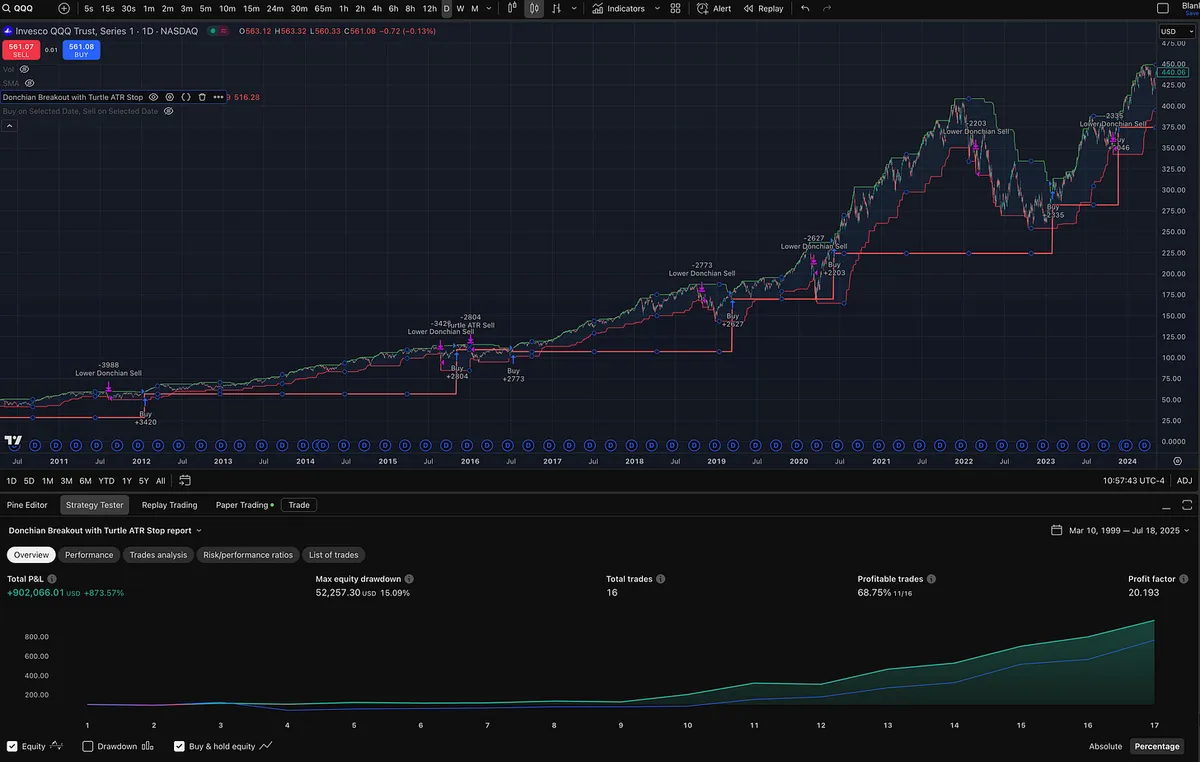
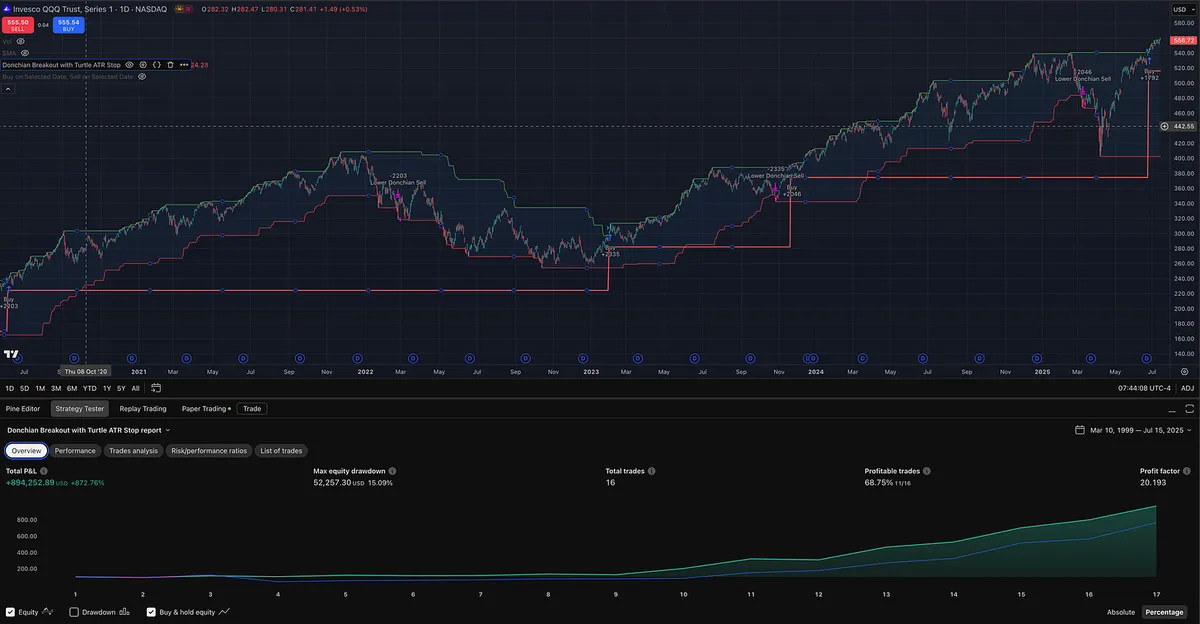
Most X macro chatter is mental masturbation—lots of talk, little action, few excellent results. Most would be better off doing something simple like the Donchian Breakout + ATR Stop Strategy with QQQ: +870% since 1999, -15% drawdown vs. buy-and-hold’s -55%. Simple and works.

View on Substack ↗

📈 Would You Be Happy With These Results? Imagine following a simple rules-based strategy to trade the Nasdaq-100...

✅ +870% total return ✅ 15% max drawdown ✅ Profit factor: 20.19 ✅ 68.75% win rate ✅ Only 16 trades in 26 years

This is the performance of a Donchian Breakout + Turtle ATR Stop strategy trading $QQQ from 1999 to 2025. It also performs well going all the way back to 1985.

No prediction. No guessing. Just trend-following rules that ride big winners and cut losses quickly.

💡Would you trade a system like this? Or stick to buy & hold?

👇 Let me know in the comments.