Momentum Trading Strategy

Notes

Becoming a Better Trader

Building and improving your trading process over time: how to learn, which method to use, and how to measure progress.

Showing 161–180 of 217 notes

View on Substack ↗

Standing on the Shoulders of Giants

Isaac Newton once wrote:

"If I have seen further, it is by standing on the shoulders of giants."

Trading works the same way.

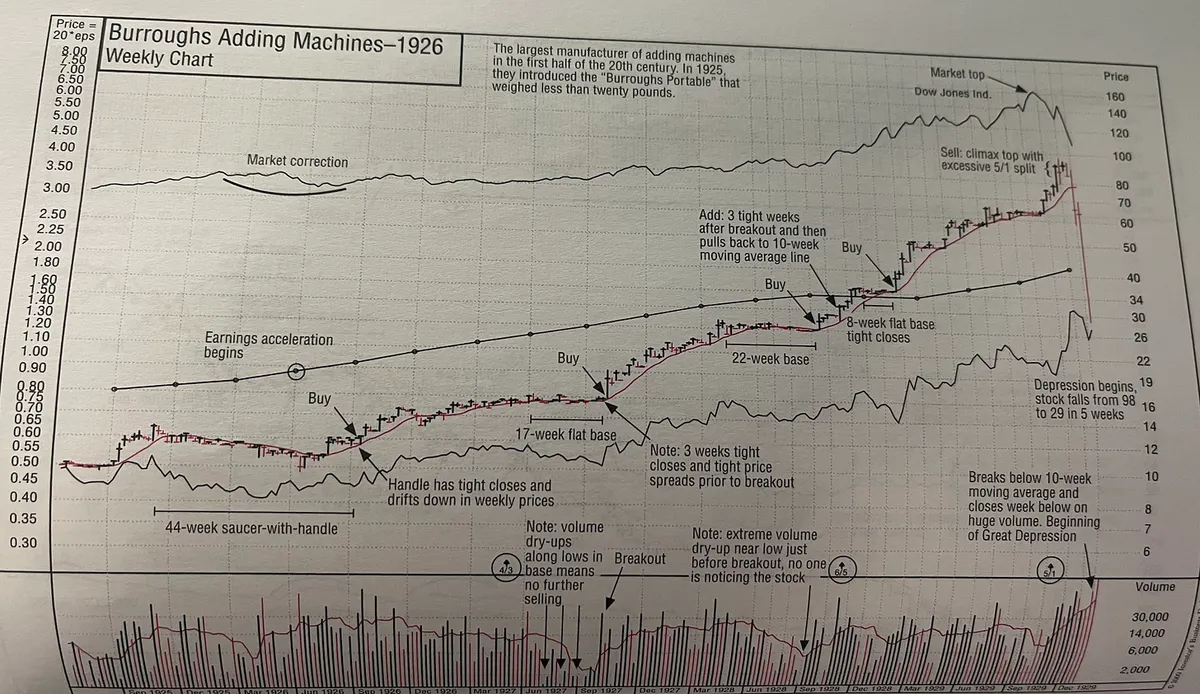
William O’Neil studied Jesse Livermore, Gerald Loeb, and the success of the Dreyfus Fund.

Mark Minervini studied O’Neil and Love.

Kristjan Kullamägi studied O’Neil.

Different generations. Different markets.

But the same core foundations.

Price. Volume. Momentum. Supply and demand. Risk management. Human psychology.

Maybe each trader adds their own twist.

But the core ideas are the same ones that have been around for decades.

Which is why the ego and hype in trading can be ridiculous.

Everyone wants to claim they discovered something revolutionary.

Those of us who have been doing this long enough know the truth.

Almost nobody is inventing anything new.

The best traders are simply executing timeless principles better than everyone else.

Study the giants.

Execute the principles.

And maybe, if you are lucky, you leave a small improvement for the next generation.

View on Substack ↗

The 100-Year Momentum Blueprint: How the Biggest Stock Market Winners Actually Move

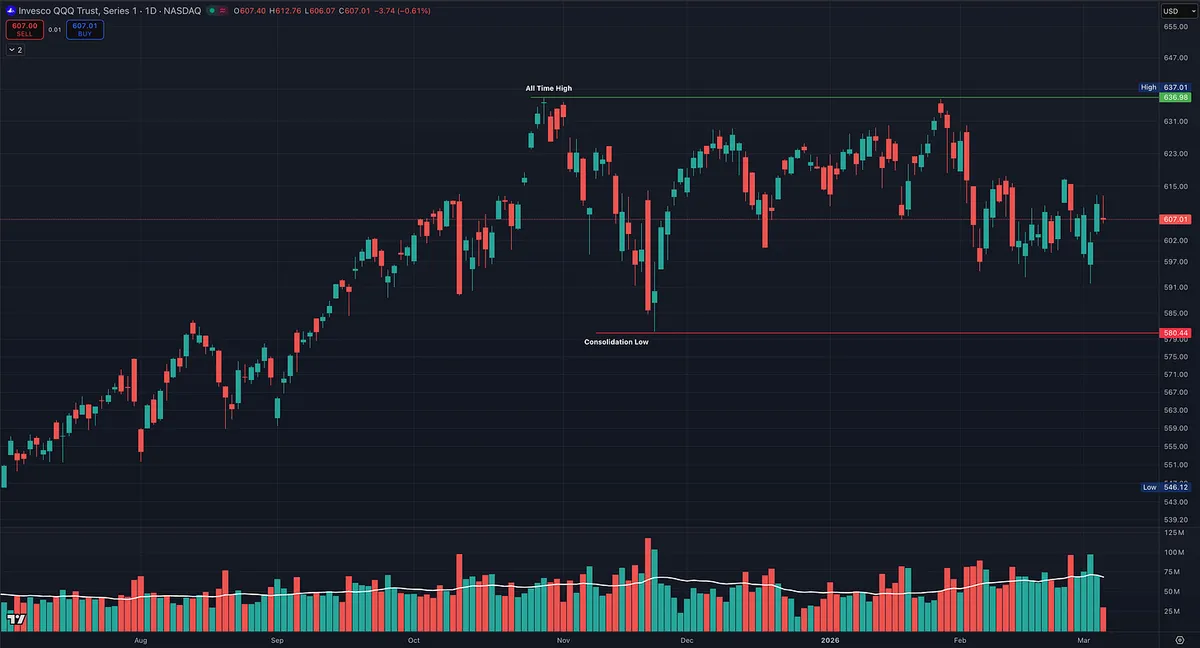
While the market has been chopping around in consolidation, it is actually one of the best times to learn.

When markets trend aggressively, traders are busy executing, but when things slow down, it is the perfect time to study, refine your process, and prepare for the next leadership cycle.

After 20 years of trading and a lot of questions about my strategy, I finally decided to turn the framework I use into a full course.

Module 1 of the Momentum Trading Strategy course is now live.

https://tradingmomentum.substack.com/p/momentum-trading-strategy-the-100

On SubstackMomentum Trading Strategy: The 100-Year Playbook Behind the Biggest Winning Stocks
View on Substack ↗

Fear Spreads Faster Than Discipline

I have only been writing on Substack for a few months.

It honestly started as a place to write random thoughts about trading so I didn’t have to keep talking about it with my wife and four kids all the time.

But something interesting happened recently.

Out of everything I have written, the post that performed the best by far was titled:

“How the Market Warns You Before the Crash and When It’s Safe to Get Back In.”

Not the posts about position sizing.

Not the posts about risk management.

The one about a crash.

And that made me laugh.

Because if you study markets long enough, you realize something.

Some of the best traders probably understand human nature better than many PhDs who study it for a living.

To survive in markets for decades you have to.

You watch fear. You watch greed. You watch euphoria. You watch panic.

And if you spend enough time studying charts and the tape, you realize something else.

Human behavior repeats.

The irrational exuberance near tops.

The panic selling near bottoms.

The disbelief during the early stages of an uptrend.

It all shows up in price and volume.

Great traders spend thousands of hours watching these emotional cycles play out.

Eventually you start to recognize the fingerprints.

Another thing traders learn quickly about human nature is this.

People are far more captivated by fear than by calm, rational information.

Psychologists call this negativity bias. Humans are wired to pay more attention to threats than to positive outcomes.

Behavioral finance research shows that people feel losses roughly twice as strongly as gains.

Which explains a lot.

It explains why the news focuses on disasters.

It explains why market crash headlines travel faster than discussions about discipline.

And apparently it explains Substack engagement too.

Now, understanding topping behavior is important. William O’Neil wrote extensively about this in How to Make Money in Stocks. Protecting capital matters.

But it is no more important than risk management, position sizing, or process.

Yet that one post traveled the furthest, by far. Almost five times further than most of the others.

Maybe the algorithm liked it.

Maybe people shared it because it tapped into fear.

I honestly don’t know.

I just wrote what I was thinking that morning while drinking coffee.

When I write about trading, I’m simply sharing thoughts about a game I’m passionate about.

Most people will never use the information to their advantage.

That’s just the math of markets.

But maybe a few will.

And maybe one day they’ll become part of the next generation of Market Wizards.

And that would be pretty cool.

https://tradingmomentum.substack.com/p/how-the-market-warns-you-before-the

ArticleHow the Market Warns You Before the Crash (and When It’s Safe to Get Back In)
View on Substack ↗

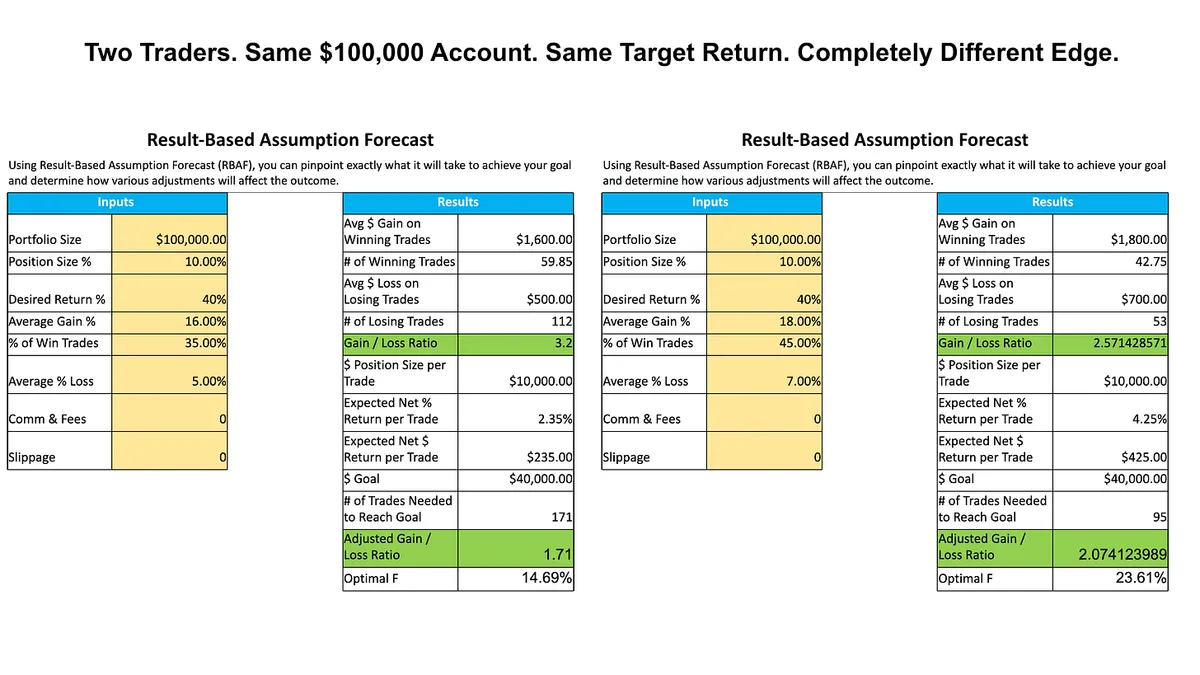
Two Traders. Same $100,000 Account. Same Target Return. Completely Different Edge.

Most traders think performance comes down to win rate.

It doesn’t.

It comes down to expectancy.

Both traders in the image:

  • Start with $100,000

  • Use 10% position size

  • Want a 40% return ($40,000)

But their math tells two completely different stories.

Trader A

  • 35% win rate

  • 16% average gain

  • 5% average loss

  • 3.2 gain/loss ratio

Expectancy:

(0.35 × 16%) − (0.65 × 5%) = 2.35% per trade

At 10% exposure, that’s:

0.235% account growth per trade ≈ $235 per trade

To hit $40,000?

He needs 171 trades.

Lower batting average. Solid asymmetry. Heavy trade frequency required.

Trader B

  • 45% win rate

  • 18% average gain

  • 7% average loss

  • 2.57 gain/loss ratio

Expectancy:

(0.45 × 18%) − (0.55 × 7%) = 4.25% per trade

At 10% exposure:

0.425% account growth per trade ≈ $425 per trade

To hit $40,000?

He needs 95 trades.

Higher win rate. Still asymmetric. Almost half the workload.

The Real Lesson

Win rate alone means nothing.

Trader A actually has the bigger raw R multiple.

Trader B compounds faster because his edge per trade is stronger.

Same capital. Same goal. Same exposure.

Different math.

That’s what Result-Based Assumption Forecast exposes.

You don’t guess your average gain. You don’t guess your win rate. You pull them from real trading data.

The only estimates are:

  • Portfolio size

  • Position size

  • Desired return

Everything else must be earned.

RBAF doesn’t predict the market.

It measures you.

And once you understand your edge, performance stops being hopeful…

It becomes engineered.

View on Substack ↗

What Growth Momentum Traders DON’T Do

There are thousands of posts about what traders should do.

Let’s talk about what we do not do.

We do not sit through massive Stage 4 declines. We do not average down in broken stocks. We do not marry positions. We do not wait decades to get back to even.

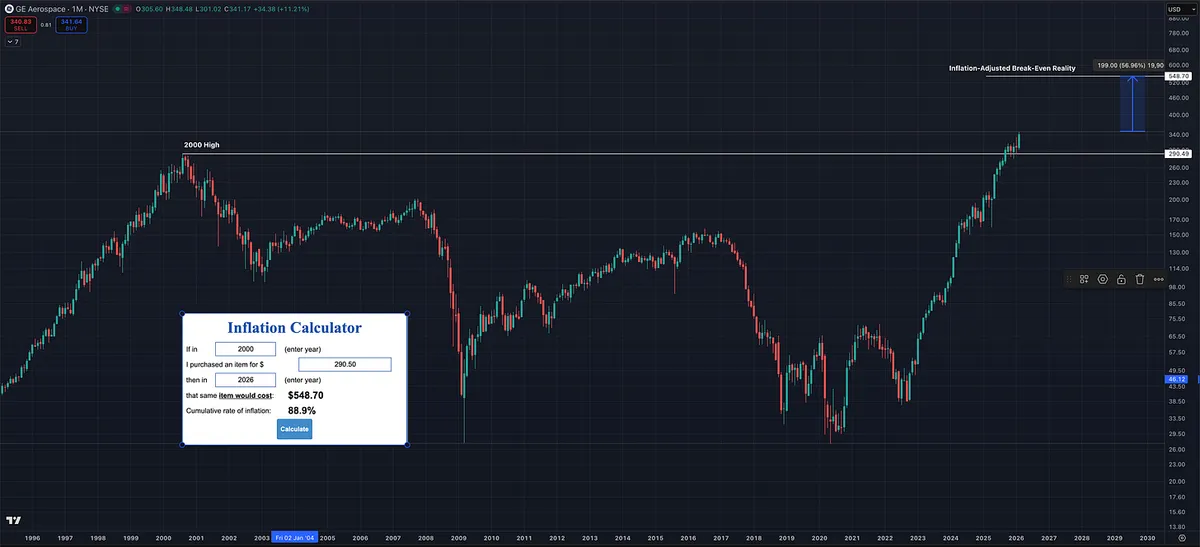
At one time, General Electric was considered one of the safest companies in America. Blue chip. Institutional favorite. A “forever” stock.

It peaked in 2000.

If you bought near the highs and held, you waited decades just to see price approach those levels again. Adjusted for inflation, you are still not truly made whole. From the inflation adjusted breakeven level, the stock would need to rise another 57 percent just to restore purchasing power.

That is the hidden cost of buy and hold without risk management.

This can happen to any stock.

There are no permanent leaders. Capital rotates. Industries evolve. Institutions move on.

Growth momentum trading is built differently.

We cut losses short. We follow the trend. We concentrate in strength. We protect capital.

A great company can be a bad stock. A bad company can be a good stock.

Ideally, we want both at the same time. A strong company in a confirmed Stage 2 advance.

That is where real compounding happens.

William O’Neil said it best:

“There are no good stocks unless they go up in price. If they go down instead, you have to cut your losses fast.”

View on Substack ↗

Why Momentum Has Persisted for Over 100 Years

Markets evolve.

Technology changes. Execution gets faster. Information spreads instantly.

But the core drivers of markets have not changed.

Human nature has not changed.

Fear and greed still drive behavior. Crowd psychology still amplifies trends. Overconfidence still creates bubbles. Panic still creates collapses.

Charts are not just pictures of price.

They are visual representations of supply and demand.

When demand consistently exceeds supply, price trends upward. When supply overwhelms demand, price declines. That dynamic is timeless.

Institutional capital is a major force behind sustained trends.

Large funds cannot build or exit positions in a single day. Their accumulation creates prolonged advances. Their distribution creates extended declines.

Leadership also concentrates.

In strong market cycles, a relatively small group of stocks drive the majority of gains. This has been true for over a century.

Earnings growth attracts capital. Capital flow reinforces trend. Trend persistence becomes structural, not random.

Momentum works not because markets are inefficient in some abstract academic sense.

It works because human behavior and capital flow dynamics repeat.

As long as fear, greed, and competition exist, strength will attract more strength.

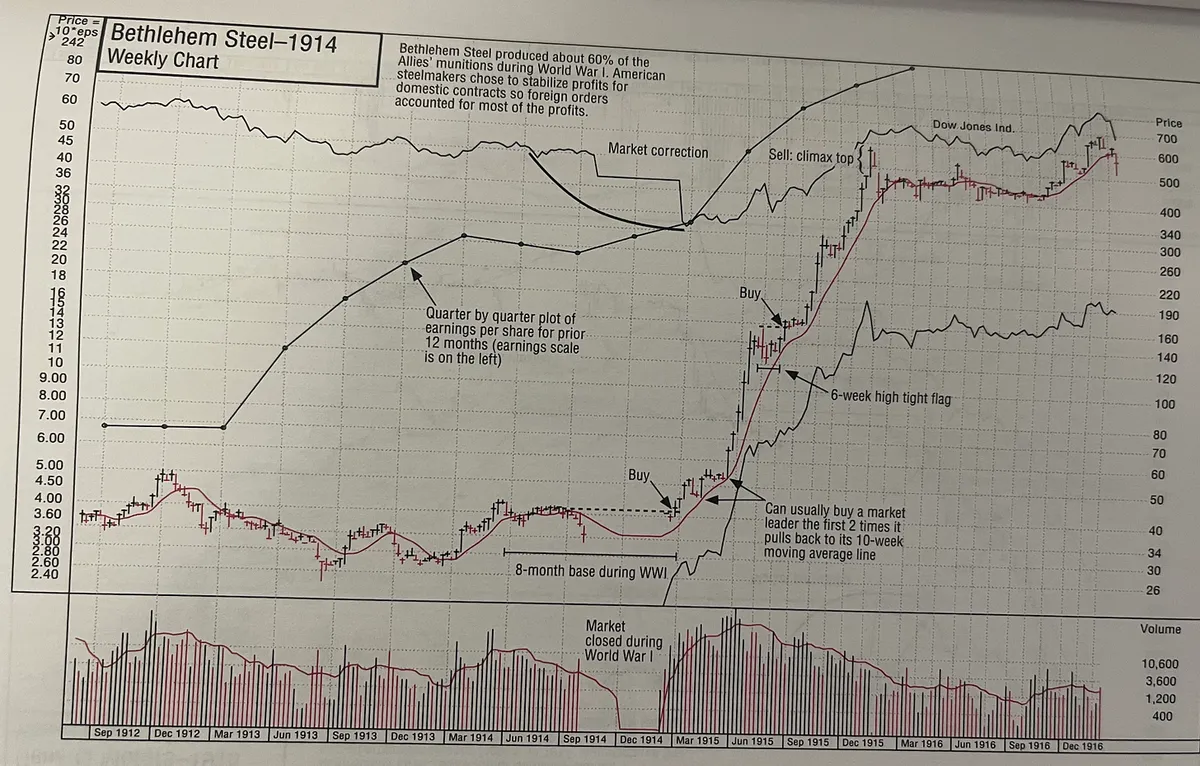
That is why principles used in the early 1900s still apply in modern markets.

Technology changes.

Human behavior does not.

And that is where trend and momentum strategies find their edge.

View on Substack ↗

Most Traders Want Results. The Professionals Focus on Process.

One thing that becomes obvious when you study the great traders across history is this:

They did not become profitable overnight.

Jesse Livermore didn’t.

Gerald Loeb didn’t.

Nicolas Darvas didn’t.

William O’Neil didn’t.

And neither did the modern growth traders people admire today.

It took years.

Years of refining rules. Years of mistakes. Years of emotional discipline. Years of learning what not to do.

Trading is treated casually by most people because it looks simple on the surface. Click buy. Click sell. Watch the screen.

But the reality is this:

Trading is a profession.

And like any profession, mastery takes time.

The problem is that most people approach the market focused on the outcome.

How much can I make? How fast can I grow this account? What stock will double next?

But there is a paradox in markets.

When you obsess over the result, you usually sabotage it.

You hesitate to cut losses. You size too big. You chase. You revenge trade.

The professionals focus on something else.

They focus on process.

They define what they buy. They define when they buy. They define when they exit. They manage risk first. They let probability do the heavy lifting.

The result becomes a byproduct of disciplined execution.

Markets change structurally. Technology evolves. Speed increases.

But human nature has not changed.

Fear and greed still drive price. Supply and demand still govern movement. Leadership still concentrates in a small group of names during strong cycles.

If you want long-term success in momentum and growth trading, the shift is simple but difficult:

Stop chasing results. Start building process.

Everything compounds from there.

View on Substack ↗

Don’t Choose a Win Rate. Discover It.

A lot of people ask me:

“How do I know what my win rate should be?” “Should I aim for 40%? 50%? 60%?”

You don’t choose it.

You discover it.

The best way to figure out your real win rate and risk-reward profile is simple:

Take the setups you naturally like. The market type you prefer. The kinds of stocks you’re drawn to.

And forward test them.

Not backtest.

Forward test.

Actually trade them in the current market.

Use:

  • A small amount of real money or

  • A paper trading account

Then take a large enough sample size. 50 to 100 trades minimum.

Now look at your data:

  • What’s your batting average?

  • What’s your average win in R?

  • What’s your average loss in R?

  • What’s your largest winner?

  • What’s your largest loser?

Two things happen.

First, you’ll know whether you actually have positive expectancy.

Second, you’ll know what kind of trader you really are.

Maybe you’re a 35% trader with 4R winners. Maybe you’re a 55% trader with 1.8R winners.

Neither is better.

But now you’re not guessing.

Now your position sizing, risk management, and expectations are based on evidence.

Think of it as market research.

You’re not “trying to make money” during this phase.

You’re collecting statistical proof.

Stop trying to pick a win rate.

Build a process. Forward test it. Let the numbers tell you who you are.

View on Substack ↗

The Best Traders Never Outgrow the Basics

I have been trading for over 20 years.

And I still reread the same trading books.

Not because I do not know the material.

Because the market has a way of pulling you slightly off process over time.

When I review, I often see that any performance slip traces back to simple foundational rules. Rules I already know.

Cut losses quickly. Buy strength, not weakness. Respect proper position size. Wait for correct setups.

It is not the fancy stuff. It is the basics.

All professionals in every field are great because they master the basics and maintain that mastery.

Elite athletes drill fundamentals. World class surgeons rehearse procedures. Top musicians practice scales.

Trading is no different.

The edge is not complexity. It is disciplined repetition.

Do not read the great books once.

Read them five to ten times.

Each pass deepens understanding. Each review sharpens execution.

Master the basics.

View on Substack ↗

Build Your Own Playbook

Most traders show up every day reacting.

Professionals show up prepared.

In The PlayBook, Mike Bellafiore makes a simple but powerful point: elite traders know their best setups. They catalog them. They study them. They build a personal playbook of trades that work for them.

Not someone else. For them.

A PlayBook is not theory. It is evidence.

It answers:

  • What setups produce my biggest gains?

  • What market conditions suit my style?

  • Where do I consistently lose money?

  • When should I press?

  • When should I sit out?

Instead of chasing random opportunities, the professional waits for their A+ setup.

They know:

  • The entry trigger

  • The risk level

  • The add point

  • The exit plan

And when the setup appears, they size appropriately.

Most traders fail because they trade everything.

Professionals succeed because they trade selectively.

Your job is not to trade more.

Your job is to build proof.

Review your best trades from the last 12 months. Find the pattern. Define the setup. Write the rules. Repeat it until it becomes automatic.

Your edge is not hidden in a new indicator.

It is hidden in your data.

Build your PlayBook.

View on Substack ↗

The Fastest Way to Build an Edge Is to Borrow One

Zoom out 100 years and you see a pattern.

The greats did not reinvent trading. They modeled it. Refined it. Executed it.

Livermore mastered price and the big swing.

Loeb made survival the first objective.

O’Neil turned those lessons into a technical and fundamental framework. Minervini and Zanger refined the execution with precision and structured risk.

Different decades. Different tools. Same blueprint.

Do not waste years trying to figure it out from scratch.

Stand on proven shoulders.

Study the greats. Apply the principles. Build your rules. Execute consistently. Refine over time.

Livermore taught us the power of reading the tape. Loeb taught us the importance of protecting our capital. O’Neil gave us a technical and fundamental framework to identify true leaders. Minervini expanded those teachings into precision, timing, and structured risk.

Many of the great traders of today built their careers on that foundation.

Why not you?

View on Substack ↗

Most Traders Track P&L. Pros Track MAE and MFE.

Everyone talks about returns.

Very few talk about what happened inside the trade.

That’s where MAE and MFE live.

MAE — Maximum Adverse Excursion

How far a trade went against you before it closed.

MFE — Maximum Favorable Excursion

How far a trade went in your favor before it closed.

These two numbers quietly expose everything.

A trade that closed +30% might have been down -30% first.

That tells you something about entry quality and risk control.

A trade that closed +10% might have been up +55% at one point.

That tells you something about exit logic.

Returns show outcomes.

Excursions show behavior.

If your average MAE is larger than your planned stop, that’s not market volatility. That’s process drift.

If your average MFE is consistently higher than what you capture, you may be cutting winners too quickly.

MAE protects capital.

MFE improves efficiency.

Track them for a month and you’ll learn more about your trading than from any single big win.

Full post soon on how to use all the key performance metrics together.

View on Substack ↗

You Don’t Need To Be An Analyst To Make Money In The Market

One of the biggest myths in investing is that you need to be a brilliant analyst to make money.

You don’t.

In fact, there is a reason many of the greatest traders were not traditional analysts.

And there is a reason many brilliant analysts never made consistent money.

In Market Wizards, Paul Tudor Jones makes it clear what matters most:

“Don’t focus on making money; focus on protecting what you have.”

Notice what that is not about.

It is not about forecasting GDP. It is not about dissecting balance sheets. It is not about predicting earnings five quarters out.

It is about risk.

Across Market Wizards, the common thread among the top traders is not analytical brilliance.

It is discipline.

It is risk control.

It is reacting to price.

Many of them openly admit they are not economists. They are not trying to predict the future. They are responding to what the market is doing now.

William O’Neil makes a similar distinction in How to Make Money in Stocks.

He emphasizes that the market is driven by institutional accumulation and supply and demand. The greatest winners are identified through price, volume, and earnings growth, not personal opinion or deep macro forecasts .

O’Neil built an entire system around this criteria.

Relative strength. Quarterly earnings acceleration. Industry group leadership. Chart patterns.

Not intellectual debate.

Mark Minervini reinforces this in Trade Like a Stock Market Wizard. His framework is not about predicting which company “should” succeed. It is about identifying when institutions are accumulating and managing risk with precision.

There is a subtle but critical difference between being an analyst and being a trader.

Analysts try to be right.

Professional traders try to manage risk.

Analysts often anchor to their thesis.

Professional traders anchor to price behavior.

Many of the brightest minds on Wall Street have produced extraordinary research and still failed to generate consistent returns.

Because analysis alone does not equal execution.

Execution requires:

Defined risk. Position sizing. Sell discipline. Adaptability.

You do not need to be the smartest analyst in the room.

You need to:

Identify institutional demand. Align with leadership. Cut losses quickly. Let winners run.

The market does not reward intelligence alone.

It rewards disciplined execution applied over time.

And that is why so many of the greatest market operators were not known for analysis.

They were known for managing money.

View on Substack ↗

Study. Execute. Review. Repeat.

Many traders study but never execute.

They read books.

Watch videos.

Take notes.

But they never put real risk on the table.

Others do the opposite.

They execute constantly.

They trade every day.

They get tons of screen time.

But they never truly studied their craft.

Both paths lead to frustration.

Great performers in any field do both.

They study the greats.

They model proven frameworks.

They build knowledge before they build size.

And then they execute.

They are not afraid to act.

They are not afraid to fail.

They are not afraid to review their own mistakes.

Execution without study is reckless.

Study without execution is fantasy.

You need both.

Study the craft.

Execute the craft.

Then study your own execution.

That feedback loop is where real edge is built.

View on Substack ↗

Why Most Traders Fail When They Go Live

I recommend traders use a simulator first.

Not to pretend trade.

Not to chase dopamine.

But to prove they actually have an edge.

If you cannot demonstrate profitability in a simulator over a meaningful sample size, going live will not magically fix that.

Simulation builds two things:

  1. Proof of edge

  2. Confidence in your process

Both matter.

But here is where many traders get blindsided.

They crush it in sim.

Then they go live… and fall apart.

Why?

Because real money changes everything.

It introduces fear.

It introduces hesitation.

It introduces the pain of loss.

That is why I recommend that once you go live, you trade with an amount that is small but meaningful.

Small enough that you can afford to lose it.

Large enough that you feel it.

You must learn how to manage your emotions with real capital at risk. That skill cannot be simulated.

View on Substack ↗

Why Trade Alert Services Fail Most Traders

There are plenty of trade alert services out there.

Some people experience short term success following alerts.

But long term, that rarely builds consistent traders.

Why?

Because trading is deeply personal.

You can absolutely model a proven system. In fact, I recommend that for beginners and this is what I did starting out. Start with a proven system. Start with rules. Learn a framework that works. ie. CANSLIM

But eventually, you must tailor it to your personality.

Your risk tolerance. Your timeframe comfort. Your volatility tolerance. Your decision making speed.

Two traders can take the exact same stock and have completely different outcomes.

One trader holds through volatility. Another cuts quickly at the first pullback. One takes profits into strength and raises stops early. Another presses the advantage and adds to the position.

Same stock. Different psychology.

Simply copying someone else’s entries and exits does not build skill. It builds dependency.

And dependency does not survive market cycles.

Every trader who achieves long term consistency eventually learns to make their own decisions without someone telling them exactly where to buy and where to sell.

That is the turning point.

My goal here is not to run a signal service.

It is to help you think independently.

To help you recognize true market leaders. To help you identify setups that clearly define risk. To help you align trades with your own style.

Because in the end, the only edge that lasts is the one you understand deeply and can execute confidently.

Learn to fish.

The market will feed you for a lifetime.

View on Substack ↗

Time Flies Anyway. Start Today.

You’ve heard the saying.

People overestimate what they can accomplish in one year.

And underestimate what they can accomplish in five to ten.

That is especially true in trading.

Many quit because it doesn’t make them rich in one or two years.

They expect mastery. They expect consistency. They expect financial freedom.

Fast.

But trading is a skill.

And real skill compounds.

If I told you that five to ten years from now you could have financial freedom from this skill… would you call that a waste of time?

Of course not.

Yet people walk away because it didn’t happen in twelve months.

Here’s the uncomfortable truth:

Five years will pass anyway.

Ten years will pass anyway.

The only question is whether you will look back wishing you had spent that time learning… or wishing you hadn’t wasted it.

Imagine doing something every day that builds skill.

Studying charts. Reviewing trades. Managing risk correctly. Improving process.

Small progress daily.

That is how real traders are built.

Not in months.

In years.

Time is going to pass no matter what.

Start today.

View on Substack ↗

Results Are Nice. Skill Is Better.

If you’ve been following the Notes and seeing the results, imagine seeing the setups before the move.

For $10 a month on the annual plan, you get:

• Full market breakdowns

• Real-time setups with defined risk

• Clear entry and stop levels

• Structured trade management

• Ongoing chat access to discuss setups, risk, and execution

• Education built into every position

This is not about stock tips.

It’s about learning how to identify leadership, manage risk, and build positions yourself.

For $100 a month on the annual VIP plan, you get:

• Everything above

• Detailed Zoom calls breaking down markets, entries, risk, and management

• One-on-one guidance

• Personal process refinement

• Help building your own repeatable system

This is not about dependency.

The goal is skill.

Invest in yourself.

View on Substack ↗

The Trader Who Adapts the Fastest Wins

One of the biggest advantages a trader can have is the ability to spot patterns and adapt.

Markets change. What worked a few months ago will eventually stop working. The traders who struggle are the ones married to a single setup or a fixed belief about how the market is supposed to behave.

An edge comes from recognition speed.

The faster you can recognize when breakouts stop working and buying support starts working, the better.

The faster you can recognize when breakouts begin working again, the better.

This is not about abandoning your process.

It is about adjusting execution to current conditions.

There are periods where:

  • Breakouts fail quickly

  • Tight entries near support outperform

  • Mean reversion pays better than momentum

Then conditions shift.

Suddenly:

  • Breakouts hold

  • Follow through improves

  • Momentum strategies regain their edge

The trader who adapts early keeps making money.

The trader who adapts late gives profits back.

The trader who never adapts eventually quits.

Pattern recognition is not a buzzword. It is a skill built through screen time, journaling, and brutal honesty about what is actually working.

Your job is not to predict.

Your job is to observe.

The market leaves clues every week.

Price tells you what is working if you are willing to listen.

Your ability to recognize new patterns, and changing patterns, is not optional.

It is essential.

View on Substack ↗

Funny What People Are Afraid to Invest In

I find it interesting how hesitant people are to spend money on trading education, yet they’ll think nothing of spending $100,000 on an MBA.

I say this as someone who actually has one.

I earned my MBA, and it absolutely had some value, but if I’m being honest about return on investment, it doesn’t come close to what I’ve made from the roughly $5,000 I spent on Mark Minervini’s Master Trader Program.

That program taught me practical, market-tested skills. Risk management. Process. Discipline. How price and volume actually work in real time. Things you can apply immediately and compound over years.

Most people aren’t afraid of spending money. They’re afraid of accountability.

An MBA feels safe. It comes with structure, credentials, and a clear path. Trading education is uncomfortable because results are personal. There’s no diploma to hide behind. Either your decisions improve or they don’t.

To be clear, there’s no affiliate link, no referral, and nothing for me to gain by saying this. I’m just stating what’s been true in my own experience.

Markets don’t reward titles.

They reward skill, discipline, and execution.

Education that sharpens decision making and risk management often delivers far higher returns than most traditional degrees, if you’re willing to do the work.

The real risk isn’t investing in yourself.

It’s avoiding it.