Momentum Trading Strategy

Notes

Becoming a Better Trader

Building and improving your trading process over time: how to learn, which method to use, and how to measure progress.

Showing 141–160 of 217 notes

View on Substack ↗

From Entry to Exit, This Is What Matters

If you struggle with precision entries, position sizing, and knowing what to do once you’re in a trade, you’re not alone.

Most traders can find a setup.

But they don’t know how to structure the trade before they enter, where their stop should go, how much to risk, or how to manage the position once it starts moving.

That’s where everything breaks down.

Module 5 is built to fix that.

This is a comprehensive class that walks you through the entire process from start to finish.

Before you enter:

  • How to identify precise entries

  • Where your stop should logically go based on the chart

  • How to define your risk

  • How to size your position correctly

Once you’re in:

  • How to manage the trade as it develops

  • How to raise stops as the trade works

  • How and when to add to a position

  • How and when to take partial profits

  • How to sell into strength and weakness

  • How to recognize when the stock is changing character

And finally:

How to close out and exit trades the right way

All of this is shown using real chart examples so you can see exactly how it works in practice.

Not theory.

Actual execution.

This is where most traders struggle, and it’s the difference between just finding setups and actually making money.

If you’re serious about improving, this is the part you can’t skip.

Start here:https://tradingmomentum.substack.com/p/momentum-trading-strategy-the-100-026

On SubstackMomentum Trading Strategy: The 100-Year Playbook Behind the Biggest Winning Stocks — Module 5
View on Substack ↗

This Is Where Most Traders Get It Wrong

Most traders know how to buy.

Very few know what to do after they’re in the trade.

Module 5 is live.

This one covers everything from entries to stops, position sizing, trade management, and exits using real charts.

Fair warning: it’s over 3 hours long, because it’s complete.

Watch the full lesson in the latest post.

If you’re not a paid subscriber yet, this is exactly what you’re missing.

https://tradingmomentum.substack.com/p/momentum-trading-strategy-the-100-026

On SubstackMomentum Trading Strategy: The 100-Year Playbook Behind the Biggest Winning Stocks — Module 5
View on Substack ↗

Struggling Right Now? Good.

If you just started trading around October or November…

During this choppy, sideways Stage 3 environment and recent decline…

I know it feels frustrating.

But you’re actually lucky.

One of the worst things that can happen to a new trader…

Is beginner’s luck.

After COVID in 2020–2021, a lot of traders made life-changing money.

And then gave it all back in 2022.

Explosive bull markets feel great…

But they teach bad habits.

They build overconfidence.

They prevent you from actually learning how to trade.

So if you’ve been struggling…

Don’t wish for easier conditions.

Be grateful.

Because you’re being forced to learn this the right way.

It’s a lot less painful to struggle early…

Than to make life-changing money…

And watch it all disappear.

Learn the process now.

Put in the work.

So that story isn’t yours.

View on Substack ↗

You Don’t Believe It… Until You See It

David Ryan said it best:

“You become a believer once you actually see it work in your own account.”

That’s the key.

Not paper trading. Not watching others. Not collecting tips.

Your account.

So stop overthinking it.

Start small. So small you’re completely fine losing it.

Then do one thing:

Follow the system. 100%. No exceptions.

Only trade:

  • Stage 2 uptrends

  • High relative strength names

  • Big earnings

  • Big sales

  • Strong ROE and/or margins

  • Leading industry groups

  • Proper buy points and proper stops

  • No shortcuts. No rule-breaking.

Because once you see it work…

Everything changes.

You stop looking for tips. You start trusting the process.

And from there…

You no longer need validation. You trust your system.

That’s when you start making life-changing returns…

and actually keep them.

That’s the goal.

To get you to the point where you don’t need anyone for stock picks…

You have the skillset to find them yourself.

That’s why I built the course.

Not to give you fish…

But to teach you how to find them on your own, over and over again.

https://tradingmomentum.substack.com/p/momentum-trading-strategy-the-100

On SubstackMomentum Trading Strategy: The 100-Year Playbook Behind the Biggest Winning Stocks
View on Substack ↗

Why I Trade Stocks Instead of the Market

Someone asked me why I focus on stocks instead of just trading indexes or futures.

The answer is simple:

There’s more edge in individual stocks.

That doesn’t mean you can’t trade the market. I trade futures at times too.

But the reality is, the overall market is harder to gain an edge in.

Why?

Because it’s more efficient.

Indexes are massive. They’re a basket of stocks. There are more participants, more eyes, more capital, and more information already priced in.

You can still time it…

But it’s harder.

Individual stocks are different.

They’re less efficient and that’s where opportunity lives.

Now, that edge only exists when a stock is in play.

Not every stock has opportunity. Most are dead money.

The real edge comes from focusing only on the names with clear catalysts and institutional demand.

What causes a stock to be “in play.”

Big earnings and sales surprises. New products. New industries. Shifts in demand or future outlook.

These are catalysts that can catch people off guard.

Institutions discover them. Then they rush in.

When that happens, you get powerful, directional moves that are much easier to capitalize on as a trader.

You’re not just trading the market…

You’re trading the leaders driving it, backed by a catalyst and real demand.

That’s where the biggest opportunities are.

That’s why I always come back to stocks.

View on Substack ↗

Why Macro Feels Smart but Keeps You Poor

Substack. Social media. News.

All full of macro takes that sound smart…

…but won’t make you money.

It feels intelligent. It sounds sophisticated. It gives you something to talk about.

But most of it is just mental stimulation…

Here’s the problem:

That content is designed to hook your emotions.

  • Fear headlines trigger stress, releasing cortisol and adrenaline

  • You get pulled into an amygdala hijack, reacting instead of thinking

  • Uncertainty keeps you glued to updates

  • Big narratives pull you away from price

It feels important.

But it’s noise.

And that noise leads to indecision.

On the flip side:

When the market is running, you feel great.

  • Dopamine kicks in, the same neurotransmitter tied to reward and excitement

  • Confidence rises

  • You start chasing

Now you’re driven by emotion again… just in the opposite direction.

This is the trap.

Fear when you should be getting involved. Excitement when you should be managing risk.

Most traders live in that cycle.

That’s why most traders lose.

This type of content is great for their business.

It keeps you engaged. It keeps you watching.

But it does not improve your execution.

That’s why everything I teach is built differently.

  • No narratives

  • No opinions

  • No emotional hooks

Just:

  • Price and Volume

  • Structure and Trend

  • Relative Strength and Leadership

  • Risk management and Position Sizing

Because the goal is not to feel smart.

The goal is to make money.

And those are two very different things.

That’s why I spend my time teaching a proven strategy you can actually execute.

View on Substack ↗

Everything You Get as a Paid Subscriber to Momentum Trading Strategy

For those considering upgrading, a paid subscription is $120 per year, which comes out to just $10 per month.

With that, you get full access to everything inside the Momentum Trading Strategy ecosystem, including all paid content here on Substack, the subscriber chat, a comprehensive course, and the full suite of tools within the Momentum Trading Strategy Web App.

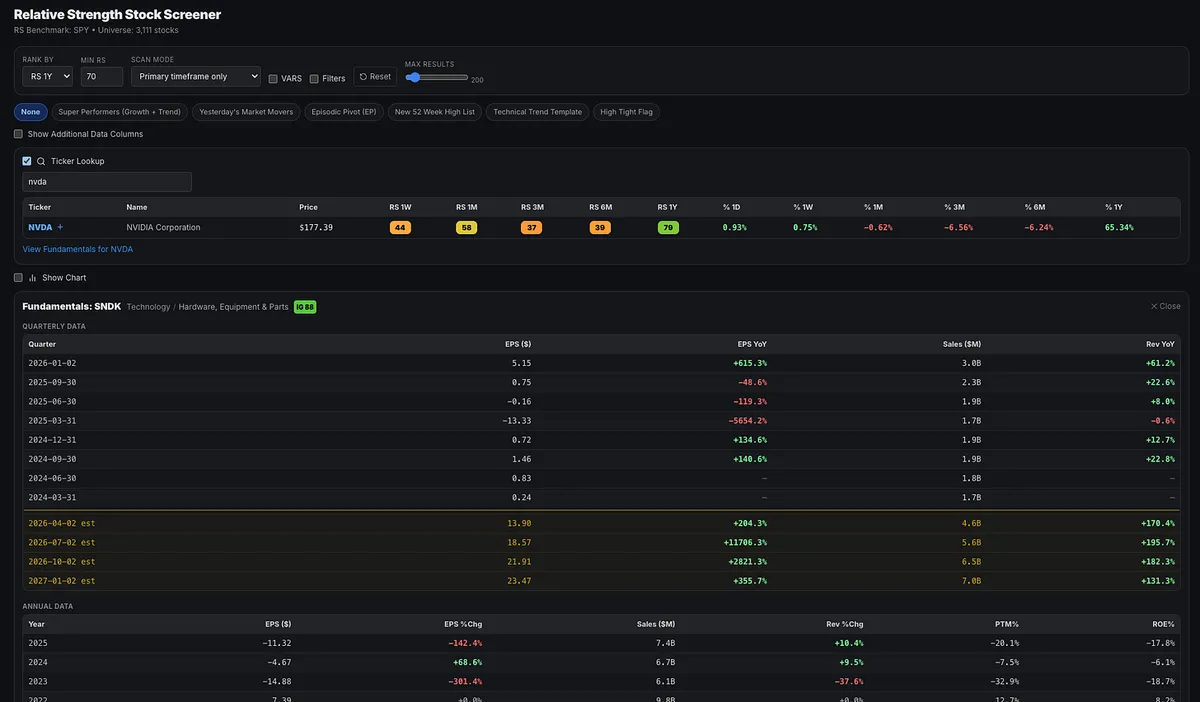
This includes the market overview dashboard, the relative strength dashboard, and a robust relative strength stock screener that integrates earnings, sales, pre-tax margins, return on equity, relative strength, and a wide range of additional filters. You also have access to a built-in watch list, position sizing tools, risk management tools, and ongoing platform enhancements.

The Relative Strength Stock Screener alone provides functionality comparable to many platforms that charge between $50 and $150 per month.

In addition, you get access to the Momentum Trading Strategy course, which teaches the complete framework built on the principles used by traders such as Jesse Livermore, Nicolas Darvas, William O’Neil, Mark Minervini, and Dan Zanger, along with insights drawn from many of the greatest market participants. The depth of this material is comparable to courses that cost hundreds or even thousands of dollars.

When market conditions are favorable, you will also receive stock ideas with defined buy zones and risk levels, along with shared screens and ongoing insights into how to apply the process in real time.

This is not just access to content or tools. It is a complete, integrated framework designed to help you identify market leaders and execute with discipline.

This is only the beginning.

View on Substack ↗

The News Is Loud. Price Pays.

I’ve made money from news catalysts.

Earnings surprises.

FDA approvals.

Government contracts.

But…

Most of my trading comes down to following price and trend.

A lot of the stocks I trade still have strong fundamentals. Big earnings. Strong sales. Expanding margins. Usually something new driving those numbers.

They often check the CANSLIM boxes.

So it’s not that the news doesn’t matter.

But price and volume tell you if institutions are actually acting on it.

That’s what I’m focused on.

I’m not trying to predict the news.

I’m reacting to what price does after it hits.

It’s actually kind of funny.

I don’t trade macro.

I don’t try to figure out geopolitics.

I don’t position based on what I think is going to happen in the world.

I don’t try to predict long term debt cycles or shifts in the global order.

But I do enjoy it.

I’ll listen to it. Watch it. Think about it.

It’s interesting. It’s mentally stimulating.

It’s just not how I make money.

And honestly, I don’t think many traders are consistently successful that way. There are a few. But for most, there are simpler and more repeatable approaches.

For me, it always comes back to the same thing.

Price.

View on Substack ↗

Module 4 of the Momentum Trading Strategy course is now live.

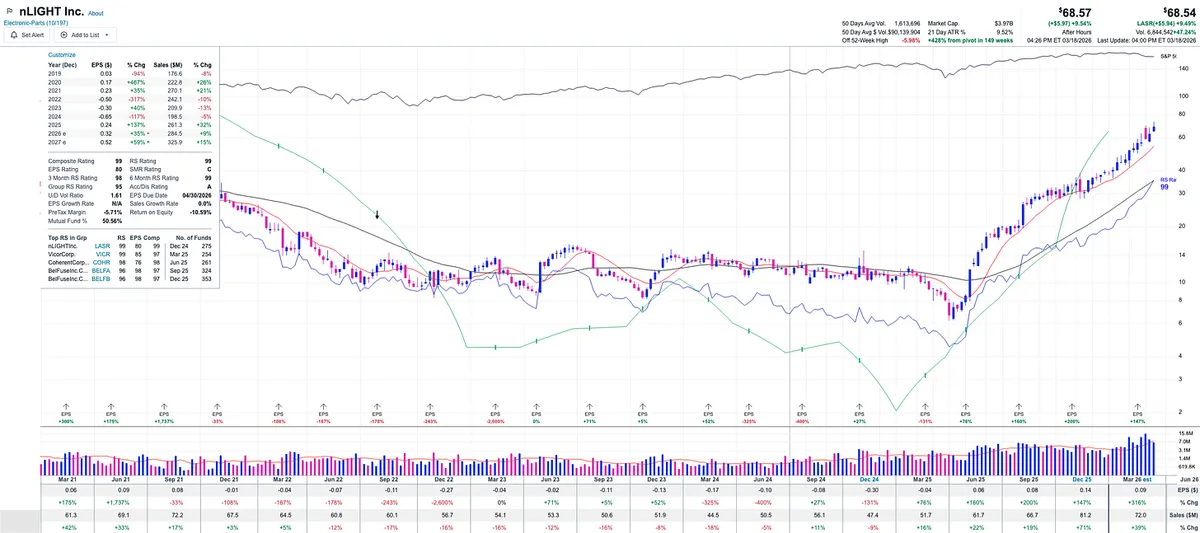
This is where everything starts to come together. We break down how to identify true market leaders using both fundamental and technical criteria, walk through real screening processes, and cover the exact chart setups used by top traders over the past 100 years.

With the market currently trading below the 200-day moving average, conditions are not ideal. This is exactly when you should be learning, refining your process, and preparing.

Better environments will come. The traders who are ready will be the ones who capitalize.

Module 4 is available now for all paid subscribers.

Get prepared.

https://tradingmomentum.substack.com/p/momentum-trading-strategy-the-100-de7

On SubstackMomentum Trading Strategy: The 100-Year Playbook Behind the Biggest Winning Stocks — Module 4
View on Substack ↗

Stop Reading About the Market. Start Watching It.

A Harvard professor once gave his students a simple assignment: study fish.

They did what most people do. They read books. Took notes. Wrote impressive reports.

He threw them all in the trash.

Then he gave them the real assignment: Sit in front of a fishbowl and watch for hours.

Only then did they begin to understand.

That is the stock market.

Most traders are still in the library.

They read news. Scroll X. Watch YouTube. Chase opinions.

If you want to get better, you need to shift from information to observation.

Watch price. Watch volume. Watch how leading stocks behave. Watch how the indexes act at key levels.

Because the truth is simple:

The market tells you everything. But only if you are actually looking.

The best traders are not guessing. They are observing patterns in real time.

They see when strength is real. They recognize when weakness begins. They feel when conditions shift.

That is how you survive tops. That is how you reenter when everyone is still bearish. That is how you build confidence that is not based on hope.

Do this every day for a few years and you will start to see what most never do. Go through a bull market, a sideways grind, and a bear cycle and your understanding will deepen.

Stay with it for 5 to 10 years.

That is when things really start to click.

View on Substack ↗

10 Reasons Traders Fail (And How to Stop Being One of Them)

If you’ve been struggling, go through this list honestly. Somewhere in here is the leak in your system.

1. Not Cutting Losses This is the big one. Small losses turn into account killers when you refuse to exit. Every great trader protects capital first.

“The elements of good trading are: (1) cutting losses, (2) cutting losses, and (3) cutting losses. If you can follow these three rules, you may have a chance.” — Ed Seykota

2. Averaging Down

“Losers average losers.” — Paul Tudor Jones

Adding to a losing position isn’t conviction. It’s denial.

3. Poor Selection Criteria If you’re trading weak stocks with no strength, don’t expect strong results. Stock selection is part of the edge.

4. Overtrading (Especially in Bad Markets) Not every environment is meant to be traded. Sometimes the best trade is no trade. Overtrading leads to subpar setups and drifting away from your process.

"It's easy to design a Holy Grail system for any one market type... It's insane to expect that trading system to work in all market types." - Dr. Van K. Tharp

5. Not Understanding Risk–Reward You can be right less than 50% of the time and still win, if your winners are bigger than your losers. Most traders have this backwards.

6. No Real Risk Management or Position Sizing Knowing where to stop out means nothing if your size is too big. Risk per trade must be defined before you enter.

7. Constantly Changing Strategies New indicators. New systems. New approaches. System hopping.

8. Lack of Discipline and Patience Waiting is part of the job. Most traders lose because they act when they should be sitting still and they are sitting still when they should be acting. Not following your own rules is a discipline problem. You don’t need better rules, you need to actually follow the ones you already have.

9. No Plan for Managing or Selling Trades Entries get all the attention. But exits determine your P&L.

10. No Understanding of Exposure Pressing when things aren’t working. Playing small when they are. You have to scale with your performance and the market.

“Decrease your trading volume when you are trading poorly; increase your volume when you are trading well.” — Paul Tudor Jones

And One More Thing…

You can follow every rule above perfectly, but if your system has no positive expectancy, none of it matters.

If your strategy doesn’t mathematically work over time, discipline won’t save you.

But here’s the part most people don’t want to hear…

Even if I gave you a proven strategy with a real edge, where all you had to do was click buy and sell, most people would still fail.

Not because the system doesn’t work. Because they won’t follow it.

This is exactly what Richard Dennis proved with the Turtle Traders.

He took ordinary people from completely different backgrounds and taught them a simple, rules-based trend following system. Many of them went on to produce exceptional returns and outperformed seasoned professionals.

At the same time, others failed.

Same rules. Same system. Different outcomes.

The difference was discipline and psychology.

“I always say that you could publish trading rules in the newspaper and no one would follow them. The key is consistency and discipline.” - Richard Dennis

That’s the truth most traders don’t want to hear.

It’s not your indicators. It’s not your system. It’s not that you need more information.

It’s that you’re not doing what you already know you should be doing.

And until you fix that, it will continue to show up in your trading.

“Win or lose, everyone gets what they want out of the market. Some people seem to like to lose, so they win by losing money.”

— Ed Seykota

View on Substack ↗

The Hard Truth About Becoming a Profitable Trader

For those pursuing this path or struggling right now… I had a great conversation today and wanted to share part of my response in case it helps someone else.

I truly believe you can do this. If others have done it, there’s no reason you can’t. The path just looks different for everyone.

Over the years working with traders, I’ve seen the roadblocks vary a lot. Some people don’t have a system with a real edge. Others struggle with self-sabotage, letting losses run or hesitating to execute out of fear. Some actually have a solid system but don’t understand position sizing, so they fail.

But the common thread among those who eventually make it is this: they don’t just work hard, they get brutally honest with themselves. They’re willing to identify what they’re doing wrong and fix it.

If you’re not profitable yet, focus on finding the specific thing or things that are holding you back. Then attack that weakness directly and keep refining.

Yes, it can take time. For some it’s a couple of years, for others it’s longer. Five to ten years for many of the best. The difference isn’t just effort, it’s the willingness to improve and take responsibility. A lot of people won’t put in the level of work required, and many never look inward. They just blame the market.

The ones who succeed do neither.

And one last thing. None of this matters if you don’t learn how to be happy now. Like Tom Basso says, enjoy the ride. Most people think happiness comes later, after the success, but if you can’t be content with what you already have, more won’t fix that. You’ll get there and still feel empty.

There are plenty of traders who have mastered the market but built an empty life along the way, constantly trying to fill that gap with attention or validation. Don’t fall into that trap. Build both at the same time.

At the end of the day, trading isn’t just a financial journey, it’s a self-help journey that, for me, made me a better person.

And rule number one in life is simple… be a good dude or dudette.

View on Substack ↗

Why Growth Stocks Offer a Bigger Edge

Most people assume the market is fully efficient.

It is not.

And the inefficiency is not evenly distributed.

Large, mature value companies are heavily covered. They have predictable business models. Cash flows are stable. Analysts have years of data to work with.

That makes them easier to model.

Estimates tend to be tighter. Expectations are more accurate. There is less room for surprise.

That means less opportunity.

Growth companies are different.

They are earlier in their lifecycle. They are changing quickly. New products, new markets, shifting demand.

This makes them harder to predict.

Analysts are often behind. Estimates are frequently wrong. Revisions come late.

This is where the edge comes from.

When a company begins to accelerate earnings and sales, the market starts to recognize it before the models fully adjust.

Institutions move early. Price begins to trend. Then analysts catch up.

That gap between reality and expectations is where the biggest moves happen.

This is why the greatest winners are almost always growth stocks.

Not because they are “better” companies.

But because they are less efficiently priced.

And in markets, inefficiency is opportunity.

View on Substack ↗

AI Won’t Make You a Better Trader (This Will)

Everyone is excited about AI in trading right now. New tools, better scanners, faster data. It feels like this is the edge everyone has been waiting for.

But let me ask you something…

If AI was the answer, why hasn’t the average trader improved?

The truth is simple.

AI does not replace understanding.

It amplifies it.

If you don’t understand how markets actually work… If you don’t understand your strategy… If you don’t know what a high-quality setup looks like…

Then AI just gives you more noise, faster.

And that’s exactly what’s happening.

More tools. More data. More confusion.

No better results.

Now flip it the other way.

A trader who understands price, structure, and leadership can take those same tools and suddenly become more precise, faster, and more efficient.

Same tools. Different outcome.

That’s the difference.

This is exactly why I’ve been building out a trading course here.

Because the real edge has never been the tool.

It’s the knowledge and experience behind how to use it.

Once you have that, everything changes.

View on Substack ↗

Every Trader Knows This. But Most Don’t Act On It.

Every trader would agree with this:

No single strategy works in every market environment.

Momentum strategies struggle in choppy markets.

Mean reversion struggles during strong trends.

Yet most traders never stop to ask a critical question:

What kind of market environment are we actually in right now?

Instead, they keep applying the same strategy regardless of conditions.

If you fail to analyze the broader market environment, you may end up trading in conditions that are completely misaligned with your strategy.

This principle doesn’t just apply to momentum or trend-following systems.

It applies to every trading style.

As Dr. Van Tharp explains:

“You need to understand how your system works in various market types and use it only in the types of markets for which it was designed. The common mistake most people make is trying to find a system that works in all market conditions. That’s insane.”

In other words:

Success in trading isn’t just about finding the right strategy.

It’s about using the right strategy in the right environment.

Module 2 and Module 3 of the Momentum Trading Course walk through how to evaluate and frame the market environment.

Start here: https://tradingmomentum.substack.com/p/momentum-trading-strategy-the-100-56a

On SubstackMomentum Trading Strategy: The 100-Year Playbook Behind the Biggest Winning Stocks — Module 3
View on Substack ↗

Trading Is Not One Skill. It Is Many.

People say you should specialize in trading.

They are right.

But you still need to be good in many different areas as well.

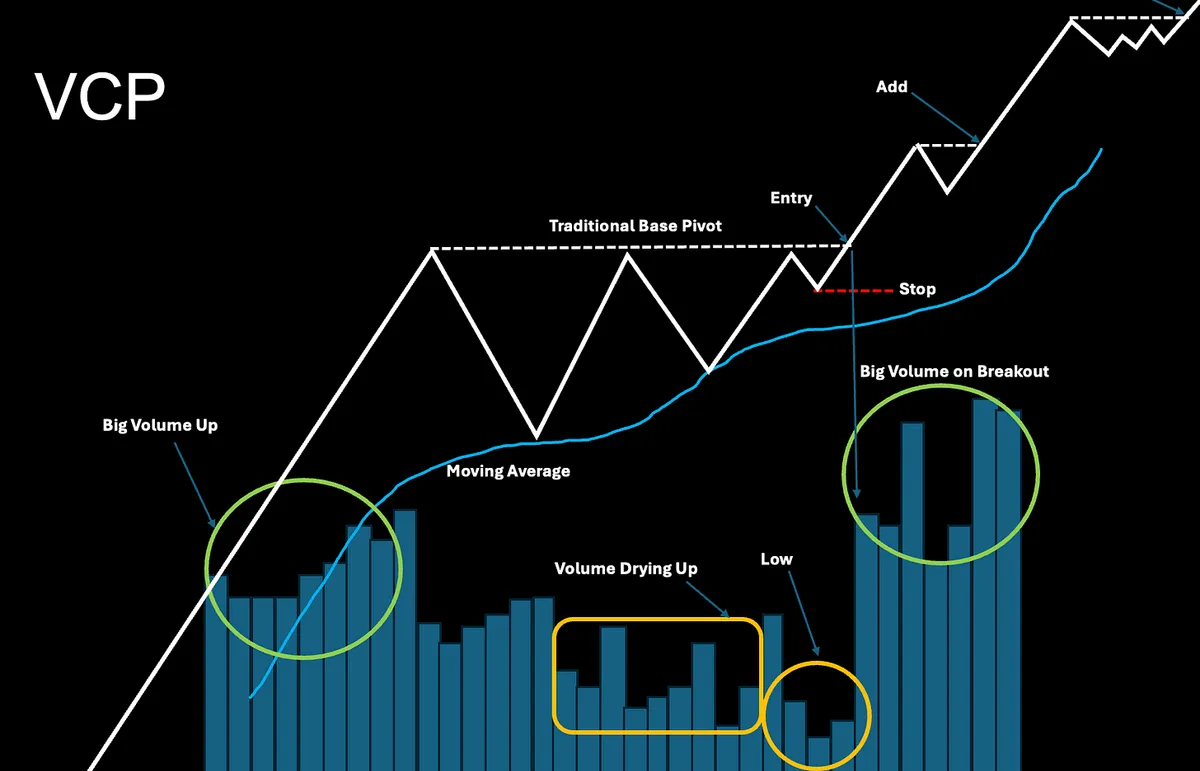
Yes, you might specialize in growth stocks or setups like VCPs, episodic pivots, or high tight flags.

But even inside that specialization, surviving in the market requires competence across multiple skills.

You still need to be a bit of a jack of all trades, even if you master one specific area.

You must be good at many different skills at the same time.

For example.

You could be the best stock picker in the room.

You scan relentlessly. You read charts perfectly. You identify catalysts like new products, new services, or accelerating fundamentals before the crowd.

But if you cannot control risk… If you oversize positions… If your emotions cause you to break your risk plan…

You will not make it.

On the other hand, you might have incredible discipline.

You cut losses fast. You size positions correctly. You follow your rules.

But if you cannot consistently find A+ setups, then you have no real edge.

You might survive.

But you will not thrive.

Great traders understand something most people miss.

Trading is a combination of skills.

You must be strong in several areas at once:

• Finding stocks in play

• Identifying A+ setups within your strategy

• Developing a process and system with positive expectancy

• Managing risk and position sizing

• Controlling emotions and staying disciplined

You do not need to be perfect at any one of them.

But if you are weak in just one, the market will find it.

And eventually it will cost you.

That is why trading is so difficult.

It is not mastery of one skill.

It is competence across many.

View on Substack ↗

Most traders are learning the market the wrong way.

They start with indicators.

Or tips.

Or someone else’s watchlist.

But if you spend enough time in markets, you eventually realize something important.

Nobody can trade for you.

No one can tell you exactly when to buy. No one can tell you when to sell. And no one can manage your risk except you.

That’s why most traders eventually fail when they rely on tips.

They never build a real process.

The traders who last in this business do something different.

They study the greats who came before them.

Jesse Livermore

William O’Neil

Nicolas Darvas

Mark Minervini

Different decades.

Different markets.

But they were all using variations of the same core momentum principles.

Why?

Because one thing has never changed.

Human behavior.

Fear. Greed. Crowd psychology. Supply and demand.

That’s the foundation of the Momentum Trading Strategy I teach.

A framework built from studying 100 years of the greatest stock market winners and the traders who captured them.

It’s the same system I’ve refined over 20 years in the market trading growth stocks and market leaders.

I finally decided to turn it into a full course.

Inside the course we cover:

  • How to identify true market leaders

  • Understanding market structure

  • The exact setups used by momentum traders

  • Risk management and position sizing

  • Managing winning trades

  • Building a complete trading plan

  • The psychology required to execute it

In other words…

The full playbook behind momentum trading.

Module 1 and Module 2 are already live. Modules 3 and 4 are coming shortly.

Each new module is released to paid subscribers as it’s completed.

If you want to learn the same principles used by the greatest traders over the past century, you can start the course below.

https://tradingmomentum.substack.com/p/momentum-trading-strategy-the-100

On SubstackMomentum Trading Strategy: The 100-Year Playbook Behind the Biggest Winning Stocks
View on Substack ↗

One of the most powerful trading ideas I’ve ever seen comes from Ed Seykota.

He called it the “discrepancy report.”

Here’s the idea. 

You build a trading system with clear rules: 

• entries 

• position sizing 

• risk management 

• exits 

Then you compare two things every day. 

  1. What your system said to do.

  2. What you actually did.

The difference between those two is the discrepancy report.

And that report tells you everything you need to know about your trading. 

Did you skip valid trades? 

Did you chase something not in your system? 

Did you hold a loser longer than your rules allow? 

Did you size bigger than your plan? 

If there is no discrepancy, you followed your system. 

If there is a discrepancy, you didn’t. 

Ed Seykota’s point was simple: 

When traders see discrepancies, they have two options. 

  1. Improve the system. 

  2. Improve themselves. 

Most traders choose a third option. 

They ignore the discrepancy. 

But that gap between what you planned and what you actually did is where almost every trading problem lives. 

Not in the strategy. 

In the execution.

View on Substack ↗

The 4 Rules That Separate Average Investors From Superperformers

Most people are taught the wrong things about the stock market.

Turn on financial TV and you will hear the same advice repeated over and over:

You cannot time the market. Diversify widely. Buy and hold. Trade less.

But traders who achieve true superperformance do something very different.

Mark Minervini laid out four key principles that helped him turn a small account into millions and win the U.S. Investing Championship.

Here they are.

1. Yes, You Can Time the Market

Most experts say market timing is impossible.

Yet every great trader times the market.

Not by predicting the future.

By waiting for specific conditions and precise setups.

When the odds are in your favor, you act.

When they are not, you stay out.

Timing is everything because asymmetric opportunities require precision.

2. Overdiversification Kills Performance

Owning too many stocks dilutes your results.

If you want broad diversification, you might as well just buy an index ETF like SPY or QQQ.

Great traders focus on a small number of high-conviction opportunities.

Concentration is what allows a big winner to actually move your portfolio.

3. Turnover Is an Advantage

Wall Street funds often hold positions for long periods.

Not because it is optimal.

Because they have billions to manage.

Individual traders have a massive advantage.

You can enter quickly. You can exit quickly. You can move capital to the best opportunities.

Flexibility is one of your greatest edges.

4. Always Demand Asymmetric Risk vs Reward

Superperformance comes from repeatedly taking trades where the potential reward greatly outweighs the risk.

Small losses are part of the process.

The goal is simple.

Lose small. Win big.

A trading system built around low risk entries and large upside potential allows a few big winners to drive your results.

Most investors try to be right most of the time.

Great traders focus on making sure their winners are much bigger than their losers.

That is how superperformance is built.

View on Substack ↗

Trading Strategies Do Not Work in Every Market Environment

Many traders struggle not because they cannot identify strong stocks or quality setups.

They struggle because they trade those setups in the wrong market environment.

In Module 2 of the Momentum Trading Strategy Course, we focus on developing a deeper understanding of market conditions. We discuss when the environment supports momentum and when it does not.

As Dr. Van Tharp explains:

“The common mistake most people make in designing systems is to try to find a system that works in all market conditions. That’s insane.”

Understanding the market environment helps traders align their strategy with conditions and avoid forcing trades when the odds are not in their favor.

Read the full lesson here: https://tradingmomentum.substack.com/p/momentum-trading-strategy-the-100-e6c

On SubstackMomentum Trading Strategy: The 100-Year Playbook Behind the Biggest Winning Stocks — Module 2