Momentum Trading Strategy

Notes

Trading Psychology & Mindset

The inner game: the emotions, beliefs and habits that decide whether a trader follows a plan.

Showing 141–160 of 235 notes

View on Substack ↗

The Market Does Not Care What You Paid

William O’Neil said something simple that most traders ignore:

Your purchase price means nothing to the market.

But it means everything to your ego.

Early on, I would hold losers because I “wanted my money back.”

The stock would drop 8 percent. Then 12 percent. Then 20 percent.

And instead of asking, “Is this acting right?”

I was thinking, “I just need it back to my cost.”

That one thought cost me more than any pattern mistake ever did.

The best traders in Market Wizards all had one thing in common:

They did not defend positions. They defended capital.

Your cost basis is not support. The 50 day moving average is. The prior breakout level is. Volume behavior is.

The market does not know where you bought.

It only knows supply and demand.

Once I stopped managing my ego and started managing risk, my equity curve changed.

Cut losses at 5 to 8 percent. Add only to strength. Never argue with price.

The market does not reward hope.

It rewards discipline.

Press winners. Cut losers.

View on Substack ↗

Geopolitical Headlines Get Priced In Faster Than You Think

Anyone that has been in the markets for a minute knows geopolitical flare ups like what we are seeing with Iran usually get priced in fast.

It is completely normal to see markets drop on the initial headline shock.

Oil spikes. Futures dip.

Then something interesting happens.

By the end of the week, a lot of that fear gets absorbed.

I am not a macro guy. I do not base my trading on any news feed. I do not trade headlines.

I will decide what to do based on price action and my criteria for stock picking. That is it.

But a lot of new traders get spun up in this stuff.

They see red futures and assume this is the start of something catastrophic.

Historically, most geopolitical shocks create an initial drop. Then they get priced in faster than people expect.

Markets are forward looking machines.

Unless there is a prolonged structural disruption, we often see fear fade and price recover quicker than the crowd thinks is possible.

I do not have a crystal ball.

I am just saying this is not something to panic over.

Watch price.

Stick to your rules. Focus on what you can control.

Let the market tell you what matters.

View on Substack ↗

Even Druckenmiller Fought His Mind

Why Mastering Yourself Is the Real Edge

At the end of his Morgan Stanley interview, Stanley Druckenmiller did something rare.

He was brutally honest about the mental battle.

Talking about mistakes and drawdowns, he said:

“I have so many scars. You can't believe it.”

On the Nasdaq melt up:

“I got emotional, which I fight every day.”

He even admitted:

“I would literally like throw up like once or twice a week, just from anxiety…”

And later:

“I had imposter syndrome for like 15 years.”

Think about that.

One of the greatest money managers of the last 40 years. 30 percent annualized. No losing years at Duquesne.

And he battled anxiety. Emotion. Self doubt.

This is the part no one talks about.

The market is not just analysis.

It is emotional regulation.

You will:

  • Get emotional

  • Doubt yourself

  • Feel pressure

  • Question your edge

The difference is not avoiding those feelings.

It is managing them.

Even Druckenmiller says you will continue to make mistakes and get emotional.

Mindset is not optional in this game.

It is the game.

View on Substack ↗

Stanley Druckenmiller on Intellectual Satisfaction vs Making Money

Druckenmiller said something very honest:

“I get some intellectual satisfaction out of playing in the 20%.”

But right before that he made the real point:

“I think contrarianism is overrated.”

And:

“Soros used to say the crowd's right 80% of the time.”

There it is.

Being contrarian feels smart. It stimulates the mind. It gives you that “I see what others don’t” rush.

I see a lot of overly intellectual, contrarian investment newsletters. I listen to them too sometimes. It is interesting. It is stimulating.

But if I am honest, it does almost nothing for my account.

It is entertainment.

The consistent money is less sexy.

Trend following. Relative strength. Risk management.

Not intellectual superiority.

Even Druckenmiller admits the 20% is intellectually satisfying.

But the 80% is where the money is.

View on Substack ↗

Markets Pay Discipline, Not Genius

In Stanley Druckenmiller’s recent interview he said:

“My advantage is not IQ. It's trigger pulling.”

That shows up again and again in Market Wizards.

Many think you need to be a genius to win in markets.

You do not.

You need:

  • Discipline

  • Risk control

  • Emotional stability

  • The ability to act decisively

Druckenmiller even said he was not top of his class and that people think he is smarter than he is.

What separates the greats is not raw intelligence.

It is execution.

Emotional intelligence matters more than IQ in this game.

The market does not reward the smartest person in the room.

It rewards the one who can see it, size it, and pull the trigger without losing control.

View on Substack ↗

Stanley Druckenmiller on Why Trend Beats Ego

Lots of great wisdom from Stan Druckenmiller in his recent interview with Morgan Stanley.

One line stood out:

“I think contrarianism is overrated.”

He doubles down with:

“Soros used to say the crowd's right 80% of the time. You just can't be caught in the other 20% because you can get your head handed to you.”

And then makes it simple:

“I don't care if a trade is crowded, if I think the thesis is right and the trend is with me.”

This is one of our core rules:

Follow the Trend.

Not because it feels good. Not because it is popular.

Because probability favors alignment over ego.

View on Substack ↗

The 50/80 Rule and Why You Must Never Fall in Love With a Stock

I once heard Mark Minervini say something that every trader should remember.

50 percent of past leaders once they top will go down 80 percent.

80 percent of past leaders will go down at least 50 percent.

Think about that.

The biggest winners of the bull market. The strongest charts. The companies with explosive earnings and dominant narratives.

Half of them will eventually collapse by 80 percent. Most will lose at least half their value.

This is why you cannot fall in love with your stocks.

It always starts the same way.

You admire the company. You believe in the product. You made great money in it before.

Now it feels familiar. Personal. Safe.

That is when it becomes dangerous.

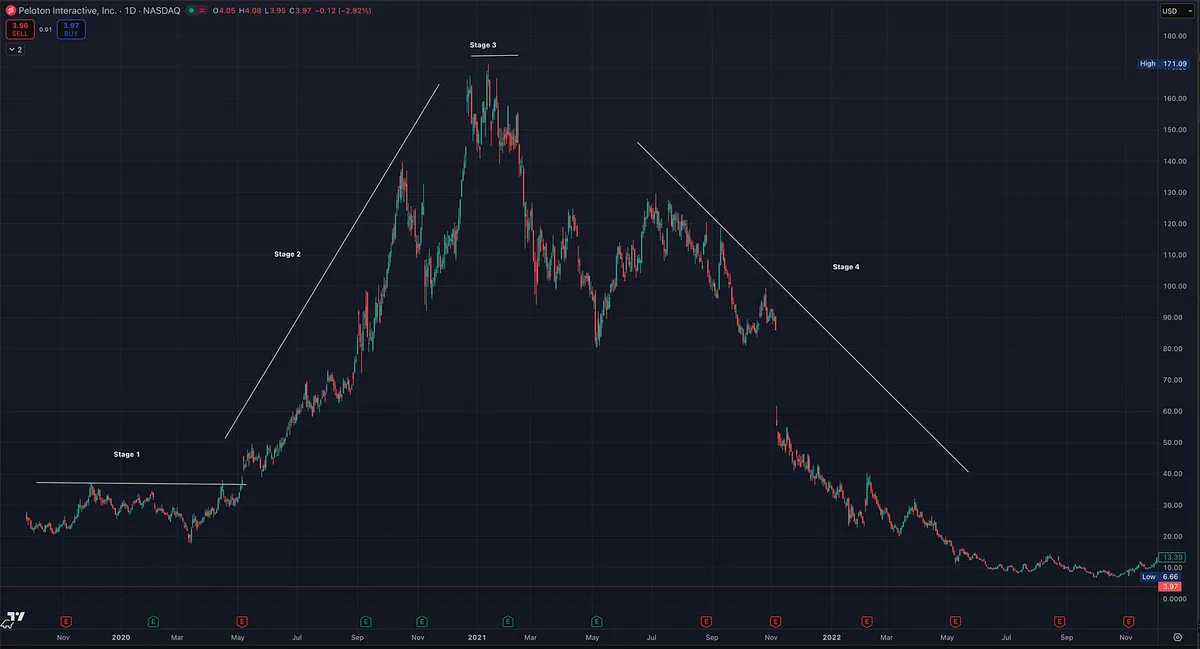
Stan Weinstein outlined the four stages of a stock cycle in Secrets for Profiting in Bull and Bear Markets . Stage 2 is where fortunes are made. Institutional accumulation drives powerful advances. That is where you press your advantage.

But Stage 4 is different.

Stage 4 is distribution. Stage 4 is broken structure. Stage 4 is long, grinding declines that destroy capital and confidence.

Once a stock transitions from leadership to deterioration, the risk profile changes completely.

If earnings and sales momentum slows. If relative strength fades. If price breaks key support. If rallies become weaker and selling becomes heavier.

You get out.

There is no way to know how far down it will go.

That is the illusion that traps investors.

They wait for it to bounce. They wait to get back to even. They tell themselves it cannot fall much further.

But a stock down 30 percent can go down 50 percent. A stock down 50 percent can go down 80 percent.

A 50 percent decline requires a 100 percent gain just to recover. An 80 percent decline requires a 400 percent gain.

The market does not care how great the company is. It does not care how much you love the story. It does not care what price you paid.

Leaders lead on the way up and they can devastate portfolios on the way down.

Great traders are not loyal to stocks. They are loyal to their process.

When the characteristics change, they act.

Love your craft. Love your discipline.

But never fall in love with your stocks.

View on Substack ↗

Most Traders Want Results. The Professionals Focus on Process.

One thing that becomes obvious when you study the great traders across history is this:

They did not become profitable overnight.

Jesse Livermore didn’t.

Gerald Loeb didn’t.

Nicolas Darvas didn’t.

William O’Neil didn’t.

And neither did the modern growth traders people admire today.

It took years.

Years of refining rules. Years of mistakes. Years of emotional discipline. Years of learning what not to do.

Trading is treated casually by most people because it looks simple on the surface. Click buy. Click sell. Watch the screen.

But the reality is this:

Trading is a profession.

And like any profession, mastery takes time.

The problem is that most people approach the market focused on the outcome.

How much can I make? How fast can I grow this account? What stock will double next?

But there is a paradox in markets.

When you obsess over the result, you usually sabotage it.

You hesitate to cut losses. You size too big. You chase. You revenge trade.

The professionals focus on something else.

They focus on process.

They define what they buy. They define when they buy. They define when they exit. They manage risk first. They let probability do the heavy lifting.

The result becomes a byproduct of disciplined execution.

Markets change structurally. Technology evolves. Speed increases.

But human nature has not changed.

Fear and greed still drive price. Supply and demand still govern movement. Leadership still concentrates in a small group of names during strong cycles.

If you want long-term success in momentum and growth trading, the shift is simple but difficult:

Stop chasing results. Start building process.

Everything compounds from there.

View on Substack ↗

Trade Your Biggest When You’re Trading Your Best

Most traders do the opposite of what they should.

They press when they are cold.

They hesitate when they are hot.

Professionals do the reverse.

When you are trading well, seeing the market clearly, executing cleanly, and building a cushion, that is when you can responsibly increase exposure.

When you are struggling, you cut back.

If you keep struggling, you cut back more.

If you are really off, you go to cash and step away.

This is not about ego.

It is about self-awareness.

You earn the right to trade bigger.

You lose that right when your performance deteriorates.

High conviction trades. A+ setups. Strong market tone. A cushion of profits behind you.

That is when size can increase.

But when you are out of sync, even good setups can fail in your hands.

That is your signal.

Reduce exposure.

Lower position size.

Simplify.

Zoom out.

Both O’Neil and Minervini emphasize capital preservation and staying aligned with market conditions. They stress that no setup works in all environments and that risk control is always first.

But here is the part nobody can give you:

No book can tell you exactly when to scale up.

No system can automatically tell you when to step back.

IBD cannot tell you.

I cannot tell you.

You have to develop the awareness to recognize when you are in sync and when you are not.

Because no strategy, no pattern, no edge works if the operator behind it lacks self-management.

This is a performance business.

Size is a privilege.

You build it through discipline.

And you protect it through restraint.

View on Substack ↗

Trading Is Like An Insurance Company…

An insurance company cannot predict which specific house will burn down this year.

But it can predict, with remarkable accuracy, how many houses out of 100,000 will burn down.

That is how it stays in business.

Trading works the same way.

You cannot predict with certainty which individual trade will become a huge winner.

You cannot know in advance which breakout will fail.

But over a large enough sample size, if you have a structured edge and controlled risk, you can predict that your system will produce positive expectancy.

Now here is the nuance.

We are not randomly insuring houses.

We are underwriting selectively.

When we see:

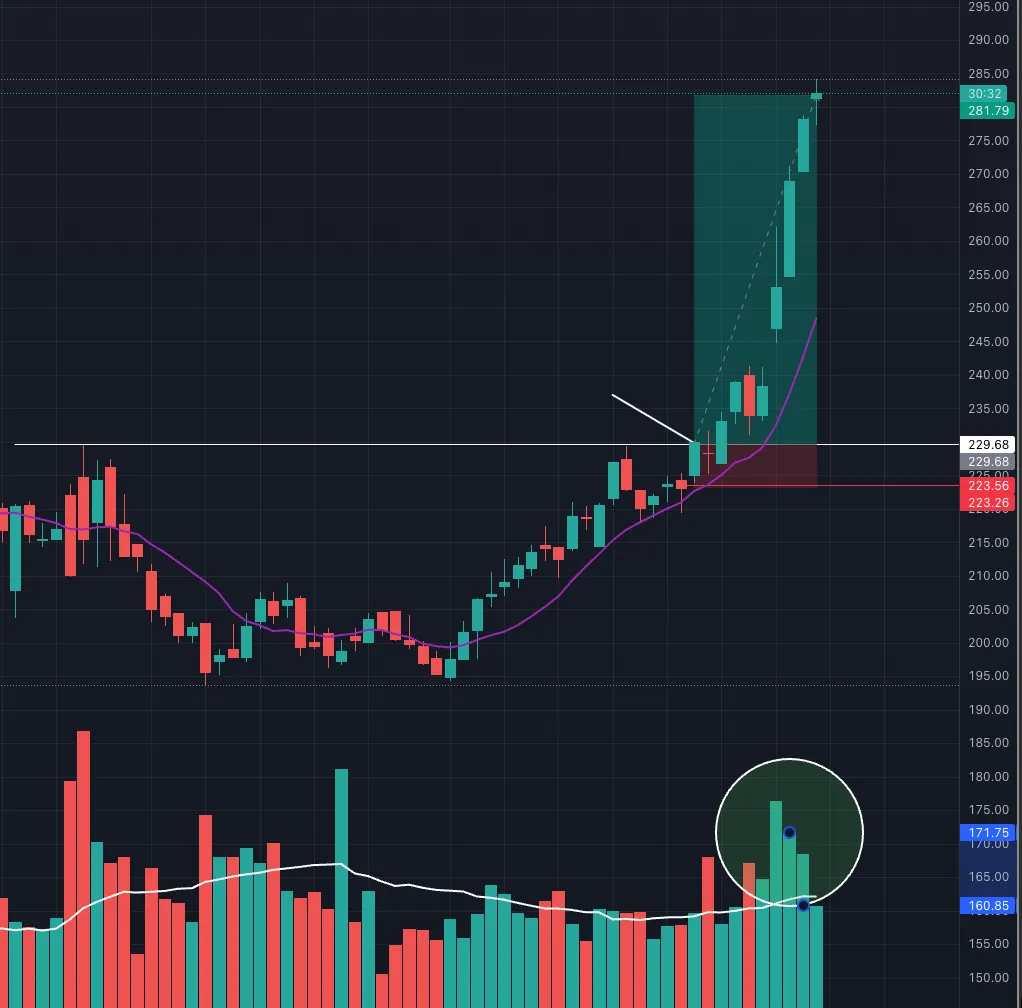
A powerful expansion in price on heavy volume. Followed by orderly contraction. Volatility tightening with volume drying up. Then a breakout on explosive demand. Combined with strong earnings, sales growth, and institutional sponsorship.

That is not random.

That is supply being absorbed.

That is institutions accumulating.

That is probability increasing.

In that sense, we are forecasting.

We are identifying conditions that historically precede large moves.

We are stacking the odds in our favor.

But we still operate with humility.

Even the cleanest VCP setup can fail.

Even the strongest CANSLIM characteristics can disappoint.

That is why we never base our performance or confidence on a single trade.

Insurance companies do not rely on one policy.

They rely on the law of large numbers.

Professional traders operate the same way.

Over hundreds or thousands of trades:

There will be small losses. There will be break-even trades. There will be modest winners. And occasionally, there will be outliers.

Those outliers drive performance.

You do not predict them with certainty.

You position for them with probability.

The goal is not to be right every time.

The goal is to consistently take high-quality setups where:

If you are wrong, the loss is small. If you are right, the upside can be significant.

That is not gambling.

That is asymmetric probability applied over time.

You increase the odds.

You control the downside.

And you let the math work in your favor.

View on Substack ↗

Getting Stopped Out Does Not Mean the Stock Is Dead

One of the biggest mistakes traders make is emotionally discarding a stock after getting stopped out.

You take a small loss.

It feels like failure.

You move on.

Then weeks later, that same stock breaks out again and becomes the leader that defines the year.

Mark Minervini addresses this directly in Trade Like a Stock Market Wizard:

“Don’t discard a stock just because it stops you out if the fundamentals remain intact. Stay on the lookout for a failure reset. The failure pivot reset is similar to the base reset, except that it occurs during the formation of the entry point over a shorter period of time than the base reset. A pivot failure doesn’t necessarily cause an outright base failure. Instead, it can reset a new entry point, usually within a number of days or weeks.”

Read that carefully.

A failed breakout does not automatically mean the story is over.

Sometimes it simply resets the setup.

A pivot failure can shake out weak hands.

It can absorb supply.

It can create a cleaner, tighter entry.

Some of your biggest winners will not work the first time.

They will stop you out.

They will reset.

Then the next breakout will be the one that runs.

If the fundamentals remain intact and the structure repairs itself, the stock deserves another look.

Professionals do not take losses personally.

They take them as information.

The goal is not to avoid getting stopped out.

The goal is to stay objective enough to re-enter when the setup reappears.

Because sometimes the trade that stops you out is simply preparing you for the one that makes your year.

View on Substack ↗

The Problem With Bubbles That Most Investors Don’t Understand

Everyone screaming “AI bubble” is likely right.

But so what?

Bubbles can last for years.

In the meantime:

Are you sitting on the sidelines scared, missing one of the strongest profit environments of the decade?

Or are you blindly buying every dip pretending it can never end?

Both extremes lose.

Here’s the uncomfortable truth:

Some of the greatest wealth-building periods in history were bubbles.

The 1920s. The dot-com era.

For the disciplined trader or investor, those weren’t disasters.

They were life-changing.

Not because bubbles are safe.

But because strong trends plus expanding emotion create massive opportunity.

The mistake isn’t participating.

The mistake is participating without a plan.

Yes, bubbles eventually pop.

They always do.

But disciplined operators don’t ride them all the way back down.

They exit to cash.

They lock gains.

They protect capital.

Often making more in one bubble cycle than they made in several prior years combined.

Don’t fear bubbles.

Fear being unprepared for them.

Markets are human emotion.

Emotion is not rational.

And bubbles will always exist because human emotions make up the market.

The real question is simple:

Are you trading the bubble…

Or is the bubble trading you?

View on Substack ↗

Why Most Traders Fail When They Go Live

I recommend traders use a simulator first.

Not to pretend trade.

Not to chase dopamine.

But to prove they actually have an edge.

If you cannot demonstrate profitability in a simulator over a meaningful sample size, going live will not magically fix that.

Simulation builds two things:

  1. Proof of edge

  2. Confidence in your process

Both matter.

But here is where many traders get blindsided.

They crush it in sim.

Then they go live… and fall apart.

Why?

Because real money changes everything.

It introduces fear.

It introduces hesitation.

It introduces the pain of loss.

That is why I recommend that once you go live, you trade with an amount that is small but meaningful.

Small enough that you can afford to lose it.

Large enough that you feel it.

You must learn how to manage your emotions with real capital at risk. That skill cannot be simulated.

View on Substack ↗

Time Flies Anyway. Start Today.

You’ve heard the saying.

People overestimate what they can accomplish in one year.

And underestimate what they can accomplish in five to ten.

That is especially true in trading.

Many quit because it doesn’t make them rich in one or two years.

They expect mastery. They expect consistency. They expect financial freedom.

Fast.

But trading is a skill.

And real skill compounds.

If I told you that five to ten years from now you could have financial freedom from this skill… would you call that a waste of time?

Of course not.

Yet people walk away because it didn’t happen in twelve months.

Here’s the uncomfortable truth:

Five years will pass anyway.

Ten years will pass anyway.

The only question is whether you will look back wishing you had spent that time learning… or wishing you hadn’t wasted it.

Imagine doing something every day that builds skill.

Studying charts. Reviewing trades. Managing risk correctly. Improving process.

Small progress daily.

That is how real traders are built.

Not in months.

In years.

Time is going to pass no matter what.

Start today.

View on Substack ↗

Struggling Right Now? Raise Your Standards.

“I just wait until there is money lying in the corner, and all I have to do is go over there and pick it up.”

—Jim Rogers

If you are struggling, the answer is usually not more trades.

It is better trades.

When performance slips, standards quietly slip with it.

A base that is almost clean.

Volume that is decent.

Market conditions that are mixed but maybe fine.

Close enough becomes good enough.

That is where drawdowns grow.

Raise the bar.

Only take A plus setups.

Clear structure.

Tight risk.

Explosive volume.

Strong relative strength.

Make sure the time frame you are trading aligns with the bigger time frame.

Make sure your stock aligns with the general market.

Make sure the wind is at your back.

If it is not obvious, skip it.

Selectivity protects capital.

Patience preserves clarity.

Alignment increases odds.

When in a slump, do less.

And do it better.

View on Substack ↗

Trading Is Not an IQ Test

Some of the most intelligent analysts in the world cannot make money trading their own analysis.

They understand the market. They see the logic. They know the fundamentals.

What they struggle with is execution.

In Market Wizards, Michael Marcus explained making more money trading someone else’s analysis than the analyst ever could themselves.

The knowledge was not the problem. Behavior was.

Trading does not reward intelligence alone. It rewards emotional control.

A trader can take partial knowledge and succeed. An analyst with superior knowledge can still fail.

The difference is discipline, risk control, and the ability to follow a system when things feel uncomfortable.

That is emotional intelligence.

View on Substack ↗

Do Not Fight Direction

“The trend is your friend.”

Ed Seykota, Market Wizards

Most traders get hurt trying to be early.

They fade strength.

They buy weakness.

They look for the turn before it exists.

Seykota did not need to predict.

Direction was enough.

When price is moving in one direction,

that information matters more than opinions.

You do not need to catch the top.

You do not need to call the bottom.

You need to participate while the trend is intact

and step aside when it changes.

Do not fight the current.

Go with it.

View on Substack ↗

Accept That Anything Can Happen

“Anything can happen.” -Mark Douglas

Most traders struggle because they secretly believe the market owes them certainty.

Douglas understood the opposite.

The moment you truly accept that anything can happen:

  • fear loses its grip

  • losses stop feeling personal

  • execution becomes calm

You stop trying to control outcomes

and start controlling risk and behavior.

That is where consistency begins.

Not in prediction.

In acceptance.

View on Substack ↗

“When a stock acts right, you don’t argue with it.”

-Jesse Livermore

Most traders argue with the market.

They explain why a strong stock should not be going up.

They justify holding weak ones because of fundamentals and opinions.

They argue that the market is wrong.

Livermore understood something simple and difficult.

Price is the final judge.

Strength is information.

Weakness is information.

Your job is not to debate it.

Your job is to respond correctly.

View on Substack ↗

Losses Are the Cost of Doing Business

“Losing is part of the business. If you cannot accept that, you cannot win.” -Marty Schwartz

Profitable traders do not avoid losses.

They plan for them.

Losses are not signals to rethink your identity.

They are expenses required to operate in uncertain markets.

When losses are expected:

  • position size stays disciplined

  • rules stay intact

  • confidence stays neutral

When losses are resisted:

  • emotions take control

  • process breaks down

  • drawdowns accelerate

The goal is not to eliminate losses.

The goal is to make sure no single loss can damage the business.

That is how professionals survive long enough to compound.