
Momentum Trading Strategy

Notes

Trading Psychology & Mindset

The inner game: the emotions, beliefs and habits that decide whether a trader follows a plan.

Showing 1–2 of 2 notes

$SPY ×
View on Substack ↗

Winning in Trading Demands Everything and Promises Nothing

Most people fail at trading because they start by treating it like a get rich quick game. When they realize it isn’t, they move on. This happens every cycle. A new group comes in, then quietly leaves.

Because of that, the hard truth is that most people would be better off consistently putting money each month into a simple ETF like SPY or QQQ and letting time do the work.

For the few who stay, the path looks very different.

They get their ass kicked.

They hit the books.

They get their ass kicked again.

They study more, test, execute, and eventually find a method with a real edge.

Just as important, they learn when and how to use that edge. That’s what gives them a chance.

Winning long term at trading requires far more than most people realize. It’s total commitment with no guarantees. It reminds me of a video I showed my boys who compete in sports:

“Winning requires all of you, and more, but it promises you nothing.”

-Lewis Caralla
View on Substack ↗

When emotions run high, zoom out

I’m a short-term trader.

I run a day trading account. I also run a swing and position trading account built around O’Neil and CANSLIM and I also have an account that does nothing fancy and consistently invests into SPY and QQQ.

You would think someone like me would be the most emotionally affected by short-term market moves.

I’m not.

A 2% down day like today is no big deal. It is not the end of the world, no matter how financial media or influencers try to frame it.

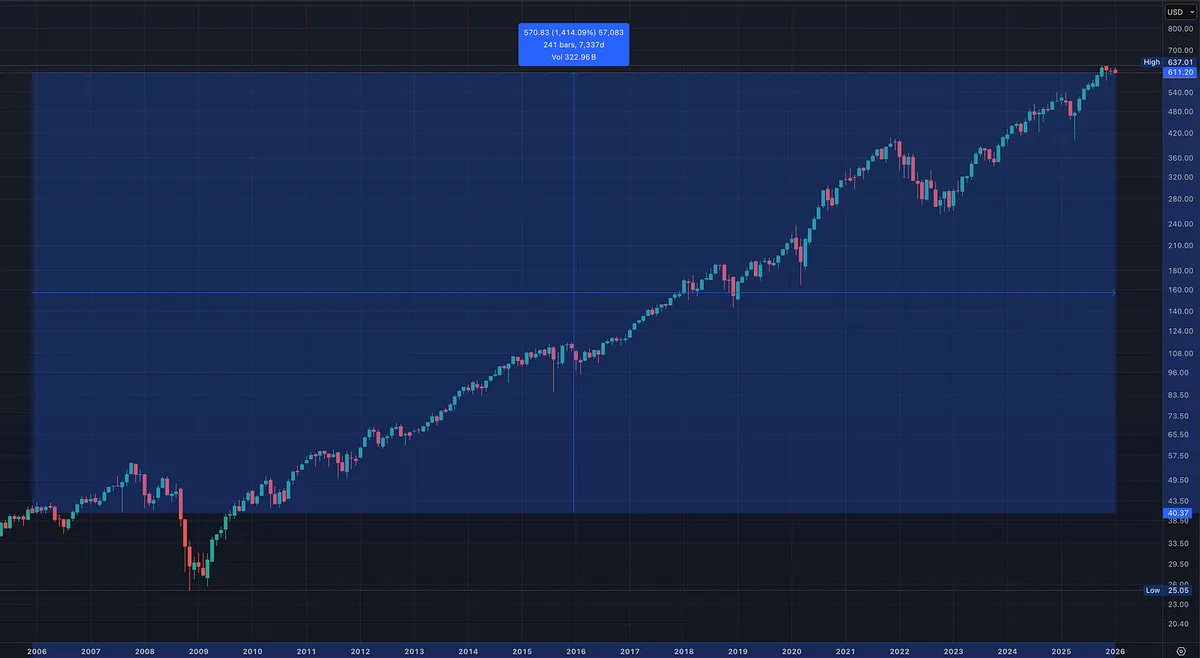
When in doubt, zoom out.

What always surprises me is how emotional people get over pullbacks, corrections, and even full bear markets. Most of these people are not short-term traders. They claim to be long-term investors with long time horizons, yet they panic at exactly the moments that long-term investors should expect.

Look at the last 20 years.

  • Tariff scares.

  • COVID.

  • The 2022 bear market.

  • 2018.

  • 2015.

  • 2011.

  • The Great Financial Crisis.

Even with all of that, the Nasdaq-100 is up over 1400% in the last two decades.

That perspective changes everything.

If normal volatility makes you emotional, that is feedback. It usually means one of two things. You are either gambling, struggle emotionally, or you do not truly understand markets or risk management.

Long-term investing is boring. It requires patience, discipline, and the ability to ignore noise.

The market does not reward emotional reactions. It rewards time, consistency, and perspective.

Zoom out.