Momentum Trading Strategy

Notes

Trading Psychology & Mindset

The inner game: the emotions, beliefs and habits that decide whether a trader follows a plan.

Showing 121–140 of 235 notes

View on Substack ↗

Why Macro Feels Smart but Keeps You Poor

Substack. Social media. News.

All full of macro takes that sound smart…

…but won’t make you money.

It feels intelligent. It sounds sophisticated. It gives you something to talk about.

But most of it is just mental stimulation…

Here’s the problem:

That content is designed to hook your emotions.

  • Fear headlines trigger stress, releasing cortisol and adrenaline

  • You get pulled into an amygdala hijack, reacting instead of thinking

  • Uncertainty keeps you glued to updates

  • Big narratives pull you away from price

It feels important.

But it’s noise.

And that noise leads to indecision.

On the flip side:

When the market is running, you feel great.

  • Dopamine kicks in, the same neurotransmitter tied to reward and excitement

  • Confidence rises

  • You start chasing

Now you’re driven by emotion again… just in the opposite direction.

This is the trap.

Fear when you should be getting involved. Excitement when you should be managing risk.

Most traders live in that cycle.

That’s why most traders lose.

This type of content is great for their business.

It keeps you engaged. It keeps you watching.

But it does not improve your execution.

That’s why everything I teach is built differently.

  • No narratives

  • No opinions

  • No emotional hooks

Just:

  • Price and Volume

  • Structure and Trend

  • Relative Strength and Leadership

  • Risk management and Position Sizing

Because the goal is not to feel smart.

The goal is to make money.

And those are two very different things.

That’s why I spend my time teaching a proven strategy you can actually execute.
View on Substack ↗

The News Will Keep You Broke

“I was thinking about selling… the situation looks worse than yesterday.”

That comment is one of the most valuable lessons a trader can learn from.

Because it captures exactly how most people think during turning points in the market.

The news feels urgent. The situation feels dangerous. It feels like risk is increasing.

So the natural reaction is to step aside or take profits.

I get it. That kind of news feels important in the moment.

But I’ve learned to largely ignore that type of analysis because it usually does one thing:

👉 It keeps you on the sidelines when you should be participating.

If you go back through history, this pattern shows up over and over again.

  • May 2025: Sentiment was extremely bearish. The NASDAQ-100 still rallied around 25%

  • Early 2023: Banking crisis headlines everywhere. The market pushed higher once it reclaimed key levels

  • April 2020: COVID panic. Many called it a bear market rally. “The end of the world” type of news. The NASDAQ went on to gain over 100%

  • 2009: News flow was terrible. It turned into one of the best buying opportunities in decades

The market is almost always climbing a wall of worry.

There is always a reason not to buy.

Always.

This is the trap.

You wait for things to feel better. You wait for clarity. You wait for the news to calm down.

But the market does not wait.

By the time everything feels safe…

👉 The move is already well underway or you missed the best low risk, high reward opportunity.

So what actually matters?

  • Not headlines.

  • Not opinions.

  • Not what “should” happen.

What matters is:

  • Price reclaiming key levels 200/50 MA

  • Leading stocks breaking out

  • Strength clustering in industry groups

  • Higher Highs, Higher Lows

  • Strong Volume Price Analysis

That is the signal.

Everything else is noise.

You do not ignore risk.

You just refuse to let headlines override what the market is actually doing.

Because if you let the news dictate your decisions…

You will always be late.

And in momentum trading, late is expensive.

The next time the news feels overwhelming, remember this:

The market does not care how things feel.

It moves on supply and demand.

Follow that.

View on Substack ↗

You Don’t Have a Trading Problem… You Have an Excitement Addiction

The brutal truth most traders refuse to admit

Ever notice how some traders say they want to be profitable…

…but keep doing the exact thing that’s losing them money?

You’ve seen it. Maybe you’ve lived it.

You review your trades. The data is obvious.

One pattern keeps showing up. One behavior is dragging your entire equity curve down.

So you tell yourself:

“I’ll just stop doing that.”

But you don’t.

Why?

Because deep down… you don’t actually want to.

There’s a story from Stock Market Wizards that exposes this perfectly.

Mark D. Cook reviewed a trader who had an 84 percent win rate…

…and still lost money.

When he dug into the data, the problem was obvious:

Just five trades caused almost all the damage.

Four of them happened on the same type of day.

Expiration Friday.

So the solution was simple:

Stop trading that day.

Problem solved.

Right?

Wrong.

The trader already knew.

And when Cook told him to stop, here’s what came out:

“Those are the most exciting trading days.”

Read that again.

He knew what was making him lose.

He was told exactly how to fix it.

And he refused.

Because it was exciting.

Six months later, he was bankrupt.

This is where most traders get exposed.

They say they want consistency. They say they want discipline. They say they want freedom.

But what they actually want…

is stimulation.

Fast moves. Big swings. Adrenaline.

The market becomes entertainment instead of a business.

Here’s the hard truth:

If you need excitement, you will sabotage your edge.

This is why the best traders, from William J. O'Neil to Tom Basso, build systems that are boring.

Because boring makes money.

Excitement costs you everything.

So here’s the question you need to answer honestly:

Are you trying to make money…

Or are you trying to feel something?

Because the market will give you both.

But never at the same time.

View on Substack ↗

You Can Be Right… And Still Blow Up Your Account

The dangerous illusion that destroys even elite traders

Let me ask you something…

Have you ever had a trade where your analysis was perfect… but you still lost money?

Not a small loss.

A painful one. The kind that sticks with you.

If you study Market Wizards, you’ll notice a pattern that shows up again and again.

The big drawdowns. Some of their worst years. The trades they regret the most.

They didn’t come from being wrong.

They came from being right… at the wrong time.

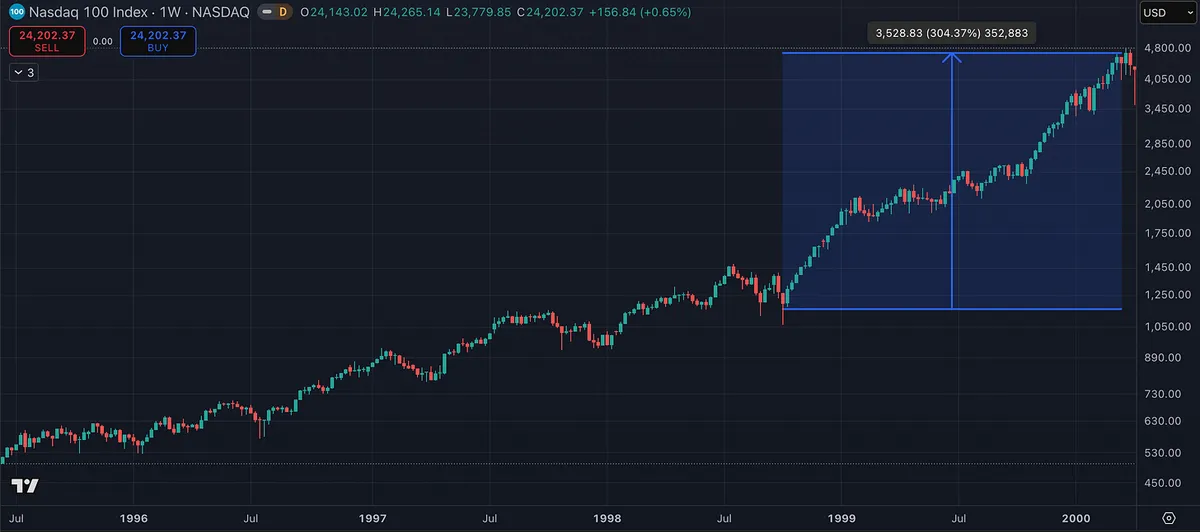
Traders saw the late 90s tech bubble forming.

The analysis was solid.

Valuations were insane. Sentiment was euphoric. The logic checked out.

And yet…

They got crushed.

Why?

Because price kept going higher and they fought it.

They argued with the market.

They were early.

And in trading, being early is the same as being wrong.

This is where most traders break.

You do the research. You build conviction. You feel certain.

And that certainty becomes your biggest mistake.

Remember, the market does not care about your thesis.

It only respects timing and risk.

There’s a principle echoed across almost every top trader:

You can be right on direction and still lose money.

That’s why traders that align with many of the market wizards I write about obsess over one thing:

Risk management.

Because once you understand this, everything changes:

• You stop trying to prove you’re right

• You start reacting to what price is actually doing

• You accept small losses quickly instead of defending bad positions

• You time entries where risk is defined and controlled

And most importantly…

You stop arguing with price.

This is how you survive and build a long career.

Not intelligence. Not research. Not conviction.

But instead managing risk through executing with proper position sizing and timing.

The market will always do one thing better than you:

Stay irrational longer than you can stay solvent.

So the next time you feel certain…

Ask yourself one question:

Am I managing risk…

Or am I trying to be right?

View on Substack ↗

10 Reasons Traders Fail (And How to Stop Being One of Them)

If you’ve been struggling, go through this list honestly. Somewhere in here is the leak in your system.

1. Not Cutting Losses This is the big one. Small losses turn into account killers when you refuse to exit. Every great trader protects capital first.

“The elements of good trading are: (1) cutting losses, (2) cutting losses, and (3) cutting losses. If you can follow these three rules, you may have a chance.” — Ed Seykota

2. Averaging Down

“Losers average losers.” — Paul Tudor Jones

Adding to a losing position isn’t conviction. It’s denial.

3. Poor Selection Criteria If you’re trading weak stocks with no strength, don’t expect strong results. Stock selection is part of the edge.

4. Overtrading (Especially in Bad Markets) Not every environment is meant to be traded. Sometimes the best trade is no trade. Overtrading leads to subpar setups and drifting away from your process.

"It's easy to design a Holy Grail system for any one market type... It's insane to expect that trading system to work in all market types." - Dr. Van K. Tharp

5. Not Understanding Risk–Reward You can be right less than 50% of the time and still win, if your winners are bigger than your losers. Most traders have this backwards.

6. No Real Risk Management or Position Sizing Knowing where to stop out means nothing if your size is too big. Risk per trade must be defined before you enter.

7. Constantly Changing Strategies New indicators. New systems. New approaches. System hopping.

8. Lack of Discipline and Patience Waiting is part of the job. Most traders lose because they act when they should be sitting still and they are sitting still when they should be acting. Not following your own rules is a discipline problem. You don’t need better rules, you need to actually follow the ones you already have.

9. No Plan for Managing or Selling Trades Entries get all the attention. But exits determine your P&L.

10. No Understanding of Exposure Pressing when things aren’t working. Playing small when they are. You have to scale with your performance and the market.

“Decrease your trading volume when you are trading poorly; increase your volume when you are trading well.” — Paul Tudor Jones

And One More Thing…

You can follow every rule above perfectly, but if your system has no positive expectancy, none of it matters.

If your strategy doesn’t mathematically work over time, discipline won’t save you.

But here’s the part most people don’t want to hear…

Even if I gave you a proven strategy with a real edge, where all you had to do was click buy and sell, most people would still fail.

Not because the system doesn’t work. Because they won’t follow it.

This is exactly what Richard Dennis proved with the Turtle Traders.

He took ordinary people from completely different backgrounds and taught them a simple, rules-based trend following system. Many of them went on to produce exceptional returns and outperformed seasoned professionals.

At the same time, others failed.

Same rules. Same system. Different outcomes.

The difference was discipline and psychology.

“I always say that you could publish trading rules in the newspaper and no one would follow them. The key is consistency and discipline.” - Richard Dennis

That’s the truth most traders don’t want to hear.

It’s not your indicators. It’s not your system. It’s not that you need more information.

It’s that you’re not doing what you already know you should be doing.

And until you fix that, it will continue to show up in your trading.

“Win or lose, everyone gets what they want out of the market. Some people seem to like to lose, so they win by losing money.”

— Ed Seykota

View on Substack ↗

The Hard Truth About Becoming a Profitable Trader

For those pursuing this path or struggling right now… I had a great conversation today and wanted to share part of my response in case it helps someone else.

I truly believe you can do this. If others have done it, there’s no reason you can’t. The path just looks different for everyone.

Over the years working with traders, I’ve seen the roadblocks vary a lot. Some people don’t have a system with a real edge. Others struggle with self-sabotage, letting losses run or hesitating to execute out of fear. Some actually have a solid system but don’t understand position sizing, so they fail.

But the common thread among those who eventually make it is this: they don’t just work hard, they get brutally honest with themselves. They’re willing to identify what they’re doing wrong and fix it.

If you’re not profitable yet, focus on finding the specific thing or things that are holding you back. Then attack that weakness directly and keep refining.

Yes, it can take time. For some it’s a couple of years, for others it’s longer. Five to ten years for many of the best. The difference isn’t just effort, it’s the willingness to improve and take responsibility. A lot of people won’t put in the level of work required, and many never look inward. They just blame the market.

The ones who succeed do neither.

And one last thing. None of this matters if you don’t learn how to be happy now. Like Tom Basso says, enjoy the ride. Most people think happiness comes later, after the success, but if you can’t be content with what you already have, more won’t fix that. You’ll get there and still feel empty.

There are plenty of traders who have mastered the market but built an empty life along the way, constantly trying to fill that gap with attention or validation. Don’t fall into that trap. Build both at the same time.

At the end of the day, trading isn’t just a financial journey, it’s a self-help journey that, for me, made me a better person.

And rule number one in life is simple… be a good dude or dudette.

View on Substack ↗

Nobody Believed in Me But One Person Did

When I first started trading, my family didn’t understand it. They weren’t supportive.

And when I walked away from a six figure career to trade full time while launching a skincare brand with my wife, they thought I was even crazier.

My dad. My uncle. My friends. None of them saw the vision.

But I didn’t care.

Because I had support from the one person who mattered most. My wife.

Next week is our anniversary. 19 years of marriage. 4 kids. Ages 16, 14, 12, and 11.

And not once has she ever not supported my trading. Not during drawdowns. Not when I was losing. Not when I was trying to figure it all out.

She has been just as important to my success as the screen time, the books, and the mentorship.

That kind of support is an edge most people will never understand.

Now let’s be real for a second.

When I’m not on here sharing trading ideas, I’m running a skincare brand with my wife. I’m driving kids to soccer, baseball, gymnastics, and horse jumping.

Life is full.

So when someone says they don’t have time to learn trading or build something…

I don’t believe it.

You don’t need more time. You need better priorities.

Cut the Netflix. Cut the scrolling. Cut the things that are giving you nothing back.

Because if you really want this, you will find the time.

And here’s the truth most people need to hear.

It’s powerful to have the right person in your corner.

But it’s not required from everyone.

Not everyone will believe in your vision and that’s fine.

You don’t need approval from the crowd.

Just get after whatever you’re passionate about, whether that’s trading or something else.

Fail. Adjust. Fail again. Adjust again.

Relentless effort with the ability to adapt and change.

What social media doesn’t show you is how many people are doing this quietly.

Grinding. Failing. Learning.

It’s a lonely game more often than not.

But don’t lose sight of what actually matters.

Time and your health are just as valuable, if not more valuable, than money.

I’ve had plenty of opportunities to make more money.

And I’ve chosen not to.

Because I want more time with my wife and my kids.

I spent 15 years grinding hard and ignoring that principle.

Don’t make that mistake.

Don’t be the person with money but no time.

The one who looks up one day and realizes they barely know their own kids.

If you’re lucky enough to have even one person who believes in you…

And you’re present enough to actually live the life you’re building…

That’s more than enough.

View on Substack ↗

Mental Rehearsal: The Edge Most Traders Ignore

Most traders prepare for the market by scanning charts and planning for the trade technically.

Elite traders prepare their mind.

One of the most powerful tools for this is mental rehearsal.

Not positive visualization.

That’s where many people go wrong.

Positive visualization imagines the best possible outcome. Every trade works. Everything goes your way.

But that’s not reality.

When the first loss hits, your nervous system panics.

Mental rehearsal is different.

You mentally walk through the entire process of trading.

You see yourself identifying the setup. You see yourself executing your plan.

But you also rehearse the other scenario.

The trade fails.

You get stopped out for a small loss.

You accept it, take a breath, and move on to the next opportunity.

No frustration. No revenge trading. Just execution.

Muhammad Ali used this same concept before every fight.

He didn’t just visualize knocking someone out.

He mentally prepared to take punches, feel the pain, and keep fighting.

So when the punch came in the ring, he had already experienced it in his mind.

Great traders do the same thing.

They rehearse the wins.

They rehearse the losses.

And most importantly…

They rehearse sticking to the plan.

View on Substack ↗

Just Because You Can Trade It Doesn’t Mean You Should

If you scan enough charts, you will always find something to trade.

A breakout forming.

A pivot setting up.

A stock sitting in a buyable zone.

But look a little deeper.

Weak sales.

Not in a leading group.

A slower mover that does not offer the risk reward your strategy is built for.

A market environment that is not supportive.

Yet traders convince themselves to take it anyway.

Why?

Because it’s there.

During consolidations like this, I’ve even caught myself throwing names out that aren’t really what we do. For most traders, this is a bad move.

Yes, those trades can work sometimes.

But they are usually lower probability than waiting for true A+ setups in strong groups when the market is supportive.

Another factor most traders ignore is where they stand for the year.

If you’ve had a huge year and are comfortable risking a small amount to probe weaker conditions, that’s one thing.

But if you’re just starting out, or the year hasn’t been great, forcing trades in mediocre names can do real damage.

Many traders believe their strategy stopped working.

Often the reality is simpler.

The environment changed, and they stopped following their own playbook.

The market will always show you something to buy.

The real edge is having the discipline to wait.

View on Substack ↗

One of the most brutally honest quotes ever said about trading

Ed Seykota once said:

“Win or lose, everybody gets what they want out of the market. Some people seem to like to lose, so they win by losing money.”

At first that sounds ridiculous.

Why would anyone want to lose?

But if you have spent enough time trading… you start to realize how true it is.

Some traders say they want to be profitable.

Yet their behavior says something very different.

They refuse to cut losses. They chase trades from FOMO. They oversize positions trying to get rich quickly. They abandon their system after a few losses. They break rules because they got away with it last time.

Consciously they want profits.

But subconsciously they want something else.

Excitement. Validation. Action. Being right. Hope.

The market gives people exactly what their behavior demands.

That is why this quote is so powerful.

It forces traders to ask a very uncomfortable question:

What do I actually want from the market?

Because if your behavior does not change…

Your results will not either.

And most traders do not need another strategy.

They need the discipline to execute the one they already have.

View on Substack ↗

The Turkey Trap Every Investor Falls Into

Right after posting about the importance of having sell rules, it reminded me of a famous story told by William O’Neil in How to Make Money in Stocks.

It perfectly captures the psychology most investors experience when it’s time to sell.

O’Neil retells a story from Fred C. Kelly about an old man trying to catch wild turkeys.

He built a simple turkey trap.

A big wooden box with a door propped open by a stick. A string ran from the stick back to the trapper sitting far away. Corn was scattered along a path leading inside the box.

The turkeys would follow the trail of corn into the trap.

Once enough birds were inside, the trapper could pull the string and the door would slam shut.

One day he had twelve turkeys inside the trap.

But then one wandered out.

“Gosh,” the trapper said, “I wish I had pulled the string when all twelve were in there. I’ll wait a minute. Maybe that one will come back.”

While he waited… two more turkeys walked out.

“I should have been satisfied with eleven,” he said. “As soon as I get one more back, I’ll pull the string.”

But more turkeys kept leaving.

Soon there were only eight.

Then five.

Then two.

Finally, there was just one turkey left.

The trapper said, “I’ll wait until he walks out or another one walks in, and then I’ll quit.”

The last turkey walked out.

The trap was empty.

He went home with nothing.

O’Neil said the psychology of investors is not much different.

When we have a good profit, we often wait for just a little more.

Then the stock pulls back.

So we wait for it to recover.

Then it pulls back more.

And before long the big winner we once had… disappears.

This is exactly why sell rules matter so much.

It’s something Mark Minervini talks about as well in Think and Trade Like a Champion. Early in his career he spent years learning how to buy great stocks, but realized later there was a huge gap in his trading plan.

He had no clear rules for how to sell a profitable position.

And that gap is where a lot of traders lose their biggest opportunities.

Because the market doesn’t reward hope.

It rewards discipline and rules.

So here’s the question.

How many of you have experienced your own version of the turkey story?

View on Substack ↗

Why Knowing the Rules Isn’t Enough

Richard Dennis once said:

“I always say that you could publish trading rules in the newspaper and no one would follow them. The key is consistency and discipline. Almost anybody can make up a list of rules that are 80 percent as good as what we taught people. What they couldn’t do is give them the confidence to stick to those rules even when things are going bad.”

This explains one of the biggest misconceptions about trading.

The problem isn’t that traders don’t know the rules.

Most traders already know them.

Cut losses quickly. Let winners run. Control position size. Trade with the trend.

None of these ideas are secrets.

The real challenge is following those rules when emotions get involved.

It’s easy to follow a plan when everything is working.

It’s much harder to stick to that same plan during a drawdown, after a series of losses, or when a trade moves against you.

That’s where discipline separates successful traders from everyone else.

Winning traders don’t just have rules.

They have the consistency and confidence to follow them even when the market tests them.

Because in the end, trading success isn’t about knowing the right rules.

It’s about executing them over and over again, no matter what the market throws at you.

View on Substack ↗

Why Most Traders Lose After a Losing Streak

“When you understand what’s involved in winning, as do professional gamblers, you’ll tend to bet more during a winning streak and less during a losing streak. However, the average person does exactly the opposite: they bet more after a series of losses and less after a series of wins.” — Dr. Van Tharp

This simple idea explains a lot about why most traders struggle.

Professionals understand that performance clusters.

When things are working, it usually means the environment is favorable for their strategy. That’s when they lean in and press their edge.

When things aren’t working, it usually means the market conditions have changed. That’s when professionals reduce risk and protect capital.

But most traders do the opposite.

After a string of losses they start forcing trades, increasing size, and trying to “make it back.”

After a few wins they become cautious, take profits too quickly, or reduce size because they’re afraid of giving gains back.

In other words, they press when they should defend and defend when they should press.

Winning traders flip that behavior.

They stay disciplined during drawdowns and aggressive when their edge is working.

Understanding this shift alone can dramatically change the way you approach risk, position sizing, and consistency in the market.

View on Substack ↗

The Hard Truth Most Traders Need to Hear

This might sound motivational.

Some people might call it woo-woo.

But after years in this business I can tell you something with certainty.

A huge part of success in trading has nothing to do with charts.

It has to do with what’s going on in your head.

This game will beat you up.

You will take losses.

You will doubt yourself.

You will feel like the market is punching you in the face over and over again.

That stage is normal.

What matters is what you do during it.

Here’s the hard truth many traders don’t want to hear.

A lot of people are sabotaging themselves.

You study.

You read the books.

You know what you should be doing.

But your actions don’t line up with what you’ve learned.

You break your rules.

You chase trades.

You ignore your risk management.

Then you blame the market.

I went through this phase too.

At some point you have to stop feeling sorry for yourself and take responsibility for your results.

Believe you can do this.

If other people have learned this skill, so can you.

But you have to give yourself time.

Most people try for a year, get frustrated, and quit.

There’s a saying that always stuck with me.

People overestimate what they can accomplish in a year.

But they underestimate what they can accomplish in five or ten.

Trading is a skill.

Like any difficult skill, it takes time, mistakes, and persistence.

If you stay disciplined, keep learning from your losses, and stop sabotaging your own progress, you give yourself a real chance.

The traders who make it are rarely the smartest.

They are the ones who simply refuse to quit on themselves.

View on Substack ↗

The One Skill That Separates Pros From Amateurs

If you want to become a great trader, read this:

“Although the cheetah is the fastest animal in the world and can catch any animal on the plains, it will wait until it is absolutely sure it can catch its prey. It may hide in the bush for a week waiting for just the right moment. It will wait for a baby antelope, and not just any baby antelope, but preferably one that is also sick or lame. Only then, when there is no chance it can lose its prey, does it attack.

That, to me, is the epitome of professional trading.” -Mark Weinstein

If you’re not getting results, get more selective.

Wait for better market conditions.

Trade the best names, in the strongest industry groups, with the best setups.

Be patient.

Start acting like a cheetah.

View on Substack ↗

“Winners know they are responsible for their results; losers think they are not.” — Van K. Tharp

One of the most powerful ideas in trading and in life.

The moment you take full responsibility for your results, you stop blaming the market, the news, or bad luck.

That’s when real improvement begins.

View on Substack ↗

Most Traders Don’t Fail Because of Their Strategy

They fail because of themselves.

Mark Douglas explained it perfectly:

“You don’t need to know what will happen next to make money.”

You only need an edge and the discipline to execute it.

But human nature fights that.

Fear makes traders sell winners too early. Ego makes them hold losers. Greed makes them chase extended stocks.

The strategy is rarely the problem.

Psychology is.

View on Substack ↗

Fear Spreads Faster Than Discipline

I have only been writing on Substack for a few months.

It honestly started as a place to write random thoughts about trading so I didn’t have to keep talking about it with my wife and four kids all the time.

But something interesting happened recently.

Out of everything I have written, the post that performed the best by far was titled:

“How the Market Warns You Before the Crash and When It’s Safe to Get Back In.”

Not the posts about position sizing.

Not the posts about risk management.

The one about a crash.

And that made me laugh.

Because if you study markets long enough, you realize something.

Some of the best traders probably understand human nature better than many PhDs who study it for a living.

To survive in markets for decades you have to.

You watch fear. You watch greed. You watch euphoria. You watch panic.

And if you spend enough time studying charts and the tape, you realize something else.

Human behavior repeats.

The irrational exuberance near tops.

The panic selling near bottoms.

The disbelief during the early stages of an uptrend.

It all shows up in price and volume.

Great traders spend thousands of hours watching these emotional cycles play out.

Eventually you start to recognize the fingerprints.

Another thing traders learn quickly about human nature is this.

People are far more captivated by fear than by calm, rational information.

Psychologists call this negativity bias. Humans are wired to pay more attention to threats than to positive outcomes.

Behavioral finance research shows that people feel losses roughly twice as strongly as gains.

Which explains a lot.

It explains why the news focuses on disasters.

It explains why market crash headlines travel faster than discussions about discipline.

And apparently it explains Substack engagement too.

Now, understanding topping behavior is important. William O’Neil wrote extensively about this in How to Make Money in Stocks. Protecting capital matters.

But it is no more important than risk management, position sizing, or process.

Yet that one post traveled the furthest, by far. Almost five times further than most of the others.

Maybe the algorithm liked it.

Maybe people shared it because it tapped into fear.

I honestly don’t know.

I just wrote what I was thinking that morning while drinking coffee.

When I write about trading, I’m simply sharing thoughts about a game I’m passionate about.

Most people will never use the information to their advantage.

That’s just the math of markets.

But maybe a few will.

And maybe one day they’ll become part of the next generation of Market Wizards.

And that would be pretty cool.

https://tradingmomentum.substack.com/p/how-the-market-warns-you-before-the

ArticleHow the Market Warns You Before the Crash (and When It’s Safe to Get Back In)
View on Substack ↗

The Trade That Taught Me I Don’t Need To Be Right

Mark Douglas wrote five truths about the market.

Most traders read them.

Very few actually trade them.

Here’s the one that changed everything for me:

You don’t need to know what is going to happen next in order to make money.

Let that sink in.

You don’t need to predict.

You don’t need certainty.

You don’t need to be right.

Because there is a random distribution between wins and losses for any edge.

That means this can happen:

Loss.

Loss.

Small win.

Loss.

Then one monster move that pays for all of it.

And if you quit after the second loss?

You never collect the edge.

This is why most traders sabotage themselves.

They think: “If this is a good setup, it should work.”

No.

Anything can happen.

Every moment is unique.

Your job is not to predict.

Your job is to execute your edge consistently and let probability play out over a series of trades.

The amateur trades to be right.

The professional trades to express an edge.

Big difference.