Momentum Trading Strategy

Notes

Trading Psychology & Mindset

The inner game: the emotions, beliefs and habits that decide whether a trader follows a plan.

Showing 201–220 of 235 notes

View on Substack ↗

Confidence Without Arrogance

“You are never really confident in this business, because you can always be wiped out pretty quickly. The way I trade is: live by the sword, die by the sword. There is always the potential that I could get caught with a big position in a fluke move. On the other hand, there is no doubt in my mind that I could walk into any market in the world and make money.” — Tom Baldwin, Market Wizards

This quote captures one of the hardest balances in trading.

You need real confidence in your ability. The kind that comes from experience, repetition, and surviving different market environments.

At the same time, you must respect risk. Markets can turn fast. No amount of skill makes you immune to bad luck, sudden volatility, or structural shocks.

The best traders understand both sides.

They trust their edge, but they never assume they are invincible. They size positions with humility. They stay aggressive only when conditions allow it.

That balance between confidence and restraint is what keeps traders in the game long enough to actually win.

View on Substack ↗

The Mindset That Kept Marty Schwartz Winning

One of the greatest traders of all time had a rule that sounds simple but is incredibly hard to live by.

“Every year, I start off poor.” — Marty Schwartz

He didn’t mean broke. He meant mentally reset.

Schwartz understood that past profits are dangerous. They create confidence. Confidence turns into comfort. And comfort leads to mistakes.

So he treated every new year as a reset.

Not because his account went to zero, but because he refused to assume his edge would automatically carry forward.

When things were working, he pressed. When they stopped working, he cut back immediately.

After strong winning periods, he reduced size on purpose. Not because he lost conviction, but because he knew success can distort judgment.

He never assumed yesterday’s edge would work tomorrow.

That’s the difference.

Most traders don’t fail because they lack skill. They fail because they stop respecting the conditions that made them profitable.

As a new year approaches, it’s worth asking:

If you had to start again from your original account size, could you still grow it?

That question alone can change how you trade.

View on Substack ↗

Gary Bielfeldt on Trading Like a Poker Pro

Gary Bielfeldt, a Market Wizard, often said that his edge in the markets came from understanding probabilities long before he ever traded a stock. He learned it at the poker table.

In poker, you don’t play every hand. You fold most of them. You only commit real money when the odds are stacked in your favor. And when they are, you press your advantage.

Trading is no different.

Most people lose because they feel compelled to always be in the market. They trade out of boredom, emotion, or the fear of missing out. Professionals wait. They pass on mediocre setups. They conserve capital. They understand that not losing is just as important as winning.

When the odds are clearly in their favor, they act decisively. Position size increases. Conviction rises. But when the trade doesn’t look right, they step aside without hesitation. No ego. No revenge trading. Just discipline.

The lesson is simple:

• Don’t play every hand.

• Protect your capital.

• Be patient.

• Press hard only when the probabilities are clearly on your side.

That mindset, not indicators or predictions, is what separates consistent traders from gamblers.

View on Substack ↗

“Human nature never changes. Therefore, the stock market never changes. Only the faces, the pockets, the suckers, the manipulators, the wars, the disasters, and the technologies change. The market itself never changes. How can it? Human nature never changes, and human nature runs the market — not reason, not economics, and certainly not logic. It is our human emotions that drive the market, as they do most other things on this planet.”

— Jesse Livermore: World’s Greatest Stock Trader by Richard Smitten

View on Substack ↗

I cannot predict what the market will do. No one can. What I can do is observe how the market behaves and how it reacts to information like Fed decisions or major catalysts. Price action tells the truth. Reactions tell you even more. My job is not to guess. My job is to interpret what the market is revealing and take trades only when the risk to reward is firmly in my favor. This is the foundation behind every great trader from O’Neil and Minervini to Zanger and Darvas. They did not predict. They observed, prepared, and acted only when the market confirmed their thesis.

View on Substack ↗

Paul Tudor Jones and the Psychology You Need to Win

Trading is similar to competitive sports in that it requires a strange mix of confidence and humility.

You need confidence to take risk, pull the trigger, and believe you can win.

You need humility to respect the market, cut losses fast, and stay a student.

Confidence moves you forward.

Humility keeps you alive.

Treat competition like it matters, but never let ego run the show.

Care enough to improve, but not so much that it controls you.

You can see this balance clearly in the 1980s Paul Tudor Jones documentary. He shows real humility toward the market, a constant fear of being wrong, and deep respect for risk. At the same time he has total confidence, a fierce competitive spirit, and the belief that he can win. That combination is what makes him dangerous.

The best traders believe they can do anything another person can do.

They also know they are not special yet and still have a lot to learn.

Hold both truths at once.

That balance builds a dangerous trader.

https://youtu.be/0Fsa4sOJwh4?si=QvZFV7rfo-QZSrgr

youtube.com- YouTube
View on Substack ↗

My trading changed when I accepted that I don’t know much. The smarter I got and the more work I put in, the more obvious it became that certainty is an illusion in this game. Letting go of the need to be right helped me trade better.

View on Substack ↗

The most important thing you do every day

When I was in the military we had a saying:

“Working out isn’t the most important thing you do in a day, but it’s the most important thing you do every day.”

Back then it wasn’t only about discipline. It was about health. Because when you are stronger, fitter, and in shape, everything else becomes easier.

-Health makes you more focused.

-Health makes you more resilient.

-Health gives you more energy to push through hard days.

-Health improves your mood and decision making.

-Health helps you recover faster from stress.

Since getting out, I’ve realized that same principle applies to running a beauty business with my wife and trading full time.

Most people separate health from work. They treat workouts as optional or something they will get to later. They never see how much harder they are making every part of their day.

When I am training consistently:

• I think clearer when I trade

• I handle stress better

• I am more patient

• I make better business decisions

• My creativity is higher

• My confidence is higher

Success is not built only on discipline. It is built on a healthy body that supports a healthy mind.

Working out might not feel like the most important thing you do in a single day.

But it is the most important thing you do every day.

Because without your health, everything else becomes harder.

With it, everything becomes easier.

View on Substack ↗

Do you know traders who crush it by focusing on just one asset?

I get it. There is a real advantage in specializing. When you trade the same asset every day you develop a feel for it. You learn how it moves, what the tape looks like when momentum shifts, and you gain confidence in execution. I experienced this firsthand trading the Nasdaq 100. That familiarity is powerful.

And although there are people who do well focusing on only one asset, the majority of professionals with long term consistent results do not. The traders who make it year after year move to what is in play. They follow strength instead of waiting for it to return.

But here is the problem no one talks about.

When you lock yourself into one asset class you give up one of the biggest edges in the entire market. You lose the ability to follow where institutional money is pouring in. You give up the ability to rotate into what is actually moving.

This is where the highest probability opportunities live.

Gold when it is breaking out and outperforming.

AI when capital starts flooding into the theme.

Robotics, energy, biotech, semiconductors, crypto. Whatever the market is rewarding right now.

What we call “stocks in play.”

I see this most with crypto traders. They only focus on that one asset class. They sit and wait for the next big move in Bitcoin or altcoins while ignoring massive opportunities happening in other areas of the market. They stay loyal to an asset that might be dead for months while strength is exploding somewhere else.

Here is the part that stings a little.

Most crypto-only traders are so in love with the idea of crypto that they become emotionally compromised. The narrative becomes part of their identity. In reality, that loyalty hurts their overall performance. They become stuck and rigid, tied to one story while the market rotates into new themes with massive momentum.

They miss powerful opportunities while crypto is sleeping, or they take massive losses because they feel loyal to the cause. It becomes almost cult like. We have seen the exact same behavior with certain stocks like Tesla, where belief and community became stronger than price action and risk management.

Why not move to cash and play the markets that are actually moving? And when nothing is moving, cash can be the best position.

When you follow strength and momentum across sectors you gain almost a margin for error. You are not trying to force trades in a dead asset. You are aligning yourself with the current market theme where volume, attention, and institutional flows are concentrated.

The traders who stay stuck in one asset often end up trading when nothing is happening. They are bored and trying to create opportunity instead of rotating into what is hot.

The market rewards movement, not loyalty.

If you want higher probability setups, follow relative strength. Go where the money is flowing right now.

Become the trader who adapts.

You need to decide what you really want. Do you want to be a great trader or investor? If the answer is yes, your job is to make money. You cannot fall in love with any asset class.

It reminds me of a William O’Neil quote that every serious trader should know:

“There are no good stocks unless they go up in price. If they go down instead, you have to cut your losses fast.”

View on Substack ↗

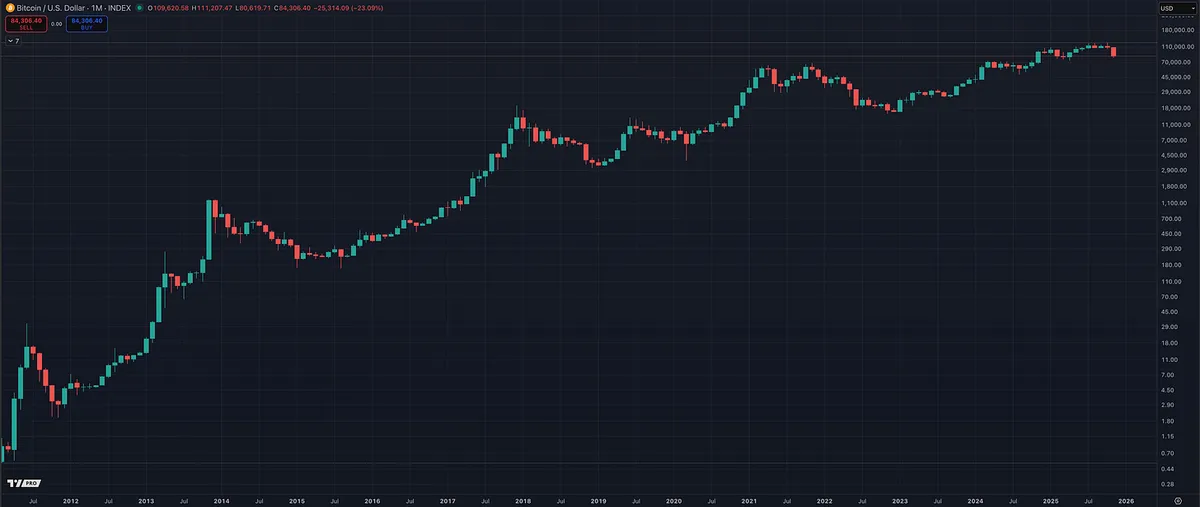
The Bitcoin Timeline No One Talks About

Why almost every fantasy return story falls apart in reality

Before you read this, answer this honestly in your head:

Would you hold through a 93 percent crash after seeing life changing gains?

If you bought $100 of Bitcoin in 2010 at twenty-five cents…

And watched it go to $12,000 in 2011… and did nothing

Then watched it crash to $800… and still did nothing

Then watched it spike to $440,000 in 2013… and still did nothing

Then watched it fade back to $80,000… and still did nothing

Then watched $80,000 rocket to $5.6 million… and still did nothing

Then watched $5.6M sink to $1.32M… and still did nothing

Then watched $1.32M explode to $24M… and still did nothing

Then watched $24M crash to $6.2M… and still did nothing

Then watched $6.2M surge to $46M in 2025… and only then decided to “do something”…

Then yes Your lonely $100 bill from 2010 would be worth about $46 million today.

Lesson: This fantasy outcome has more in common with gambling than investing. If you want to be more than lucky, you need a long term strategy that works over and over, compounding not just over time but with each new investment or trade. And remember, it worked in this rare instance with Bitcoin, but imagine how many more times this approach failed completely.

View on Substack ↗

Why Following the Trend Is My Contrarian Move

Funny thing about markets: doing the simple, obvious thing is actually contrarian.

Most investors fight the trend. They try to call bottoms, average down, over-diversify, cling to their favorite assets, and obsess over being “right.”

I do the opposite.

I buy strength. I only trade Stage 2 uptrends. I rotate to where institutional money is flowing. I cut losers fast, let winners run, and sit in cash when there’s no edge.

I have a thesis, but I’m never attached to it. The market is always right.

Most want to be right. I want to make money.

View on Substack ↗

Don’t Marry Your Investments

A lot of people think the biggest risk in investing is picking the “wrong” asset.

It’s not.

The real danger is falling in love with the asset you picked.

When you tie your identity to Bitcoin, gold, real estate, or a favorite stock, you stop evaluating it objectively. You defend it. You rationalize. You ignore trend, data, and risk because admitting it’s no longer working feels like admitting you were wrong.

That’s how portfolios quietly bleed out over years… sometimes decades.

History is full of assets that soared with passionate fanbases, only to stagnate or collapse and never recover. The people who stayed loyal suffered, not because they lacked intelligence, but because they lacked detachment.

The pros don’t marry assets. They marry process.

And that mindset is what keeps them alive over multiple cycles.

👇 Read the full breakdown here

https://tradingmomentum.substack.com/p/the-cost-of-bias-why-loving-your

ArticleThe Cost of Bias: Why Loving Your Asset Class Is a Liability
View on Substack ↗

I love pullbacks like this. It either sets up the next buying opportunity, or if I have to take a small loss, it’s insignificant compared to what the market has given since early 2023. Either the bull resumes, or it ends and creates an even bigger opportunity down the road.

Shift your mindset.

View on Substack ↗

The Best Trading Book Isn’t About Trading

Just re-read Mind Gym with my teenage boys. It’s written for athletes… but honestly, it might be one of the BEST trading mindset books ever.

Gary Mack tells a story from Alex Rodriguez that stopped me:

“I visioned winning the batting title… I could see .380 flashing on exit signs…

Some nights I would tell myself 150 times: ‘I hit the ball solid. I hit the ball solid.’

I believe a champion wins in his mind first. Then he plays the game.”

A-Rod saw the outcome before it happened. He rehearsed success from different angles: the batter’s box, the dugout, even from the fans’ perspective.

And he did win the batting title.

Not because he tried harder, but because he trained his mind to perform under pressure.

As traders, we spend endless hours studying charts, entries, indicators, and news… but do we invest even HALF of that time training our mindset?

Mental skill is more than 50% of performance for elite athletes. Is it any different for us?

I wrote a new piece about how lessons from Mind Gym apply directly to trading: visualization, identity, presence, emotional control, and mental reps.

The market tests your psychology more than your strategy. You don’t conquer the market. You conquer yourself.

Read it here: 👉 https://tradingmomentum.substack.com/p/mind-gym-for-traders-why-one-of-the

ArticleMind Gym for Traders: Why One of the Best Trading Books Isn’t About Trading at All
View on Substack ↗

The Market Doesn’t Care What You Think

“I think one of my strengths is that I view anything that has happened up to the present point in time as history. I really don’t care about the mistake I made three seconds ago in the market. What I care about is what I am going to do from the next moment on. I try to avoid any emotional attachment to a market. I avoid letting my trading opinions be influenced by comments I may have made on the record about a market.” -Paul Tudor Jones

View on Substack ↗

When Fear and FOMO Collide

Every bubble ends, just not always when you expect it.

That’s what makes them so dangerous: the pain of staying in too long and the regret of stepping aside too soon.

You can lose when the music stops, lose by jumping in too late from FOMO, or lose by never participating out of fear.