
Momentum Trading Strategy

Notes

Trading Psychology & Mindset

The inner game: the emotions, beliefs and habits that decide whether a trader follows a plan.

Showing 181–200 of 235 notes

View on Substack ↗

Why Great Traders Can Imagine the Impossible and Why Most People Can’t Hold Winners

Bruce Kovner once said:

“First, I have the ability to imagine configurations of the world different from today and really believe it can happen. I can imagine that soybean prices can double or that the dollar can fall to 100 yen. Second, I stay rational and disciplined under pressure.”

That quote explains more about real trading skill than most indicators ever will.

The edge is not prediction. The edge is imagination plus discipline.

Great traders can mentally allow prices to do things that feel uncomfortable, unlikely, or extreme. They can imagine a stock going far higher than today’s price even when it already feels expensive. They can also imagine it going far lower and accept that reality without denial.

This matters because markets move further than logic suggests and longer than emotions can tolerate.

Most traders cut big winners early because they simply cannot imagine how much higher a stock can go. The move feels abnormal. It feels greedy. It feels unsafe. So they sell.

At the same time, those same traders hold losers too long because they cannot imagine how much further down price can fall.

That is the trap.

Being able to imagine extreme outcomes is not about forecasting. It is about trade management. It allows you to sit in winners and let trends work, while cutting losses quickly because you respect how violent downside can be.

We have seen this repeatedly in recent years. Metals and mining runs. AI and semiconductor leaders. Entire groups that looked stretched, over owned, and “done” before they even reached the halfway point of their move.

The people who made real money were not smarter. They were not better predictors. They were better at mentally accepting that price could do something bigger than their comfort zone.

If you struggle to hold winners, this is usually why.

Train yourself to think in ranges that feel uncomfortable. Allow for upside that sounds unreasonable. Respect downside that feels unlikely.
View on Substack ↗

When emotions run high, zoom out

I’m a short-term trader.

I run a day trading account. I also run a swing and position trading account built around O’Neil and CANSLIM and I also have an account that does nothing fancy and consistently invests into SPY and QQQ.

You would think someone like me would be the most emotionally affected by short-term market moves.

I’m not.

A 2% down day like today is no big deal. It is not the end of the world, no matter how financial media or influencers try to frame it.

When in doubt, zoom out.

What always surprises me is how emotional people get over pullbacks, corrections, and even full bear markets. Most of these people are not short-term traders. They claim to be long-term investors with long time horizons, yet they panic at exactly the moments that long-term investors should expect.

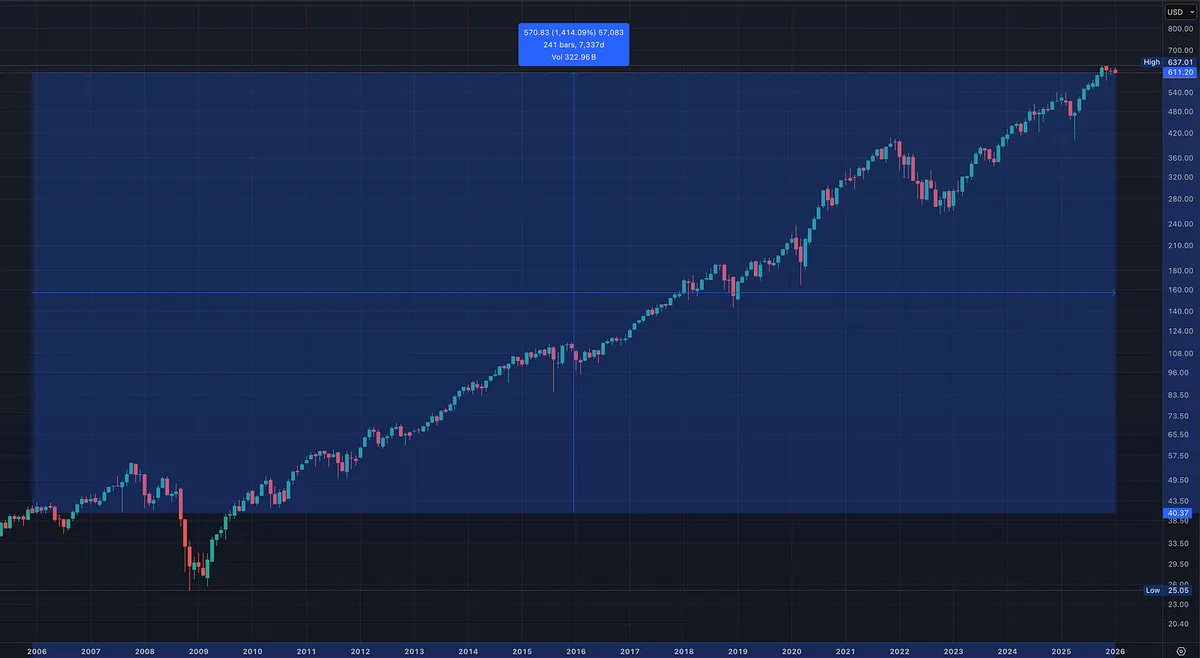
Look at the last 20 years.

  • Tariff scares.

  • COVID.

  • The 2022 bear market.

  • 2018.

  • 2015.

  • 2011.

  • The Great Financial Crisis.

Even with all of that, the Nasdaq-100 is up over 1400% in the last two decades.

That perspective changes everything.

If normal volatility makes you emotional, that is feedback. It usually means one of two things. You are either gambling, struggle emotionally, or you do not truly understand markets or risk management.

Long-term investing is boring. It requires patience, discipline, and the ability to ignore noise.

The market does not reward emotional reactions. It rewards time, consistency, and perspective.

Zoom out.

View on Substack ↗

Most Profitable Traders Spend More Time Doing Nothing

One of the most misunderstood edges in trading is inactivity.

Most traders believe success comes from constant participation. More scans. More trades. More action. That mindset quietly destroys performance.

Markets do not offer opportunity evenly. They compress it.

A large portion of meaningful gains tend to occur in short windows when conditions align. Strong trends. Expanding volume. Clear leadership. Broad participation. Outside of those windows, the market mostly produces noise.

This is why overtrading is so dangerous. You spend capital and emotional energy during low-quality periods and arrive exhausted when the real opportunity finally appears.

Jesse Livermore understood this long before modern markets existed.

“There are only a few times in a year when a trader should make a commitment.”

And

“It was never my thinking that made the big money for me. It was my sitting.”

Great traders internalize this idea. They wait. They observe. They protect capital. They accept boredom as part of the process.

This behavior aligns with how trading returns actually work. Outcomes follow power law dynamics. A small number of trades and a small number of market phases drive most long-term results. The rest are largely irrelevant or harmful.

By staying selective, you preserve capital, confidence, and focus so you can act decisively when conditions improve. You are not trying to force profits from an average market. You are waiting for moments that justify risk.

This is also why many traders feel like they are always late. They burn themselves out during the wrong phases and miss the right ones.

The answer is not trading more.

The answer is knowing when not to trade.

View on Substack ↗

Why Great Traders Hold Two Opposing Beliefs at Once

You need confidence to take a trade, but also humility to survive.

Lose either one, and trading breaks down.

“You need to believe in something, but at the same time, you are going to be wrong a considerable number of times. The balance between confidence and humility is best learned through extensive experience and mistakes. There should be a respect for the person on the other side of the trade. Always ask yourself: Why does he want to sell? What does he know that I don’t? Finally, you have to be intellectually honest with yourself and others. In my judgment, all great traders are seekers of truth.” — Michael Steinhardt, Market Wizards

That word matters: balance.

Confidence without humility becomes arrogance. Humility without confidence becomes hesitation.

Great traders hold both at the same time.

They believe enough to put risk on. They doubt enough to manage it.

They respect the trader on the other side of the trade. They assume opposing information exists.

This is not weakness. It is professionalism.

The market does not reward certainty. It does not reward doubt either.

It rewards balance of the two.

View on Substack ↗

Why One Trade Should Never Matter to You

If one trade can ruin your day, if one loss can change how you trade the next setup, if one win makes you feel invincible, this mindset will change everything.

“I would tell that trader to think of each trade as one of the next one thousand trades he’s going to make. If you start thinking in terms of the next one thousand trades, all of a sudden you’ve made any single trade seem very inconsequential. Who cares if a particular trade is a winner or a loser? It’s just another trade.” — Tom Basso, Market Wizards

One trade is not special. One trade is not important. One trade does not define you.

It is simply one data point in a very long series.

Most traders do the opposite.

They give one trade too much meaning. They attach emotion to the outcome. They let a single result influence the next decision.

That is how discipline breaks down.

When you zoom out to the next one thousand trades, something powerful happens.

Fear loses its grip. Ego gets quieter. Patience increases.

You stop trying to be right on this trade. You start trying to execute well over time.

That is how professionals think.

When you think in thousands, losses feel smaller. Wins feel less intoxicating. Consistency becomes possible.

And here is the part most traders miss.

Many of your biggest winners will not be the ones you anticipated. They rarely feel special at entry. They only become special because you stayed disciplined long enough to let them work.

If you try to predict which trade will matter most, you will almost always be wrong.

So stop assigning importance to individual outcomes. Manage risk. Execute the process. Let the probabilities decide.

One trade does not matter.

The next thousand do.

View on Substack ↗

Stop Letting Your Last Trade Ruin the Next One

If you have ever replayed a mistake in your head, If you have ever hesitated because of the last loss, If you have ever traded differently just to “make it back,”

You know this feeling all too well.

You are not trading the market. You are trading your memory.

“I think one of my strengths is that I view anything that has happened up to the present point in time as history. I really don’t care about the mistake I made three seconds ago in the market. What I care about is what I am going to do from the next moment on. I try to avoid any emotional attachment to a market. I avoid letting my trading opinions be influenced by comments I may have made on the record about a market.” — Paul Tudor Jones

This is not about ignoring mistakes. It is about handling them correctly.

You learn the lesson. You take the information forward. And then you let it go.

Because if you do not, the mistake does not stay in the past. It starts trading for you.

The best performers in every field understand this.

The greatest baseball players fail about 70 percent of the time at the plate. The best soccer players only score on 10 to 20 percent of their shots.

Yet they step back into the box. They take the next shot. They do not carry the last miss into the next attempt.

They have what professionals call short-term memory.

Not because they do not care. Because they care enough to protect their performance.

Most traders do the opposite.

They hesitate after a loss. They overtrade after a win. They defend opinions instead of managing risk.

Not because they lack strategy. Because emotion from the last trade is driving the next one.

But the market does not reward memory. It rewards clarity.

The professionals reset. They detach. They respond to what is happening now, not what just happened.

When you stop trading your past: You manage risk instead of ego. You execute instead of react. You follow process instead of emotion.

That is real trading psychology. That is discipline. That is how consistency is built.

Learn from the mistake. Take the lesson with you. Then let it go.

The next decision is all that matters.

View on Substack ↗

Dr. Van K. Tharp on What Actually Creates Trading Success

“There are three primary factors: beliefs, mental states, and mental strategies. If you duplicate how the best traders use those three factors, you can duplicate their results.” — Van K. Tharp, Market Wizards

Most people try to copy setups. Tharp says the real edge is internal.

Top performers are often unconsciously competent. They do things automatically, which means when they teach, the most important pieces get left out. Tharp’s work is about uncovering and installing those missing pieces.

His research shows that beliefs drive performance.

The Army once modeled its best sharpshooters and cut training time in half while improving results. The biggest difference was not mechanics. It was what the best shooters believed about preparation, responsibility, and precision.

Tharp found the same pattern in elite traders. They tend to believe:

• Money is not the goal

• Losses are acceptable

• Trading is a game with rules

• Mental rehearsal matters

• They have already won in the long run

Most traders do the opposite. They obsess over money, fear losses, and abandon their rules under pressure.

You do not duplicate success by copying trades. You duplicate success by installing the beliefs, mental state, and decision framework of the best.

View on Substack ↗

This Mark Weinstein Story Will Only Make Sense to Traders

This story from Mark Weinstein always makes me laugh. Not because it is light, but because only another trader truly understands it.

There are a lot of lessons inside this quote, but it is also funny in a dark way. Anyone who has moved past this stage probably went through something similar in their early days.

“Before that trade, I had nearly $1.5 million in my trading account. So I was losing nearly 10 percent of my equity prior to the trade each day. I was devastated. I felt like I was wounded in a trench and watching myself bleed to death. The market went limit-down five days in a row, and I lost over $600,000. On the fifth day, I remember sitting in a park holding hands with a girl I had picked up, literally crying on her lap. I was practically in a psychotic state. I thought about getting out of the business altogether. I started to think that what everybody was telling me was true. Maybe it was just luck that I had made money all those years. I worried that if I continued trading, I could wind up losing it all and be forced to go back to some job I didn’t like.” — Mark Weinstein, Market Wizards

If you have traded long enough, you recognize this instantly. The emotional free fall. The self-doubt. The existential crisis over whether you ever had an edge at all.

Every trader eventually learns this lesson the hard way. Markets do not care about your confidence. They do not care about your past success. They will test you until you either develop discipline or leave the game.

What makes this story funny is not the pain. It is the familiarity.

Most traders who survive long enough to become professionals went through some version of this. The moment when losses stop being numbers and start becoming emotional. The moment when you question everything.

And if you make it through that phase, you come out different. More risk aware. More humble. More focused on process over outcome.

The market does not teach gently, but it teaches you what you need.

If you can survive this stage, you will likely make the necessary improvements and be around for the long term.

Unfortunately, most of us have to go through some form of struggle like this to move to the next level in our trading. If you are going through it right now, realize this: you are not alone. Many of us have made the same emotional mistakes. And for those who stayed in the game, those mistakes were part of the journey.

View on Substack ↗

Brian Gelber on Why Knowing Yourself Is an Edge in Trading

“I think I’m a good trader, but there is a guy working for me who is better. I could go out there and beat my head against the desk and try to outdo him, or I can just be myself. Let him make whatever he can, and I’ll make whatever I can.”

— Brian Gelber, Market Wizards

When you are first getting into trading, it is inspiring to study other traders.

Seeing what is possible shows you that success in this business is real, just like in any other profession.

But at some point, that inspiration can turn into something else.

Constantly comparing your results to others becomes destructive.

You try to mimic other traders instead of following your own path.

You start questioning your process.

You measure yourself against someone else’s strengths instead of refining your own.

Many great traders are not trying to be the best.

They are trying to be the best version of themselves.

Those who focus on improving their own discipline, execution, and decision-making often become great traders.

Those who try to copy other people’s methods or compete purely on P&L usually perform poorly.

Know yourself.

Trade in a way that fits you.

Let others make what they can.

Your job is simple.

Make what your edge allows, and focus on improving yourself.

View on Substack ↗

Most traders are not losing because of their strategy. They are losing because of their mind.

Less than 5 percent of traders consistently make money. Not because markets are unfair. Not because information is hidden. But because trading is a psychological game played in a probabilistic world.

There is no magic indicator. No perfect system. No formula that removes uncertainty.

The traders who succeed think differently.

They operate with a probability mindset. They treat every trade as one outcome in a long series. They cut losing situations quickly and stay with winning ones. They look the same when they win and when they lose.

With big emotional highs come big emotional lows. Understanding this, they regulate their emotions. They avoid euphoria during winning, which helps prevent depression during losing. Similar to how neuroscientist Andrew Huberman explains the importance of controlling dopamine.

They replace positivity with clarity. They replace hope with focus. They judge the market as it is, not as they want it to be.

Trading is not about being right. It is about executing a repeatable edge and letting probability do the work.

Maybe this is why many winning traders often say trading is boring, while losing traders are chasing the thrill.

View on Substack ↗

Why Intelligence Does Not Make You Money in Trading

Victor Sperandeo once told a story in Market Wizards that every trader should read.

He described two people he trained.

One was a former phone clerk. Aggressive. Alert. But shaped by trauma from Vietnam. He was always afraid of losing. In trading, that fear made him cut losses quickly and protect capital first.

The other was a genius.

A 188 IQ.

Amazing performance on Jeopardy.

And in five years of trading, he never made a dime.

Sperandeo’s conclusion was simple:

You cannot train people to trade by just giving them knowledge. The key to success is emotional discipline.

Making money has nothing to do with intelligence.

Think about that.

Wall Street is full of brilliant minds. If intelligence were the edge, far more people would be consistently profitable.

But markets do not reward who is smartest. They reward who can manage fear, control ego, and execute under pressure.

You can be extremely intelligent and still fail. You can know very little and succeed if you act with discipline.

In trading, your biggest advantage is not what you know. It is how you behave when it matters.

View on Substack ↗

Why Some Traders Lose on Purpose and Do Not Even Know It

Most people think losing in the market is about bad strategy. Wrong entries. Wrong timing. Wrong indicators.

But Dr. Van K. Tharp said something most traders are not ready to hear.

When asked whether some people actually want to lose on a subconscious level, he replied: “Half the traders I work with have problems of this nature. I think it’s very common.”

That is not a technical problem. That is a psychological one.

Ed Seykota said the same thing in different words: “Win or lose, everybody gets what they want out of the market. Some people seem to like to lose, so they win by losing money.”

Read that again.

Some traders are not losing because they lack knowledge. They are losing because losing fulfills something inside them.

For some, it confirms a belief that they are not meant to succeed.

For others, it provides drama, excitement, or emotional intensity.

For some, it avoids the responsibility that comes with consistency.

The market becomes a mirror.

Not of your strategy. Of your identity.

Until that is confronted, no system will save you. No indicator will fix it. No better setup will change the outcome.

Because the real trade is not just on the screen. It is inside you.

If your results never improve, ask the harder question. What are you actually getting from the market?

Sometimes the path to success is not technical. It is psychological.

View on Substack ↗

Why Giving Away a Trading System Rarely Changes Anything

Most people think success comes from “the secret.”

The setup. The indicator. The method no one else has.

But Linda Bradford Raschke said something that cuts straight through that illusion:

“I truly feel that I could give away all my secrets and it wouldn’t make any difference. Most people can’t control their emotions or follow a system. Also, most traders wouldn’t follow my system, even if I gave them step by step instructions, because my approach wouldn’t feel right to them… And even if the patterns I follow changed, new ones would be created, and I’m confident I would find them.”

Most traders do not fail because they lack information. They fail because they cannot follow a system when fear, boredom, or ego shows up.

And even when they are handed a proven method, it rarely “feels right,” so they abandon it the moment discomfort appears.

The professionals understand something most never do.

Secrets do not make traders successful. Systems only work for those who can actually follow them.

Finding a system with an edge is the easy part.

Following it is the hard part.

View on Substack ↗

Is It Intuition or Just Wishful Thinking?

The difference between professional judgment and emotional trading

Do you want to trust your instincts?

Do you want fewer emotional mistakes?

Then this matters.

William O’Neill once said:

“Gut feel is important… If it persists, then it might be a valuable subconscious analysis of some subtle information. Otherwise, it might be a dangerous sublimation of an inner desire for excitement… Be sensitive to the difference between ‘intuition’ and ‘into wishing.’”

That quote explains why most traders struggle.

Some of the best professionals do not suppress emotion. They become aware of it. Over years of experience, those feelings evolve into real intuition. Pattern recognition. Subtle signals. Calm conviction.

But for beginners, gut feel is dangerous.

What feels like instinct is often just excitement, fear, or the need for action.

That is when people enter too early.

Move stops when they should not.

Sell too soon and miss the real move.

That is not intuition.

That is emotion dressed up as insight.

Real intuition takes years to develop.

It is not a reaction. It is recognition.

Wishful thinking is different.

It pressures you to act.

It bends logic to match what you want.

The goal is not to eliminate emotion.

It is learning to become aware of it.

And eventually, to recognize whether what you feel is a true signal to act on or just emotion that should be ignored.

In markets, the most dangerous voice is the one that sounds confident, logical, and urgent while quietly pulling you away from reality.

For anyone who wants to go deeper on this, Dennis Shull wrote a powerful book called Market Mind Games. She is known as the real “Wendy” from Billions and worked as a performance psychologist for top traders. Her work is all about understanding how emotion, awareness, and decision making can actually drive results.

Intuition is real.

So is self deception.

An edge is knowing which one is speaking.

View on Substack ↗

Stop Predicting. Start Profiting.

The one mindset shift that separates amateurs from consistent winners

Do you want consistency?

Do you want less stress?

Do you want long-term, professional-level performance?

Then read this.

Most traders are obsessed with predictions. Targets. Price forecasts. “Where will it go next?”

That feels right. It feels intelligent. It feels like control.

But it is the exact habit that keeps people from real performance.

The best traders are not trying to predict.

In fact, they know they do not have a clue what will actually happen next.

You see it everywhere. Endless market calls. Exact price targets. Confident opinions about the future.

And beginners feel comforted by that certainty.

But it is all wrong.

The real edge is not in being right.

It is in how you respond.

As Stanley Druckenmiller said it simply:

“I never predict. I just react.”

That is why I do not put profit targets on my charts.

I trade patterns that have shown positive expectancy over time.

I know that, on average, my winners are larger than my losers with these setups.

But any single trade could be a 1.5R outcome. A loser.

Or it could be a 10R outlier.

There is no way to know which one it will be in advance.

So I remove the illusion of control.

I enter knowing two things only.

My entry.

My stop.

That is it.

From there, I react.

If price breaks out, stalls, and collapses back into my stop, I am out. No debate.

If price moves higher and begins forming higher lows and higher highs, I move my stop to break even and trail structure.

If price goes vertical into a blow-off top, I sell into strength.

No hoping.

No forecasting.

No emotional attachment to a target that exists only in my head.

Just information. Then action.

Here is the truth most traders never accept.

You do not get paid for being right about the future.

You get paid for managing risk and acting on what the market is giving you right now.

Paul Tudor Jones explained this perfectly in Market Wizards:

“Don’t be too concerned about where you got into a position. The only relevant question is whether you are bullish or bearish on the position that day. Always think of your entry point as last night’s close. I can always tell a rookie trader because he will ask me, ‘Are you short or long?’… Next he will ask, ‘Where are you long from?’ Who cares where I am long from? That has no relevance to whether the market environment is bullish or bearish right now, or to the risk/reward balance of a position at that moment.”

This is the difference.

You stop hoping trades hit your prediction.

You stop fighting price because it “should” do something.

You stop turning small losses into large ones just to defend an idea.

You trade what is happening, not what you want to happen.

If you want better results, you do not need a new indicator.

You need a new relationship with uncertainty.

React. Do not predict.

View on Substack ↗

Gary Bielfeldt on the Traits That Actually Matter

Gary Bielfeldt shared one of the clearest summaries of what actually matters in trading, from Market Wizards:

“The most important is discipline; I am sure everyone tells you that. Second, you have to have patience; if you have a good trade on, you have to be able to stay with it. Third, you need courage to go into the market, and courage comes from adequate capitalization. Fourth, you must have a willingness to lose; that is also related to adequate capitalization. Fifth, you need a strong desire to win.”

This is not theory. It is lived experience.

Capitalization shapes behavior. When traders are undercapitalized, fear dominates decisions. Winners are cut short. Losses feel unbearable. Discipline becomes impossible.

With adequate capital, patience becomes realistic. Courage is no longer forced. Losses are survivable, not threatening.

Bielfeldt also makes an important distinction. Wanting to win is not ego. It is commitment. It is the willingness to prepare, follow rules, and stay engaged through difficult periods.

Discipline keeps you aligned.

Patience keeps you in trends.

Capital keeps emotions under control.

That combination is what allows consistency to exist at all.

View on Substack ↗

The Hard Truth About Anything Worth Having

Almost everything meaningful in life comes from the same place: hard work, discomfort, and the willingness to keep going when it would be easier to quit.

That’s true in trading. It’s true in business. It’s true in relationships, health, and life itself.

Building something real takes sacrifice. There are no shortcuts.

Being a good parent is hard. Staying patient, present, and emotionally available takes effort. But the reward is a deep bond with your kids and a family built on trust and love.

Building a strong marriage takes work. Choosing communication over ego. Commitment over convenience. The payoff is stability, partnership, and a life shared with someone who truly knows you.

Saving money and delaying gratification isn’t fun in the moment. Saying no to impulse buys or short-term pleasure can feel restrictive. But over time, it creates freedom, security, and peace of mind that most people never experience.

Building a business is the same. There will be setbacks, long stretches of uncertainty, and moments where quitting feels justified. The people who make it through aren’t always the smartest. They’re the ones who refuse to quit when it gets uncomfortable.

Even taking care of your body follows the same rule. Saying no to junk food, late nights, and excuses is hard. Showing up to train when your body and mind both say no is harder. But the payoff is energy, confidence, and long-term health that most people never earn.

Everything worthwhile demands something from you first.

Discomfort is the price of admission. Discipline is the toll you pay. And the reward goes to those who stay the course when others walk away.

View on Substack ↗

William Eckhardt on What Really Makes a Great Trader

William Eckhardt, co-creator of the famous Turtle Trading experiment alongside Richard Dennis, shared one of the most honest observations ever made about trading success.

He put it simply:

“I haven’t seen much correlation between good trading and intelligence. Some outstanding traders are quite intelligent, but a few aren’t. Many outstandingly intelligent people are horrible traders. Average intelligence is enough. Beyond that, emotional makeup is more important.”

It’s a statement that cuts straight through one of the biggest myths in trading.

Success in the markets isn’t about being the smartest person in the room. It’s not about complex models, high IQ, or academic brilliance. Plenty of brilliant minds fail miserably in trading.

What matters more is emotional control.

The ability to stay disciplined when fear hits. The ability to stay humble when things go well. The ability to follow a plan even when your instincts are screaming otherwise.

That’s why so many traders with average intelligence outperform those with extraordinary intellect. They don’t overthink. They don’t force trades. They don’t let ego drive decisions.

In the end, trading is less about how smart you are and more about how well you can manage yourself.

And that, according to Eckhardt, is what truly separates the great ones.

View on Substack ↗

Tom Basso on the Power of Thinking Long-Term

Tom Basso, often called Mr. Serenity, once gave one of the most important pieces of advice a trader can hear:

“I would tell that trader to think of each trade as one of the next one thousand trades he’s going to make. If you start thinking in terms of the next one thousand trades, all of a sudden you’ve made any single trade seem very inconsequential. Who cares if a particular trade is a winner or a loser? It’s just another trade.”

This mindset changes everything.

Most traders sabotage themselves by treating every trade like it has to matter. Every entry feels heavy. Every loss feels personal. Every drawdown feels like failure.

Basso’s insight flips that thinking completely.

When you view trading as a long series of decisions, not a single outcome, pressure disappears. Losses stop hurting your confidence. Wins stop inflating your ego. You start focusing on process instead of emotion.

That’s when consistency begins to emerge.

Not because you’re predicting better, but because you’re executing better.

The goal isn’t to win the next trade. The goal is to survive and perform across the next thousand.

View on Substack ↗

Michael Marcus, a student of Ed Seykota and one of the most successful traders of all time, once turned a small account into more than $80 million.

He also said something that still holds true today:

“I really feel that if you can trade one market, you can trade them all. The principles are the same. Trading is emotion. It is mass psychology, greed, and fear. It is all the same in every situation.”

Do you agree?

https://tradingmomentum.substack.com/p/the-legendary-trader-michael-marcus

ArticleThe Legendary Trader Michael Marcus Once Said Something Most Traders Still Ignore