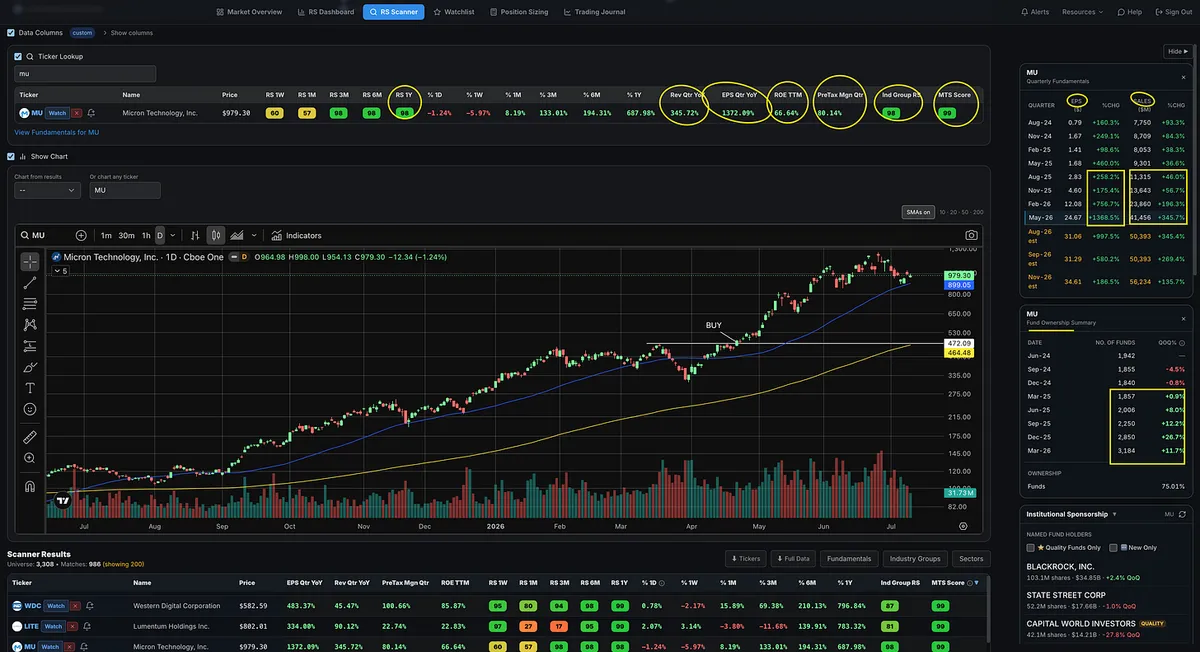
Momentum Trading Strategy

Notes

Risk Management & Position Sizing

Notes whose main point is limiting losses and deciding how much to buy and how much to risk on each trade.

Showing 41–60 of 224 notes

View on Substack ↗

The Best Thing About a VCP Isn’t the Breakout

One of my favorite quotes in Market Wizards comes from Bruce Kovner:

“Whenever I enter a position, I have a predetermined stop. That is the only way I can sleep. I know where I’m getting out before I get in. The position size on a trade is determined by the stop, and the stop is determined on a technical basis. For example, if the market is in the midst of a trading range, it makes no sense to put your stop within that range, since you are likely to be taken out. I always place my stop beyond some technical barrier.”

- Bruce Kovner, Market Wizards

That quote explains one of the biggest reasons I love the Volatility Contraction Pattern.

Most people focus on the obvious part of a VCP.

  • Price tightens.

  • Volume dries up.

  • Supply appears to diminish.

It is almost like a rubber band being pulled tighter and tighter, creating the potential for an explosive move once demand overwhelms the remaining supply.

All of that is great, but that is not my favorite part.

My favorite thing about a VCP is that it can give you a very clear technical level where you have decided the trade is wrong.

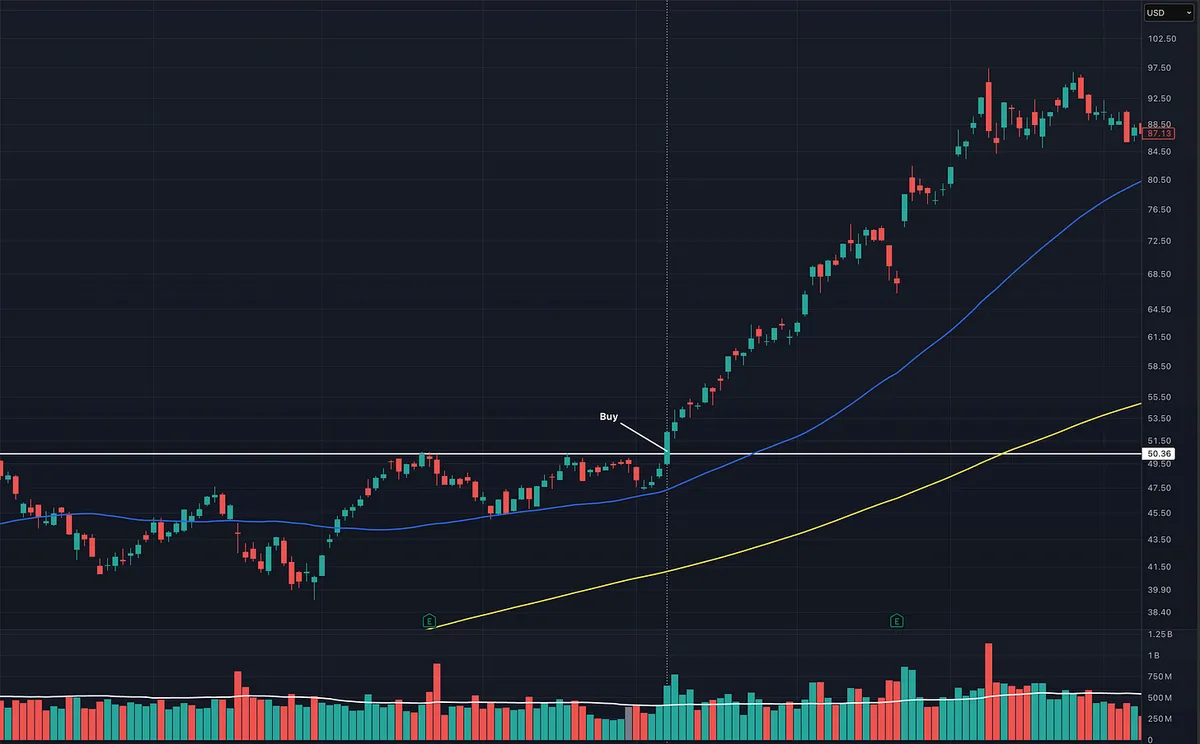
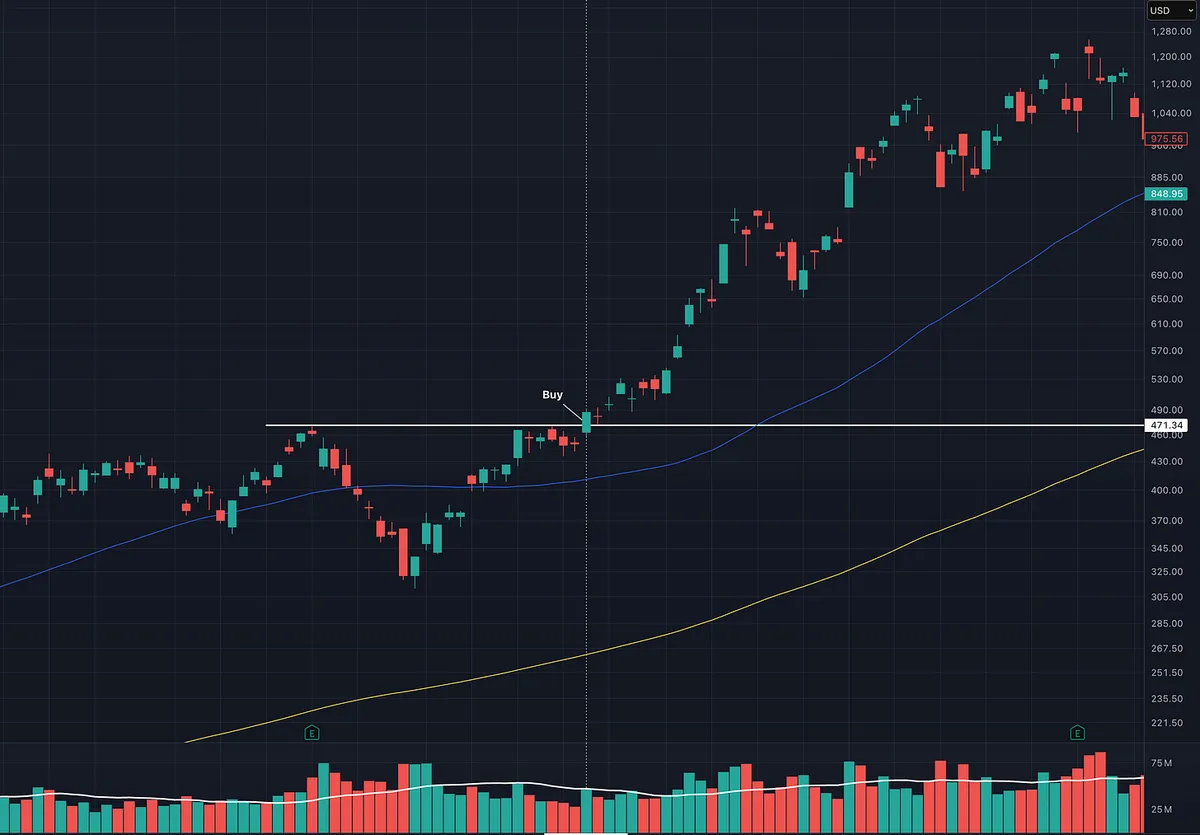
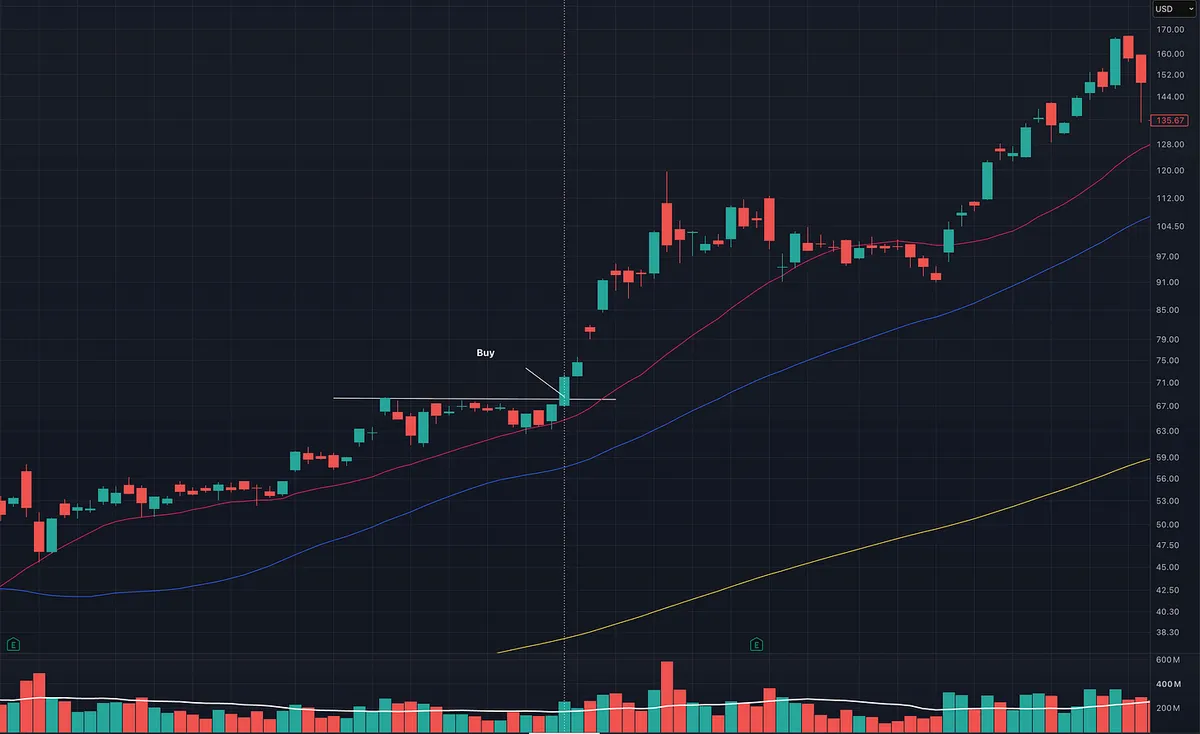
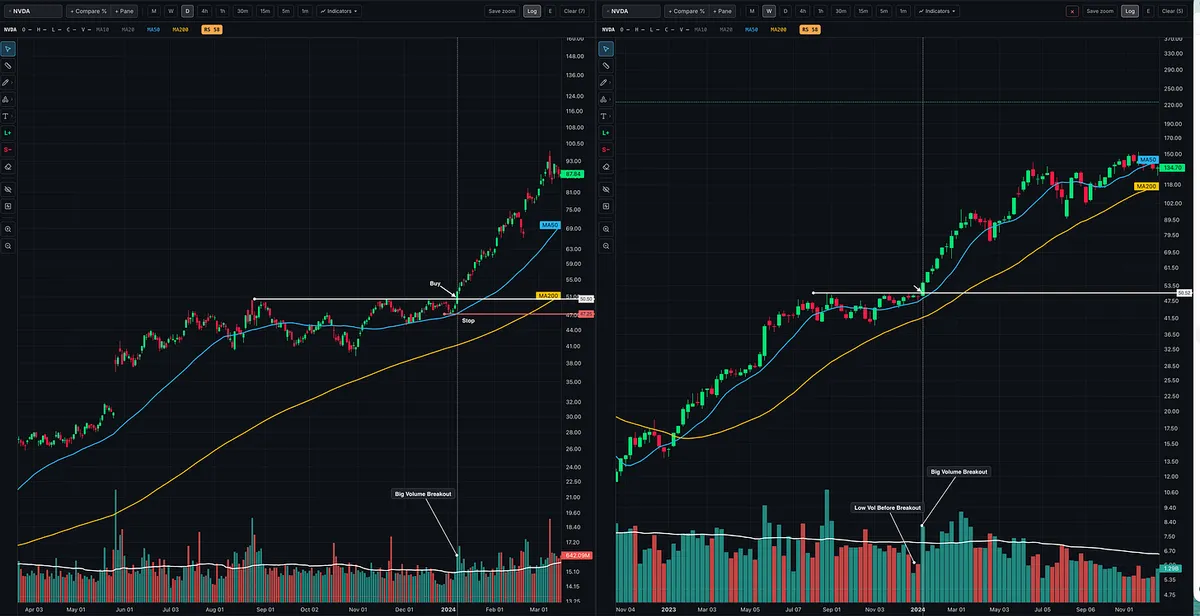
Look at NVIDIA in early 2024.

The stock tightened up near the pivot. Volume dried up. Then price broke through the line of least resistance on expanding volume.

But before the breakout ever happened, I could already identify my risk.

I knew where I wanted to enter.

I knew where the technical structure would begin to fail.

And because I knew my stop, I could determine my position size before putting capital at risk.

That is the part many traders get backwards.

They decide how many shares they want to own first, then try to squeeze a stop somewhere underneath the trade.

I prefer the opposite:

  • Find the setup.

  • Find the technical level that invalidates the setup.

  • Set the stop beyond that level.

  • Then size the position.

The chart determines the risk.

Your desired position size should not determine the chart.

And this is why a tight, well-formed setup can be so powerful. It is not simply that the stock might explode higher.

It is that you can potentially participate in that move while knowing where your idea no longer makes sense.
View on Substack ↗

The Most Important Rule of Trading

“The most important rule of trading is to play great defense, not great offense. Every day I assume every position I have is wrong. I know where my stop risk points are going to be. I do that so I can define my maximum possible drawdown. Hopefully, I spend the rest of the day enjoying positions that are going in my direction. If they are going against me, then I have a game plan for getting out.”

—Paul Tudor Jones, Market Wizards

Most traders spend far too much time thinking about how much they can make.

Great traders think first about how much they can lose.

That is the lesson here.

Before the upside matters, you should already know where you're wrong, where you're getting out, and how much damage that trade can do to your account.

Once the downside is defined, you’re free to let the market do the rest.

If the stock works, enjoy the ride and manage the winner.

If it doesn’t, there’s no panic, hoping, or negotiating with yourself. You already have a game plan.

Protect the downside first. The upside will take care of itself.

View on Substack ↗

The Best Trading Advice I Ever Got Sounds Completely Backwards

Assume every trade is going to be a loser.

That sounds pessimistic, but it’s not. It’s one of the best pieces of advice I’ve ever received in trading.

You find a stock that checks every box.

Big earnings growth. Big sales growth. Strong margins or return on equity. High relative strength. A beautiful cup with handle. Then price starts breaking out through the handle on heavy volume.

Everything looks perfect.

Buy it.

But still assume the trade will fail.

Why?

Because when you assume the trade could be a loser, you stop trying to predict what happens next and start focusing on what you can actually control.

Your process.

You size the position correctly. You define your risk. You know where you’re wrong before you enter. You don’t overbet because you’re convinced “this is the one.” You don’t pile on too much leverage because the setup looks perfect.

And if it fails?

You already planned for that.

If it works?

Great. Now you manage the winner.

The aim is to make sure no single trade matters enough to hurt you when you’re wrong.

Such a simple mindset shift.

But it had an enormous impact on my trading.

View on Substack ↗

One of the Most Important Lessons I Learned From Mark Minervini

The market can look great.

Other traders can be making money.

IBD or your exposure models can all be telling you to get more aggressive.

But don’t forget progressive exposure.

This is one of the most important lessons I learned from Mark Minervini.

If you’re only 20% invested and you’re not finding success at 20%, what sense does it make to suddenly go to 40%, 60%, or 100% just because the market looks good?

Build exposure based on YOUR own success.

If your positions are working, add exposure.

If new buys are following through, add exposure.

If you’re gaining traction, get more aggressive.

But if things stop working, scale it back.

The market gives you information, but your own portfolio gives you information too.

You don’t need to match someone else’s exposure level.

You need to earn your way into higher exposure through your own results.

As things work, increase. As things stop working, decrease.

Simple concept. Incredibly important in practice.

View on Substack ↗

The Best Traders Look Wrong All the Time

To every beginner who thinks they understand the market after making a few good calls, you probably do not know nearly as much as you think.

If the greatest traders showed you every trade, every idea, every market read, and every stop-out with 100% transparency, many of you would think they were terrible.

They are wrong far more often than most people realize.

Not just on individual trades, but on market direction, timing, themes, and ideas. Many are wrong more often than they are right.

The difference is that their systems already account for being wrong.

They remain successful because of their consistency, discipline, risk management, position sizing, and willingness to exit quickly when the market proves them wrong.

Mark Minervini recently shared that he was short the S&P 500. He was wrong, closed the position, and openly admitted it. That is not weakness. That is what professional trading looks like.

People also attack Michael Burry every time one of his calls is wrong, as though a single incorrect idea erases an entire career. I do not trade or invest the way he does, but I know traders who use similar asymmetric strategies and have been highly successful for decades with win rates near 20%.

They are wrong roughly 80% of the time and still produce exceptional returns because their losses are controlled while their winners can be enormous.

That is the point most beginners miss.

Your win rate means very little without understanding the size of your average win, the size of your average loss, and how consistently you execute your strategy.

Social media has trained people to judge traders by whether their latest opinion was correct. The market judges them by how they manage uncertainty across hundreds of decisions.

If your first reaction when a successful trader is wrong is to call them washed up, call them a fraud, or claim they have lost their edge, then you still do not understand how this game works.

You do not need to be right all the time.

You need to lose small when you are wrong, make significantly more when you are right, and repeat that process with discipline.

View on Substack ↗

The Skill That Separates Profitable Traders From Everyone Else

Most people think great traders are great winners.

They’re not.

They’re great losers.

That sounds backwards until you realize what actually destroys trading accounts.

It isn’t bad entries.

It isn’t bad indicators.

It isn’t even bad strategies.

It’s the inability to lose well.

The market doesn’t reward being right. It rewards managing being wrong.

The trader who refuses to take a 6% loss eventually takes a 30% loss.

The trader who keeps averaging down eventually blows up.

The trader who protects their ego instead of their capital eventually has neither.

The irony is that the better you become at accepting small losses, the bigger your winners become.

Why?

Because you’re no longer afraid.

You’re free to take the next setup.

You’re free to size up when conditions are favorable.

You’re free to let your winners compound because you know a loss isn’t a personal failure. It’s simply the cost of doing business.

Tom Hougaard built an entire book around this idea: Best Loser Wins. His central argument isn’t that great traders avoid losing. It’s that they lose differently. They accept losses without emotional attachment and without trying to “get even.”

The goal isn’t to become a better winner.

The goal is to become an elite loser.

Because in trading, the people who lose the best…

Win the most.

View on Substack ↗

One Account Made 4%. Another Made 95%. The Trades Were Identical.

Most traders assume that if two people take the same trades, they should produce roughly the same results.

Same starting capital. Same broker. Same commissions. Same entries. Same exits. Same fully automated trading system.

The results should be nearly identical, right?

They were not even close.

In Van K. Tharp’s Trading Beyond the Matrix, the book describes a system traded across 25 separate accounts. Each account began with $100,000 and took exactly the same trades.

The system was profitable in every account, but the returns ranged from 4% to 95% in one year and 2% to 72% the year before.

How is that possible?

The difference was position sizing.

One account risked only 0.5% of its equity per trade. It experienced the smallest drawdowns, but it also produced the smallest gains.

Another account increased its risk as the account moved further into profit. That investor regularly earned more than 50% annually, but also experienced a drawdown as large as 65%.

Same system. Same edge. Same trades.

Completely different outcomes.

Everyone says risk management is important.

Everyone says position sizing matters.

There are entire books about trading psychology, discipline, and controlling emotions. But very few books actually make you understand how dramatically position sizing can change your results.

Van Tharp’s books did that for me.

The best way to experience it is through the Van Tharp marble game.

Every person receives the exact same sequence of trades. The only decision each player makes is how much to risk.

By the end of the game, one person might be bankrupt. Another might make 2%. Another might make 15%. Another might double the account.

The only thing that changed was how much each person risked.

That is why I built the marble game directly into the Momentum Trading Strategy software.

You can run automated simulations, play the original version against other traders, select prebuilt strategies with different win rates and expectancies, or enter your own custom trading strategy.

Then you can test different position-sizing methods and watch what happens over dozens or hundreds of trades.

It will change the way you think about risk.

You begin to see how overbetting destroys a profitable strategy. You see how smaller risk protects you but may prevent you from reaching aggressive objectives. You see how drawdowns affect your psychology. You see how compounding works in both directions.

Most importantly, you realize that finding a profitable strategy is only part of the equation.

Your strategy determines whether you have an edge.

Your position sizing determines whether you survive long enough to benefit from it, whether you can emotionally tolerate the drawdowns, and whether you ultimately reach your objectives.

Two traders can follow the same signals and trade the same stocks.

One can go broke.

The other can become wealthy.

That is not theory. It is mathematics.

View on Substack ↗

The Market Doesn’t Care How Smart You Are. Read That Again.

Another superstar hedge fund manager just blew up.

After posting enormous returns over the last few years, excessive leverage and poor risk management caught up with him.

If you’ve studied market history, you’ve seen this movie before.

It isn’t rare. It repeats.

Every few years, another “genius” appears. The returns look unstoppable. Confidence turns into overconfidence. Position sizes grow. Leverage increases. Risk controls slowly disappear.

Then one trade, one event, or one unexpected move erases years of success.

I’m not against leverage.

I use leverage.

But leverage only amplifies what already exists. If your risk management is poor, leverage simply helps you fail faster.

This is also why I laugh when people assume systematic traders or algorithmic funds are immune. Many of the biggest blowups in history came from highly sophisticated models combined with excessive leverage and the belief that “this time is different.”

The market doesn’t reward intelligence.

The market rewards discipline.

You do not need to be the smartest trader in the room.

You need to be the trader who is still standing ten, twenty, and thirty years from now.

View on Substack ↗

Would You Risk Months of Progress on One Earnings Report?

You finally find the right stock.

The setup works. The stock breaks out. You sit through the normal pullbacks, manage the position correctly, and build a meaningful profit.

Then you see the earnings date.

Now the question starts running through your head:

Do I hold and risk giving back the gain, or sell and watch the stock gap up without me?

Every serious trader eventually faces this decision.

There is no perfect answer because earnings reactions are unpredictable. A company can report outstanding numbers, raise guidance, and still sell off. Another company can report disappointing results and gap higher.

That is why I never buy a new position immediately before earnings.

But if earnings are still a couple of weeks away and the setup is excellent, I may take the trade. That gives the stock time to move higher and allows me to build a profit cushion before the report.

If I am up 15% to 20%, I will often sell part of the position into strength and hold a smaller piece through earnings.

But here is the part traders often misunderstand:

A profit cushion does not eliminate earnings risk.

A stock can easily gap down more than your entire gain. The real question is not simply whether you are profitable.

The real question is:

How much damage could this position do to your account if the reaction is brutal?

That is what determines how much I hold.

I consider the health of the market, the strength of the industry group, the stock’s price action, its volatility, my total exposure, and how well I have been trading recently.

When the market is healthy, my portfolio is performing well, and the stock remains a leader in a strong group, I may accept more earnings risk.

When the market is deteriorating or my trades have been struggling, I protect capital. I may reduce heavily or sell the entire position before the report.

That is progressive exposure.

You earn the right to take more risk through strong performance. You do not force risk when the market or your own results are telling you to become defensive.

Longer-term positions can be different. If I have owned a stock for months, already held through a previous report, and built a very large cushion, I may hold the next earnings report without trimming.

But even then, I am not holding blindly.

The market, the industry group, the fundamentals, and the stock’s price action still need to support the decision.

Some great traders occasionally hold through earnings with reduced size and a cushion. Others refuse to hold through earnings at all.

The lesson is not that one approach is always right.

The lesson is that you need a rule before the report arrives.

Never wait until the final minutes before the close and make an emotional decision.

Know how much you are willing to lose.

Know how much of the position you are willing to hold.

Know what a severe gap would do to your total account.

And remember this:

If holding the position is going to prevent you from sleeping, the position is probably too large.

Earnings risk cannot be eliminated.

But it can be planned for, reduced, and controlled.

That is the difference between holding with a strategy and simply holding with hope.

This is the type of practical risk-management framework I teach inside the MTS Course, including a method for using a stock’s own volatility to estimate the type of earnings gap you should be prepared to withstand.

View on Substack ↗

You Don’t Need to Be Right to Make a Lot of Money

One of the biggest turning points in my trading was realizing that I did not need to be right most of the time to make a lot of money.

In Module 6 of the MTS Course, we break down expectancy and compare high-win-rate and low-win-rate trading systems.

Both can make money.

Both can lose money.

A trader can win 70% of the time and still be unprofitable if the losses are significantly larger than the gains. Another trader can be wrong more than 50% of the time and build an incredible career by keeping losses small and allowing the winners to become disproportionately large.

Like many of the Market Wizards who influenced me, I have gravitated toward a system designed to make money even when I am wrong more often than I am right.

Yet beginners are naturally attracted to whoever appears to be right the most on social media.

Someone can be right on most of their public calls and still not make money.

You rarely see the position sizing, the losses, the risk taken, the exits, or what happens when the trade moves against them. Being right is not the same as being profitable.

This lesson extends far beyond trading.

Nearly every successful entrepreneur talks about taking many small bets, knowing that most ideas and experiments will not work. Companies like Amazon have built cultures around experimentation because one massive success can pay for countless unsuccessful attempts.

Owning businesses and building a skincare brand has made this even clearer to me.

The majority of our ideas do not become major successes. We take controlled, low-risk bets, collect the information, adjust, and try again.

Then something eventually works.

It is usually not the idea we expected to become the biggest winner, but when it hits, it pays for the unsuccessful experiments and much more.

Those experiments were not failures.

They were the cost of discovering the winner.

Trading works the same way.

Keep taking intelligent, controlled bets. Protect yourself when you are wrong. Stay open when you are right.

You do not need every trade, product, idea, or experiment to work.

You only need to make sure the downside remains small enough that you are still there when the big winner finally arrives.

Learn more about the risk-management and position-sizing framework here:

https://tradingmomentum.substack.com/p/momentum-trading-strategy-risk-management

On SubstackMomentum Trading Strategy: The 100-Year Playbook Behind the Biggest Winning Stocks — Module 6 Risk Management & Position Sizing
View on Substack ↗

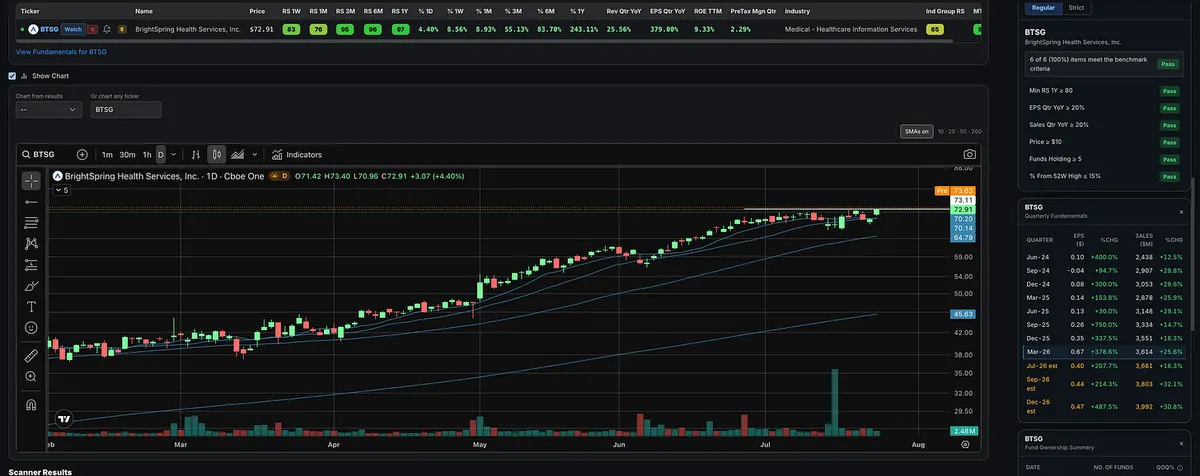
BTSG Looks Good, but Earnings Are Close

BTSG is another name that has been consistently showing up on my screens. It was appearing last fall as well and continues to display strong relative strength, accelerating earnings, double-digit sales growth, and tightening price action near its highs.

But earnings are only a few days away, which adds significant gap risk.

View on Substack ↗

The Best Trades Usually Don't Give You Much Time to Doubt

Have you ever noticed that your biggest winners often seem to work almost immediately?

That's not just your imagination.

William O'Neil, David Ryan, and Mark Minervini all studied their greatest winning trades and reached a similar conclusion. The vast majority moved in their favor almost immediately after the breakout. A few came back to test the entry, but most simply took off and never looked back.

What's interesting is that Peter Brandt, a classical chartist who trades differently and focuses primarily on commodities rather than growth stocks or fundamentals, arrived at the same conclusion after decades of reviewing his own results.

He found that roughly 20% of his trades produced the majority of his profits. And those exceptional trades? Most never looked back after entry. Only a small percentage returned to test the breakout.

  • Different markets.

  • Different strategies.

  • Different decades.

  • The same lesson.

The biggest winners often tell you they're winners early.

That's why these legendary traders all preach the same principle:

Cut your losses quickly and keep them small. Then give your winners the time and space to become exceptional.

The next monster winner probably won't spend much time asking for your permission. It will simply go.

View on Substack ↗

You Can Be Right About the Market and Still Lose Money

Everybody gravitates toward the person on social media who seems to make the best calls.

They called the breakout.

They predicted the selloff.

They posted the winner before it ran.

So naturally, people assume that person must be a great trader.

But correctly predicting whether a stock or the market will go up or down is not what ultimately determines whether you make money.

The market does not pay you for being right.

It pays you for how much you make when you are right, how little you lose when you are wrong, how you size your positions, and how consistently you execute a process with positive expectancy.

Many highly successful traders have win rates below 50%. Some operate with win rates in the 20% to 35% range.

They are wrong more often than they are right, yet they still extract enormous amounts of money from the market.

On social media, their results might look terrible.

They may post several losing trades in a row, get criticized for being wrong, and have people question whether they know what they are doing.

Some successful traders deal with this constantly because many of their critics simply do not understand expectancy.

Meanwhile, a trader can be right 70% of the time and still lose money.

Amateurs obsess over predictions because predictions are visible, exciting, and easy to understand.

Experienced traders focus on expectancy, risk management, position sizing, and executing favorable risk-to-reward opportunities because those are the things that determine whether they survive and become profitable.

Once you understand this, you begin separating yourself from the majority.

The majority are searching for someone who can tell them what will happen next, even though predictions alone will never teach them how to make money consistently or keep it over the long run.

The minority are executing a process that makes money without needing to be right most of the time.

Become the minority.

View on Substack ↗

The Most Important Part of Trading Is the Part Nobody Wants to Study

Paul Tudor Jones described the trading process in five parts:

  1. Analysis

  2. Instrument selection

  3. Position sizing

  4. Execution

  5. Risk management

Stanley Druckenmiller was then asked what separated him from other traders across those five areas.

His answer was position sizing.

Not analysis. Not stock selection. Not execution.

Position sizing.

This is why I have written articles and created videos about it. It is why I cover it extensively in Module 6, Risk Management, of the Momentum Trading Strategy course.

It is also why I developed the Optimal Sizing Calculator and added Dr. Van Tharp’s Marble Game to the Momentum Trading Strategy software. You can run countless simulations using different trading strategies to see how position sizing changes the final outcome.

You can even play against other people. Everyone receives the exact same trades, entries, stops, winners, and losers. The only difference is how much each person chooses to risk before every trade.

Some produce Market Wizard-type performance. Some finish flat. Others blow up their accounts.

Same trades. Completely different results.

Use these resources, and study books such as Dr. Van Tharp’s The Definitive Guide to Position Sizing Strategies.

Spend some time learning the part of trading nobody wants to study.

View on Substack ↗

Everyone Tells You to Diversify. Buffett, Druckenmiller, and O’Neil Said the Opposite.

Many investors believe strongly in diversification and do not understand why I prefer to concentrate my capital in a select few names, ideally the strongest market leaders.

But I did not come up with this idea out of nowhere.

Some of the most respected investors and traders in history have expressed the same belief. Maybe these three quotes explain it better than I can.

Stan Druckenmiller said:

“Put all your eggs in one basket and watch the basket carefully.”

William O’Neil said:

“Diversification is a hedge for ignorance. I think you are much better off owning a few stocks and knowing a great deal about them. By being very selective, you increase your chances of picking superior performers. You can also watch those stocks much more carefully, which is important in controlling risk.”

Warren Buffett said:

“Diversification is protection against ignorance. It makes little sense if you know what you are doing.”

Concentration does not mean blindly putting everything into one stock and hoping for the best.

It means being highly selective, knowing what you own, understanding why you own it, controlling your risk, and allocating more capital to your best ideas instead of spreading it across dozens of mediocre ones.

Diversification may reduce the damage caused by being wrong, but excessive diversification can also dilute the rewards of being right.

I would rather closely follow a small number of exceptional market leaders than own a large collection of mediocre stocks I barely understand.

View on Substack ↗

I’ve received a lot of comments from people who believe today’s market is fundamentally different, that O’Neil did not trade stocks with this level of volatility, and that past leaders did not have comparable price swings, ADRs, or ATRs.

Qualcomm in 1999 directly challenges that assumption.

O’Neil absolutely traded highly volatile stocks during highly volatile market periods. The names, industries, and technology may change, but powerful leaders with wide price swings are NOT new.

I added an important Qualcomm 1999 example to this post that I left out when I originally published it.

When I recreated O’Neil’s Qualcomm setup using historical data, I found that a stop below the most recent higher low would have been about 10.1%, outside his traditional 7% to 8% guideline.

But a stop at the low of the high-volume breakout day would have been roughly 6.2%, keeping the trade comfortably within O’Neil’s framework.

Qualcomm was highly volatile and still went on to produce an extraordinary advance. It is a strong reminder that fast-moving market leaders are not unique to today’s market.

The lesson is not that O’Neil ignored his rule. We do not know the exact stop he used. The lesson is that a more precise entry and stop location can sometimes allow you to participate in a volatile leader without accepting a wider stop loss.

I added all three Qualcomm charts and the full breakdown to the article. Take another look at the updated post.

ArticleDoes O’Neil’s 8% Stop Rule Still Work Today?
View on Substack ↗

The Hottest Stock in the Market Can Still Be a Bad Trade

You find a true market leader.

Big earnings. Strong sales. High relative strength. A quality setup. Volume dries up, demand comes in, and the stock is ready to break out.

Everything looks right.

Then you measure the distance from your entry to the logical technical stop.

It is not 6%, 7%, or 8%.

It is 11%, 12%, or even 15%.

Now what?

  • Do you force a tighter stop into normal price action?

  • Reduce your position size?

  • Use a more precise intraday entry?

  • Wait for another setup?

  • Or pass completely?

This is where finding a great stock ends and structuring a great trade begins.

You do not need to follow CAN SLIM or even know who William O’Neil is to face this problem. Every serious trader must understand how the setup, technical stop, position size, account risk, and potential reward fit together.

I just published a deep dive into O’Neil’s 7% to 8% rule, how to handle more volatile stocks, position sizing, concentration, staggered stops, tighter entry tactics, and managing risk without forcing the chart to fit an arbitrary percentage.

The chart determines the stop.

The stop determines the position size.

The position size determines your account risk.

Read: https://tradingmomentum.substack.com/p/does-oneils-8-stop-rule-still-work

ArticleDoes O’Neil’s 8% Stop Rule Still Work Today?
View on Substack ↗

Most Traders Learn the Pieces. Few Put Them Together.

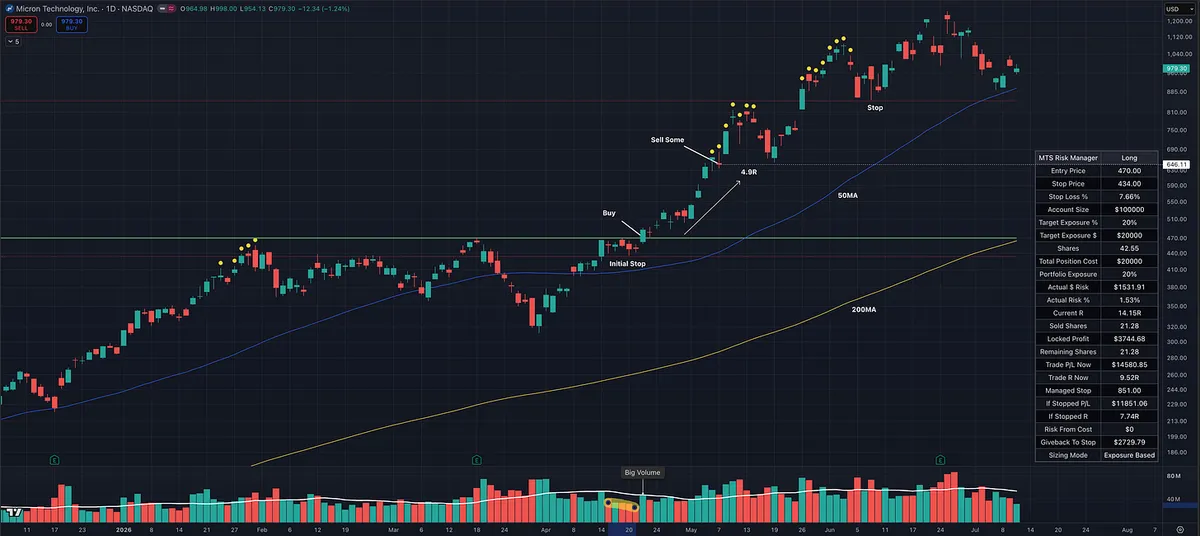
This chart shows how several critical trading principles can come together in one trade.

William O’Neil: Use relative strength, growth fundamentals such as powerful earnings and sales growth, institutional sponsorship, and industry leadership to find stocks with the characteristics of history’s biggest winners. Then wait for a proper setup and let the chart determine the initial stop.

Anna Coulling: Study the relationship between price and volume. Volume dried up as the stock tightened in the handle, then expanded as it broke into new highs.

Dr. Van Tharp: Define the risk first, calculate the correct position size, and measure the trade in R multiples.

Mark Minervini: Sell some into strength, raise the stop as the trade proves itself, and finance the rest of the trade.

George Soros: His risk-first philosophy reinforces the goal of protecting principal and reaching a point where you are managing accumulated profits instead of continuing to risk your original capital.

The process shown on this chart:

  1. Use the RS Scanner to identify the leader.

  2. Wait for a proper chart setup.

  3. Confirm the setup through price and volume.

  4. Identify the initial stop from the chart.

  5. Position size based on the technical stop level and acceptable account risk.

  6. Sell some into strength to reduce the remaining risk.

  7. Raise the stop to breakeven when the price action allows.

  8. Manage the trade through higher highs and higher lows.

  9. Add to the winner when another low-risk setup appears, or sell some more to lock in additional profits along the way.

  10. Repeat.

This is not the entire trading process. A complete system also includes understanding the general market environment, positive expectancy, analytics, journaling, mindset, continuous review, and more.

But this chart shows how stock selection, chart analysis, position sizing, risk management, and trade management can begin working together within a single trade.

To dive deeper into how these principles fit together, take the Momentum Trading Strategy Course.

View on Substack ↗

The Fastest Way to Improve at Trading Is to Stop Trying to Make Money

Most struggling traders don’t have a strategy problem.

They have a sizing problem.

They’re risking enough money that every trade becomes emotional. They hesitate on losses, move their stops, hold winners too long, sell too early, and obsess over every tick.

Then they wonder why they can’t follow the system they already know.

The solution is simple, but most people are too stubborn to do it:

Trade smaller.

Reduce your position size and overall portfolio risk to the point where you almost don’t care whether any individual trade works.

Long term, you can’t trade tiny forever. Eventually, your winners need to be large enough to meaningfully grow your account. That’s why position sizing and risk management are so important.

But when you’re still building confidence, your primary goal should not be to make as much money as possible.

Your goal should be to execute correctly.

Smaller size gives you more reps with less emotional pressure. It becomes easier to:

Take losses without hesitation.

Respect your initial stops.

Sell some into strength.

Avoid holding too long out of greed.

Stop regretting a sale just because the stock keeps running.

Follow your process instead of reacting to your emotions.

Ironically, once you stop trying so hard to make money, you may surprise yourself and start making more of it.

But the bigger win is that you begin building confidence in yourself and in the system.

A lot of traders ignore this advice. They spend five years or even ten trading too large, breaking rules, repeating the same mistakes, and letting emotion control every decision.

Some quit.

Others finally hit rock bottom and decide that enough is enough.

The traders who make meaningful progress in 18 months to 2 years usually aren’t more talented.

They’re simply less stubborn.

They accept that the goal at the beginning isn’t to maximize profits.

It’s to master the process.

Once consistent execution becomes second nature, increasing your size is the easy part.

Confidence isn’t built through one huge winner.

It’s built by doing the right thing, over and over again.

View on Substack ↗

You Cannot Predict the Winner. You Can Control the Risk.

I screen for stocks with the same characteristics shared by many of the biggest winners in market history.

Strong relative strength. Accelerating sales. Triple-digit earnings growth. High ROE and margins. Leading industry groups. The CANSLIM characteristics and many of the traits I teach throughout Modules 4 and 5 of the Momentum Trading Strategy Course.

All of that improves the probabilities.

But even then, I never truly know which stock will become the big winner.

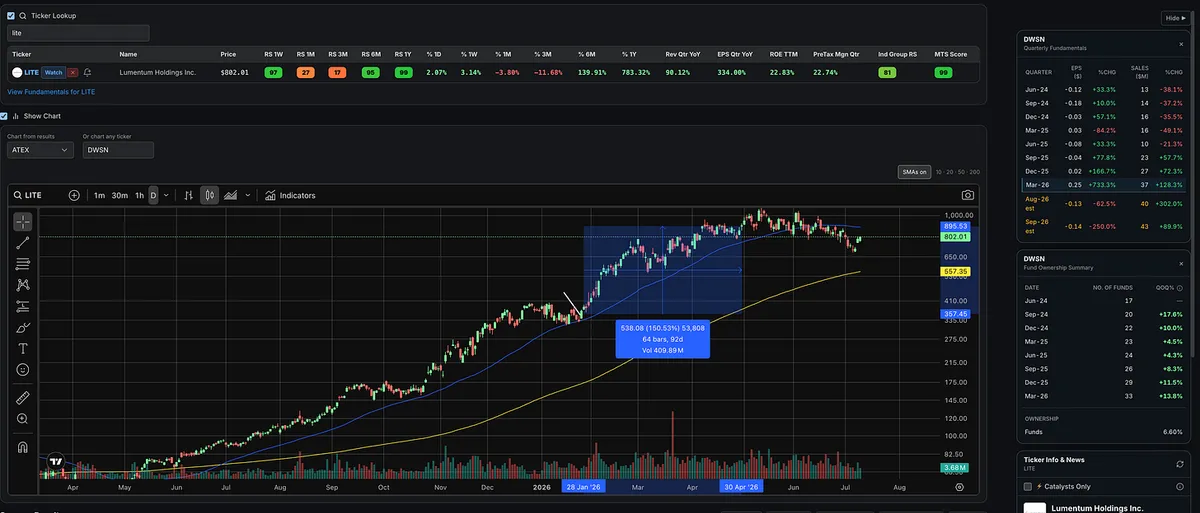
There are plenty of names I expect to work that quickly stop me out. Then there are trades like LITE.

I bought LITE in late January as it found support around the 50-day moving average. It had a 99 RS Rating, accelerating sales, improving triple-digit earnings, strong ROE and pre-tax margins, and belonged to a strong industry group.

I did not know the company well. I did not fully understand the story. I did not even know NVIDIA was a major investor until that news surfaced later.

I was simply following my system.

LITE became a much larger winner than I could have predicted. But there were several other stocks with similar characteristics where I entered, took a small loss, and moved on.

That is trading.

Your criteria create an edge, but they do not create certainty.

The one thing you can control before entering is how much you are willing to risk.

I stay concentrated, cut losing positions, and add to positions that prove themselves. Once I have sold some into strength and raised my stop toward breakeven, I become more adaptable.

Sometimes a trade I expect to hold for a few days becomes a multi-month winner.

Sometimes a stock I expect to hold as a position trade stops acting right, and I exit quickly.

You do not decide which stock becomes the monster winner.

The stock and the market decide.

Your job is to control the risk, follow your system, and stay with the winners that prove themselves.