Momentum Trading Strategy

Notes

Lessons from Legendary Traders

Notes built around one named market figure's own words or story, such as O'Neil, Livermore, Minervini, Seykota, Druckenmiller, Tudor Jones or other Market Wizards.

Showing 161–180 of 263 notes

View on Substack ↗

“There are only a few times a year when you should allow yourself to make a commitment at all.” — Jesse Livermore

Many people try to treat trading like a job where they earn a consistent paycheck. That is not how markets work. You may go six months where conditions are not conducive to your strategy, and then make your entire year in a one to three month window.

Livermore said this over a century ago, and it is still true today. Entrepreneurs understand this instinctively, and so do successful traders and investors.

Markets reward patience at every timeframe.

View on Substack ↗

“The real money made in speculating has been: ‘IN COMMITMENTS IN A STOCK OR COMMODITY SHOWING A PROFIT RIGHT FROM THE START.’” — Jesse Livermore

This one sentence reveals a trading behavior most professionals have known for decades and most retail traders still miss.

I break down why this matters, and how the biggest stock winners in history behave exactly this way.

If your trade needs time to work, it’s already telling you something.

👉 https://tradingmomentum.substack.com/p/the-best-trades-put-you-in-the-money

ArticleThe Best Trades Put You in the Money Immediately and Never Look Back
View on Substack ↗

The best trades work from the start.

They put you in the money immediately and never look back.

I break down why the biggest stock winners over the last 100 years behave this way, and how Jesse Livermore figured it out long ago.

If your trade needs time to work, it is already telling you something.

The full article is live:

https://tradingmomentum.substack.com/p/the-best-trades-put-you-in-the-money

ArticleThe Best Trades Put You in the Money Immediately and Never Look Back
View on Substack ↗

Why Risk Control Comes Before Everything

Most traders obsess over entries. Some obsess over indicators. Almost none obsess enough over risk.

“Risk control is the most important thing in trading.” — Paul Tudor Jones

That sentence explains why some traders last decades and most don’t.

You can be wrong and survive with good risk control. You can be right and still fail without it.

Risk control:

  • Keeps you in the game

  • Protects you from emotional decisions

  • Turns mistakes into tuition instead of disasters

The market does not reward boldness without survival.

If you can control risk, everything else has time to improve.

If you can’t, nothing else matters.

View on Substack ↗

Stop Letting Your Last Trade Ruin the Next One

If you have ever replayed a mistake in your head, If you have ever hesitated because of the last loss, If you have ever traded differently just to “make it back,”

You know this feeling all too well.

You are not trading the market. You are trading your memory.

“I think one of my strengths is that I view anything that has happened up to the present point in time as history. I really don’t care about the mistake I made three seconds ago in the market. What I care about is what I am going to do from the next moment on. I try to avoid any emotional attachment to a market. I avoid letting my trading opinions be influenced by comments I may have made on the record about a market.” — Paul Tudor Jones

This is not about ignoring mistakes. It is about handling them correctly.

You learn the lesson. You take the information forward. And then you let it go.

Because if you do not, the mistake does not stay in the past. It starts trading for you.

The best performers in every field understand this.

The greatest baseball players fail about 70 percent of the time at the plate. The best soccer players only score on 10 to 20 percent of their shots.

Yet they step back into the box. They take the next shot. They do not carry the last miss into the next attempt.

They have what professionals call short-term memory.

Not because they do not care. Because they care enough to protect their performance.

Most traders do the opposite.

They hesitate after a loss. They overtrade after a win. They defend opinions instead of managing risk.

Not because they lack strategy. Because emotion from the last trade is driving the next one.

But the market does not reward memory. It rewards clarity.

The professionals reset. They detach. They respond to what is happening now, not what just happened.

When you stop trading your past: You manage risk instead of ego. You execute instead of react. You follow process instead of emotion.

That is real trading psychology. That is discipline. That is how consistency is built.

Learn from the mistake. Take the lesson with you. Then let it go.

The next decision is all that matters.

View on Substack ↗

Every Market Wizard Says the Same Thing. How Many Times Do You Need to Hear It?

If you skim Market Wizards, you’ll see every style imaginable.

Trend followers. Discretionary traders. Macro. Technical. Systematic.

Different methods.

Different personalities.

Different markets.

And yet they all say the same thing.

“What is the key trading rule you live by? Never add to a loser.”

— Brian Gelber

“Don’t ever average losers.”

— Paul Tudor Jones

“The most important thing is to have a method for staying with your winners and getting rid of your losers.”

— Gary Bielfeldt

“You cannot let ego get in the way of a trade that is a loser. You have to swallow your pride and get out.”

— Tom Baldwin

“The most important advice is to never let a loser get out of hand. You want to be sure you can be wrong twenty or thirty times in a row and still have money in your account.”

— Randy McKay

“Perhaps the most important rule is to hold on to your winners and cut your losers.”

— Michael Marcus

“The elements of good trading are:

(1) cutting losses,

(2) cutting losses, and

(3) cutting losses.

If you can follow these three rules, you may have a chance.”

— Ed Seykota

“Letting losses run is the most serious mistake made by most investors.”

— William O’Neil

“Learn to take losses. The most important thing in making money is not letting your losses get out of hand.”

— Marty Schwartz

“You have to learn how to lose. It is more important than learning how to win.”

— Mark Weinstein

“Two of the cardinal sins of trading: giving losses too much rope and taking profits prematurely.”

— William Eckhardt

Different words.

Same rule.

Do not add to losers.

Do not average down.

Do not let ego turn a trade into a position.

Do not let a small mistake become a career-ending one.

Yet most traders still do the opposite.

They hold because they “believe.”

They average because they “need to get back to even.”

They hesitate because they “don’t want to be wrong.”

That is not strategy.

That is emotion.

The market does not care about your opinion.

It only cares about your risk.

Every one of these traders made fortunes in different ways.

But they all survived the same way.

They cut losses fast.

They protect capital first.

They stay in the game.

So here is the real question.

How many times do you need to hear the same rule…

before you finally change?

View on Substack ↗

William O’Neil on When to Step Aside

“If you hit a losing streak, and it is not because what you are doing is wrong, that tells you the whole market may be going bad. If you have five or six straight losses, you want to pull back to see if it is time to start moving into cash.” — William O’Neil

Most traders treat a losing streak as a personal problem. They assume it means they are off. That they need to try harder. That they should push through.

O’Neil saw it differently.

Sometimes it is not you. It is the market environment.

When solid setups stop working, when leadership breaks down, when follow-through disappears, the message is not to trade more. The message is to step back.

Five or six losses in a row is not bad luck. It is feedback.

The best traders listen to that feedback.

They reduce exposure. They raise cash. They wait for conditions to improve.

Because no matter how good your strategy is, it only works in the right environment.

The market goes through phases:

• trending

• choppy

• distribution

• correction

Trying to force trades in the wrong phase is how discipline erodes and capital disappears.

Great traders do not measure success by how often they trade. They measure it by when they choose not to.

Sometimes the most profitable position is cash. Sometimes the best trade is waiting.

That is not weakness. That is professional awareness.

If your edge is not being rewarded, listen. Pull back. Protect capital.

The opportunity will come back.

View on Substack ↗

Paul Tudor Jones on Why Defense Wins in Trading

“The most important rule of trading is to play great defense, not great offense. Every day I assume every position I have is wrong. I know where my stop risk points are going to be. I do that so I can define my maximum possible drawdown. Hopefully, I spend the rest of the day enjoying positions that are going in my direction. If they are going against me, then I have a game plan for getting out.” — Paul Tudor Jones

View on Substack ↗

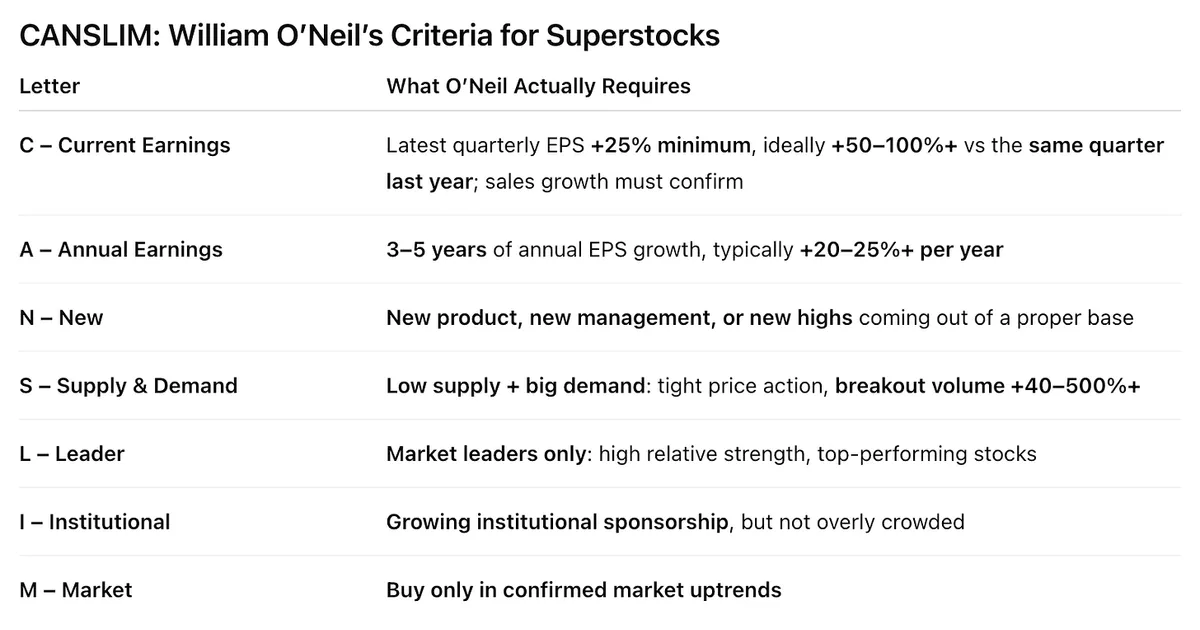
CANSLIM: William O’Neil’s Criteria for Superstocks

If you have been struggling trading stocks, maybe it is time to get back to the basics. Here is a time-tested framework that has worked for over a hundred years.

This is the original system from How to Make Money in Stocks and the exact set of rules behind many of the greatest stock market winners in history.

Below is the screen and checklist O’Neil used to identify superstocks before they made their biggest moves.

This chart summarizes O’Neil’s true CANSLIM criteria: earnings growth, leadership, institutional demand, and market conditions that repeatedly showed up in history’s biggest winners. Many of us drift over time and develop our own tweaks, but sometimes the best move is to return to what actually works. And honestly, it never hurts to reread How to Make Money in Stocks.

View on Substack ↗

Ed Seykota on the Only Rule That Really Matters

The legendary Ed Seykota, who mentored and influenced traders like Michael Marcus, Bruce Kovner, and Larry Hite, was once asked:

What are the elements of good trading?

His answer:

“The elements of good trading are:

(1) cutting losses,

(2) cutting losses, and

(3) cutting losses.

If you can follow these three rules, you may have a chance.”

— Ed Seykota, Market Wizards

Not finding the perfect setup.

Not predicting the market.

Not being right more often.

Cutting losses.

That is what separates professionals from everyone else.

Most traders focus on how much they can make.

Seykota focused on how much he could avoid losing.

Because the game is not about winning big once.

It is about not losing big ever.

Every blown account has the same cause.

A loss that was not cut.

A position that got emotional.

A trade that became personal.

Great traders understand something simple:

You do not need to be right all the time.

You just need to stay in the game.

Cut losses quickly.

Preserve capital.

Let probabilities work.

Do that long enough and the edge compounds.

Ignore it, and no strategy in the world will save you.

Seykota said it in three rules for a reason.

View on Substack ↗

Dr. Van K. Tharp on What Actually Creates Trading Success

“There are three primary factors: beliefs, mental states, and mental strategies. If you duplicate how the best traders use those three factors, you can duplicate their results.” — Van K. Tharp, Market Wizards

Most people try to copy setups. Tharp says the real edge is internal.

Top performers are often unconsciously competent. They do things automatically, which means when they teach, the most important pieces get left out. Tharp’s work is about uncovering and installing those missing pieces.

His research shows that beliefs drive performance.

The Army once modeled its best sharpshooters and cut training time in half while improving results. The biggest difference was not mechanics. It was what the best shooters believed about preparation, responsibility, and precision.

Tharp found the same pattern in elite traders. They tend to believe:

• Money is not the goal

• Losses are acceptable

• Trading is a game with rules

• Mental rehearsal matters

• They have already won in the long run

Most traders do the opposite. They obsess over money, fear losses, and abandon their rules under pressure.

You do not duplicate success by copying trades. You duplicate success by installing the beliefs, mental state, and decision framework of the best.

View on Substack ↗

Marty Schwartz’s Trading Rules From Market Wizards

When people ask what separates professionals from everyone else, the answer is almost never a secret indicator.

It is rules. Process. Discipline.

Marty Schwartz laid out his trading rules in Market Wizards, and they read like a blueprint for survival.

Start with the trend “I always check my charts and the moving averages before taking a position. Is the price above or below the moving average? That works better than any tool I have. I try not to go against the moving averages. It is self-destructive.”

If you fight the trend, the market eventually reminds you who is in control.

Look for relative strength “Has a stock held above its most recent low when the market has broken its own low? If so, that stock is much healthier than the market. Those are the divergences I always look for.”

Strength reveals where real demand exists.

Question every trade “Before putting on a position, always ask: Do I really want to have this position?”

If you cannot defend the trade before entering, you will not defend it when it goes against you.

Respect winning streaks “After a successful period, take a day off as a reward. I have found it difficult to sustain excellent trading for more than two weeks at a time. After a strong run of profits, I try to play smaller rather than larger. My biggest losses have always followed my largest profits.”

Euphoria is dangerous. Protect yourself from yourself.

Avoid bottom fishing “Bottom fishing is one of the most expensive forms of gambling.”

Sometimes it works, but only when it is planned, controlled, and risk-defined. Not emotional. Not impulsive.

Know your ‘uncle point’ before entering “Before taking a position, always know the amount you are willing to lose. Know your pain threshold and honor it.”

If you do not decide your exit in advance, the market will decide it for you.

Wait for confirmation “When different markets disagree with each other, have no position until one confirms the direction of the other.”

When signals conflict, cash is a position.

Do the work “Work, work, and more work.”

There are no shortcuts.

And above all: money management “The most important thing is money management, money management, money management. Anybody who is successful will tell you the same thing.”

Edge means nothing without risk control.

Even the best are still improving “The one area I am constantly trying to improve is letting my gains run. To my dying day, I will probably still be working on it.”

That is the real lesson.

Great traders are not finished products. They are craftsmen. Always refining. Always adjusting. Always learning.

Not chasing perfection. Just trying to get a little better every day.

That is how you last.

View on Substack ↗

How Market Tops Actually Form: William O’Neil’s Blueprint

Most investors look for the exact top. They want the moment. The headline. The one signal that says, “Get out.”

That is not how real market tops form.

William O’Neil explained it best in Market Wizards. According to O’Neil, major tops in the market averages usually develop in one of two ways:

1. New highs on weak volume When the market pushes to fresh highs on low volume, it is telling you something important. Demand is thinning. Fewer institutions are stepping in. The rally is becoming vulnerable.

2. Heavy volume with little price progress Sometimes volume surges for several days, but prices go nowhere. This is distribution. Big money is selling into strength. The market may not collapse immediately, because the selling has already happened on the way up.

In both cases, the message is the same. The fuel behind the trend is fading.

But O’Neil went further.

Watch the Leaders

Another way to identify a market top is to stop staring at the index and start watching leading stocks.

When the stocks that powered the bull market begin to break down, that is not noise. That is rotation out of risk. That is institutional money leaving the field.

Markets do not collapse randomly. They roll over when leadership disappears.

Follow the Federal Reserve

O’Neil also pointed to monetary policy. Historically, after the Federal Reserve raises rates two or three times, the market often runs into trouble.

Liquidity tightens. Risk appetite contracts. Valuations compress.

It does not cause an immediate crash, but it changes the environment.

Breadth Tells the Truth

Finally, watch market participation.

The advance/decline line tracks how many stocks are rising versus falling. At major tops, a common pattern appears:

• Indexes push to new highs • But fewer stocks are participating • Breadth fails to confirm the rally

When fewer stocks are carrying the market higher, the structure is weakening from the inside.

The Big Picture

Market tops are not events. They are processes.

They form through:

  • thinning demand

  • quiet institutional selling

  • breakdowns in leadership

  • tightening liquidity

  • and deteriorating breadth

By the time the headlines appear, the smart money has already acted.

You do not need to predict the exact top. You need to recognize when the character of the market changes.

That is what separates professionals from spectators.

As O’Neil taught, markets give you the clues. You just have to know where to look.

View on Substack ↗

Tom Baldwin: Trading Is a Profession, Not a Shortcut to Riches

Tom Baldwin once said:

“The average guy might not be a million-dollar trader, but if he stands there for five years, he would have to pick it up. It is just like a job. You don’t start any job and feel comfortable in the first six months.” — Tom Baldwin

Trading can be learned no differently than any other profession.

There is no magic talent.

No shortcut.

No overnight mastery.

What determines how long it takes is not intelligence. It is focus, work ethic, discipline, and dedication.

Most people quit before the learning curve has a chance to work.

They expect comfort too early.

They confuse early struggle with failure.

Every real profession is uncomfortable at first. Every craft requires years of repetition, mistakes, and refinement.

The traders who make it are not the ones who avoid losses. They are the ones who outlast them.

Once you reach consistency, the next phase begins. That is where the real separation happens.

The additional work. The refinement of edge. The discipline around risk. The emotional control.

That is why P&L varies so widely among traders. Not because the market is unfair, but because effort, process, and discipline compound differently for everyone.

You do not need to be extraordinary to succeed. You need to be persistent.

Stand there long enough.

Do the work.

And good things will happen.

View on Substack ↗

This Mark Weinstein Story Will Only Make Sense to Traders

This story from Mark Weinstein always makes me laugh. Not because it is light, but because only another trader truly understands it.

There are a lot of lessons inside this quote, but it is also funny in a dark way. Anyone who has moved past this stage probably went through something similar in their early days.

“Before that trade, I had nearly $1.5 million in my trading account. So I was losing nearly 10 percent of my equity prior to the trade each day. I was devastated. I felt like I was wounded in a trench and watching myself bleed to death. The market went limit-down five days in a row, and I lost over $600,000. On the fifth day, I remember sitting in a park holding hands with a girl I had picked up, literally crying on her lap. I was practically in a psychotic state. I thought about getting out of the business altogether. I started to think that what everybody was telling me was true. Maybe it was just luck that I had made money all those years. I worried that if I continued trading, I could wind up losing it all and be forced to go back to some job I didn’t like.” — Mark Weinstein, Market Wizards

If you have traded long enough, you recognize this instantly. The emotional free fall. The self-doubt. The existential crisis over whether you ever had an edge at all.

Every trader eventually learns this lesson the hard way. Markets do not care about your confidence. They do not care about your past success. They will test you until you either develop discipline or leave the game.

What makes this story funny is not the pain. It is the familiarity.

Most traders who survive long enough to become professionals went through some version of this. The moment when losses stop being numbers and start becoming emotional. The moment when you question everything.

And if you make it through that phase, you come out different. More risk aware. More humble. More focused on process over outcome.

The market does not teach gently, but it teaches you what you need.

If you can survive this stage, you will likely make the necessary improvements and be around for the long term.

Unfortunately, most of us have to go through some form of struggle like this to move to the next level in our trading. If you are going through it right now, realize this: you are not alone. Many of us have made the same emotional mistakes. And for those who stayed in the game, those mistakes were part of the journey.

View on Substack ↗

Brian Gelber on Why Knowing Yourself Is an Edge in Trading

“I think I’m a good trader, but there is a guy working for me who is better. I could go out there and beat my head against the desk and try to outdo him, or I can just be myself. Let him make whatever he can, and I’ll make whatever I can.”

— Brian Gelber, Market Wizards

When you are first getting into trading, it is inspiring to study other traders.

Seeing what is possible shows you that success in this business is real, just like in any other profession.

But at some point, that inspiration can turn into something else.

Constantly comparing your results to others becomes destructive.

You try to mimic other traders instead of following your own path.

You start questioning your process.

You measure yourself against someone else’s strengths instead of refining your own.

Many great traders are not trying to be the best.

They are trying to be the best version of themselves.

Those who focus on improving their own discipline, execution, and decision-making often become great traders.

Those who try to copy other people’s methods or compete purely on P&L usually perform poorly.

Know yourself.

Trade in a way that fits you.

Let others make what they can.

Your job is simple.

Make what your edge allows, and focus on improving yourself.

View on Substack ↗

How to Trade After a Big Loss Without Blowing Up

Marty Schwartz gave incredible insight into how a true professional handles a major drawdown.

“After a devastating loss, I always play very small and try to get black ink, black ink. It’s not how much money I make, but just getting my rhythm and confidence back. I shrink my size totally, to a fifth or a tenth of the position that I trade normally. And it works. I think I ended up losing only $57,000 in November 1982, after taking a $600,000 hit on November 4.” — Marty Schwartz, Market Wizards

Most traders do the opposite.

They size up to “make it back.” They take subpar trades to get out of the hole faster. They trade emotionally instead of strategically.

And that is exactly how losses turn into career-ending ones.

The professionals do something counterintuitive. They reduce risk. They tighten their standards. They focus on process, not profits.

Size down. Get more selective and patient. Or sit out entirely until conditions improve.

You would be surprised how quickly you can recover with a fraction of the size, simply by trading A+ setups and using proper position sizing.

The goal after a loss is not to “make it back.” The goal is to stay in the game long enough to compound again.

View on Substack ↗

“In our research, we found there was a very low correlation between the P/E ratio and the best-performing stocks.” -William O’Neil

Cheap stocks are not automatically winners.

Low P/E does not mean high returns.

And many of the biggest leaders looked “expensive” before their best moves.

What actually matters?

Strength.

Demand.

Institutional accumulation.

Leadership.

The market does not reward what looks cheap. It rewards what is being aggressively bought.

That is why the best stocks often trade at higher multiples. Not because they are overvalued. Because they are being accumulated before the crowd understands why.

If you are still screening only for low P/E, you are filtering out tomorrow’s leaders.

If you are a momentum trader or growth investor searching for high-performing stocks, P/E has little value in your scans.