
Trading articles/The Momentum Burst Setup: How to Capture Explosive Moves Before They Happen
Mar 20, 2026 · Momentum Trading Strategy
The Momentum Burst Setup: How to Capture Explosive Moves Before They Happen
How to Position Early for Explosive Moves in High Relative Strength Stocks
Originally published on Substack.
There is a specific moment in the market that most traders consistently miss.
Not because it is hidden, but because it does not look like opportunity when it first appears.
A leading stock tightens. Volatility contracts. Volume fades. Price drifts in a narrow range, almost uneventful. It feels too quiet to matter, too obvious to be meaningful. This is the moment where attention disappears.
And that is exactly why it works.
Then it happens.
Demand returns with urgency. Price expands with intent. Within a few sessions, the stock is up 10%, 20%, sometimes far more, leaving behind anyone who hesitated.
But what most traders fail to recognize is that this is not a one-time event.
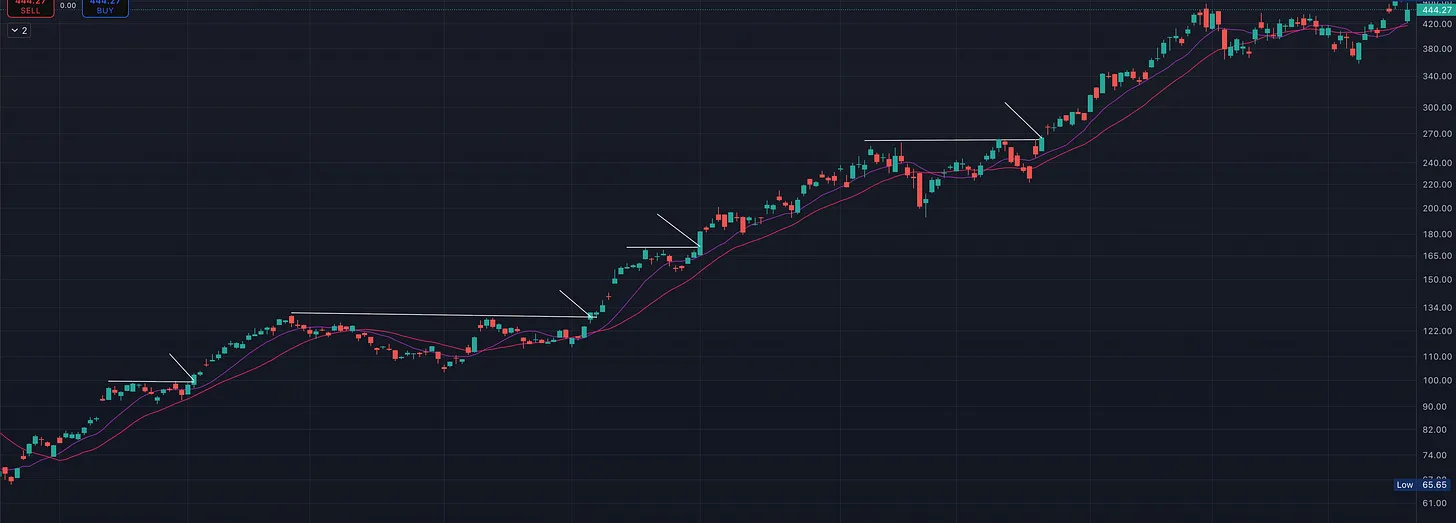
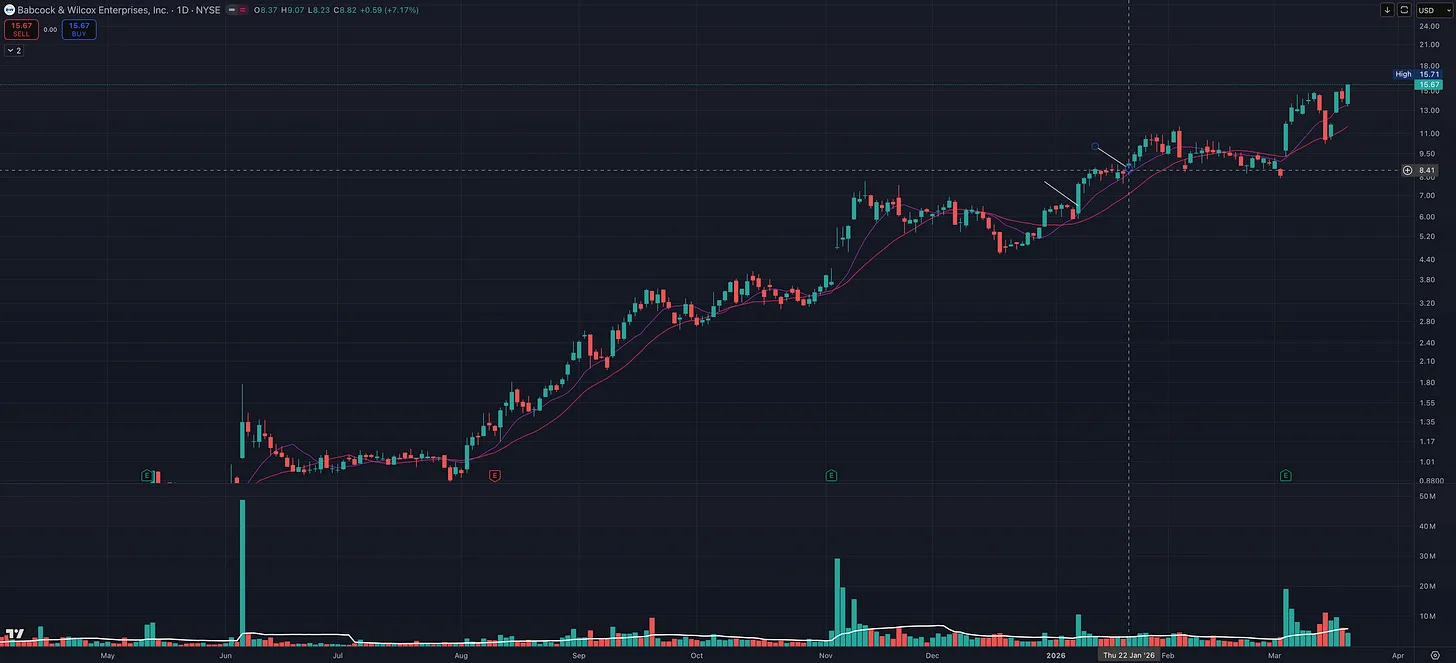
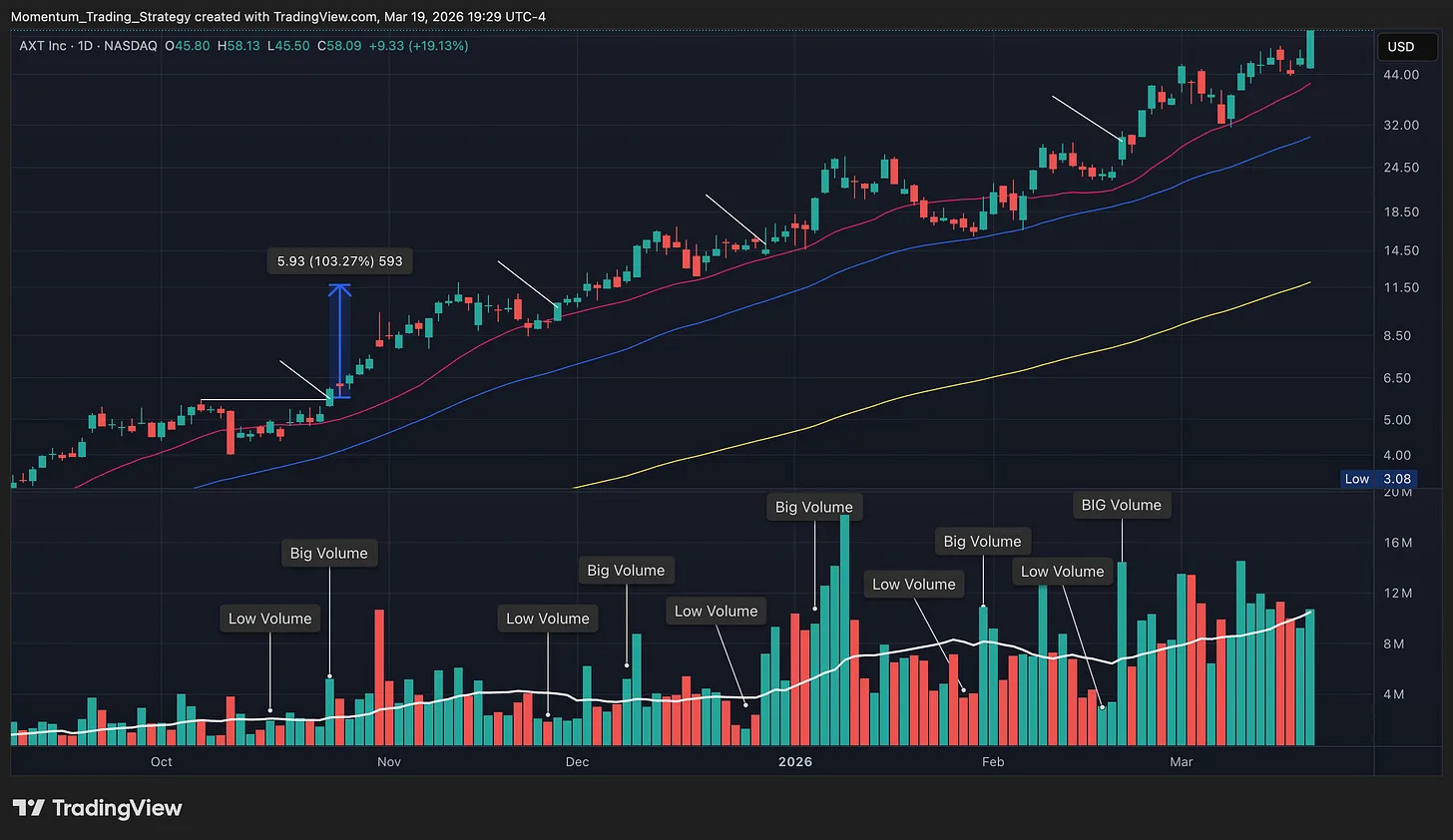
In strong, high relative strength names, this process repeats. The stock advances, pauses, tightens again, and then expands once more. Each contraction sets the stage for the next burst of momentum, creating multiple opportunities within a single trend.
By the time the move becomes obvious, the asymmetry is gone.
The Momentum Burst Setup is built around a single principle:
position at the moment expansion begins, not after the move is already in progress.
This is not prediction. It is the recognition of a repeatable structural behavior in price and volume that has persisted across market cycles for decades.
The Structural Reality of Momentum
Strong stocks do not trend in a straight line. They move in a step-like sequence of advance, pause, and expansion.
This behavior has been documented across multiple successful trading frameworks. Leading stocks advance, consolidate in an orderly fashion, and then resume their move when demand overwhelms remaining supply .
The pause is not weakness. It is preparation.
During this phase:
- Early buyers are holding positions
- Weak hands are gradually removed
- Supply becomes limited at higher price levels
When that process completes, even a modest increase in demand can trigger a sharp upward move.
The Momentum Burst Setup is simply designed to capture that transition point from contraction to expansion.
The Psychological Engine Behind Momentum Bursts
Markets are driven by behavior before they are driven by logic.
When a stock begins to move higher from a tight consolidation:
- Early participants gain confidence
- Short sellers begin to feel pressure
- Sideline traders experience urgency
This creates a feedback loop where demand accelerates.
Price movement itself becomes the catalyst.
As trading psychology research emphasizes, perception and emotional response drive decision-making under uncertainty . In momentum environments, that emotional response compresses into a short time window, which is why these moves often unfold over just three to five days.
The setup does not create the move. It aligns with the moment when that psychological pressure is released.
Defining the Momentum Burst Setup
Not every breakout qualifies. In fact, most should be ignored.
The edge comes from filtering aggressively and focusing only on the highest quality structures.
1. Linear Price Trend Before the Base
The stock must show a clean, directional trend leading into consolidation. Smooth price action reflects consistent institutional demand.
Erratic or volatile movement suggests a lack of conviction and should be avoided.
2. Orderly Consolidation
The consolidation phase should last at least three days and display tight, controlled price action.
Pullbacks are shallow. Volatility contracts. Each day shows reduced range relative to prior movement.
This tightening is critical. It reflects a reduction in available supply.
3. Absence of Heavy Selling
During the base, there should be no large breakdown candles or abnormal volume spikes to the downside.
Strong stocks do not experience aggressive distribution during consolidation. If they do, the setup is compromised.
4. Narrow Range Day Before Breakout
The session immediately preceding the move is often the most important.
A narrow range or low volatility day signals that selling pressure has largely been absorbed. The stock is effectively coiled.
When supply is exhausted, price becomes highly sensitive to demand.
5. Avoid Extended Moves
A key rule is to avoid stocks that have already advanced for three consecutive days.
At that point, the probability of continuation diminishes, and risk increases. The setup is designed to capture the beginning of a move, not participate after it is extended.
6. Expansion Through Price
On the breakout day, the stock should move with intent.
A minimum expansion of approximately 4% indicates that the move is meaningful. Anything less may lack follow-through.
7. Strong Closing Behavior
The stock should close near the high of the day.
This reflects sustained demand throughout the session. Weak closes suggest distribution and reduce the probability of continuation.
8. Volume Confirmation
Volume should increase relative to prior sessions.
Price and volume together provide the clearest signal of institutional participation. Without volume, the move lacks credibility.
Identifying Candidates Efficiently
The process begins with scanning for strength, but also requires real-time observation during market hours.
Focus on stocks that are:
- Showing strong intraday momentum or expanding range (often 4% or higher)
- Gapping up or breaking out of tight consolidations
- Market cap greater than $100M
- Strong performers over the past one, three, and six months (high relative strength)
- Positioned within a defined Stage 2 uptrend
- Showing a prior strong move followed by tight, orderly consolidation
While scans for stocks up 4% or more can help identify candidates entering expansion, the highest quality entries often occur earlier in the move. Traders should monitor leading stocks in real time, as many momentum bursts begin before the move becomes obvious on standard scans.
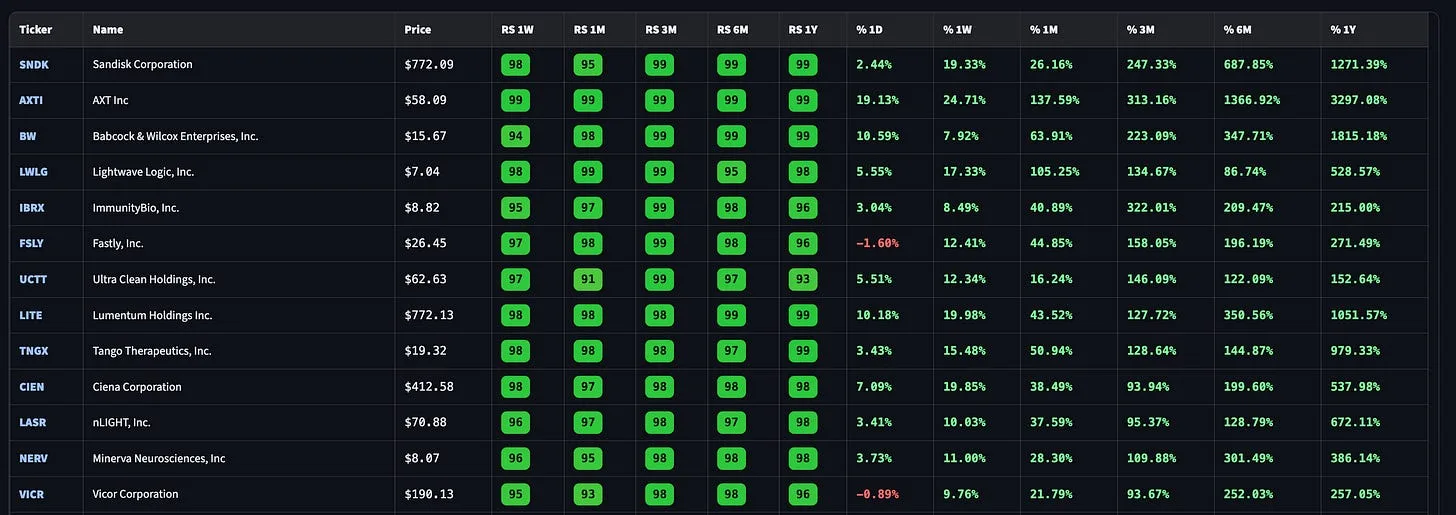
The simplest and most effective method is to scan for stocks with high relative strength. Inside the community, I provide a curated relative strength screener that consistently surfaces these types of setups in real time.
👉Access it here
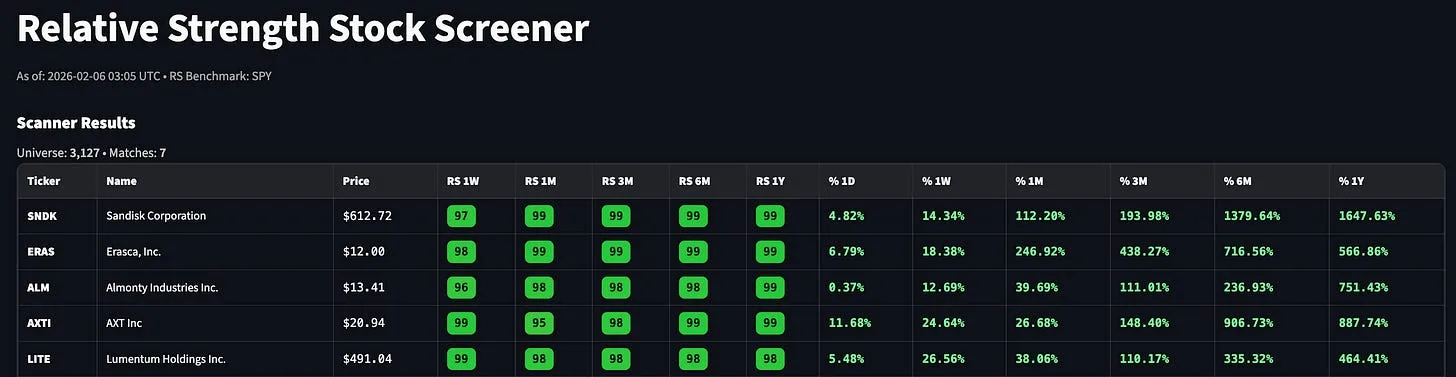 Why Relative Strength Is the Fastest Way to Find Big Winning StocksBefore going any further, it is important to clarify what I mean by relative strength.Feb 6, 2026 · Read the article →
Entry Execution: Precision Over Perfection
Timing is critical.
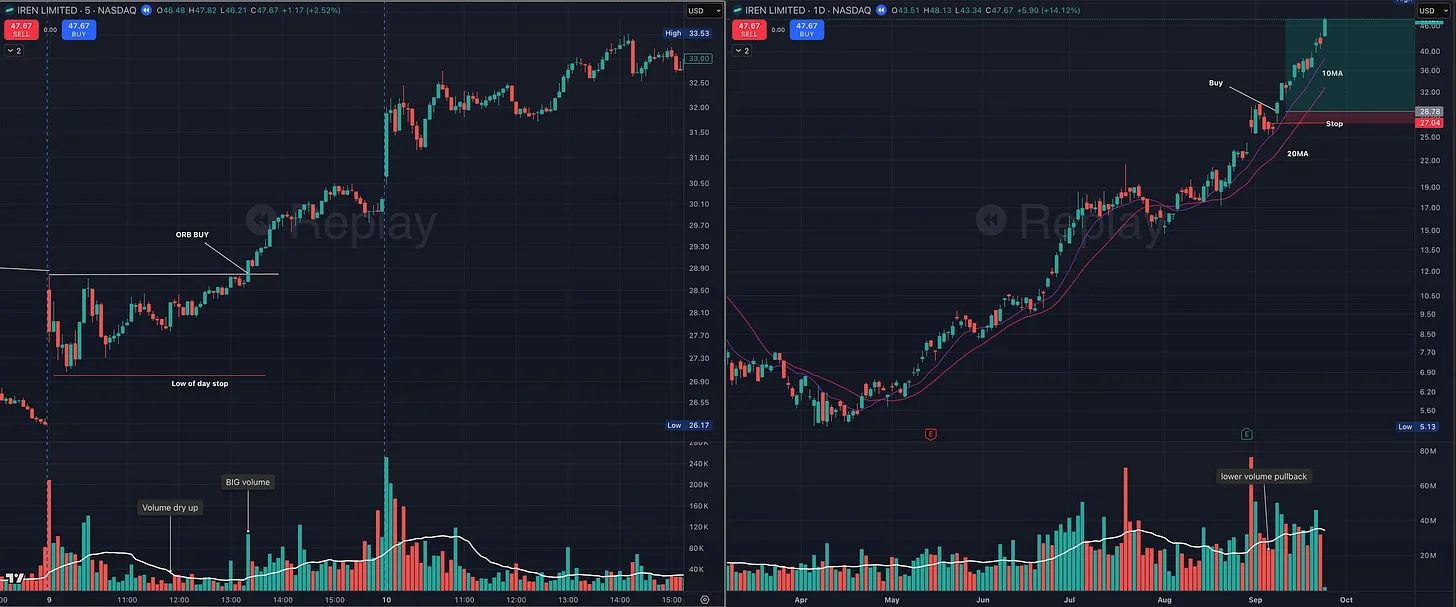
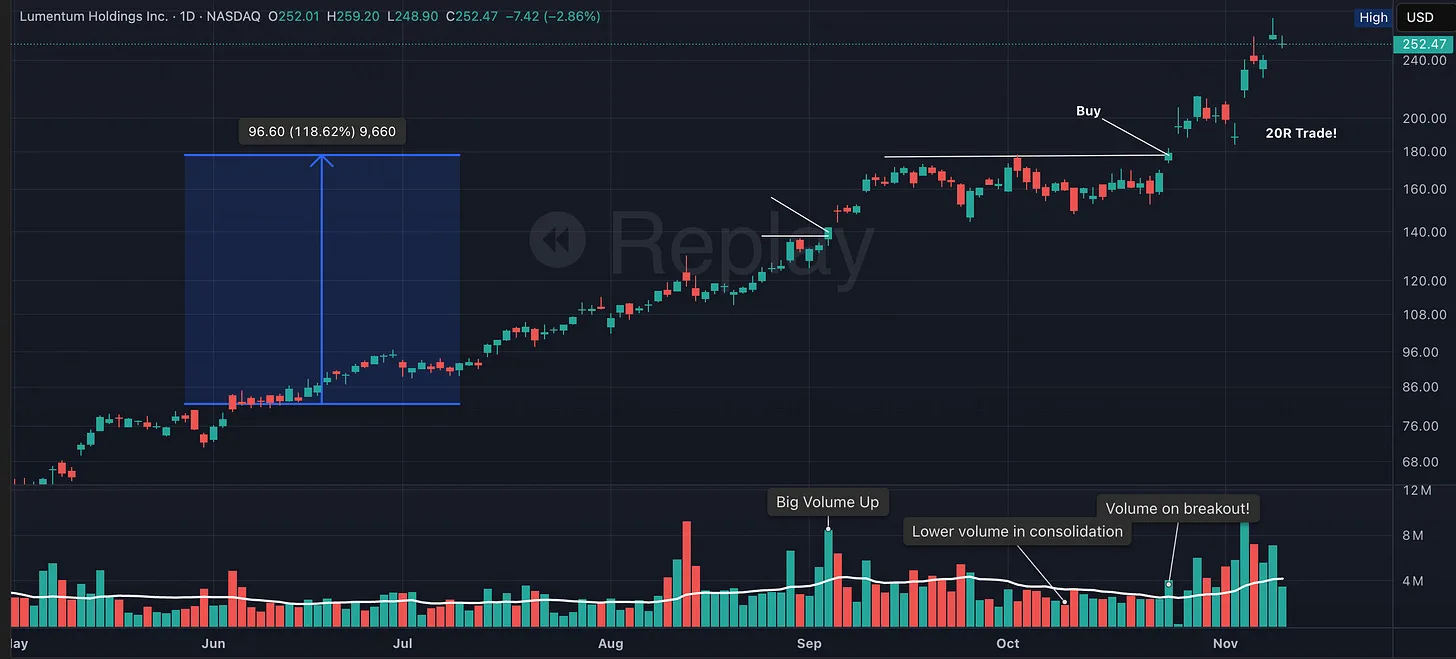
The highest probability entries occur as the move begins, often within the first hour of trading.
Common entry triggers include:
- Breakout above the consolidation range
- Upside reversal off support
- Break above a tight area
- Opening range breakout (ORB)
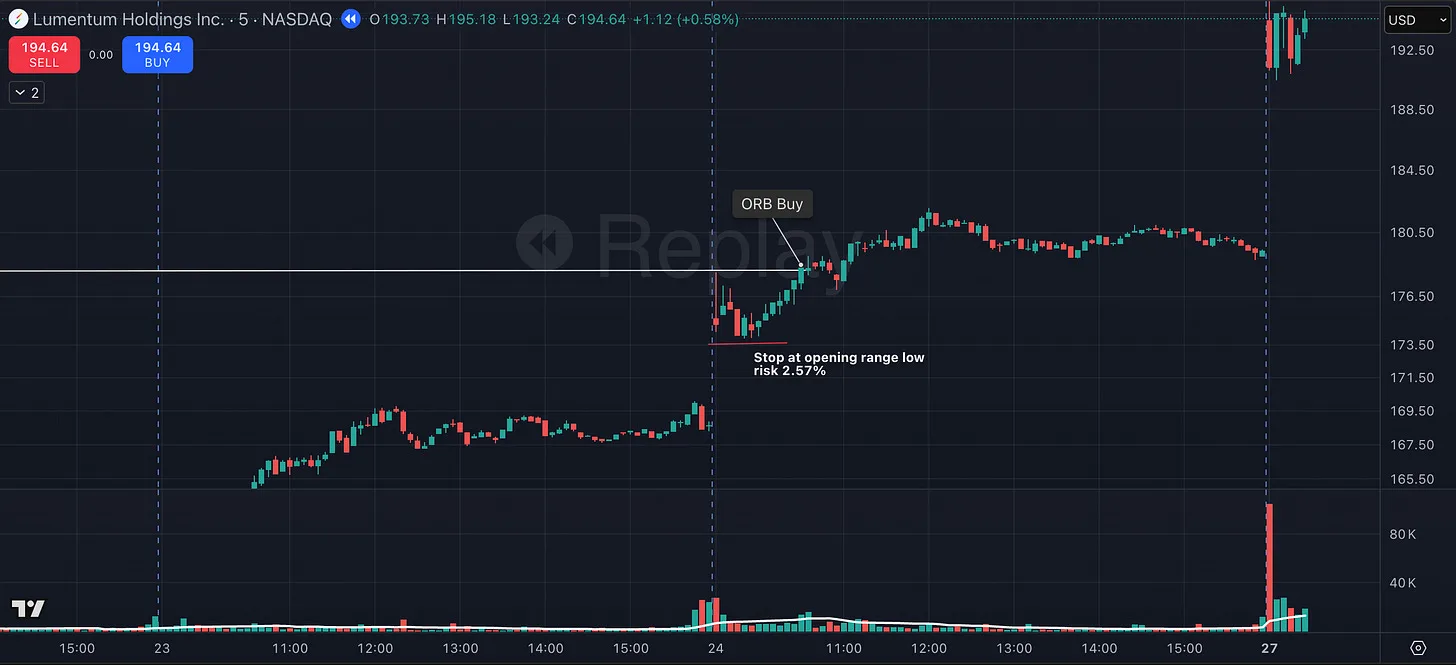
Example: LITE broke out from consolidation range on daily chart and opening range break (ORB) on intraday chart. Combining two entry techniques.
Risk Management and Position Sizing
Risk control is not secondary. It is foundational.
Stops should be placed:
- At the low of the breakout day, or
- At a logical level within the range
Typical risk per trade should remain small, often around 3% or less.
Position sizing should reflect that risk. For example, risking less than 1% of total capital per trade allows for consistency across a series of outcomes.
This reflects how professional traders think: risk first, opportunity second.
*Important note: It is important to note that stop placement and position sizing must work together as part of a unified risk framework. While many momentum traders operate with tight risk parameters around 2 to 3%, others, may allow for wider stops in the 5 to 6% range when the setup justifies it. In these cases, the trade must offer either a higher expected reward or demonstrate a higher probability of success. The key is not the size of the stop itself, but whether the overall risk-to-reward profile remains favorable and consistent with your system.
The Role of Market Conditions
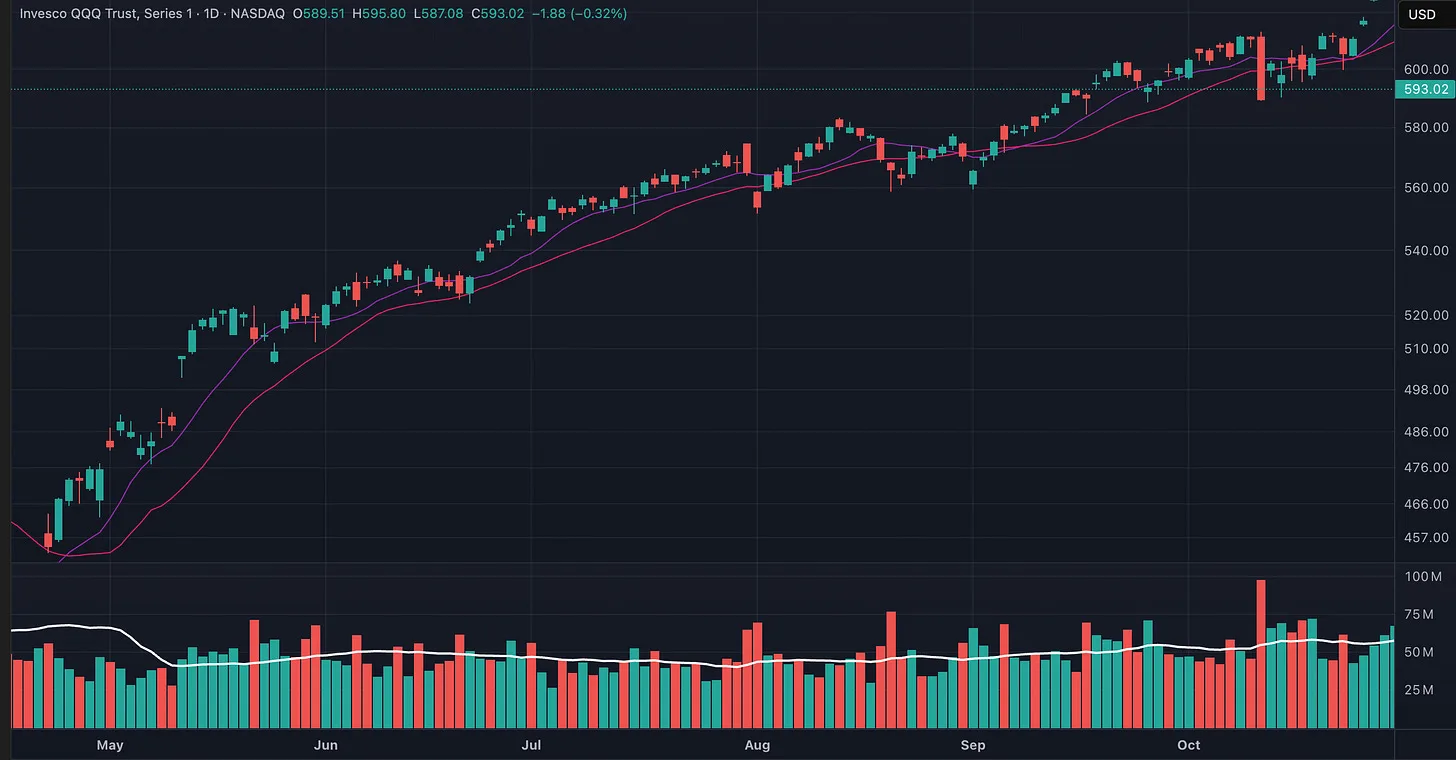
No setup performs equally across all environments.
Momentum Burst setups are most effective during Stage 2 uptrends, when the broader market is in a confirmed advance and institutional capital is actively flowing into equities. In practical terms, this often means major indexes such as the Nasdaq-100 are trading above their short-term moving averages, with the 10 and 20 day lines trending higher.
In these conditions, momentum tends to persist, and expansion phases follow through with greater consistency.
Momentum Burst performs best when:
- Breakouts are being rewarded
- Leading stocks are trending cleanly
- Market breadth is supportive and expanding
When these elements align, the probability of continuation increases significantly.
Conversely, in weak, choppy, or corrective markets, even technically sound setups can fail. Breakouts stall, follow-through is limited, and volatility becomes less directional.
For this reason, daily situational awareness is essential. Traders must continuously assess what is actually working in the current market, not what should be working in theory.
This includes evaluating:
- The recent success rate of breakout trades
- The behavior and follow-through of leading stocks
- The overall direction and health of the broader market
Adaptation is not optional. It is a requirement for consistency.
Managing the Trade
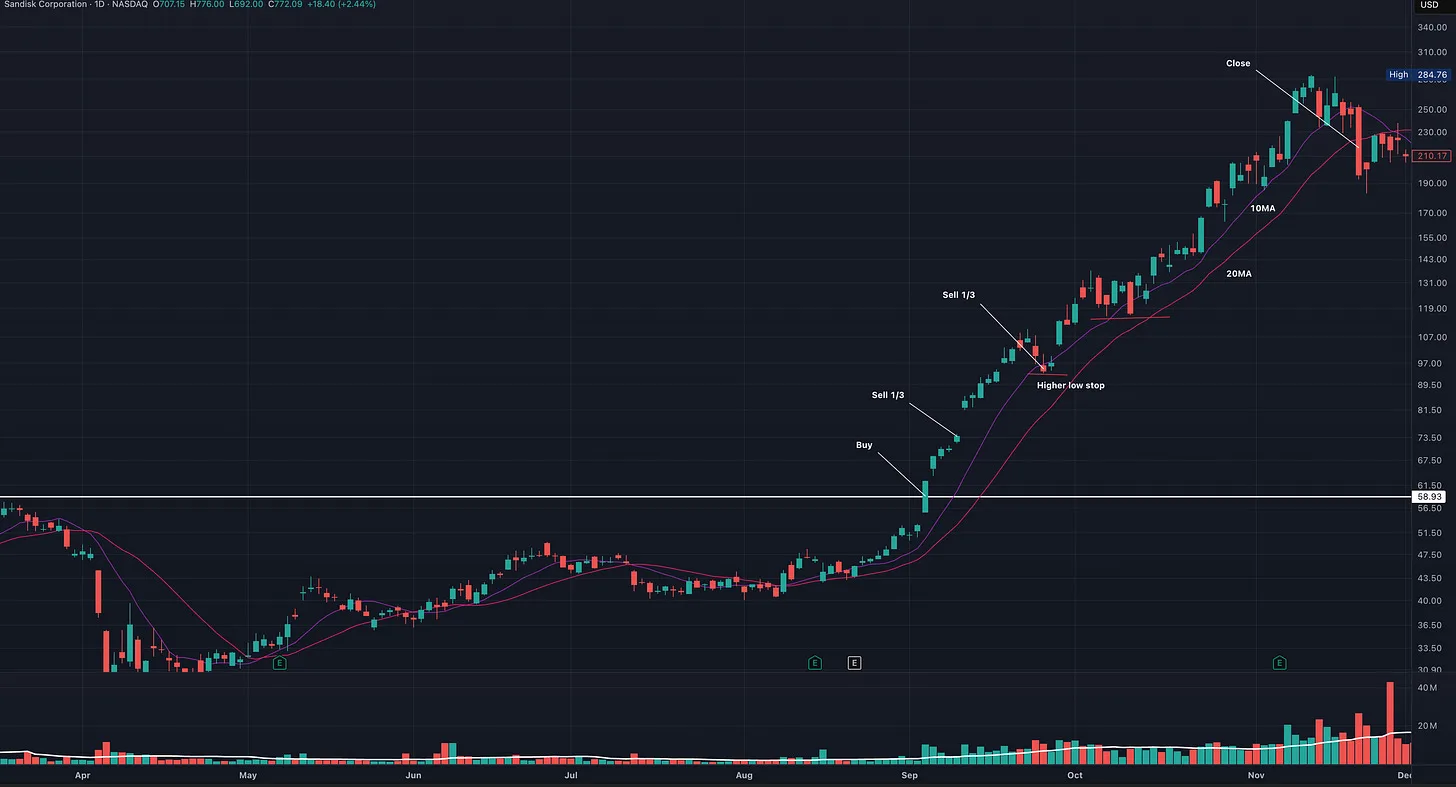
Initial profits are often taken within the first few days of the move, especially after rapid expansion, while the remaining position is held as long as the stock continues to act right. This may occur within three to five days or extend longer depending on price action and the stock being traded.
A structured approach may include:
- Taking partial profits into strength or on the first sign of weakness, often within the first few days of a powerful move (1/2 or 1/3 position)
- Moving the stop to breakeven after initial profit is secured or once a new higher high and higher low are established
- Trailing the remaining position using the 10 or 20 day moving average, or beneath higher lows as price makes new highs
This approach allows the trader to lock in gains early while still maintaining exposure to continued upside during strong momentum phases.
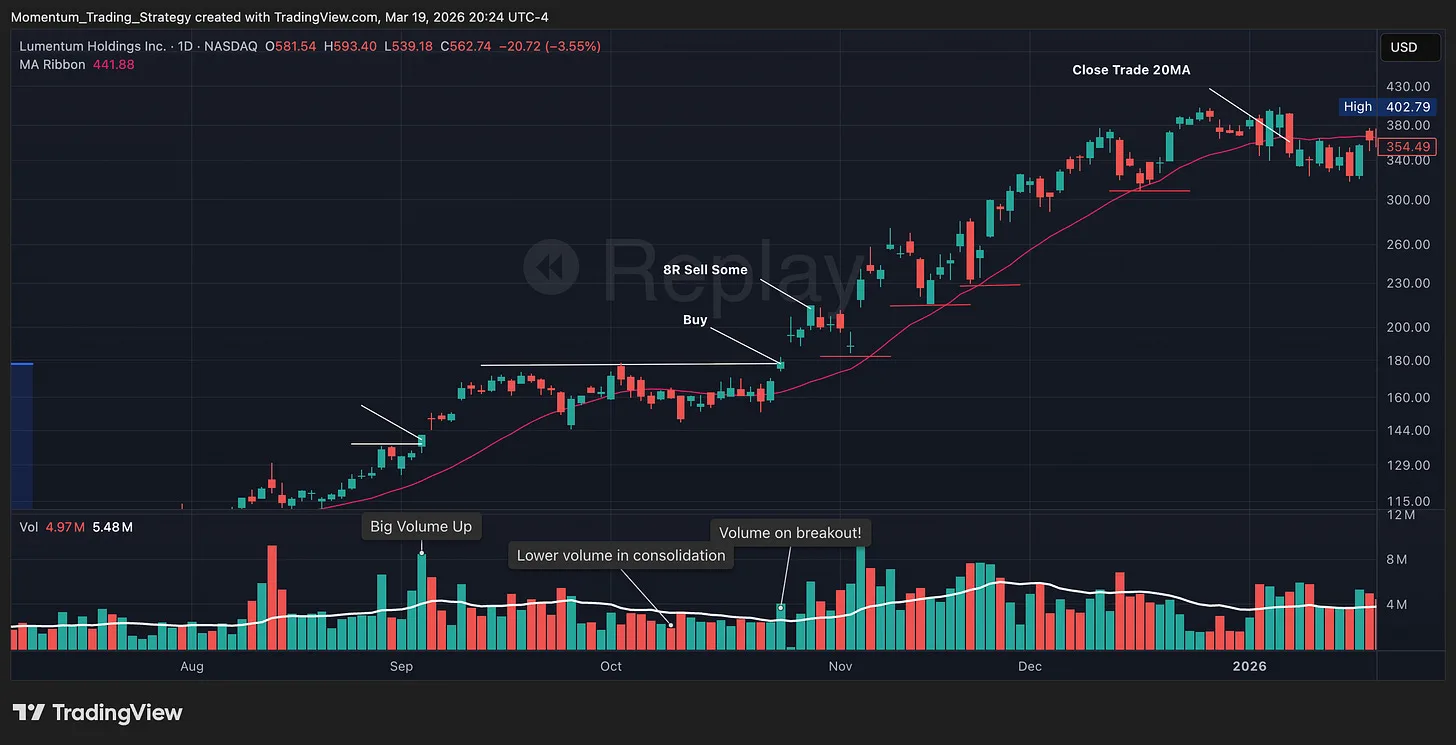
MA Trailing Stop:
Sell partial into strength to lock in gains, then trail the remaining position using a short-term moving average to stay with the trend.
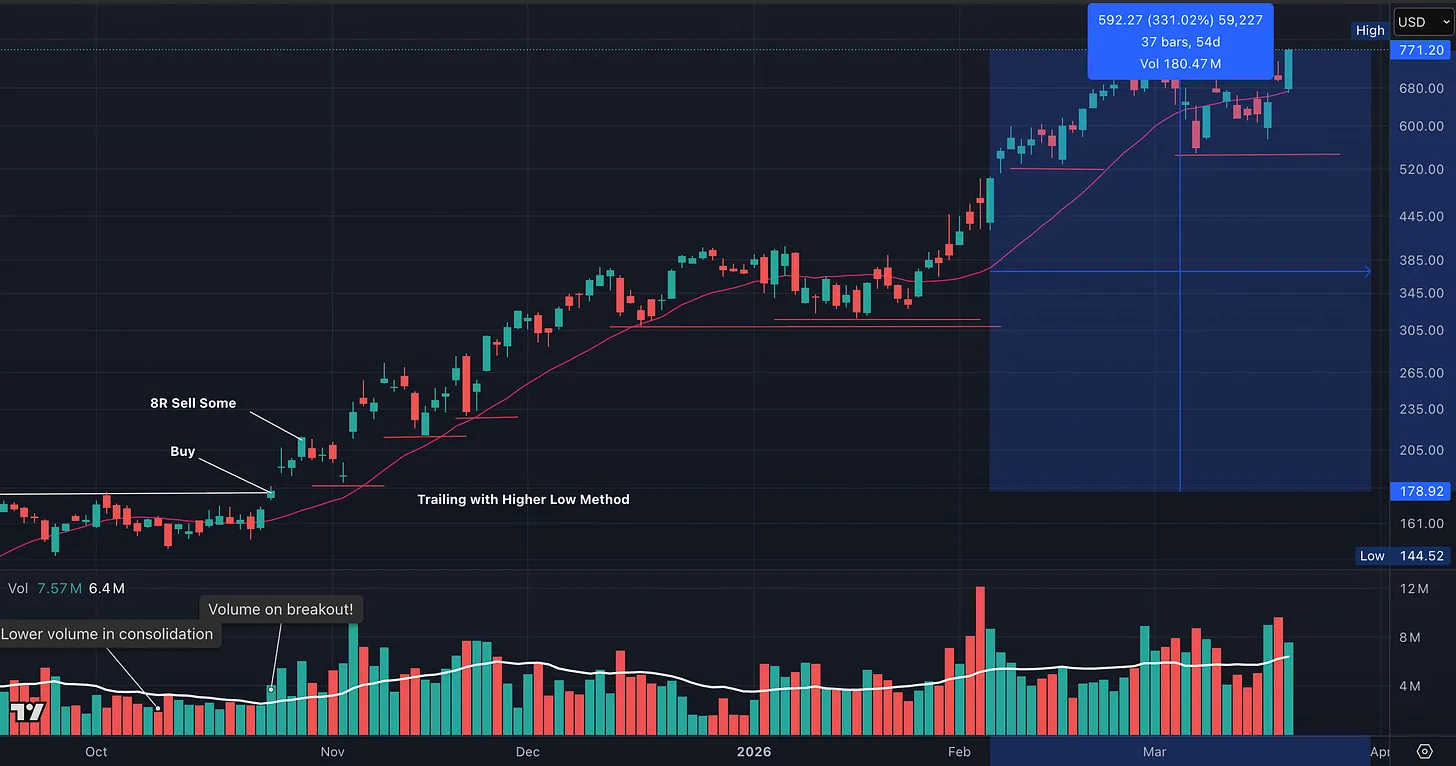
Higher Low Stop:
Sell partial into strength to lock in gains, then trail the stop beneath each new higher low as price advances. This approach allows more room for the trade to develop and capture larger moves.
This approach allows the trader to balance risk reduction with the opportunity to participate in extended gains. While holding a full position may occasionally produce larger returns, it ignores the reality that many trades will not follow through. Consistently taking partial profits helps smooth equity curves and reinforces the primary objective of any trading system: protecting the downside.
The Real Edge
There is nothing rare about these setups.
They appear repeatedly across different stocks, sectors, and market cycles.
The difference is not opportunity. It is execution.
The edge comes from:
- Focusing only on clean, high-quality price action
- Entering early, before the move becomes obvious
- Managing risk with consistency
- Trading in alignment with current market conditions
Momentum Burst is not about predicting moves.
It is about recognizing when demand is entering a stock and acting before the crowd.
That is where the edge exists.
Closing Perspective
Most market participants operate reactively. They respond to price after it has already moved.
Professional traders operate differently. They focus on identifying conditions where movement is likely to occur and position accordingly.
The Momentum Burst Setup is one of the clearest expressions of that approach.
It is not about predicting what will happen.
It is about recognizing when the conditions for a rapid move are already in place.
And when you learn to recognize that moment, the market begins to look very different.
Not random. Not chaotic.
But structured, repeatable, and, with the right discipline, highly exploitable.
More in Strategy & Tactics
All Strategy & Tactics articles →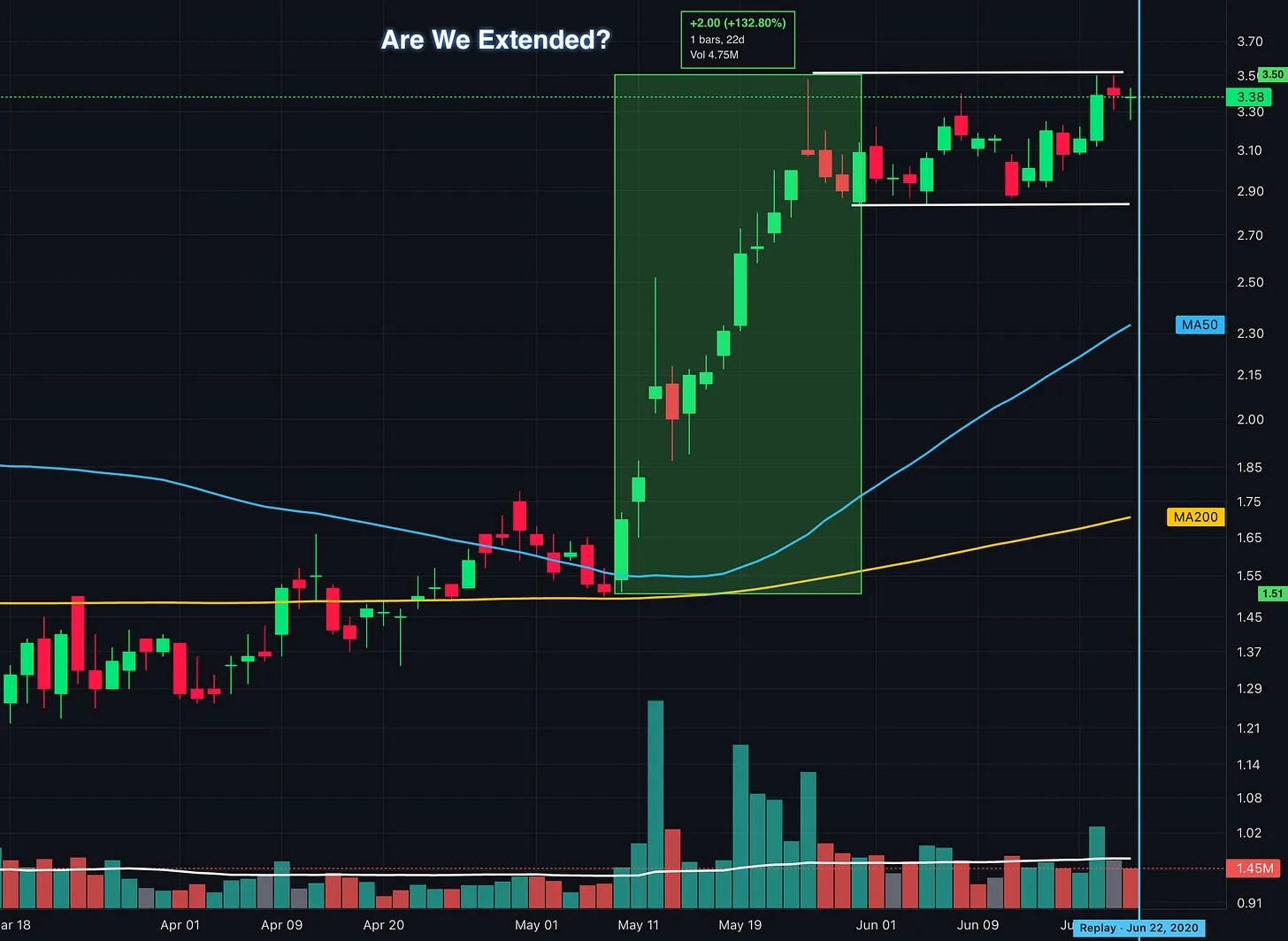
Oct 8, 2026 · Strategy & Tactics
Up 100% and Still Buyable? What Traders Get Wrong About Extended Stocks
How to identify proper buy points, avoid chasing stock breakouts, and manage entry risk using lessons from William O’Neil, Mark Minervini, David Ryan, and Dan Zanger.
- Momentum Trading
- VCP
- position trading
- Growth Stock Trading
- David Ryan
- Flag Pattern
- chart patterns
- Cup and Handle
Sep 27, 2026 · Strategy & Tactics
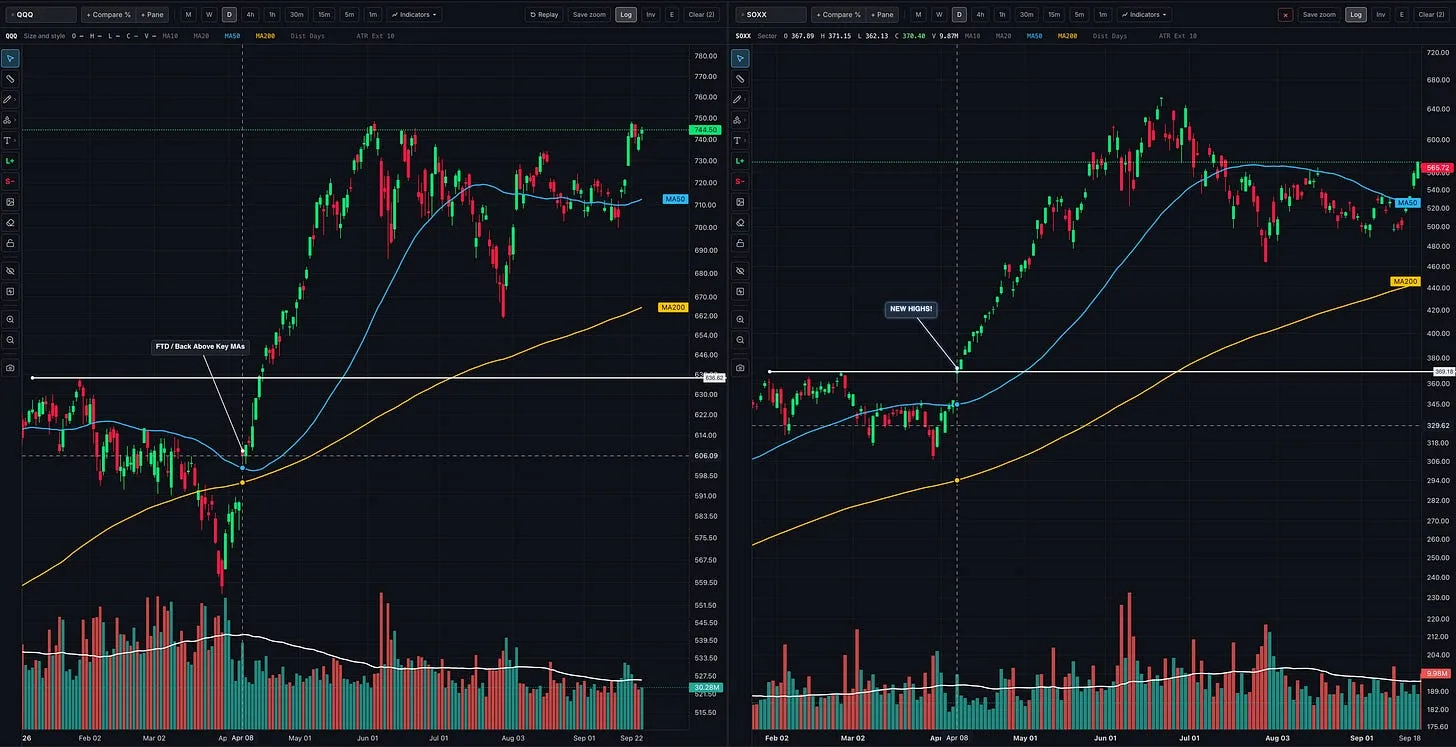
Should You Follow Leading Stocks or Wait for Market Confirmation?
How to read the market, industry groups, and individual stocks together so you can recognize opportunities, build exposure, and respond when conditions change
- growth stocks
- CANSLIM
- Trading
- position trading
- Stan Weinstein
- William O'Neil
- Momentum Trading Strategy
- Trade stocks
Sep 25, 2026 · Strategy & Tactics
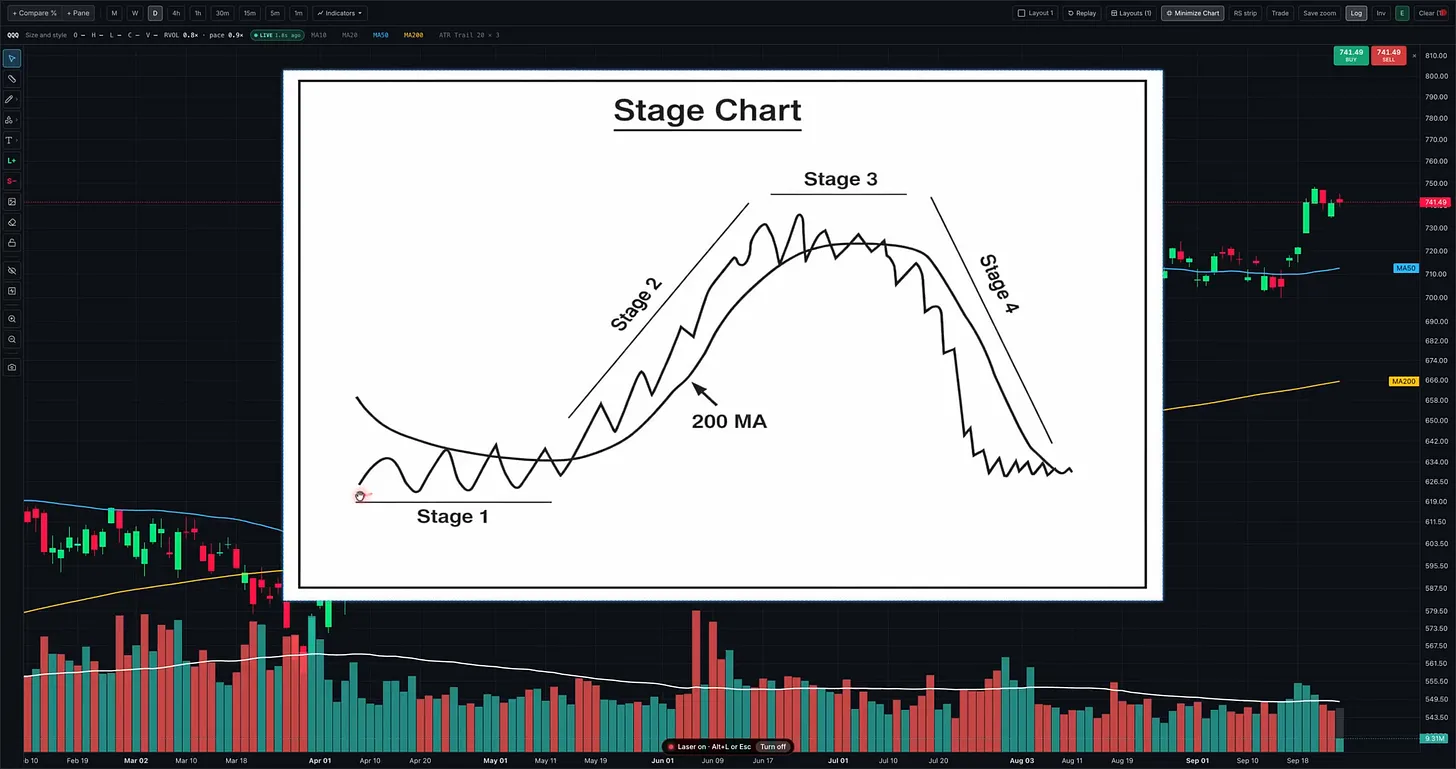
Stage Analysis: How to Spot Stage 3 in Real Time
Recognize a developing Stage 3 using Stan Weinstein’s framework, with real chart examples, warning signs, and lessons for protecting your gains
- Momentum Trading
- Nasdaq
- technical analysis
- CANSLIM
- position trading
- Stan Weinstein
- QQQ
- Find True Market Leaders