
Trading articles/The Most Addicting Habit in Trading That Almost Never Makes You Money
Nov 24, 2025 · Momentum Trading Strategy
The Most Addicting Habit in Trading That Almost Never Makes You Money
Why prediction culture hurts traders more than it helps
Originally published on Substack.
Most people never make money from market predictions, yet they cannot stop chasing them. The idea of calling the top, the bottom, or the next explosive stock gives traders a powerful emotional hit. It feels like control. It feels like certainty. It feels like being smart.
And it gets attention.
In my short time on Substack and Twitter, I have noticed that people are obsessed with making calls. Calling the top. Calling the bottom. Calling which stocks will explode. It gets people excited and it drives engagement. It also sells newsletters, courses, and alert services.
But here is the truth that nobody selling predictions wants to say:
That stuff will not make you money.
It is great for marketing. It is great for creating hype. It gives people the emotional rush they crave. There are plenty of snake oil tactics behind why prediction content works so well.
If that is what you are looking for, I am not the person to read.
I care about what actually puts money in your account, not what gets the loudest reaction.
What actually matters
We all form a thesis when we trade or invest. We look at data, trends, sentiment, fundamentals, or technicals and try to find lower risk and higher reward opportunities.
But the harsh reality is simple:
Anything can happen.
Most of the time, I have no clue whether the market will go up, down, or sideways. I do not pretend otherwise. I will never build my reputation on guessing.
I can feel one way about the market one minute and completely adjust my opinion the next. This is what great traders do. They do not die on the hill of trying to be right. They adapt. They respond to what the market is actually doing, not what they hoped it would do.
Flip flopping will kill a politician’s career, but in trading it is a requirement for success. Do not be fooled into thinking that changing your view is a bad quality. In this game, stubbornness destroys accounts. Flexibility protects them.
So what do I actually know?
After studying the markets for more than 20 years and executing countless trades, I have found things that increase my probabilities of being right. When I apply those consistently, I have a positive expectancy that beats the market over time.
That is all that matters.
Why I focus on CANSLIM criteria
Some of my biggest winners share the same characteristics:
• big sales growth
• big earnings growth
• new product or service
• new price highs
• increasing institutional sponsorship
• high relative strength
• strong accumulation and volume patterns
This is the core of CANSLIM.
When I combine that with tape reading and chart setups, I get opportunities that offer low risk and high reward. The chart tells me where my stop goes. The chart gives me a tactical entry. The chart helps me manage the trade.
Have I been successful trading purely based on chart patterns? Yes.
But over time, I do much better when I combine strong fundamentals with strong technical setups.
A real example
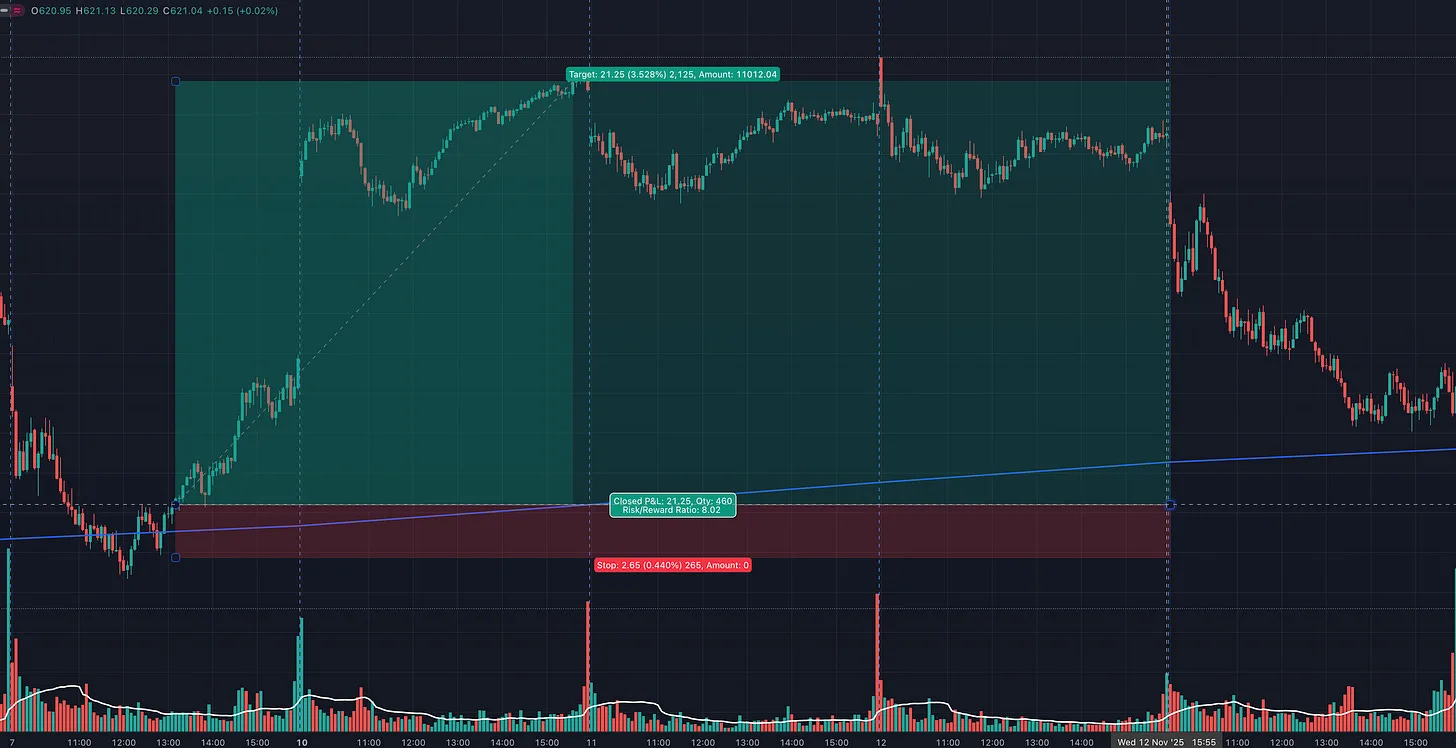
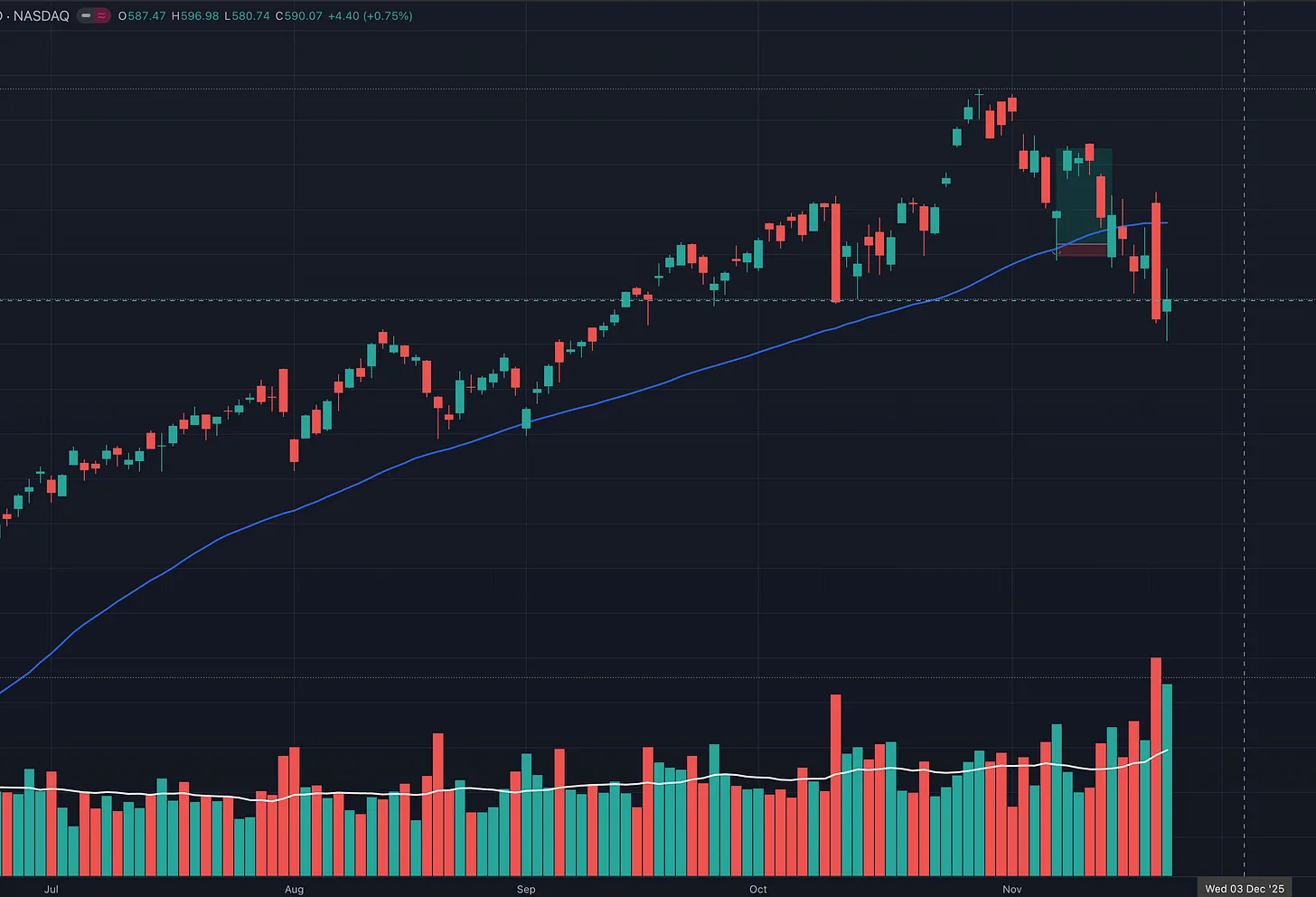
Recently, the market showed exhaustion. Breadth was weak. Many traders were bearish. Yet on November 7th, when the Nasdaq 100 bounced near the 50 day moving average, I waited for a higher low and a higher high on the intraday chart and I bought.
I risked only 0.44 percent on the trade. After position sizing, it was even less relative to my total portfolio.
I sold some into strength and moved my stop to breakeven. The trade ran to an 8 to 1 risk reward ratio before pulling back and stopping me out.
The internet trolls would say I was wrong.
Anyone who actually trades would recognize that it was a low risk, high reward opportunity. That is the entire game. You are not going to be right all the time. Some of the best traders in history are wrong a lot.
Context matters
I also knew this trade had a high probability of failing because of poor breadth. However, the market has rallied from the 50 day moving average plenty of times even with weak breadth. I had cushion from prior winners, my portfolio was performing well, and I could afford to take the shot.
If it had been a tough market and my portfolio was struggling, I would have skipped the trade. I would have waited for the market to get above key moving averages and looked for a stock in play with a proper setup.
This was a lesson I learned the hard way. Not from theory, but from studying markets going back to the 1800s and watching the same behaviors repeat through bull and bear cycles.
I invented nothing
Everything I do has been done by countless traders before me, going back to the early 1900s. In the military, I did not invent tactics. I studied, trained, and applied time tested strategies from generations of experience.
Trading is the same.
The edge is not in calling the future.
The edge is in execution, risk management, positive expectancy, and taking low risk, high reward opportunities again and again.
If you want loud predictions to feed excitement, there are plenty of people who will happily sell that dream.
If you want to actually learn how to trade and invest successfully over time, that is what I focus on.
Education, Not Predictions
When I start sharing my trades in real time, it will not be to predict the future or act like I know what is going to happen. I do not. Nobody does.
I will be doing it for the people who want to follow along for educational purposes. My goal is to show, over the course of many trades, how this process actually works in real conditions. You will see the wins, the losses, the management decisions, and how positive expectancy develops through disciplined execution.
This is what helped me most from the mentors I learned from. It was never the loud calls, the price targets, or the big predictions. It was seeing the process play out trade after trade, and watching how they managed risk, entries, exits, and mindset.
I simply hope to pass on that knowledge the same way it was passed on to me.
More in Trading Psychology
All Trading Psychology articles →
Oct 27, 2026 · Trading Psychology
The Hidden Beliefs Sabotaging Your Trading
Why knowing the rules isn’t enough. Lessons from Van Tharp and Ed Seykota on trading psychology, self-sabotage, and changing the beliefs that hold you back.
- trading psychology
- Investing
- Trading
- Momentum Trading Strategy
- Market Wizards
Sep 1, 2026 · Trading Psychology
The Market Isn’t Your Biggest Opponent. You Are.
Why the greatest traders eventually discover that trading psychology, discipline, and self-mastery matter more than another setup, indicator, or strategy
- growth stocks
- Momentum Trading
- Learn Trading
- trading psychology
- Investing
- ed seykota
- position trading
- Peter Brandt
Aug 26, 2026 · Trading Psychology
Most Traders Fail. But That Statistic Doesn’t Tell the Whole Story
Why the failure rate in trading may say more about preparation, persistence, and process than your actual odds of success
- Momentum Trading
- Learn Trading
- CANSLIM
- Growth Stock Trading
- trading stocks
- growth stock investing