
Trading articles/The Moment Trading Stops Being About Getting Rich
Jun 6, 2026 · Momentum Trading Strategy
The Moment Trading Stops Being About Getting Rich
Why the best traders eventually stop chasing bigger returns and start protecting what they have already built.
Originally published on Substack.
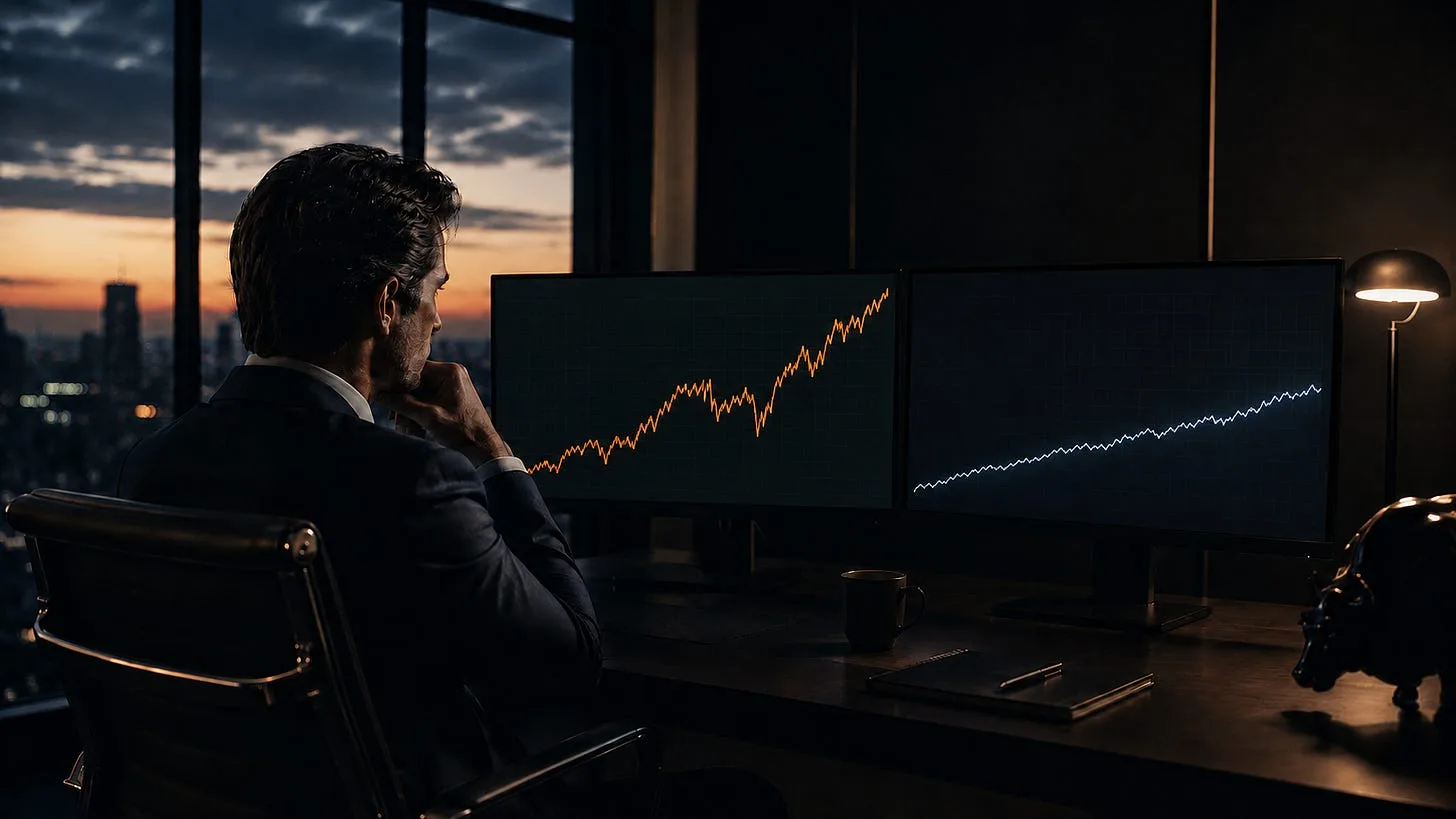
Early in your trading journey, risk feels different.
If you are starting with a small account and trading with money you can afford to lose, taking bigger risks can feel natural. Losing a few thousand dollars might sting, but it probably will not change your life. At that stage, the upside of aggressive growth can feel much more meaningful than the downside of a temporary setback.
But once you have built meaningful capital, the psychology changes.
A trader trying to turn $10,000 into $100,000 is playing a very different emotional game than a trader trying to turn $10 million into $20 million. It is not necessarily harder. It is just different. The strategy may still work, the setups may still be there, and the risk-reward may still look good on paper, but real life changes the equation.
This is also why learning to trade with a small account is so powerful.
If you can learn how to follow a process, manage risk, find quality setups, cut losses, and let winners work with a small account, that skill can scale over time. A 20% gain is a 20% gain whether the position is $1,000 or $1 million. The process may not need to change nearly as much as people think.
But the result is completely different.
A 20% gain on $1,000 is $200.
A 20% gain on $1 million is $200,000.
Same percentage. Completely different reality.
That is the exciting part of trading. Once you build the skill, what changes over time is not always the process. What changes is the size.
But there is another side to that.
As the account gets larger, the emotional and financial relationship to risk changes too. Going from your first $100,000 to your first million can completely change your life. Going from your first million to several million can change your family’s future.
But going from $10 million to $20 million may not change your day-to-day life nearly as much as losing a large chunk of that capital would hurt.
That is the part most people do not think about.
When your account is small, you often need bigger percentage returns to make a meaningful difference. You may be more willing to deal with volatility, deeper drawdowns, and a more aggressive growth phase because the upside is life-changing. But when your account is large, even smaller percentage gains can produce substantial dollar returns.
A 10% return on $50,000 is $5,000.
A 10% return on $10 million is $1 million.
Again, same percentage. Completely different reality.
At that stage, you no longer need to swing for the fences the same way. You do not need to push for +100% years to have an incredible year in dollar terms. A much smaller return, earned with less volatility and smaller drawdowns, can still produce great money.
This is why many experienced traders eventually stop chasing the same type of performance they pursued in their earlier years.
It is not always because they lost their edge. It is not always because their strategy stopped working. It is not always because they are no longer capable of producing higher returns. And while liquidity can become an issue at larger sizes, that is not always the main reason performance changes.
Many times, the real reason is simpler:
They no longer need to push as hard.
The objective changes.
In the early years, the goal may be aggressive growth. Later, the goal may become controlled growth with far less emotional and financial damage during drawdowns. The focus shifts from maximizing every opportunity to protecting capital, managing risk, and compounding intelligently.
At a certain point, the question changes from:
“How much can I make?”
To:
“How do I keep what I have built while still growing consistently?”
That is not fear.
That is maturity.
The best traders understand that risk is not just mathematical. It is psychological. It is personal. It is tied to your lifestyle, your responsibilities, your family, your net worth, and your stage in the journey.
The risk that makes sense when you are building your first stake may not make sense once you have already built real wealth.
That is something many people do not understand when they look at successful traders from the outside. They see lower returns and assume the trader lost their edge.
But in reality, they may have simply transitioned to a more mature stage of the game.
More in Trading Psychology
All Trading Psychology articles →
Oct 27, 2026 · Trading Psychology
The Hidden Beliefs Sabotaging Your Trading
Why knowing the rules isn’t enough. Lessons from Van Tharp and Ed Seykota on trading psychology, self-sabotage, and changing the beliefs that hold you back.
- trading psychology
- Investing
- Trading
- Momentum Trading Strategy
- Market Wizards
Sep 1, 2026 · Trading Psychology
The Market Isn’t Your Biggest Opponent. You Are.
Why the greatest traders eventually discover that trading psychology, discipline, and self-mastery matter more than another setup, indicator, or strategy
- growth stocks
- Momentum Trading
- Learn Trading
- trading psychology
- Investing
- ed seykota
- position trading
- Peter Brandt
Aug 26, 2026 · Trading Psychology
Most Traders Fail. But That Statistic Doesn’t Tell the Whole Story
Why the failure rate in trading may say more about preparation, persistence, and process than your actual odds of success
- Momentum Trading
- Learn Trading
- CANSLIM
- Growth Stock Trading
- trading stocks
- growth stock investing