
Trading articles/Why Most Traders Fail Even With a Winning System: The Edge Almost Everyone Ignores
Aug 25, 2026 · Momentum Trading Strategy
Why Most Traders Fail Even With a Winning System: The Edge Almost Everyone Ignores
Richard Dennis, Paul Tudor Jones, Ed Seykota, Larry Hite, and Van Tharp all point to the same uncomfortable truth: the trader is part of the system.
Originally published on Substack.
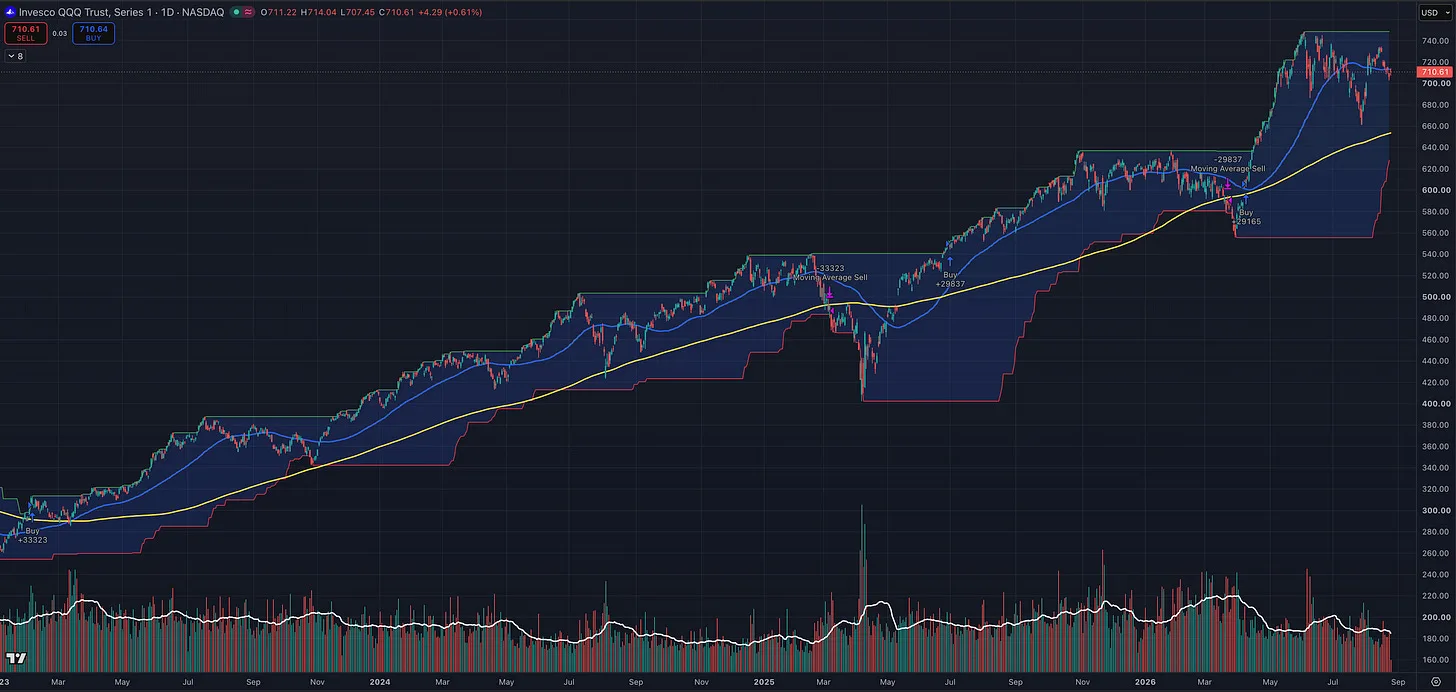
This may be one of the most important articles I ever write about trading, because it explains why so many traders fail even after they find a strategy that works.
Richard Dennis once made an observation that should bother anyone who believes the secret to trading is simply finding the right rules. When Jack Schwager asked Dennis whether he worried about teaching his trading methods to other people, Dennis argued that the rules themselves were not nearly as valuable as most traders imagined. He said you could essentially publish a sound set of rules for everyone to see and most people still would not follow them, adding that “the key is consistency and discipline.” More importantly, Dennis said the real difficulty was giving traders enough confidence to stick with those rules when things were going badly.
That distinction goes to the heart of one of the most repeated and most casually dismissed ideas in trading: know thyself. Most traders hear that phrase, acknowledge that psychology probably matters, and immediately move on to what they believe is the real work. Show me the setup. Give me the screen. Tell me the indicator, the stock, the entry, the stop, and the sell rule. Knowing yourself sounds philosophical by comparison, almost like something to acknowledge before getting to the serious business of making money.
The longer I trade, study successful traders, and watch other people try to navigate markets, the more convinced I become that the opposite is true. Knowing yourself is not some secondary psychological exercise that sits outside the trading system. Your beliefs, temperament, risk tolerance, habits, strengths, weaknesses, and emotional reactions all affect whether the system is ever executed as designed. You are part of the trading system.
A Profitable Strategy Can Still Be the Wrong Strategy for You
I love growth stock investing. Much of my own approach has been influenced by William O’Neil, CANSLIM, Mark Minervini, David Ryan, Dan Zanger, and other traders who built careers around identifying leading companies with strong earnings, sales, relative strength, institutional sponsorship, and constructive price and volume action. Those principles can work exceptionally well, but that does not mean every person should become a growth stock trader. A strategy can be objectively sound and still be a terrible match for the person trying to execute it.
Another investor may be far better suited to value investing. Someone else may thrive following longer-term trends, while another trader is temperamentally suited to shorter-term opportunities. Some people are comfortable buying stocks near new highs, while others find it psychologically agonizing. Some traders can endure a system with a relatively low winning percentage because they understand that a handful of large winners drive the expectancy, while others become so uncomfortable after several consecutive losses that they begin interfering with the strategy.
Life circumstances matter just as much. A method requiring constant attention during market hours may be perfectly reasonable for a full-time trader and completely inappropriate for someone with a demanding career who can only look at the market before work and after the close. A method requiring wider stops and longer holding periods may mathematically work, yet still be impossible for someone who cannot psychologically tolerate the drawdowns involved.
Van Tharp spent much of his career emphasizing precisely this point. In Trading Beyond the Matrix, he argues that knowing yourself is necessary because only then can you develop objectives and trading systems that fit your values, strengths, weaknesses, beliefs, and personal criteria for trading with confidence. In Super Trader, he similarly asks traders whether they understand how their system behaves in different markets, whether they trust the testing, whether the method fits their schedule, and whether they can realistically execute it without repeatedly making mistakes.
None of this means you should simply trade whatever feels comfortable. Comfort does not create positive expectancy, and personality cannot rescue a strategy that has no edge. You still need a legitimate methodology, sound risk management, favorable expectancy, and rules governing entries, exits, and position sizing. But after you find something that actually works, another question becomes equally important: Can you execute it consistently enough to realize the edge that exists on paper?
Psychology Is Not Separate From the System
Trading psychology is often treated as a vague motivational category, while entries, charts, statistics, and systems are treated as the serious technical work. Tharp rejected that separation. In Super Trader, he writes that “psychology is part of methodology,” then recommends regular self-assessment to determine whether confidence, greed, fear, outside stress, or the desire to override a system is beginning to distort decision-making. He argues that the best traders and investors repeatedly perform this kind of internal assessment rather than assuming they are psychologically unchanged from one day to the next.
This is also why I disagree with the idea that psychology is simply something you are born with and have to accept. Traders sometimes talk about their weaknesses as though they were permanent diagnoses: I am emotional, I am impatient, I cannot handle losses, I lack confidence, or I always sell too early. Those statements may accurately describe your current behavior, but they do not prove that the behavior cannot change.
We accept this principle everywhere else in life. You can improve your physical conditioning through training. You can improve your health by changing your habits. You can become more knowledgeable through study and more capable through deliberate practice. Trading psychology can improve in much the same way.
That does not mean you completely reinvent your personality. It means you can recognize recurring behaviors, understand what triggers them, structure rules around weaknesses, and practice different responses until the better behavior becomes more natural. Tharp’s framework explicitly treats weaknesses that lead to trading mistakes as things traders should work to improve rather than simply accept. Knowing yourself, therefore, is not an excuse for remaining exactly as you are. It is the starting point for deciding what needs to change.
Confidence and Humility Have to Exist Together
Trading also demands an unusual psychological balance because confidence is essential, yet too much confidence can eventually become destructive. If you have no confidence in yourself or your methodology, you will hesitate when legitimate opportunities appear, abandon the system after normal losses, and cut potentially great trades short because you are terrified of giving back a small profit. If you do not believe in your system or your ability to execute it, you have very little chance of surviving the inevitable periods when the market makes you question both.
Larry Hite’s philosophy captures both sides of that equation. At the end of his Market Wizards interview, Hite gives two rules: if you do not bet, you cannot win, and if you lose all your chips, you cannot bet. Schwager summarizes the larger lesson by explaining that an effective method is necessary but insufficient. Without rigorous respect for risk, the market eventually takes the trader out of the game.
Blind confidence, therefore, is not the goal. The trader whose ego convinces him that he cannot be wrong eventually encounters a market that proves otherwise. That is the trader who refuses to honor a stop because he “knows” the company is going higher, averages down because the market must eventually recognize what he sees, or treats a losing position as an argument he needs to win rather than information he needs to process. Favorable markets can hide those weaknesses for surprisingly long periods, but eventually the environment changes.
Tharp addresses this paradox almost perfectly in Super Trader. A trader writes to him explaining that confidence seems necessary for performance, yet his periods of greatest confidence often precede his largest losses. Tharp begins his answer with a remarkably simple statement: “First, you have to know yourself.” The objective is not maximum confidence. It is earned confidence paired with enough humility to recognize that every trade can still fail.
Do Not Copy Another Trader’s Nervous System
Another mistake developing traders make is assuming that because a legendary trader behaved a certain way, they need to behave the same way. We should absolutely study great traders, but what is transferable is usually their principles, process, risk management, and understanding of probability. Their personality is not necessarily transferable, and attempting to imitate it can be disastrous.
Paul Tudor Jones provides a fascinating example. In Market Wizards, Jones describes the emotional intensity of trading in unusually vivid terms and concludes, “Emotionally, you live on the extremes.” He clearly appears capable of operating in an environment that many other people would find mentally exhausting. There are traders who genuinely seem to thrive under that kind of pressure. A drawdown sharpens them, difficulty focuses them, and the pressure to recover causes them to strip away distractions and return aggressively to whatever originally made them successful.
But notice what comes immediately afterward. When Schwager asks Jones for his most important advice to an average trader, Jones tells him to focus on protecting what he already has rather than obsessing over making money. Schwager then explains that Jones reduced his position size when trading poorly, became especially cautious about overconfidence after winning streaks, and built his entire approach around rigorous risk control.
That distinction is critical. The lesson is not that everyone should learn to live emotionally on the extremes because Paul Tudor Jones could. The transferable lesson is that even a trader capable of operating at those extremes constructed multiple layers of defense around himself. You can study another trader’s principles, but you should be very careful about trying to copy another trader’s nervous system.
Two Completely Different Traders Can Both Succeed
I have also watched people perform better with almost the opposite personality. For some traders, financial pressure does not sharpen performance; it destroys it. Sitting in front of screens for 15 hours does not create greater focus. It gradually erodes judgment, creates fatigue, and increases the temptation to manufacture opportunities that are not really there. A drawdown does not produce productive urgency but instead triggers fear, hesitation, revenge trading, overtrading, or an overwhelming need to make the money back.
That trader may perform dramatically better when position sizes are small enough that no individual trade feels particularly important. Winning does not create euphoria, and losing does not create devastation because each outcome is simply one observation within a long series of trades. When trading becomes mentally exhausting, the correct response for that person may not be to grind harder but to reduce exposure, step away, reset mentally, and return when decisions can once again be made from a calm state.
Those approaches appear contradictory, yet both kinds of people can build successful careers in markets. One trader may genuinely thrive under intense pressure while another trader performs best when there is almost no emotional pressure at all. The important question is not which personality sounds more impressive when described in a book or interview. It is which one actually produces better decisions for you.
If you are capable of functioning both ways, there is another question worth asking as well: Which version gives you the better life? Trading is difficult enough without intentionally building a process that creates unnecessary stress, damages relationships, or leaves you mentally exhausted. Performance matters, but if two approaches can both produce acceptable results, the one you can sustain for years without destroying everything around it probably deserves serious consideration.
Do Not Confuse Trading Less With Learning Less
There is an important distinction here because I am not suggesting that a beginner should stop working hard. When I say many experienced traders eventually perform better by not trying so hard, I am talking primarily about execution with live capital, not education and preparation. Someone who barely understands markets cannot simply relax, make a few trades, and expect expertise to appear.
Trading is a profession, and learning it requires real work. Tharp explicitly makes this point in Trading Beyond the Matrix, stating that learning to trade well requires the kind of effort and education expected in other professions. In Super Trader, he makes the comparison even more concrete, noting that no one would expect to read one textbook and immediately become capable of performing brain surgery or engineering a bridge, yet people regularly approach trading with almost exactly that expectation.
There is an enormous amount to learn. You need to understand price and volume, setups, entries, exits, stop placement, position sizing, portfolio risk, expectancy, market environments, screening, fundamentals, relative strength, and trade management. Eventually you realize that even “screening for stocks” is not one skill because different environments reward different characteristics, and the same screen that produces exceptional candidates during one phase of a bull market may be nearly useless in another.
There may be years when you spend thousands of hours studying charts, reviewing trades, reading books, testing ideas, replaying historical markets, and learning from people who came before you. That kind of work can dramatically improve your competence. The distinction is that you can work relentlessly on your craft while remaining relatively calm during execution. Preparing harder and trading harder are not the same thing.
Richard Dennis Proved the Rules Are Not Enough
This brings us back to Richard Dennis because his Turtle experiment demonstrates both sides of the problem. Dennis believed that important trading principles could be codified and taught, and he built an experiment specifically to test that belief. His trainees learned probability, money management, and systematic rules, and Dennis reported that the program worked remarkably well.
But Dennis also understood that having the rules and following them were entirely different problems. His trainees were required to keep logs explaining why they made their trades because Dennis wanted to see whether they were consistently applying what they had been taught. He believed people could create reasonably good rules without possessing the discipline and confidence necessary to continue executing them when results became uncomfortable.
This is one of the biggest misunderstandings in trading education. Finding a genuine positive-expectancy system is not trivial, and there are certainly countless bad systems being promoted by people who prey on beginners’ lack of knowledge. But once you genuinely have an edge, the problem changes. Now you have to become the person capable of following it through drawdowns, losing streaks, missed trades, periods of underperformance, and times when somebody else’s strategy appears to be making far more money than yours.
The system may be written on paper, but the trader still has to live it.
Financial Pressure Changes What You See
This becomes especially important when someone attempts to make trading his or her primary source of income. One of the hardest conditions under which to make objective decisions is when you need the market to provide money immediately. Your mortgage does not care whether your strategy is currently in season, your electric bill does not care whether growth stocks are in a favorable environment, and your family expenses do not care whether volatility has expanded or your methodology is experiencing a statistically normal drawdown.
The market owes you nothing on your preferred schedule. Once you need the next trade to produce income, however, your perception of opportunities can change without you realizing it. A mediocre setup suddenly looks good enough, a position that should be cut gets another day, position size creeps higher because the normal return no longer feels large enough, and activity increases because doing nothing feels incompatible with needing to make money.
Some unusual personalities may be capable of converting that pressure into extraordinary focus, but many people perform much better without it. Having substantial financial reserves, another source of income, or simply enough capital that trading does not feel like a survive-or-die proposition can make it easier to wait, size appropriately, sit in cash, and accept losses without transforming them into emergencies. A financial cushion does not create a trading edge, but it can create enough psychological room to execute the edge you already have.
This is also one reason many aspiring traders get themselves into trouble by cutting off every other source of income too early. They believe that making trading their only option will force them to succeed, just as burning the boats might work in another area of life. For some rare people, perhaps that pressure works, but for many others it changes their decision-making in exactly the wrong direction. The desire to make money becomes the reason they stop doing the things that would have given them the best chance of making it.
Trading Is Different From Other Forms of Achievement
This was something I had to learn personally because much of my life had rewarded almost the opposite mentality. My wife and I built a skincare company, and I have also worked in environments ranging from the military to software startups and large corporations. In many of those settings, resilience, leadership, persistence, and sheer work ethic can materially influence the outcome because you have significant control over many of the variables.
If customers do not like your packaging, you can change it. If they do not respond to the branding, you can change the branding, improve the product, reposition it, adjust the price, modify the marketing, or discontinue it entirely. You can motivate a team, change processes, move resources, alter strategy, and sometimes work another five hours and directly improve tomorrow’s result. None of that guarantees success, but your actions have enormous influence over the eventual outcome.
Markets are different because you do not control the companies whose stocks you own. You cannot walk into management’s office and change their strategy, force customers to buy their products, convince institutions to accumulate the shares, or make the market recognize what you believe a company should be worth. Most importantly, you cannot make a stock rise because you woke up earlier, worked harder, researched longer, or wanted the outcome more badly than someone else.
That means a mentality that creates enormous success elsewhere can become dangerous when transferred blindly into trading. In business, refusing to quit may be admirable; in trading, refusing to quit a losing position can destroy you. Persistence is still important because you need it to survive setbacks and continue learning, but persistence in the profession is very different from stubbornness in an individual trade.
You Cannot Outwork a Losing Position
Suppose I believe a company is exceptional. Earnings are growing, sales are accelerating, the industry has enormous potential, management appears capable, and I have done enough research to develop substantial conviction. Then the stock begins behaving terribly.
At some point, it does not matter how strongly I believe in the company because the market is providing new information. Maybe I am early, maybe my analysis is wrong, maybe conditions have changed, maybe institutions know something I do not, or maybe the broad market environment has deteriorated. I do not need to know which explanation is ultimately correct before controlling my risk.
That adjustment can be especially difficult for achievement-oriented people because many of us have spent our lives being rewarded for pushing harder whenever something becomes difficult. The market does not respond to that kind of effort. You cannot negotiate with it, inspire it, intimidate it, or outwork a losing position until it agrees with you.
Your job is not to control the market. Your job is to control your response to the market, which means knowing when conviction is still supported by evidence and when conviction has quietly turned into ego.
Know the Environments in Which You Trade Best
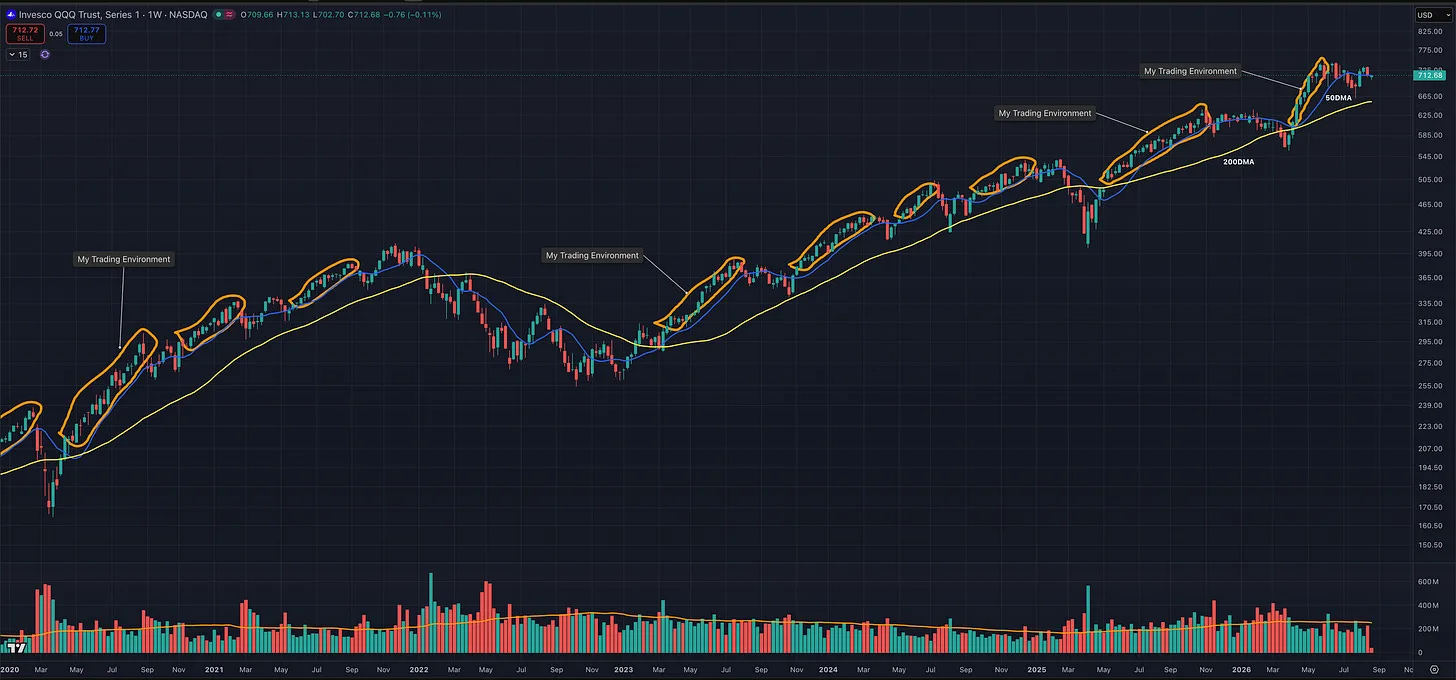
Knowing yourself also means understanding when you trade well. A strategy can have positive expectancy in several environments without having positive expectancy in every environment, and expecting one methodology to behave equally well everywhere is unrealistic. Tharp repeatedly emphasizes that traders should understand the market types in which their systems are designed to work and avoid forcing them into environments where the underlying conditions have changed.
One trader profiled in Trading Beyond the Matrix describes realizing that a system can work beautifully in one environment and terribly in another. Once he understood when his method worked, he also understood that he could simply stop trading it when the conditions were wrong instead of forcing the strategy into a market for which it had never been designed.
There is another layer to this that is even more personal. Your strategy may technically be capable of operating in several environments, but you may not be equally capable of trading it in all of them. Perhaps your records show that you perform exceptionally well when the market is trending and leadership is obvious but give a significant portion of those profits back during choppy rotational periods. Perhaps you trade early-stage breakouts well but become increasingly aggressive after an extended market run, exactly when risk is increasing.
Those patterns are information, not character flaws. If your historical record shows that particular environments repeatedly cause mistakes, incorporate that knowledge into the process by reducing exposure, raising setup standards, trading smaller, requiring more confirmation, or simply doing nothing. You do not receive extra points for proving that you can trade every type of market.
Awareness of Yourself Creates Awareness of the Market
One reason I believe “know thyself” matters so much is that it develops the same kind of awareness required to recognize changes in the market. Markets constantly undergo character changes, sometimes before the major indexes make anything obvious. Breakouts that worked easily several weeks earlier may begin failing, stocks may stop responding to good earnings, leadership can narrow, volatility can increase, your screens can produce fewer high-quality candidates, and stocks that previously bounced immediately from support can begin slicing through it.
None of those observations requires predicting the future. They require noticing what is actually happening instead of insisting that the market continue behaving the way it behaved last month. A trader who develops the habit of noticing subtle changes in himself may also become better at noticing subtle changes in the environment around him.
The same questions can be directed inward. Am I becoming fearful or greedy? Am I increasing size because the opportunity improved or because I recently made money? Am I taking this trade because it satisfies my criteria or because I am bored? Am I rejecting information because it conflicts with a position I already own?
Tharp’s mindfulness work in Super Trader is built around this kind of observation. He encourages traders to consider information they may normally reject, observe themselves almost like neutral third parties, and judge their performance partly on whether they actually followed their own rules rather than simply on whether the trade made money.
What Are You Really Trying to Get From the Market?
Ed Seykota takes this idea somewhere even more uncomfortable. In Market Wizards, Schwager asks whether all traders really want to win, and Seykota answers, “Win or lose, everybody gets what they want out of the market.” He then describes a trader who repeatedly built a relatively small account into a large one, changed his behavior once he became successful, and eventually lost everything again.
At first, the idea that someone might somehow “want” to lose sounds absurd because virtually nobody consciously sits down at a trading desk hoping to destroy his account. But Seykota’s deeper point is that financial profit may not be the only reward a person is unconsciously seeking from the market. A trader may be getting excitement, drama, sympathy, validation, a sense of identity, an excuse for failure, or the emotional thrill of repeatedly risking everything and trying to come back.
This is where self-sabotage becomes much more complicated than simply not knowing the rules. A trader may know exactly where the stop should go, understand his position-sizing model, recognize that the setup is mediocre, and still violate the process repeatedly. If that behavior continues despite knowledge of the consequences, the useful question may no longer be, “What rule don’t I understand?” It may be, “What am I getting from breaking the rule?”
That is also why markets can become such an expensive place to search for excitement. If what you unconsciously want is stimulation, the market can provide an almost unlimited amount of it through oversized positions, constant action, leverage, reversals, dramatic gains, and painful losses. The problem is that it may charge you a tremendous amount of money for the experience.
Loving the Game Can Become a Weakness
I love markets. Financial gain was obviously part of what originally attracted me to trading and investing, and I would be lying if I pretended otherwise, but over time I also began to love the game itself. I enjoy studying markets, screening stocks, analyzing price and volume, watching leadership develop, and trying to understand how the different pieces fit together.
Over a long enough period, the money becomes the report card, but on any individual day or week I can enjoy trying to play the game well even when the results are temporarily disappointing. I think of it somewhat like training for a marathon: you do not enjoy every mile, every workout, or every setback, yet you can still genuinely love the process. There is nothing inherently wrong with loving the work.
The danger is that love can become obsession and obsession can become addiction. Markets are almost always available now, with stocks during the day, futures at night, international markets, crypto on weekends, earnings reports, financial media, social media, podcasts, and endless charts that can be reviewed at any hour. I have been guilty of allowing markets to consume too much mental space, and recognizing that tendency is itself part of knowing myself.
There are times when I have to deliberately force myself away from the screen, get outside, exercise, spend time with family, and do something that has absolutely nothing to do with markets. Interestingly, when I return, I often see the charts more clearly. A setup that had been staring me in the face becomes obvious, while something I had been trying to force suddenly looks far less attractive.
There is a practical reason for that. If you stare at markets long enough, your brain naturally starts looking for something to do, and if you search hard enough for a trade, eventually you can convince yourself that you found one. Distance restores perspective.
The Obsession With Entries Misses the Bigger Picture
One of Van Tharp and Tom Basso’s most interesting experiments illustrates how easily traders can focus too heavily on one part of the system. Tharp describes teaching a workshop with Basso in which they emphasized psychology, exits, and position sizing. Someone suggested that perhaps those components mattered enough that a trader might even be able to make money using random entries, so Basso tested the idea and found that his exit and sizing rules could still produce profits.
Tharp then created his own test using 10 commodities over a 10-year period, with long or short entries determined randomly and risk managed through volatility-based stops and position sizing. His results also produced profits over the test period, although the approach gave up the advantage that a skilled entry could provide and experienced difficult drawdowns. The lesson is not that entries are meaningless or that anyone should begin flipping coins before entering trades. The lesson is that traders often devote a wildly disproportionate amount of attention to entries while underestimating everything surrounding them.
A beautiful setup can still lose money if position size is irresponsible, a great entry can be ruined by poor exits, and a positive-expectancy strategy can be destroyed by inconsistent execution. A trader can also become so afraid of giving back a small profit that every potential large winner is cut short, or so overconfident after several winners that the next trade is sized far beyond what the system intended. Entry matters, but it is only one component of a much larger process.
That returns us to the central argument. A trading system is not merely the rule that gets you into the market. It includes the way you manage risk, the way you exit, the environments in which you participate, the amount you risk, the way you react to drawdowns, and the behavioral rules that keep you from sabotaging what the mathematics says should work.
Build Your Trading Around Reality, Not Fantasy
This is why becoming a better trader should include studying your own behavior with the same seriousness that you study price and volume. Your trade history can tell you far more than which setup makes the most money because it can reveal where your judgment begins to deteriorate, what environments bring out your best decisions, and what circumstances repeatedly cause you to abandon your process.
A useful self-audit might include questions such as:
- Which market environments produce my best results, and which consistently hurt me?
- What happens to my behavior after several consecutive losses or several consecutive winners?
- Do I become timid after a drawdown or reckless after a strong month?
- Does financial pressure improve my decision-making or impair it?
- Do I make better decisions watching every tick, or when orders and predefined rules remove me from the noise?
- How much drawdown do I think I can tolerate, and how much have I actually tolerated without changing my system?
- Am I trading primarily to make money, or am I sometimes using the market for excitement, validation, entertainment, or emotional stimulation?
One trader profiled in Trading Beyond the Matrix describes realizing that even an objectively good system would be difficult for him to trade if it did not fit his personality, beliefs, and needs. He also observed that people frequently overestimate how much drawdown they can tolerate until they actually experience it with real money. Those are not secondary psychological questions. They directly determine whether a mathematically sound methodology can survive contact with the person operating it.
You Cannot Automate Yourself Out of the Equation
At this point, some traders may reach what seems like the obvious solution: eliminate as much discretion as possible. Turn the methodology into rules, automate the decisions, and remove emotion from the process. There is a great deal of value in systematic trading, and clear rules can prevent countless mistakes, but I think it is a mistake to believe that becoming systematic somehow removes the trader from the system.
Ed Seykota is one of the strongest examples because he was a pioneer of computerized trading systems. Yet in Market Wizards, Seykota makes a remarkably important observation: “Systems trading is ultimately discretionary.” The system may determine entries and exits, but someone still decides which markets to trade, how much risk to take, how much capital to allocate, when to increase or decrease exposure, and whether the system itself still deserves to be followed. Seykota considered some of those decisions even more important than trade timing.
Richard Dennis arrived at something similar from another direction. The Turtle methodology was highly systematic, yet Dennis told his trainees that they were still expected to incorporate their own judgment rather than become identical copies of him. He also acknowledged that his experience and intuition could sometimes influence whether he remained in a position even when a trend-following system had not yet changed direction.
That does not mean systematic trading is somehow inferior to discretionary trading. A well-designed systematic process can dramatically reduce emotional interference, create consistency, and force decisions to be made according to predetermined rules. But it cannot completely eliminate the human being because a human being still designs the system, chooses the assumptions, determines the risk, decides when to deploy it, evaluates its performance, and ultimately decides whether to continue following it when the inevitable drawdown arrives.
This matters because some traders move toward systematic trading for the wrong reason. They are not simply trying to improve consistency. They are trying to escape themselves. But if fear causes you to abandon a discretionary trade, it can also cause you to shut off a system during a drawdown. If greed causes you to oversize a discretionary position, it can also cause you to increase the leverage of a systematic strategy. If impatience causes you to jump from setup to setup, it can just as easily cause you to abandon one algorithm after a difficult quarter and replace it with whatever backtest currently looks best.
Systematic trading can reduce the opportunities for human error. It cannot eliminate the human being responsible for the system.
That brings the article right back to where it began. Whether you are discretionary, systematic, or somewhere in between, the same question remains: Do you know yourself well enough to build a process you can actually follow?
The Market Will Eventually Show You Who You Are
“Know thyself” sounds simple because the words are simple, but the work behind them is not. It requires acknowledging that two successful traders can follow completely different routines, two profitable systems can demand completely different personalities, and two people can experience the same drawdown and need opposite responses. What sharpens one trader may destroy another.
It also requires understanding that knowing yourself does not mean accepting every weakness as permanent. Psychology can be trained, confidence can be developed, patience can improve, discipline can be strengthened, and rules can be created to protect you from tendencies you already know are dangerous. The objective is not to become emotionless, because that is unrealistic. The objective is to become aware enough that emotion no longer quietly takes control of the decision-making process.
You need confidence, but not arrogance. You need humility, but not fear. You need conviction, but you also need the ability to exit when the evidence changes. You need work ethic, but you must understand that no amount of effort can force the market to agree with you. You also need to love the game enough to study it deeply without allowing the game to consume your entire life.
There are still principles that are difficult to negotiate with. You need an edge, positive expectancy, risk management, appropriate position sizing, rules for entries and exits, enough capital to survive normal drawdowns, and an understanding of the environments in which your methodology works. But after all of that, Richard Dennis’s problem remains: Can you actually follow the rules when following them becomes uncomfortable?
Can you take the next legitimate setup after five losses without trying to make the money back? Can you sit in cash when nothing meets your criteria, reduce exposure when your environment deteriorates, and give a good position enough room to work without allowing fear to micromanage every fluctuation? Can you work relentlessly on mastering the craft and then remain patient enough not to force your will onto a market that is offering you nothing?
And perhaps most importantly, can you answer Seykota’s question with complete honesty: What are you really trying to get from the market?
The market eventually exposes the difference between who we imagine ourselves to be and how we actually behave when money, uncertainty, fear, greed, ego, boredom, and excitement become involved. Closing that gap may be one of the greatest trading edges available.
Before searching for another indicator, another stock screen, another setup, or another supposedly perfect strategy, spend some time studying the one variable that will be present in every trade you ever make: you.
Maybe “know thyself” only sounds like a cliché until the market forces you to understand what it really means.
More in Legendary Traders
All Legendary Traders articles →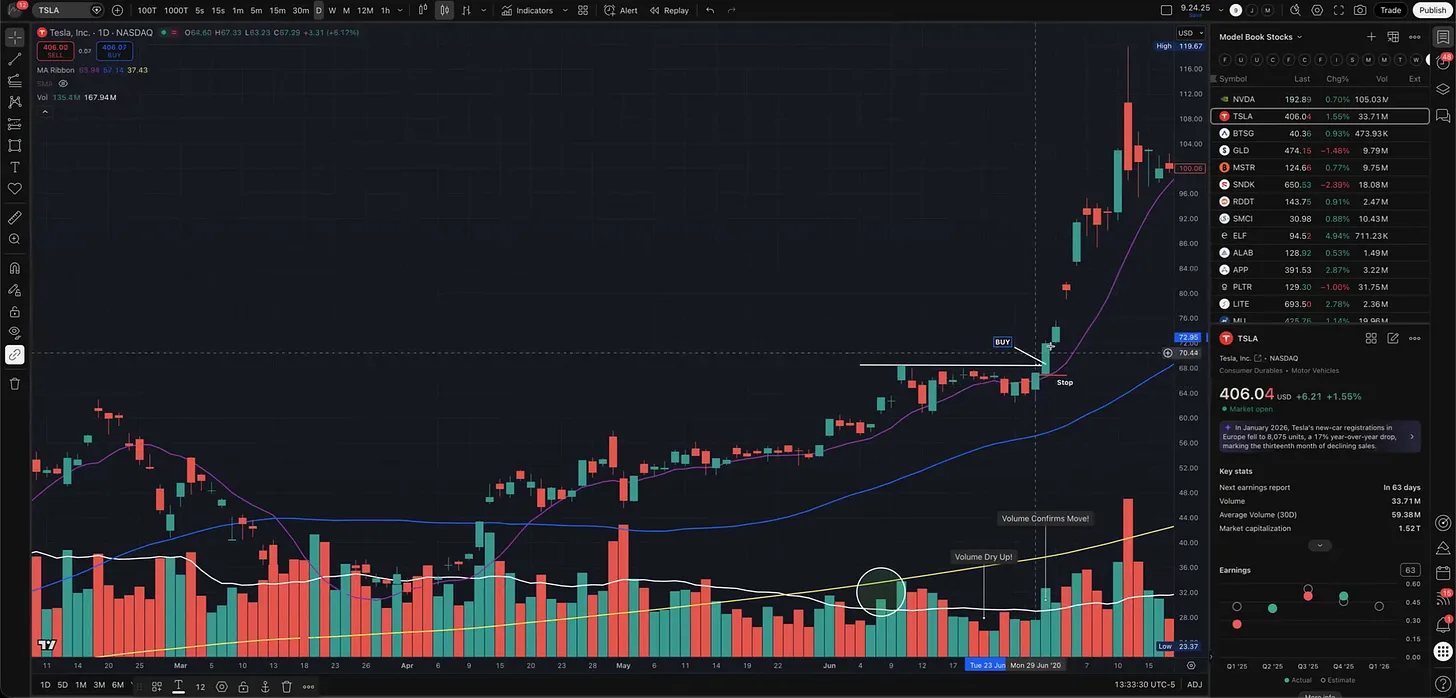
Sep 17, 2026 · Legendary Traders
4 Legendary Traders. 4 Breakout Entry Tactics.
A chart-by-chart breakdown of Minervini’s VCP, O’Neil’s cup with handle, Darvas’s box breakout, and Kullamägi’s opening range breakout.
- how to make money in stocks
- IBD
- Momentum Trading
- VCP
- technical analysis
- CANSLIM
- Trading Setups
- position trading
Sep 6, 2026 · Legendary Traders
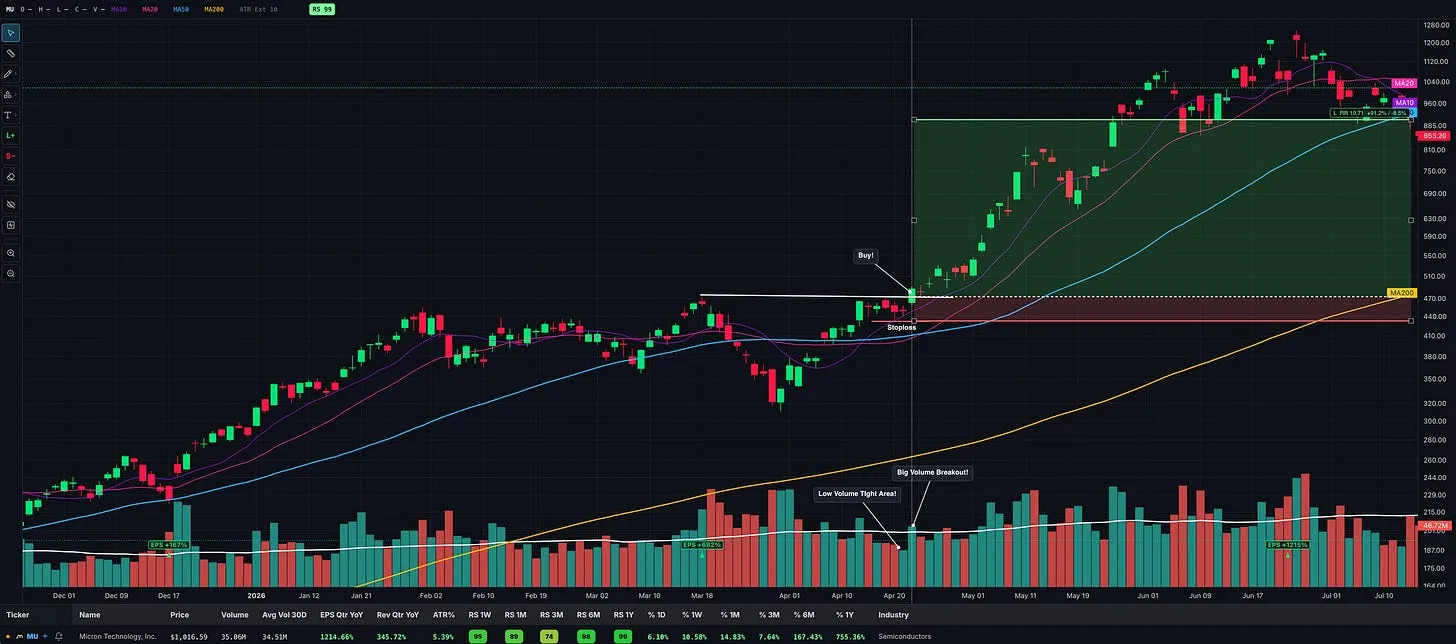
Market Wizard David Ryan: How He Made 1,379% in Three Years
Inside the growth-stock approach of William O’Neil’s protégé and three-time U.S. Investing Champion, from precise entries to holding major winners.
- IBD
- fundamental analysis
- Learn Trading
- technical analysis
- position trading
- David Ryan
- Market Wizard
- CAN SLIM
Aug 29, 2026 · Legendary Traders
Why the Market’s Biggest Winning Stocks Rarely Move Alone
Lessons from Nicolas Darvas, William O’Neil, and Mark Minervini on using industry-group strength and relative strength to find new market leaders without getting whipsawed.
- growth stocks
- CANSLIM
- position trading
- David Ryan
- stock trading
- Kristjan Kullamägi
- Nicolas Darvas
- industry groups